Amaterasu: Japan's Goddess of the Sun and Queen of the Heavens
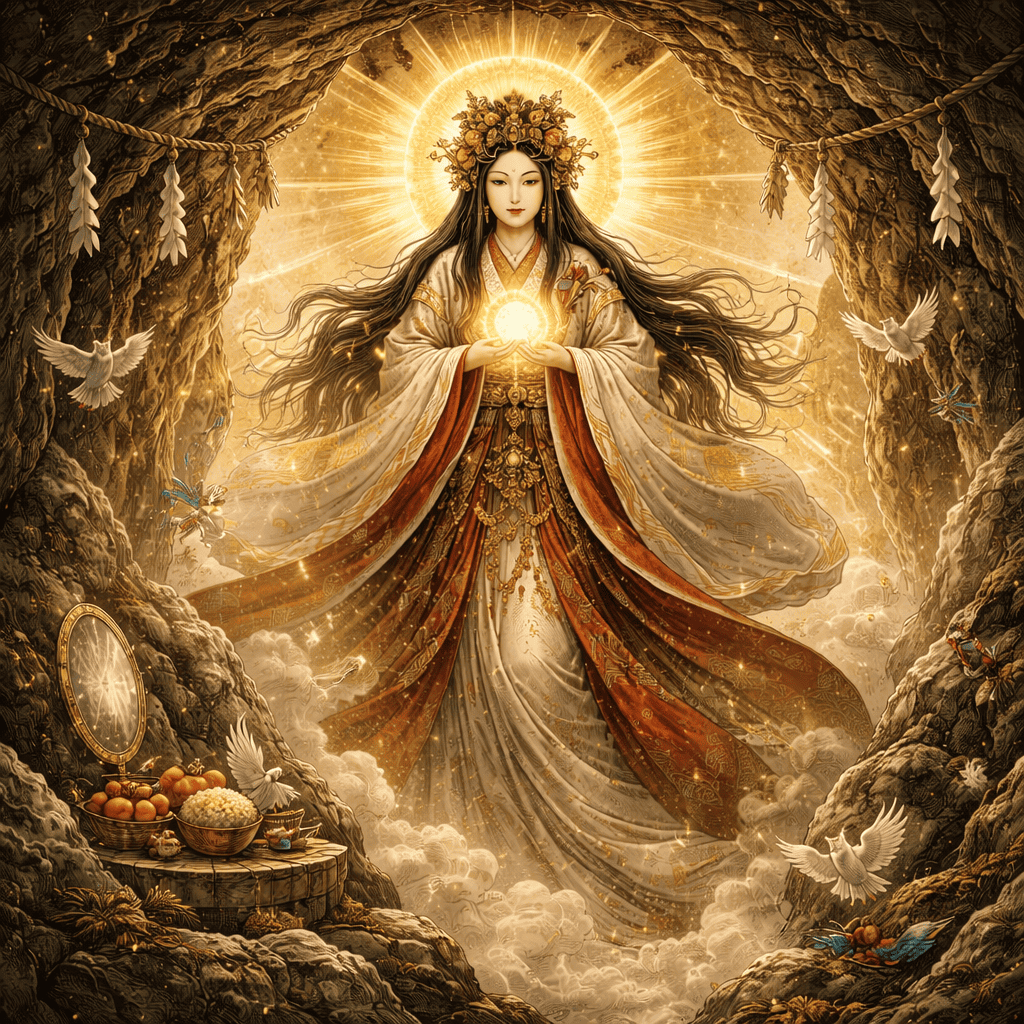
There is a moment in the oldest surviving chronicle of Japan when the entire world falls into darkness. The sun has not been eclipsed by any natural phenomenon, nor has the cosmos suffered some cataclysmic collision. Instead, the supreme deity of the Japanese pantheon — Amaterasu Omikami, goddess of the sun and sovereign of the High Plain of Heaven — has sealed herself inside a cave, and with her withdrawal, every last photon of light vanishes from existence. Rice paddies wither. Evil spirits multiply in the endless night. The eight hundred myriads of gods gather at the riverbed of heaven, desperate to coax their queen back into the open. It is one of the most celebrated episodes in world mythology, and it belongs entirely to Japan.
To study Amaterasu is to stand at the intersection of religion, politics, art, and identity. She is the ancestress of the Imperial House, the enshrined deity of the nation's holiest sanctuary, and the inspiration for characters in video games and anime watched by millions around the globe. Her story, recorded in the Kojiki (712) and the Nihon Shoki (720), is not merely ancient — it is alive, woven into the rituals performed at Ise Grand Shrine every single day and into the cultural exports that define modern Japan. In this article, we descend into that celestial cave to recover her light.
Who is Amaterasu?
Amaterasu Omikami — whose name translates roughly as "the Great Divinity Illuminating Heaven" — is the principal kami of the Shinto religion and the highest-ranking deity in the Japanese mythological canon. She rules Takamagahara, the High Plain of Heaven, and serves as the divine progenitor of the Japanese imperial line. According to the Kojiki, compiled by O no Yasumaro in 712 CE at the command of Empress Gemmei, Amaterasu was born when her father Izanagi washed his left eye during a purification ceremony after escaping the underworld of Yomi. From his right eye came Tsukuyomi, the moon god, and from his nose, the tempestuous Susanoo.
The character 天 (ama/ten) means "heaven" and 照 (terasu) means "to shine," so her very name is a cosmological statement: she is the radiance of the sky itself. Unlike many solar deities in other traditions who are male, Amaterasu's femininity is central to her mythology. She is a weaver, a cultivator of sacred rice paddies, and a ruler who governs through consensus among the heavenly kami rather than through brute force. The noted folklorist Michael Dylan Foster describes her as "the luminous center around which the entire Shinto cosmos orbits" (Foster, "The Book of Yokai," 2015). This centrality has persisted for over thirteen centuries, making Amaterasu one of the most enduring deities in any living religion.
What is the Origin Story of Amaterasu?
The defining myth of Amaterasu is the Iwato-gakure — the "hiding in the rock cave" — and it unfolds with all the dramatic tension of a celestial thriller. Her brother Susanoo, exiled from the heavens for his unruly behavior, arrives at Takamagahara and wreaks devastation. He destroys Amaterasu's sacred rice paddies, fills her irrigation ditches, and hurls a flayed horse through the roof of her weaving hall, killing one of her attendants. Traumatized and enraged, Amaterasu retreats into the Ama-no-Iwato, the Heavenly Rock Cave, and seals the entrance with a massive boulder. Instantly, the world is plunged into perpetual night.
The Kojiki (712) records that "the plain of High Heaven was entirely dark, and the Central Land of Reed-Plains was completely dark." Evil spirits ran rampant, and calamities arose on every side. The eight hundred myriads of gods — yaoyorozu no kami — convened on the banks of the Tranquil River of Heaven to devise a plan. The wisdom-god Omoikane proposed an elaborate ritual. The smith-god Ishikoridome forged the sacred mirror Yata no Kagami. Jewelers fashioned the magatama necklace Yasakani no Magatama. The goddess Ame-no-Uzume mounted an overturned tub before the cave entrance and performed a wild, ecstatic dance, stomping and exposing herself until the assembled gods roared with laughter.
Amaterasu, puzzled that the gods could be merry in a world without light, opened the cave door a crack. Ame-no-Uzume declared that a deity more glorious than Amaterasu had appeared. The mirror was angled toward the opening, and when Amaterasu saw her own brilliant reflection, she paused in wonder. At that instant, the mighty god Ame-no-Tajikarao seized her hand and pulled her fully into the open. A shimenawa rope was stretched across the cave mouth so she could never retreat again. Light flooded back into the universe, and the world was restored.
This myth operates on multiple levels simultaneously. It is an explanation for solar eclipses. It is a political allegory about the necessity of the sovereign's presence for cosmic order. And it is a ritual template: the sacred objects created during the event — the mirror, the jewel, and later the sword Kusanagi obtained by Susanoo — became the Three Imperial Regalia of Japan, still used in enthronement ceremonies to this day (Nihon Shoki, 720). The continuity is staggering; the same mythic architecture supports both an eighth-century chronicle and a twenty-first-century coronation.
Which Shrines Are Dedicated to Amaterasu?
No discussion of Amaterasu can proceed without addressing the Ise Grand Shrine — Ise Jingu — located in Mie Prefecture. It is the holiest site in all of Shinto, and its Inner Shrine, the Naiku, is dedicated exclusively to Amaterasu Omikami. The shrine's origins are traditionally dated to the first century BCE, when the divine mirror Yata no Kagami was enshrined there by Princess Yamatohime-no-Mikoto, who had wandered the land for twenty years seeking the perfect location for the goddess's earthly abode.
Ise Jingu is rebuilt entirely every twenty years in a ceremony called Shikinen Sengu, a practice that has continued for approximately 1,300 years. The most recent rebuilding was completed in 2013, the sixty-second iteration. This cyclical renewal is itself a reflection of Amaterasu's solar nature — the eternal return of light, the perpetual regeneration of the sacred. Roughly six million pilgrims visit Ise every year, walking across the Uji Bridge, passing through ancient cryptomeria forests, and approaching the simple yet profoundly powerful cypress-wood structures that house the spirit of the sun.
Beyond Ise, Amaterasu is venerated at thousands of smaller shrines across Japan, including the Amanoiwato Shrine in Miyazaki Prefecture, which sits beside the very cave where, according to local tradition, the goddess concealed herself. Visitors can view the cave entrance from a special observation point across the gorge, and the adjacent Amano Yasugawara — the riverbed where the gods deliberated — is piled high with stone cairns left by pilgrims. The landscape itself becomes scripture, the geological formations testifying to myths written in the rock long before they were written in ink.
Which Anime and Manga Feature Amaterasu?
Amaterasu's reach extends far beyond shrine precincts and into the luminous screens of contemporary popular culture. In Masashi Kishimoto's Naruto (Studio Pierrot, 1999), the technique known as Amaterasu is one of the most devastating abilities in the entire series. Wielded by Uchiha clan members through the Mangekyo Sharingan, Amaterasu manifests as inextinguishable black flames that burn anything within the user's gaze for seven days and seven nights — an inversion of the goddess's life-giving light into an unstoppable destructive force. Itachi Uchiha and Sasuke Uchiha both employ the technique in pivotal battles, and its very name signals that the power is of divine, cosmic magnitude. The black flames are a darkened mirror of the sun itself.
Perhaps the most lavish homage to Amaterasu in gaming is Capcom's Okami (2006), an action-adventure title in which the player controls Amaterasu herself — reimagined as a white wolf carrying the divine instrument on her back. The game is rendered in a sumi-e ink-wash art style that evokes classical Japanese scroll paintings. Players restore color and life to a darkened world by wielding the Celestial Brush, literally painting the sun back into the sky. Okami received universal critical acclaim and is widely regarded as one of the most beautiful and culturally literate video games ever made. It demonstrates how mythology can be not merely referenced but structurally inhabited — the player does not just hear about Amaterasu; the player becomes her, performing the act of cosmic restoration.
Additionally, Amaterasu appears in the Persona series (Atlus), in the manga Noragami by Adachitoka, and in numerous other anime, manga, and light novel properties. Her name is invoked whenever a narrative requires the ultimate expression of solar authority, purity, or indomitable light. She has become a universal signifier in Japanese pop culture — a single word that conjures an entire cosmology.
Why Does Amaterasu Still Matter Today?
Amaterasu is not a relic of the past. She is the living core of Shinto, and by extension, an active element in Japan's national identity. The emperor's legitimacy has been understood for millennia through the doctrine of divine descent from Amaterasu. When Emperor Naruhito ascended the Chrysanthemum Throne in 2019, the enthronement rituals included the private Daijosai ceremony, in which the new emperor communed with Amaterasu by offering her newly harvested rice. The Three Imperial Regalia — mirror, jewel, and sword — were transferred in rites whose forms descend directly from the mythic events of the Kojiki and Nihon Shoki.
Beyond politics, Amaterasu represents a distinctly Japanese understanding of the sacred feminine. She is powerful without being martial, sovereign without being tyrannical, and luminous in a way that is simultaneously cosmic and intimate. Her withdrawal into the cave resonates with anyone who has experienced depression, burnout, or the desire to hide from a world that has become too violent and chaotic. Her emergence is a narrative of recovery — the community gathers, performs joy, and coaxes the light back into being. It is a myth about collective care.
In an era of climate anxiety and cultural fragmentation, Amaterasu offers an ancient template for renewal. The sun always returns. The shrine is always rebuilt. The light, once hidden, can always be drawn back out. That is not naive optimism; it is the structural logic of a mythology that has sustained a civilization for more than a thousand years. Amaterasu endures because the questions she answers — how do we survive darkness? how do we restore what is broken? — never stop being asked.
Conclusion
From the primordial purification of Izanagi's left eye to the black flames of Sasuke Uchiha's Mangekyo Sharingan, Amaterasu spans the full arc of Japanese culture — ancient and modern, sacred and popular, political and deeply personal. She is the sun that refuses to die, the mirror that reflects our own hidden brilliance, and the goddess whose cave is always waiting to be reopened. To know Amaterasu is to understand why Japan calls itself the Land of the Rising Sun. It is not merely geography. It is theology.
This is The Yokai Files.
Support The Yokai Files
Enjoyed this deep dive into Japanese folklore?
The Yokai Files is reader-supported. Your support helps us research deeper, write more, and keep the darkness alive.