Fujin: The Wind God of Japan and the Breath of the Divine
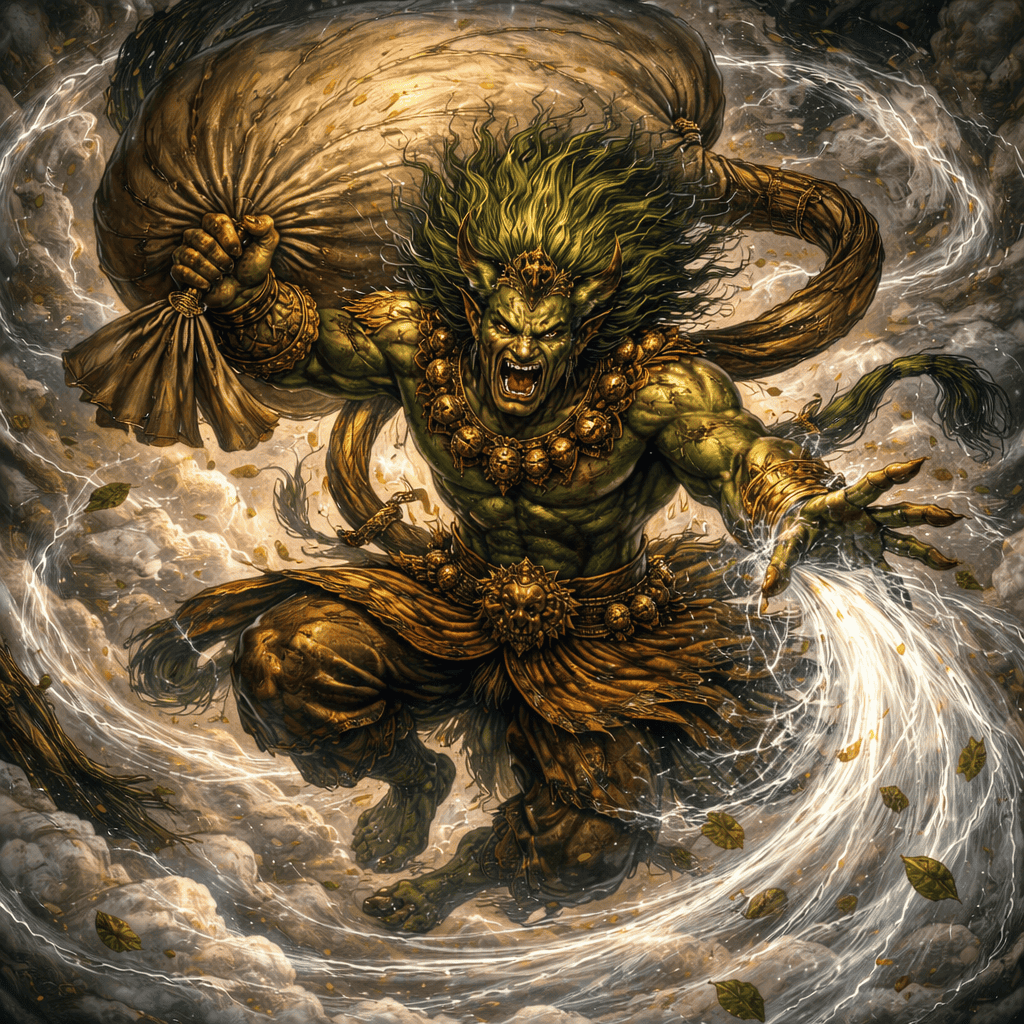
He is always running. In every depiction — whether carved in wood at a thirteenth-century temple, painted in gold on a seventeenth-century folding screen, or rendered in digital ink for a twenty-first-century video game — Fujin is in motion. His wild hair streams behind him. His robes billow. His bag of winds balloons above his shoulders like a living thing, straining to release the gales contained within. He is the god who never stands still, because wind, by definition, cannot. To capture Fujin in art is to capture motion itself, and for over a thousand years, Japanese artists have accepted this impossible challenge and produced some of the most dynamic images in the history of world art.
Fujin (also known as Futen) is the Shinto and Buddhist god of wind, eternally paired with his brother Raijin, the thunder god. Together they guard temple gates, decorate palace screens, and embody the elemental forces that shape Japan's island climate — the typhoons that batter the coast, the sea breezes that fill fishing sails, and the divine winds that, legend has it, twice saved Japan from Mongol invasion. Fujin is less frequently discussed than Raijin, but his cultural footprint is arguably deeper, because the wind god's definitive artistic representation — Tawaraya Sotatsu's Fujin Raijin-zu (Wind God and Thunder God Screens) — is considered one of the supreme masterpieces of Japanese painting. In this article, we open the bag and let the wind tell its own story.
Who is Fujin?
Fujin (風神, literally "Wind God") is the Japanese deity of wind, known also as Futen (風天, "Wind Heaven") in the Buddhist tradition. His name combines "fu" (wind, 風) and "jin" (god, 神). Unlike the major kami of the Kojiki creation myth — Amaterasu, Susanoo, Tsukuyomi — Fujin does not appear in the canonical texts with a clearly defined origin story. His mythology is instead constructed from a confluence of sources: indigenous Japanese wind worship, Chinese wind deity traditions (particularly Feng Bo), Central Asian art transmitted along the Silk Road, and Buddhist guardian deity iconography imported from India via China and Korea.
The visual template for Fujin — a green or blue-skinned, wild-haired figure carrying a large bag of winds over his shoulders — has been traced by art historians to the Greco-Buddhist art of Gandhara (modern Pakistan and Afghanistan), where depictions of the Greek wind god Boreas were adapted into Buddhist artistic vocabulary. The scholar Fabio Rambelli has noted that "Fujin's iconography is a remarkable example of cultural transmission across Eurasia — a Greek wind god, filtered through Indian Buddhism, Chinese artistic convention, and Korean transmission, arriving in Japan as a fully formed visual archetype" (Rambelli, "Buddhist Materiality," 2007). By the time Fujin reached Japan, he had accumulated thousands of miles of cultural DNA, making him one of the most internationally layered deities in the Japanese pantheon.
What is the Origin Story of Fujin?
The Kojiki (712) mentions the birth of wind deities in the context of Izanagi and Izanami's creation of the world. After creating the islands of Japan, the divine couple gave birth to various kami, including Shinatsuhiko-no-Kami, the god of wind, who was born from Izanagi's breath. The Nihon Shoki (720) provides a similar account, naming the wind deity as Shinatsuhiko and describing him as the kami who "blew away the morning mists and filled the space between heaven and earth." These textual wind deities are not identical to the Fujin of later artistic and folk tradition, but they establish the theological foundation for wind worship in Japan.
The transformation from textual wind deity to the visual Fujin we recognize today occurred primarily through Buddhist sculptural and painted traditions imported from China during the Nara (710-794) and Heian (794-1185) periods. The earliest surviving Japanese depictions of Fujin in his characteristic form — bag-bearing, wild-haired, dynamically posed — date from the Kamakura period (1185-1333), when the great temple sculpture workshops of Nara and Kyoto produced the masterworks that would define Japanese Buddhist art for centuries.
The most historically significant wind event associated with Fujin is the Kamikaze — the "Divine Wind" — that destroyed the Mongol invasion fleets of Kublai Khan in 1274 and again in 1281. When the massive Yuan dynasty armadas threatened to overwhelm Japan's defenses, typhoons arose and scattered the enemy ships, sinking hundreds of vessels and drowning tens of thousands of soldiers. The Japanese interpreted these storms as divine intervention — the wind gods protecting the sacred islands from foreign conquest. The word "kamikaze" entered the Japanese vocabulary as a synonym for providential deliverance, long before its tragic twentieth-century appropriation. Fujin, as the god of wind, was understood as one of the celestial agents responsible for this miracle, and the Kamikaze legend cemented the wind god's status as a national protector.
In folk tradition, Fujin is often depicted as a companion rather than a rival to Raijin. Where Raijin brings the thunder and lightning, Fujin brings the wind and rain — together they constitute the storm. Some folk tales depict them as brothers, others as eternal competitors whose rivalry produces the weather. Their perpetual pairing in art — always shown together, always in dynamic counterbalance — reflects the meteorological reality that thunder and wind are inseparable components of the same atmospheric system. You cannot have one without the other, and Japanese art has understood this for a millennium.
Which Shrines Are Dedicated to Fujin?
The definitive sacred site for Fujin is the same as for Raijin: the Sanjusangendo (Rengeo-in) in Kyoto. The Kamakura-period statue of Fujin that stands at the north end of the hall — counterpart to the Raijin statue at the south end — is a National Treasure and one of the most important sculptures in Japanese art history. The Fujin statue depicts the wind god with green skin, wild hair, and a massive wind bag (kazebukuro) draped over his shoulders. His expression is fierce but not malevolent — the face of elemental force rather than intentional cruelty. The statue's dynamic pose, with one leg forward and the body twisted in mid-stride, creates an impression of perpetual motion that anticipates the Baroque sculpture of Europe by several centuries.
The Kaminarimon ("Thunder Gate") at Senso-ji in Asakusa, Tokyo, features Fujin on the right side and Raijin on the left, making it one of the most visited Fujin sites in the world. The current statues are reconstructions (the originals were destroyed by fire), but they maintain the traditional iconographic program: Fujin with his wind bag, Raijin with his drums, both serving as guardians of the sacred precinct. Millions of visitors pass between them annually, walking through the threshold between the profane and the sacred that the wind and thunder gods define.
The artistic masterpiece most associated with Fujin is not a shrine or temple but a pair of folding screens: the Fujin Raijin-zu Byobu (Wind God and Thunder God Screens) by Tawaraya Sotatsu, painted in the early seventeenth century and now housed at Kennin-ji temple in Kyoto. Sotatsu's Fujin is an explosion of green energy against a gold background — a figure of pure kinetic force, his bag bursting with wind, his body arcing through space with superhuman vitality. The painting has been designated a National Treasure and has been copied, reinterpreted, and homaged by virtually every major Japanese artist since, including Ogata Korin and Sakai Hoitsu. It is, without exaggeration, one of the most influential paintings in Japanese art history, and Fujin is its co-protagonist.
Which Anime and Manga Feature Fujin?
Fujin's most prominent recent appearance in anime is through the Wind Breathing (Kaze no Kokyu) style in Koyoharu Gotouge's Demon Slayer: Kimetsu no Yaiba (ufotable, 2019). The Wind Hashira, Sanemi Shinazugawa, is one of the most formidable demon slayers in the Corps, and his Wind Breathing techniques — characterized by sweeping, cyclonic blade arcs that slice through the air with visible wind currents — are a direct aesthetic descendant of Fujin's mythology. Sanemi's personality mirrors Fujin's traditional characterization as well: fierce, untamable, volatile, but ultimately protective. The visual effects used by ufotable to animate Wind Breathing — swirling green crescents, tornado-like spirals, atmospheric distortion — are among the most visually striking in the entire series and draw unmistakably on the visual vocabulary established by Sotatsu and the Sanjusangendo sculptors.
In Naruto (Studio Pierrot, 1999), wind-based jutsu represent an entire elemental affinity (Futon), and characters like Naruto Uzumaki and Temari wield wind techniques that channel Fujin's mythological energy. Naruto's Rasenshuriken — a spinning sphere of wind chakra shaped like a shuriken — is one of the series' most iconic techniques, and its destructive power at the cellular level reflects the mythological understanding of wind as an invisible force capable of enormous devastation. The Wind Country (Kaze no Kuni) and the Village Hidden in the Sand are thematically aligned with Fujin's domain.
Beyond specific character representations, Fujin's influence pervades the visual language of Japanese animation whenever wind is depicted as a dramatic force. The famous Ghibli "wind shots" — Nausicaa's glider cutting through turbulent skies, Kiki wobbling on her broomstick in a gale, the wind rushing through the grass in My Neighbor Totoro — carry the cultural weight of centuries of wind worship and artistic representation. Hayao Miyazaki's The Wind Rises (2013) takes its title from Paul Valery but its spiritual substance from the Japanese tradition of understanding wind as a living, divine force. In Japanese visual culture, the wind is never merely weather; it is always, at some level, Fujin's breath.
Why Does Fujin Still Matter Today?
Fujin matters because wind matters — and in Japan, wind matters more than almost anywhere else on earth. The Japanese archipelago sits in the path of Pacific typhoons, and the annual typhoon season (June through October) is a defining feature of Japanese life, agriculture, and disaster preparedness. The same winds that destroyed the Mongol fleets continue to batter the coast every year, and the Japanese relationship with wind — respectful, wary, and deeply informed by centuries of experience — is encoded in Fujin's mythology. The wind god is not merely a cultural artifact; he is a living metaphor for the atmospheric reality that shapes Japanese existence.
Fujin also matters because of what he represents in art. The Fujin Raijin-zu by Tawaraya Sotatsu is not just a painting of two gods; it is a statement about the possibility of capturing motion in a static medium. Sotatsu's innovation — placing the figures against a vast empty gold background, with no landscape or architecture to anchor them — creates the impression that Fujin and Raijin exist in pure space, pure energy, pure becoming. This aesthetic philosophy — ma (negative space), do (motion), and the beauty of forces in dynamic balance — runs through Japanese art from ink painting to anime. Fujin is not just a subject of Japanese art; he is a principle of Japanese art.
In the era of climate change, Fujin's relevance takes on new dimensions. As typhoons intensify and weather patterns shift, the ancient Japanese practice of acknowledging wind as a divine force — something to be respected, prepared for, and lived alongside rather than controlled — offers a wisdom that purely technological approaches to climate lack. Fujin does not promise to stop the wind; he promises that the wind has meaning, that it is part of a larger order, and that human beings can find ways to coexist with forces far more powerful than themselves. That promise is as relevant in the twenty-first century as it was in the thirteenth.
Conclusion
Fujin opens his bag and the world bends. Cherry blossoms scatter across temple grounds. Typhoon waves crash against the seawalls. A seventeenth-century brushstroke captures what no photograph can — the shape of the invisible, the form of formlessness, the divine breath that moves through all things. From the Greco-Buddhist sculptures of Gandhara to the wind-slashed animation frames of Demon Slayer, Fujin has traveled farther than any other Japanese god, accumulating the artistic DNA of every culture his winds have touched. He is the god of motion, of change, of the invisible forces that shape the visible world. He is still running. He will never stop.
This is The Yokai Files.
Support The Yokai Files
Enjoyed this deep dive into Japanese folklore?
The Yokai Files is reader-supported. Your support helps us research deeper, write more, and keep the darkness alive.