Inari: The Fox God of Rice, Prosperity, and Thirty Thousand Shrines
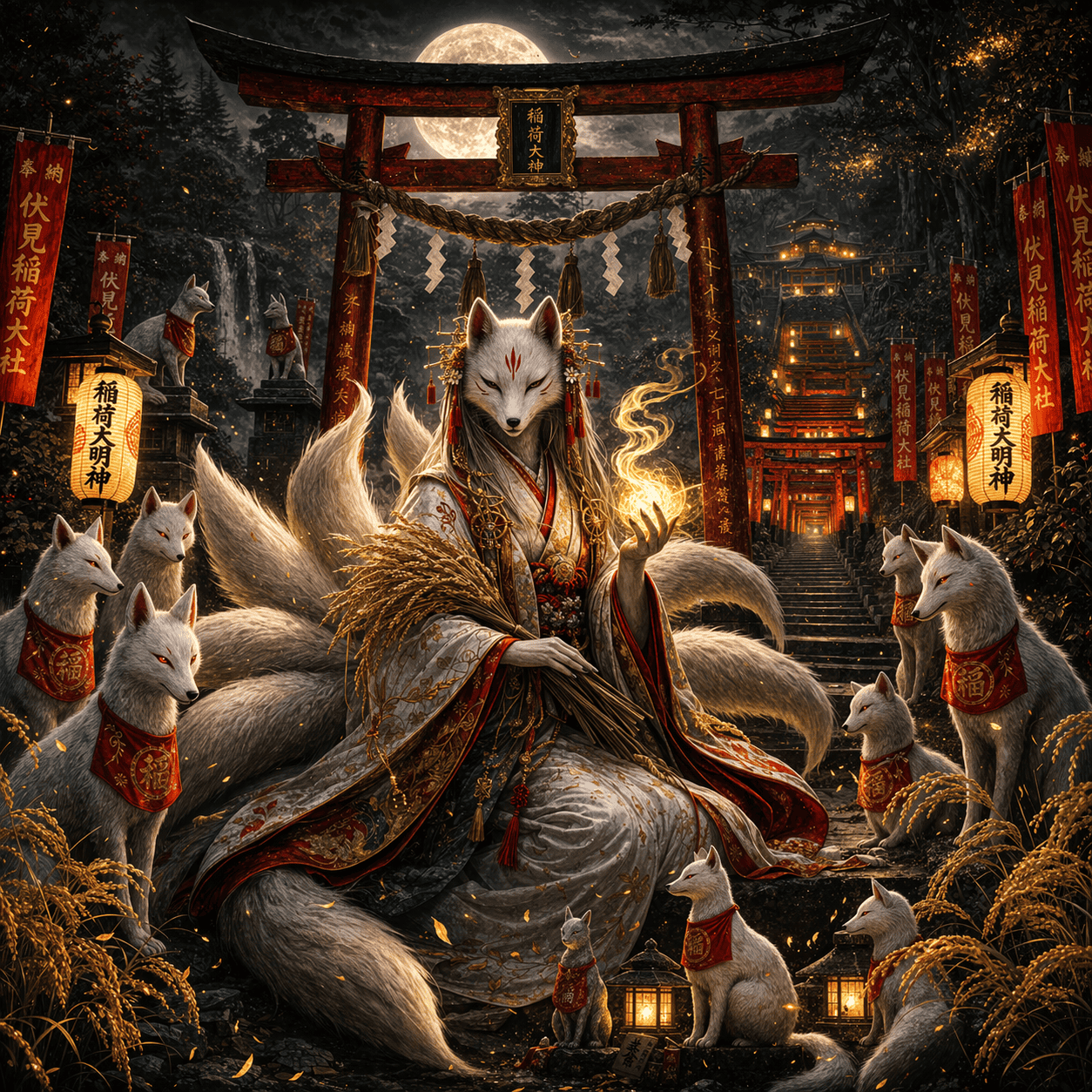
If you have ever seen a photograph of a tunnel of vermillion torii gates climbing a forested mountainside in Kyoto, you have seen the work of Inari. If you have ever noticed a stone fox statue flanking the entrance to a small neighborhood shrine in Tokyo, Osaka, or any Japanese city, you have encountered one of Inari's messengers. If you have ever eaten inari-zushi — sushi rice tucked into a pocket of sweetened fried tofu — you have tasted an offering to a god whose influence permeates Japanese life so thoroughly that most people never stop to think about it. Inari Okami is the kami of rice, fertility, tea, sake, agriculture, industry, general prosperity, and worldly success, and with over thirty thousand shrines across Japan — roughly one-third of all Shinto shrines in the country — Inari is far and away the most ubiquitous deity in the Japanese religious landscape.
And yet, for all this omnipresence, Inari remains profoundly mysterious. Is Inari male or female? The answer depends on the shrine, the era, and the worshiper. Is Inari a single deity or a collective? Both, simultaneously. Is the fox Inari, or merely Inari's messenger? Scholars have debated this for centuries. Inari is the god who refuses to be pinned down — a shape-shifter in theology as well as mythology — and that very fluidity may be the secret to Inari's extraordinary staying power. In this article, we walk through the thousand gates of Fushimi Inari Taisha and explore the deity who guards them all.
Who is Inari?
Inari Okami (also written as O-Inari-sama or simply Inari) is a Shinto kami associated with rice cultivation, fertility, foxes (kitsune), tea, sake, agriculture, industry, and general material prosperity. The name "Inari" is most commonly derived from "ine-nari" (growing rice), reflecting the deity's agrarian origins. Inari's worship dates back to at least 711 CE, when the Fushimi Inari Taisha in Kyoto was officially founded, though folk veneration of rice spirits and fox deities almost certainly predates this by centuries.
One of Inari's most distinctive characteristics is gender fluidity. Depending on the tradition, Inari appears as a young female food goddess (associated with Ukanomitama-no-Kami), as an old man carrying rice on his back, as an androgynous bodhisattva (in the Buddhist-Shinto syncretic tradition), or as a fox itself. The scholar Karen Smyers, in her landmark study "The Fox and the Jewel: Shared and Private Meanings in Contemporary Japanese Inari Worship" (1999), documented that modern worshipers hold widely varying conceptions of Inari's identity, and the shrine establishment has deliberately maintained this ambiguity rather than enforcing orthodoxy. Inari is, in Smyers's phrase, "a deity of the people" — shaped by the needs and imaginations of millions of individual worshipers across more than thirteen centuries.
What is the Origin Story of Inari?
The founding myth of Inari worship is tied to the Hata clan, an immigrant family of Korean or Chinese descent who settled in the Kyoto region and became powerful landholders. According to the Yamashiro no Kuni Fudoki (the provincial gazetteer of Yamashiro Province), a member of the Hata clan, grown wealthy from rice cultivation, used a rice cake as a target for archery practice. The arrow struck the cake, which transformed into a white bird and flew to the peak of Inari Mountain, where rice plants grew spontaneously at the spot where it landed. This miracle was understood as a divine manifestation, and the Hata clan established a shrine on the mountain in 711 CE — the origin of Fushimi Inari Taisha.
The association between Inari and foxes (kitsune) developed over centuries and is one of the most complex deity-animal relationships in any religion. In Japanese folklore, foxes are supernatural beings capable of shape-shifting, possession, and both benevolent and malevolent acts. The white fox — byakko — became Inari's primary messenger and, in popular understanding, virtually indistinguishable from the deity itself. Stone fox statues (komainu-like kitsune) guard the entrances to Inari shrines, often depicted holding a key in their mouths (the key to the rice granary), a jewel (the hoshi-no-tama, the fox's spiritual essence), or a scroll of sacred teachings.
The theological relationship between Inari and foxes has been debated extensively. The Shinto establishment generally maintains that the fox is Inari's servant (tsukai), not Inari incarnate. But in folk practice, the distinction collapses. Devotees leave offerings of fried tofu (abura-age) — said to be the fox's favorite food — at Inari shrines. Businesses that erect small Inari shrines on their rooftops address prayers to "O-Kitsune-sama" (Honorable Fox). The fox and the god have become so intertwined that separating them would require undoing centuries of lived religious experience. As Michael Dylan Foster observes, "The kitsune is one of the most complex and ambiguous figures in Japanese folklore, simultaneously feared and revered" (Foster, "The Book of Yokai," 2015).
Which Shrines Are Dedicated to Inari?
Fushimi Inari Taisha in southern Kyoto is the head shrine of all Inari shrines in Japan and one of the most visited tourist sites in the entire country. Its signature feature — the Senbon Torii, or "Thousand Torii Gates" — is actually composed of over ten thousand vermillion gates donated by businesses and individuals seeking Inari's blessing for commercial success. The gates line a network of trails that wind up Inari Mountain (Inariyama, 233 meters), passing subsidiary shrines, fox statues, and sacred stones along the way. The full circuit takes approximately two to three hours and offers a progressively more intimate and atmospheric experience as the crowds thin on the upper slopes. At night, when the tourists have departed, the mountain becomes genuinely otherworldly — a tunnel of red in the darkness, lit only by occasional lanterns, with stone foxes watching from every shadow.
Beyond Fushimi, Inari shrines are so numerous that they constitute the default shrine type in Japan. The Toyokawa Inari in Aichi Prefecture is one of the largest, blending Shinto and Buddhist traditions (it is technically a Zen temple). The Kasama Inari Shrine in Ibaraki is another major center of worship. In Tokyo, the Anamori Inari Shrine near Haneda Airport and numerous small neighborhood Inari shrines demonstrate the deity's role in everyday urban life. Corporate Inari shrines — small red shrines perched atop department stores and office buildings — are a distinctive feature of Japanese commercial districts, reflecting the deity's function as a patron of business success.
The sheer scale of Inari's shrine network — over thirty thousand locations — is unmatched by any other kami. This saturation means that for most Japanese people, the first shrine they ever visit, the shrine they pass on their daily commute, and the shrine where they pray for exam success or business prosperity is an Inari shrine. Inari is not the most exalted deity in the Shinto hierarchy, but Inari is undoubtedly the most encountered — the kami of the street corner, the rice field, and the rooftop, as accessible as the daily bread.
Which Anime and Manga Feature Inari?
The kitsune — Inari's messenger and alter ego — is one of the most frequently depicted supernatural creatures in anime and manga. In Rumiko Takahashi's InuYasha (Sunrise, 2000), the young fox demon Shippo serves as comic relief and emotional heart, embodying the kitsune's traditional association with playful trickery and shape-shifting. While Shippo is not explicitly an Inari devotee, his fox magic — illusions, transformations, fox fire — draws directly from the kitsune folklore that is inseparable from Inari worship.
The anime Inari, Konkon, Koi Iroha (Inari, Kon Kon, Love Colored) (Production IMS, 2014) is one of the most direct engagements with Inari in contemporary anime. The series follows a middle school girl named Inari Fushimi (a name referencing the Fushimi Inari shrine) who is granted the power of transformation by the goddess Uka-no-Mitama — one of Inari's canonical identities. The show explores the relationship between human desire and divine power, set against the vermillion gates and fox statues of Inari's sacred landscape. It is a rare example of anime that takes shrine worship seriously as a living spiritual practice rather than mere aesthetic backdrop.
Fox spirits and Inari-adjacent figures also appear in Natsume's Book of Friends (Brain's Base, 2008), Kamisama Kiss (TMS Entertainment, 2012), and the video game Okami (Capcom, 2006), where fox imagery and shrine aesthetics pervade the game world. The kitsune mask — a white fox face with red markings — has become an iconic prop in anime and cosplay culture, worn by characters in Demon Slayer, Hotarubi no Mori e, and countless other properties. Whether or not these works explicitly reference Inari, they are drawing on a visual and narrative vocabulary that Inari worship created.
Why Does Inari Still Matter Today?
Inari matters because Inari is everywhere. Not in the abstract, theological sense, but in the physical, geographical, daily-life sense. The thirty thousand Inari shrines that dot the Japanese landscape mean that nearly every Japanese person lives within walking distance of an Inari shrine. These shrines serve as community gathering points, as spaces for private prayer, and as tangible reminders that the sacred is not confined to grand institutions but permeates the everyday. The salary worker who pauses at a rooftop Inari shrine before a big presentation, the farmer who offers rice at a field-edge hokora before planting season, the student who buys an Inari charm before university entrance exams — all are participating in a tradition that has adapted seamlessly to every era of Japanese history.
Inari's gender fluidity and theological ambiguity also make the deity remarkably relevant to contemporary discussions about identity, inclusivity, and the limits of categorization. In an age when rigid definitions of gender, religion, and cultural identity are being questioned worldwide, Inari offers an ancient model of sacred indeterminacy — a deity who has been all things to all people for over thirteen hundred years without losing coherence or power. The fact that Inari's worship crosses the Shinto-Buddhist boundary (many Inari sites are technically Buddhist temples) further demonstrates this capacity for transcending categories.
Economically, Inari's relevance is self-reinforcing. Japan's commercial culture — from multinational corporations to neighborhood ramen shops — continues to seek Inari's blessing through shrine donations, rooftop altars, and seasonal rituals. The vermillion gates of Fushimi Inari are donated by businesses, each gate inscribed with the donor's name and the date of offering. The tunnel of gates is, in effect, a physical ledger of Japanese commercial ambition stretching back generations. Inari does not just reflect Japanese prosperity; Inari is woven into the mechanism of it. As long as there is rice to grow and money to earn, Inari will have devotees.
Conclusion
Inari is the fox in the gate, the rice in the paddy, the coin in the offering box, and the vermillion tunnel climbing into the mountain mist. No other deity in the Japanese pantheon is so widely worshiped, so deeply embedded in daily life, and so resistant to simple definition. Inari is male and female, Shinto and Buddhist, ancient and modern, the god of the rice farmer and the god of the tech startup. To walk through the ten thousand gates of Fushimi Inari Taisha is to walk through thirteen centuries of Japanese faith, commerce, and imagination — and to emerge on the other side understanding that the sacred, in Japan, is not somewhere else. It is here. It is everywhere. It has fox ears and a key in its mouth.
This is The Yokai Files.
Support The Yokai Files
Enjoyed this deep dive into Japanese folklore?
The Yokai Files is reader-supported. Your support helps us research deeper, write more, and keep the darkness alive.