Izanagi: The Creator God Who Walked Into Hell and Birthed the Sun
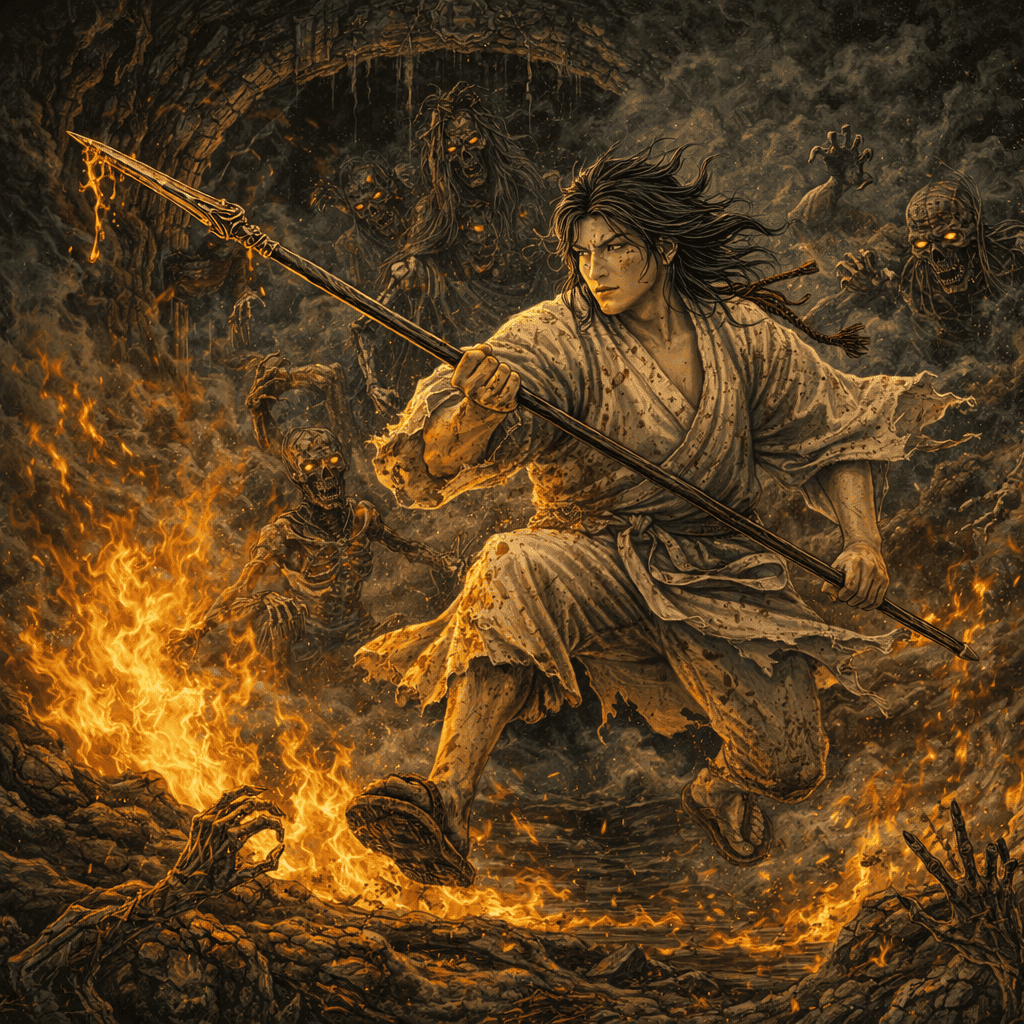
Before there were islands, before there were gods of sun and storm, before there was anything recognizable as Japan, there was a bridge — the Floating Bridge of Heaven — and upon it stood two deities charged with an impossible task: create solid ground from the churning chaos below. One of them was Izanagi-no-Mikoto, the Male Who Invites, and together with his consort Izanami-no-Mikoto, the Female Who Invites, he would thrust a jeweled spear into the primordial brine and stir the cosmos into existence. The drops that fell from the spear's tip became Onogoro-jima, the first island, and from that island, all of Japan would follow.
But the story of Izanagi is not merely a creation myth. It is a love story, a horror story, and a meditation on the boundary between life and death. After Izanami died giving birth to the fire god, Izanagi descended into Yomi-no-Kuni — the Land of the Dead — to retrieve her. What he found there shattered him, and the purification he performed upon his return birthed the three most powerful deities in the Japanese pantheon: Amaterasu, Tsukuyomi, and Susanoo. Every act of Shinto purification, every ritual washing of hands at a shrine, every misogi ceremony performed in icy waterfalls — all trace their origin to one god's desperate attempt to wash the stench of death from his skin. This is the story of Izanagi, the father of everything.
Who is Izanagi?
Izanagi-no-Mikoto (also written as Izanaki) is one of the primordial creator deities (kotoamatsukami) of Japanese Shinto mythology. His name is commonly translated as "He Who Invites" or "The Male Who Beckons," paired eternally with Izanami-no-Mikoto, "She Who Invites." Together they constitute the seventh and final generation of divine beings who emerged after heaven and earth separated from the primordial chaos. The Kojiki (712) names them as the culmination of the divine procession, the pair chosen by the elder gods to descend and create the terrestrial world.
Unlike many creator deities in world mythology, Izanagi is not omnipotent. He makes mistakes, experiences grief, feels fear, and is physically contaminated by contact with death. Scholars such as Joseph Campbell have noted that this fallibility makes the Japanese creation myth uniquely human in tone (Campbell, "The Masks of God: Oriental Mythology," 1962). Izanagi does not speak the world into being from a position of cosmic remove; he labors, he loves, he loses, and he runs — literally runs — from the consequences of looking where he should not have looked. He is the creator as tragic figure, and his tragedy is the engine that drives the entire Japanese mythological system.
What is the Origin Story of Izanagi?
The Kojiki and Nihon Shoki agree on the essential outline. Izanagi and Izanami stood upon the Ama-no-Ukihashi, the Floating Bridge of Heaven, and thrust a jeweled spear called Ama-no-Nuboko into the ocean of chaos below. When they withdrew the spear, brine dripped from its tip and congealed into the island of Onogoro. They descended to this island, erected a heavenly pillar, and performed a marriage ritual by walking around it in opposite directions and greeting each other. Their first attempt failed — Izanami spoke first, violating ritual protocol — and their firstborn, Hiruko (the Leech Child), was malformed and set adrift on the waters. They consulted the heavenly gods, corrected the ritual, and began again. This time, Izanagi spoke first, and from their union the islands of Japan were born: Awaji, Shikoku, Oki, Kyushu, Iki, Tsushima, Sado, and finally Honshu, the largest island (Kojiki, 712).
After the islands, Izanagi and Izanami continued to create deities — gods of wind, of trees, of mountains, of rivers. But when Izanami gave birth to Kagutsuchi, the god of fire, the flames scorched her fatally. She sickened and died, and from her vomit, feces, and urine, more gods were born even as she perished. Izanagi, consumed by grief and rage, drew his sword Ame-no-Ohabari and decapitated Kagutsuchi. From the fire god's blood and body sprang yet more deities — gods of thunder, of mountains, of swords — in a cascade of creation born from violence and loss.
Unable to accept Izanami's death, Izanagi traveled to Yomi-no-Kuni, the underworld, to bring her back. He found her in a vast dark palace and begged her to return. Izanami agreed to petition the gods of Yomi but warned Izanagi not to look at her. He waited in the darkness, but his patience failed. He broke a tooth from his comb, lit it as a torch, and saw his beloved wife as she truly was: a rotting, maggot-infested corpse, surrounded by the Eight Thunder Gods who had taken up residence in her decaying flesh. Izanami, humiliated, shrieked and sent the Ugly Females of Yomi to pursue him. Izanagi fled in terror, hurling his headdress (which became grapes), his comb (which became bamboo shoots), and finally urinating to create a river that slowed his pursuers.
At the border between the living world and Yomi — the Yomotsu Hirasaka — Izanagi sealed the entrance with a massive boulder. From opposite sides of the stone, the estranged couple exchanged final words. Izanami vowed to kill one thousand people every day. Izanagi replied that he would cause fifteen hundred to be born. In that exchange, death and birth were established as the fundamental rhythm of existence. The myth is not merely about the origin of mortality; it is about the arithmetic of survival — life must always slightly outpace death for the world to continue (Kojiki, 712).
Which Shrines Are Dedicated to Izanagi?
The primary shrine dedicated to Izanagi is the Izanagi Shrine (Izanagi Jingu) on Awaji Island in Hyogo Prefecture. According to shrine tradition, Awaji was the first island created when brine dripped from the jeweled spear, and the shrine marks the spot where Izanagi retired after his cosmic labors. The shrine dates its founding to the reign of Emperor Jimmu, the legendary first emperor, and has been a site of imperial worship for millennia. Its serene grounds, surrounded by ancient trees and approached through a series of vermillion torii gates, convey a sense of primordial stillness appropriate for the resting place of the creator.
The Taga Taisha in Shiga Prefecture is another major shrine dedicated to Izanagi (and Izanami), and its founding legend claims that the creator gods settled there after completing their work. The shrine's famous saying — "O-Ise mairi ni Taga e yore" ("On your way to Ise, stop at Taga") — indicates that even in the medieval period, Taga was considered a pilgrimage site of comparable importance to Ise Grand Shrine. The shrine specializes in prayers for longevity and recovery from illness, reflecting Izanagi's association with purification and the renewal of life after contact with death.
The Eda Shrine in Miyazaki Prefecture claims to mark the site of Izanagi's purification — the Misogi — where he washed in the river and birthed Amaterasu, Tsukuyomi, and Susanoo. Nearby, the Aoshima Shrine sits on a tiny island connected to the mainland by a bridge, evoking the mythological Floating Bridge of Heaven. These shrines collectively map the mythological geography of creation onto the physical landscape of Japan, turning geology into theology and coastline into scripture.
Which Anime and Manga Feature Izanagi?
In Masashi Kishimoto's Naruto (Studio Pierrot, 1999), Izanagi is the name of a forbidden technique that allows the user to rewrite reality itself. By sacrificing a Sharingan eye, the caster can turn any event — including their own death — into a dream, and any desired outcome into reality. It is, in essence, the ultimate undo button, and it reflects the mythological Izanagi's role as the god who attempted to reverse the irreversible: the death of his beloved. The technique's cost — the permanent loss of sight in one eye — mirrors the mythological themes of sacrifice and the price of transgressing the boundary between life and death.
Izanagi appears prominently in the manga and anime Noragami by Adachitoka, where the relationships between primordial gods inform the power dynamics of the story's divine hierarchy. The series explores what it means for gods to be remembered or forgotten, and Izanagi's foundational role in the mythological canon makes him a touchstone for discussions of divine authority and legacy. In the Persona franchise (Atlus), Izanagi is the initial Persona of the protagonist in Persona 4 (2008), manifesting as a figure in a long black coat wielding a naginata — a design that blends mythological gravitas with contemporary style.
The myth of Izanagi's descent into Yomi has also inspired horror-adjacent works. The visual novel and anime series Higurashi no Naku Koro ni (When They Cry) contains thematic echoes of the forbidden gaze and the rotting beloved, and numerous manga have retold the Yomi episode as outright horror. The image of Izanagi lighting his makeshift torch and seeing Izanami's decomposing body is one of the most cinematic moments in world mythology — a scene that practically storyboards itself — and manga artists have exploited its visual potential extensively.
Why Does Izanagi Still Matter Today?
Izanagi matters because his story answers the question that every human being eventually faces: what do we do after we lose the person we love most? His answer — descend into the underworld, confront death directly, and then purify yourself and create new life — is not a comfortable answer, but it is an honest one. The myth acknowledges that grief can drive us to impossible places, that the desire to retrieve what death has taken is universal, and that the only healthy response to the contamination of loss is ritual purification: washing, cleansing, beginning again.
Every act of temizu — the ritual hand-washing at shrine entrances — reenacts Izanagi's misogi. Every time a Shinto priest performs a purification ceremony, they are channeling the moment when Izanagi stood in the river at Tachibana-no-Odo and washed the filth of death from his body. The concept of kegare (ritual impurity) and harae (purification) that pervades Japanese culture — from the removal of shoes before entering a home to the salt thrown after a funeral — traces its origin to Izanagi's desperate need to become clean after his journey to Yomi.
In a world increasingly uncomfortable with death, increasingly inclined to sanitize and euphemize mortality, Izanagi's myth offers a confrontation. He looked at death — literally looked it in the face — and the experience nearly destroyed him. But he survived. He purified himself. And from that purification came the sun, the moon, and the storm — the three forces that make the world inhabitable. The myth insists that creation is not a one-time event but an ongoing process, and that the raw material for new life can be found even in the aftermath of catastrophic loss. That is a truth worth carrying across thirteen centuries.
Conclusion
Izanagi is the god who did everything first: the first creation, the first marriage, the first grief, the first descent into hell, the first purification, and the first establishment of the boundary between life and death. His spear stirred the cosmos into being. His torch illuminated the horror of mortality. His tears birthed the gods who rule heaven and earth. To study Izanagi is to study the architecture of existence itself — the load-bearing walls of Japanese mythology upon which every other story is built. He is the beginning, and every beginning carries his name.
This is The Yokai Files.
Support The Yokai Files
Enjoyed this deep dive into Japanese folklore?
The Yokai Files is reader-supported. Your support helps us research deeper, write more, and keep the darkness alive.