Izanami: The Mother of Japan Who Became Queen of the Dead
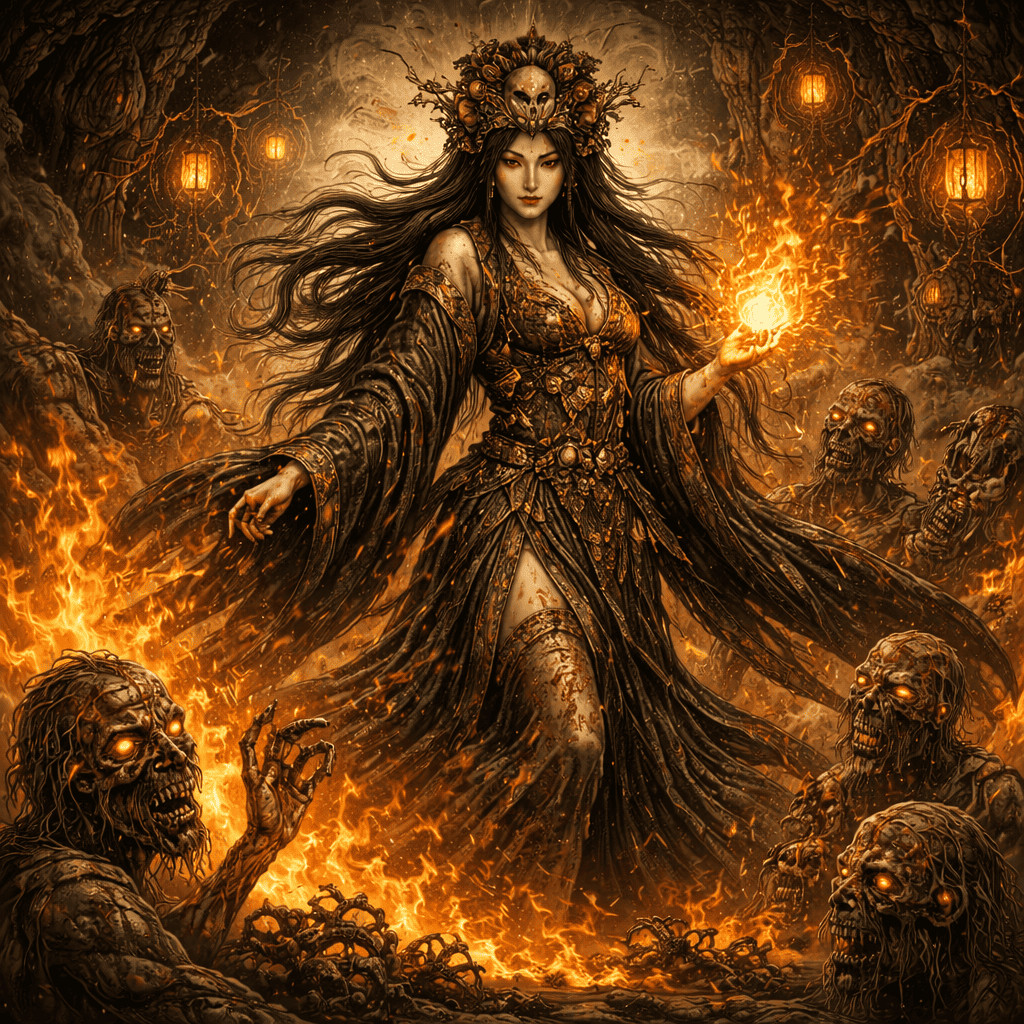
She helped create every island of Japan. She gave birth to the gods of wind, sea, mountains, and rivers. She was one half of the primordial couple who stirred the cosmos into existence with a jeweled spear. And then she died — burned from the inside by her own child, the fire god Kagutsuchi — and descended into the Land of the Dead, where she became something far more terrifying than any deity she had ever created. Izanami-no-Mikoto, the Female Who Invites, is the mother of Japan and the queen of its underworld, and her story is one of the most devastating in world mythology.
What makes Izanami's myth so enduringly powerful is not merely its horror — though the image of her rotting corpse teeming with thunder gods is among the most nightmarish in any religious tradition — but its emotional complexity. She is simultaneously victim and monster, creator and destroyer, a mother who wanted to nurture life and a death goddess who vows to extinguish it. Her final exchange with Izanagi, screamed across the boulder that seals the underworld, establishes the fundamental equation of human existence: one thousand will die, but fifteen hundred will be born. Izanami is the reason that equation exists at all. She is the reason there is death.
Who is Izanami?
Izanami-no-Mikoto (also rendered as Izanami-no-Kami) is the primordial female deity of Japanese mythology, counterpart and consort to Izanagi-no-Mikoto. Her name means "She Who Invites" or "The Female Who Beckons," and together with Izanagi she constitutes the seventh and final generation of divine beings described in the opening passages of the Kojiki (712) and Nihon Shoki (720). Before their descent to the newly formed island of Onogoro, heaven and earth had separated from chaos, but the terrestrial world remained formless — a floating, jellyfish-like mass with no solid ground. Izanami and Izanagi were commanded by the elder gods to "complete and solidify this drifting land" (Kojiki, 712, Chamberlain translation).
Izanami's role in Japanese mythology is dual from the very beginning. She is the co-creator of the physical world — the islands, the seas, the deities who govern natural phenomena — but she is also the first being in the mythological canon to die. Her death transforms her from a creator goddess into a chthonic deity, the ruler of Yomi-no-Kuni (the Land of the Dead), whose power is defined not by generation but by dissolution. The scholar Michiko Yusa has argued that Izanami represents "the terrifying maternal principle — the womb that is also the tomb" (Yusa, "Japanese Religions," 2002). She gives life, and she takes it. The two functions are inseparable.
What is the Origin Story of Izanami?
The Kojiki records that after Izanami and Izanagi created the islands of Japan and populated them with deities, Izanami gave birth to Kagutsuchi (also called Homusubi), the god of fire. The birth was catastrophic: Kagutsuchi's flames scorched Izanami's birth canal, inflicting mortal burns. As she lay dying, deities continued to emerge from her — from her vomit came the gods of mining, from her feces the gods of clay, from her urine the goddess of irrigation. Even in death, she was still creating. But the creation was now inextricable from suffering, and the body that had birthed the world was being consumed by the element it had produced.
Izanami died and descended to Yomi-no-Kuni. Izanagi, wild with grief, slew Kagutsuchi with his sword, but the fire god's death only produced more deities from the blood that splashed across the rocks. Violence begat creation begat more violence — the cycle that would define the mythological world was already spinning. Izanagi then made the fateful decision to follow Izanami into the underworld.
When he arrived at the palace of Yomi, Izanami spoke to him from behind a closed door. She agreed to petition the gods of the underworld for permission to return, but she warned him: "Do not look at me." Izanagi waited in the darkness. Time passed. His patience broke. He snapped a tooth from his comb, lit it as a torch, and pushed open the door. What he saw was his wife's body in an advanced state of decomposition — bloated, crawling with maggots, and infested with eight thunder deities who had taken up residence in her rotting flesh: Great-Thunder in her head, Fire-Thunder in her breast, Black-Thunder in her belly, Crack-Thunder in her genitals, Young-Thunder in her left hand, Earth-Thunder in her right hand, Rumbling-Thunder in her left foot, and Reclining-Thunder in her right foot (Kojiki, 712).
Izanami's humiliation at being seen in this state transformed her grief into rage. She dispatched the Ugly Females of Yomi (Yomotsu-shikome) to pursue Izanagi, and when they failed, she sent the Eight Thunder Gods and an army of fifteen hundred warriors. Izanagi fled, throwing objects behind him that transformed into obstacles — grapes, bamboo shoots, a river of urine. He reached the Yomotsu Hirasaka, the slope between the worlds, and sealed the passage with a boulder called Chibiki-no-Iwa. From behind the stone, Izanami screamed her curse: "My dear husband, if you do this, I will strangle to death one thousand of the people of your country every day." Izanagi replied: "My dear wife, if you do this, I will cause fifteen hundred birth-huts to be built every day" (Kojiki, 712). In that exchange, mortality was established. Death and birth became the twin engines of human existence, and Izanami became Yomotsu-Okami — the Great Deity of Yomi, the sovereign of the dead.
Which Shrines Are Dedicated to Izanami?
Izanami's primary sacred site is the Hana-no-Iwaya Shrine (Flower of the Rock Cave Shrine) in Kumano, Mie Prefecture. This ancient shrine, which predates the construction of formal shrine buildings, centers on a massive rock face approximately forty-five meters high that is said to be Izanami's burial place. No main hall exists; the rock itself is the sacred object. Ropes and shimenawa are strung across its face during festivals, and the surrounding forest maintains the atmosphere of primordial mystery appropriate for the resting place of the mother of creation. The shrine is part of the UNESCO-designated "Sacred Sites and Pilgrimage Routes in the Kii Mountain Range."
Mount Hiba (Hiba-yama), straddling the border between Hiroshima and Shimane Prefectures, is another traditional burial site of Izanami, as mentioned in the Kojiki: "So the deity Izanami-no-Mikoto is buried at the border of the Land of Izumo and the Land of Hahaki, on Mount Hiba" (Kojiki, 712). The Hiba-yama Kumangu shrine complex on the mountain preserves this tradition, and the mountain itself is considered sacred ground, its forests dense and dark in a way that feels genuinely underworld-adjacent.
The Kamosu Shrine in Matsue, Shimane Prefecture, also venerates Izanami, and the broader Izumo region — already associated with Susanoo and Okuninushi — maintains numerous sites connected to the creation myth. What is striking about Izanami's shrine landscape is its emphasis on natural formations rather than built structures: caves, rock faces, mountains. The architecture of her worship reflects her mythological trajectory — from the constructed splendor of the heavenly pillar to the raw geological reality of the underworld. Her shrines do not prettify death; they present it as the earth presents it, in stone and silence.
Which Anime and Manga Feature Izanami?
In Masashi Kishimoto's Naruto (Studio Pierrot, 1999), Izanami is the name of a technique that serves as the counterpart to Izanagi. While Izanagi rewrites reality to undo unfavorable outcomes, Izanami traps the target in an infinite time loop, forcing them to relive the same sequence of events until they accept their true selves. The technique was created specifically to counter those who abused Izanagi, establishing a mythological check-and-balance system. This mirrors the original myth perfectly: Izanami's curse of death exists as the necessary counterbalance to Izanagi's power of creation. In the manga, Itachi Uchiha uses Izanami against Kabuto Yakushi, trapping him in a cycle of self-confrontation that ultimately leads to Kabuto's spiritual redemption. The technique is compassionate destruction — it breaks the target in order to heal them.
In Noragami by Adachitoka, the mythology of the underworld and the relationships between creator gods provide structural scaffolding for the series' exploration of death, memory, and divine obligation. The series' portrayal of the borderland between the living and the dead draws heavily on the Yomi-no-Kuni imagery established in Izanami's myth. The rotting beloved, the forbidden gaze, and the sealed border between worlds are motifs that recur throughout Japanese horror and fantasy manga, from Shigeru Mizuki's GeGeGe no Kitaro to Rumiko Takahashi's InuYasha.
Izanami's myth also resonates deeply with the horror genre. The image of the decomposing wife — beautiful in life, hideous in death, and furious at being seen — is a prototype for the onryo (vengeful ghost) tradition that produced Sadako in Ring, Kayako in Ju-On, and countless other figures in J-horror. Izanami is, in a very real sense, the original Japanese horror monster: a woman transformed by death and betrayal into an engine of supernatural vengeance. Every long-haired ghost crawling out of a well or television set carries a fragment of Izanami's rage.
Why Does Izanami Still Matter Today?
Izanami matters because she embodies the most uncomfortable truth in human experience: that the source of life is also the source of death. She is the womb and the tomb, the mother and the reaper, the beloved and the horror. Her myth refuses to separate creation from destruction, insisting that they are the same process viewed from different angles. The fire that cooked food and warmed homes was the same fire that burned Izanami to death. The love that created a world was the same love that drove Izanagi to violate the sacred prohibition against looking at the dead.
Japanese funeral customs bear the imprint of Izanami's myth at every turn. The concept of kegare — ritual impurity associated with death — derives directly from Izanagi's contamination in Yomi. The practice of offering salt after funerals, the avoidance of the number four (shi, which also means death), and the elaborate purification rituals performed by those who have been in contact with the deceased all reflect the mythological framework established by Izanami's transformation. Even the architecture of Japanese cemeteries, with their stone markers and dark, forested settings, echoes the geological sacred sites where Izanami is believed to rest.
Perhaps most importantly, Izanami's myth validates grief. Izanagi's love for her was so powerful that he defied the cosmic order to try to retrieve her. His failure does not diminish the love; it elevates it. And Izanami's rage — while terrifying — is comprehensible. She was burned to death by her own child, abandoned in a realm of darkness, and then exposed in her most vulnerable, degraded state by the husband she trusted. Her curse is not motiveless malignity; it is the fury of the betrayed. To read Izanami's myth with compassion is to understand that even the goddess of death was once a mother who simply wanted to create.
Conclusion
Izanami created the islands of Japan, gave birth to the gods, and died in fire. In the darkness of the underworld, she became the sovereign of death, the rotting queen whose curse established the mortality that defines human existence. She is the shadow behind every shrine, the absence at the center of every creation myth, and the dark mirror in which Izanagi saw the truth about love and loss. Her story is not comfortable. It is not meant to be. It is meant to be true — true in the way that myths are true, which is to say, true in the ways that matter most. Izanami reminds us that creation costs something, that love cannot conquer death, and that the world we inhabit was built on a foundation of grief. She is the mother of Japan, and Japan has never forgotten her.
This is The Yokai Files.
Support The Yokai Files
Enjoyed this deep dive into Japanese folklore?
The Yokai Files is reader-supported. Your support helps us research deeper, write more, and keep the darkness alive.