Raijin: The Thunder God of Japan and His Drums of Divine Wrath
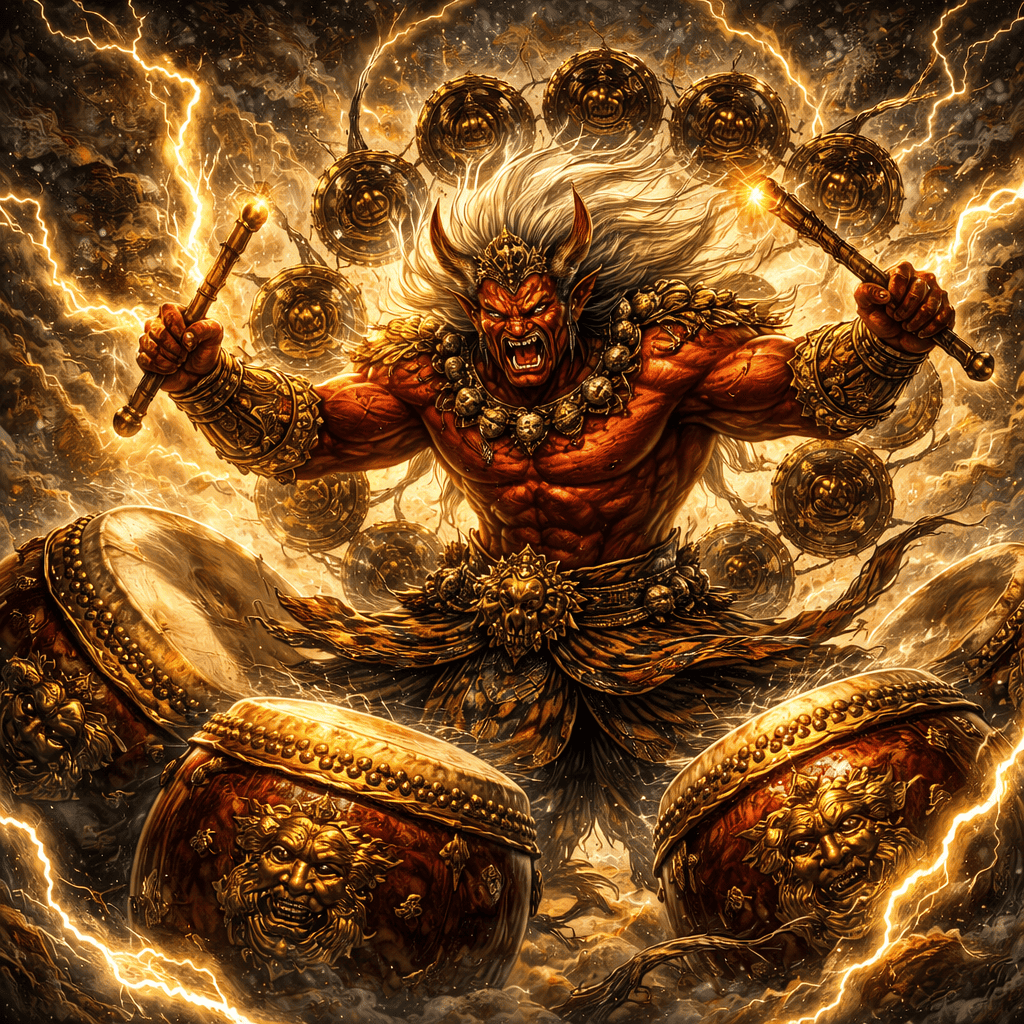
When thunder splits the summer sky over Japan, there are those who still instinctively cover their navels. The superstition is ancient and specific: Raijin, the god of thunder, is said to have a particular appetite for the belly buttons of children, and a well-placed hand is the only defense against a god who rides the storm clouds with a ring of taiko drums strapped to his back. It is an absurd image — cosmic terror reduced to a playground warning — but it captures something essential about Raijin's place in Japanese culture. He is simultaneously fearsome and familiar, a deity of apocalyptic destructive power who has been domesticated into nursery rhymes without losing an ounce of his mythological authority.
Raijin (also known as Raiden, Raiden-sama, or Kaminari-sama) is the Shinto god of thunder, lightning, and storms. His iconography — a muscular, demonic figure surrounded by connected drums, leaping through clouds with a manic grin — is one of the most recognizable images in Japanese art. Paired eternally with his brother Fujin, the wind god, Raijin guards the gates of temples, decorates the screens of palaces, and crashes through the panels of manga with the same ferocious energy he has projected for over a thousand years. In this article, we listen for the thunder and trace Raijin's rumble from ancient myth to modern screen.
Who is Raijin?
Raijin is the kami of thunder and lightning in the Shinto tradition. His name combines "rai" (thunder, from the Chinese character 雷) and "jin" or "shin" (god/spirit, 神). He is sometimes called Raiden (雷電, "thunder and lightning"), Kaminari-sama (雷様, "Lord Thunder"), or Narukami (鳴る神, "Sounding God"). Unlike the neatly genealogized deities of the Kojiki's divine lineage, Raijin's mythological origins are somewhat fluid, reflecting his roots in both Shinto cosmology and folk religion.
The Kojiki (712) does not name a single "Raijin" but describes the Eight Thunder Gods (Ya-Ikazuchi) who inhabited the decomposing body of Izanami in the underworld of Yomi. These eight thunder deities — Great-Thunder, Fire-Thunder, Black-Thunder, Crack-Thunder, Young-Thunder, Earth-Thunder, Rumbling-Thunder, and Reclining-Thunder — represent the terrifying aspect of thunder as a phenomenon associated with death and the underworld. Over centuries of folk religious development, these diffuse thunder associations consolidated into the singular figure of Raijin, who absorbed elements from Buddhist thunder deities, Chinese thunder gods (particularly Lei Gong), and indigenous agricultural thunder worship. The result is a deity who is simultaneously Shinto, Buddhist, and folk — a thunderclap that refuses to belong to any single tradition.
What is the Origin Story of Raijin?
Raijin's mythology, unlike the tightly plotted narratives of Amaterasu or Susanoo, is diffuse — scattered across folk tales, temple legends, and artistic traditions rather than concentrated in a single canonical text. The most significant textual anchor is the Kojiki's description of the Eight Thunder Gods dwelling within Izanami's corpse, which establishes thunder as a force intimately connected to death, decay, and the underworld. When Izanagi lit his torch in Yomi and saw the thunder gods writhing in his wife's rotting flesh, he fled in terror — and his terror is the template for humanity's instinctive fear of thunderstorms.
Folk traditions elaborate Raijin's character considerably. In many regional legends, Raijin is a somewhat dim-witted but immensely powerful oni-like figure who occasionally falls from the sky and must be helped back to heaven by humans. The Taiheiki (14th century) records a legend in which a thunder god falls into a farmer's well and pleads for assistance, promising in return to grant the farmer's wish. These stories humanize Raijin, transforming him from a cosmic terror into a bumbling neighbor whose destructive power is more accidental than intentional.
The Buddhist tradition adds another layer. In esoteric Buddhism (Shingon and Tendai), thunder deities serve as dharma protectors — fierce guardians who use their terrifying appearance to defend the Buddhist law. The sculptural tradition of placing Raijin (and Fujin) as temple guardians reflects this protective function. They are not demons to be feared but sentinels to be respected, their ferocity directed outward against evil rather than inward against the faithful. This dual nature — destructive and protective — is central to understanding why Raijin appears at the gates of some of Japan's holiest sites.
Perhaps the most famous folk belief associated with Raijin is the belly button superstition. Parents throughout Japan have traditionally warned children to cover their navels during thunderstorms, lest Raijin descend and steal them. The origin of this belief is debated — some scholars connect it to the practical concern of keeping children's abdomens warm during the cold rains that accompany storms (hypothermia being a genuine risk for young children), while others trace it to the association between the navel (as the center of life force) and the thunder god's hunger for vital energy. Whatever its origin, the superstition demonstrates Raijin's thorough integration into Japanese childhood experience. He is the boogeyman of the storm, and every Japanese child has been warned about him.
Which Shrines Are Dedicated to Raijin?
The most celebrated artistic depiction of Raijin — and arguably the most important site for his worship in visual form — is the Sanjusangendo (Thirty-Three Bay Hall) in Kyoto. This thirteenth-century temple, officially named Rengeo-in, houses 1,001 statues of the Thousand-Armed Kannon, flanked by twenty-eight guardian deities and, at either end of the hall, the magnificent statues of Fujin and Raijin. The Raijin statue, carved in the Kamakura period (13th century), depicts the thunder god with a fierce red-skinned demonic face, muscular body, and a circle of drums arrayed behind him like a halo of sound. The statue is designated a National Treasure and represents the apex of Japanese Buddhist sculptural art.
The Kaminarimon ("Thunder Gate") of Senso-ji temple in Asakusa, Tokyo, is perhaps the most photographed Raijin-associated site in the world. The massive red lantern that hangs beneath the gate is flanked by statues of Fujin (to the right) and Raijin (to the left), serving as the guardians of Tokyo's oldest temple. Millions of tourists pass between the thunder and wind gods every year, most without realizing they are walking through a mythological threshold — a gate guarded by the same forces that once terrified Izanagi in the depths of the underworld.
Beyond these famous sites, Raijin is venerated at numerous Kaminari Shrines (Kaminari Jinja) throughout Japan, particularly in agricultural regions where thunder was understood as a fertilizing force. The word "kaminari" (thunder) literally means "god-sound" (kami-nari), and the rumble of thunder was interpreted as the voice of the kami speaking to the earth. Lightning strikes in rice paddies were believed to promote fertility — the Japanese word for rice paddy, "ta" (田), is sometimes etymologically linked to the idea of fields "charged" by divine electricity. Raijin, in his agricultural aspect, is not a destroyer but a fertilizer — the god whose violence makes things grow.
Which Anime and Manga Feature Raijin?
Raijin's influence on contemporary anime and manga is enormous, though it often operates through indirect channels rather than direct character representation. The most significant recent example is Koyoharu Gotouge's Demon Slayer: Kimetsu no Yaiba (ufotable, 2019), in which the Thunder Breathing (Kaminari no Kokyu) style is one of the five core breathing techniques used by demon slayers. Zenitsu Agatsuma, the series' beloved cowardly swordsman, is a practitioner of Thunder Breathing, and his signature move — Thunderclap and Flash (Hekireki Issen) — transforms him from a sniveling wreck into a blur of lightning-fast strikes. The visual representation of Thunder Breathing — electric yellow arcs trailing behind the blade — is a direct aesthetic descendant of Raijin's drum-circle iconography, with speed and electric power replacing percussion.
In Naruto (Studio Pierrot, 1999), the Fourth Hokage Minato Namikaze earned the nickname "Konoha's Yellow Flash" for his lightning-fast technique, and the broader Naruto universe is saturated with lightning-based jutsu (Chidori, Raikiri) that channel Raijin's mythological energy. The Hidden Cloud Village's entire aesthetic — lightning, drums, power — is essentially a Raijin-themed ninja culture. The Raikage (Lightning Shadow) is a Raijin figure in all but name.
Beyond these specific examples, Raijin's visual template — the muscular figure surrounded by drums, riding storm clouds, grinning with demonic glee — appears in fighting games (Mortal Kombat's Raiden, though spelled differently, draws on the same mythological source), in the Persona franchise, and in countless manga depictions of thunder deities. The taiko drum circle that Raijin carries has become a universal visual shorthand for "Japanese thunder god," as instantly recognizable as Poseidon's trident or Thor's hammer. Raijin has achieved what few mythological figures manage: total iconographic saturation across every medium.
Why Does Raijin Still Matter Today?
Raijin matters because humans still flinch at thunder. For all our scientific understanding of electrical discharge between clouds and ground, the visceral response to a thunderclap — the jolt, the instinctive ducking, the child's scream — has not changed since the Kojiki was written. Raijin personifies that flinch. He gives it a face, a story, and a set of drums. And by doing so, he transforms raw terror into something manageable, even entertaining. The child who covers their belly button during a storm is not actually afraid; they are playing a game with fear, and Raijin is the game's mascot.
The Japanese relationship with natural disaster is one of the defining features of the national character. Earthquakes, typhoons, tsunamis, volcanic eruptions — Japan is a country where nature's violence is not theoretical but quotidian. Raijin belongs to this tradition of deities who personify natural forces — not to control them, but to live alongside them. Worshiping a thunder god does not stop lightning from striking; it provides a framework for understanding why the strike occurs and how to respond to it with courage rather than despair. In this sense, Raijin is less a god of fear than a god of resilience — the embodied acknowledgment that nature is powerful, that storms will come, and that life continues after the thunder passes.
Raijin's modern manifestations — in anime, in gaming, in the visual culture of Japanese pop art — demonstrate that this ancient function remains active. When Zenitsu Agatsuma channels Thunder Breathing and transforms from coward to hero, the narrative is performing exactly the same function as the Raijin myth: showing that terror and power are two faces of the same coin, and that the flinch can become the strike. Raijin endures because the storm endures — and because the human need to make sense of the storm never fades.
Conclusion
Raijin beats his drums and the sky cracks open. Lightning strikes the rice paddy and the grain grows tall. A child covers their belly button and laughs nervously. A swordsman draws his blade and becomes a thunderbolt. From the rotting body of Izanami in the depths of Yomi to the electric-yellow arcs of Demon Slayer's animation, Raijin has thundered through Japanese culture for over a millennium — feared, worshiped, sculpted, painted, and reimagined in every generation. He is the sound of the sky reminding the earth that the gods are still awake. Listen carefully. You can hear him now.
This is The Yokai Files.
Support The Yokai Files
Enjoyed this deep dive into Japanese folklore?
The Yokai Files is reader-supported. Your support helps us research deeper, write more, and keep the darkness alive.