Susanoo: Storm God, Serpent Slayer, and the Sword of Heaven
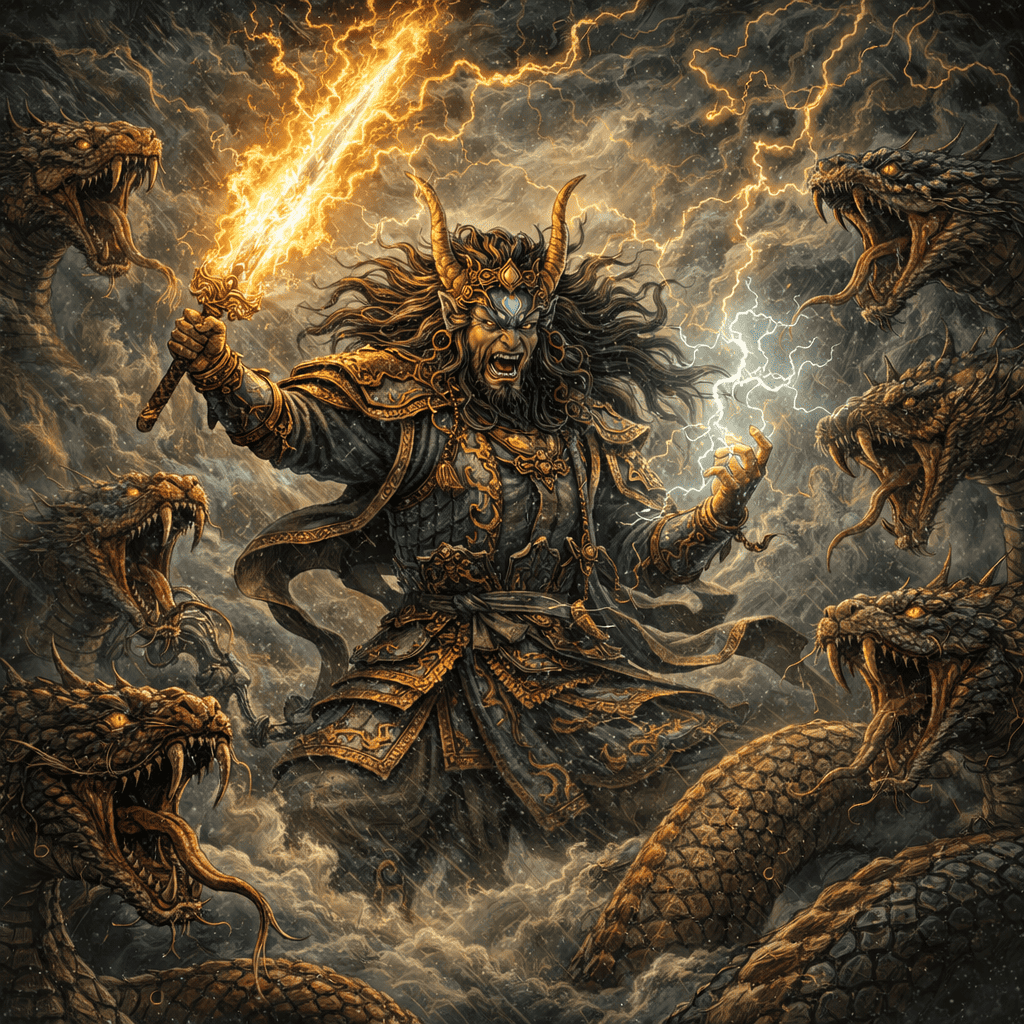
He was born from the nose of a god who had just fled the realm of the dead, and from the moment of his creation, Susanoo-no-Mikoto — the Raging Male of the Storm — brought nothing but chaos. He wept so violently that mountains withered and oceans dried. He defiled sacred rice paddies, desecrated weaving halls, and terrorized the highest deity in the Japanese pantheon until she hid from the entire world. For these crimes, he was expelled from heaven, stripped of his beard, his fingernails, and his dignity. And yet, within hours of his exile, this same god would slay an eight-headed serpent, discover one of Japan's Three Imperial Regalia, and found a divine lineage that endures in Shinto worship to this day.
Susanoo is the paradox at the heart of Japanese mythology: the destroyer who becomes the protector, the outcast who founds a kingdom, the storm that clears the sky for new growth. His story, preserved in the Kojiki (712) and Nihon Shoki (720), refuses to resolve into simple moral categories. He is neither hero nor villain but something far more interesting — a force of nature that must be endured before it can be understood. In this article, we follow the storm from heaven to earth and discover what it leaves behind.
Who is Susanoo?
Susanoo-no-Mikoto (also written as Susano-o or Takehaya-Susanoo-no-Mikoto) is the god of storms, the sea, and — in some traditions — agriculture and the underworld. His name is commonly interpreted as "the Raging, Swift, Brave Male," though scholars have debated the precise etymology for over a century. The sinologist and folklorist Nelly Naumann has linked the "susa" element to the concept of violence and surging (Naumann, "Japanese Prehistory," 2000), while others connect it to the place-name Susa in Izumo Province, where his mythology is most deeply rooted.
According to the Kojiki, Susanoo was born when Izanagi washed his nose during the purification rite at Tachibana-no-Odo in Tsukushi after his harrowing escape from the underworld of Yomi. Amaterasu was born from Izanagi's left eye, Tsukuyomi from his right eye, and Susanoo from his nose. Izanagi divided the cosmos among his three noble children: Amaterasu received the High Plain of Heaven, Tsukuyomi the realm of night, and Susanoo the sea. But Susanoo refused his dominion. Instead, he wailed and howled, declaring that he wished to visit his mother Izanami in the land of the dead. His grief was so violent that it caused trees to wither, rivers to dry up, and evil spirits to swarm across the world (Kojiki, 712). Izanagi, exasperated, banished his youngest son from his presence entirely.
What is the Origin Story of Susanoo?
Before descending to the mortal realm, Susanoo ascended to Takamagahara to bid farewell to his sister Amaterasu. His arrival shook the mountains and made the earth tremble, and Amaterasu — suspecting an invasion — armed herself with bow and quiver. Susanoo proposed a contest of sincerity: the Ukehi, a ritual oath in which both gods created offspring from each other's possessions. Amaterasu chewed Susanoo's sword and produced three goddesses; Susanoo chewed her jewels and produced five gods. Susanoo declared victory, claiming his pure intentions were proven by the birth of male children, and in his triumph, he went on a rampage. He broke down the ridges between Amaterasu's rice paddies, defiled her sacred halls, and finally hurled a flayed piebald horse through the roof of the weaving hall, killing a weaving maiden. This act drove Amaterasu into the Ama-no-Iwato, plunging the world into darkness.
The assembled gods punished Susanoo severely. His beard was cut, his finger and toenails were pulled out, and he was expelled from heaven permanently (Nihon Shoki, 720). He descended to the province of Izumo, to the headwaters of the Hi River, where he found an elderly couple — Ashinazuchi and Tenazuchi — weeping beside their daughter Kushinadahime. They explained that an eight-headed, eight-tailed serpent called Yamata no Orochi came every year to devour one of their daughters, and only Kushinadahime remained. Susanoo agreed to slay the beast in exchange for her hand in marriage.
His plan was cunning rather than martial. He instructed the couple to brew sake — eight vats of it — and to place the vats behind a fence with eight openings. When Yamata no Orochi arrived, it thrust each of its eight heads into a vat and drank deeply. Once the serpent was stupefied, Susanoo attacked, hacking the creature to pieces. As he cut through one of the tails, his blade struck something hard. Inside the flesh he discovered a magnificent sword — the Kusanagi no Tsurugi, the "Grass-Cutting Sword" — one of the Three Imperial Regalia of Japan. He presented it to Amaterasu as a peace offering, and it has remained a symbol of imperial authority ever since.
Susanoo then married Kushinadahime and built a palace in Izumo, composing what is traditionally regarded as the first Japanese waka poem: "Yakumo tatsu / Izumo yaegaki / tsuma-gomi ni / yaegaki tsukuru / sono yaegaki wo" — "Many clouds rise / The clouds form a fence / A many-layered fence / To enfold this pair of newlyweds / What a fine many-layered fence!" (Kojiki, 712). The storm god had become a poet, a husband, and a builder. Destruction had given way to creation.
Which Shrines Are Dedicated to Susanoo?
The spiritual capital of Susanoo's worship is Izumo Province — modern-day Shimane Prefecture — and specifically the Izumo Taisha, one of the oldest and most important Shinto shrines in Japan. While the main deity enshrined at Izumo Taisha is Okuninushi — Susanoo's descendant — the entire mythological geography of Izumo is saturated with Susanoo's presence. Local legends identify rivers, mountains, and forests with specific episodes from his serpent-slaying adventure.
Yasaka Shrine in Kyoto is dedicated primarily to Susanoo under the syncretic name Gozu Tenno, a deity identified with the Indian Buddhist figure associated with pestilence prevention. The annual Gion Matsuri, one of Japan's three greatest festivals, originated as a ritual to appease Susanoo-Gozu Tenno and ward off plague. For over a thousand years, elaborate floats have been paraded through Kyoto's streets every July, a living testament to Susanoo's role as both the bringer and the banisher of calamity.
The Susa Shrine in Izumo and the Hikawa Shrine in Saitama are also important centers of Susanoo worship. At Hikawa Shrine, Susanoo is venerated alongside Kushinadahime and their son, forming a divine family unit that blesses visitors with marital harmony, prosperity, and protection against evil. The sheer number and geographic spread of Susanoo-related shrines across Japan attests to his enduring popularity — he is, paradoxically, the outcast god whom everyone wants on their side.
Which Anime and Manga Feature Susanoo?
In Masashi Kishimoto's Naruto (Studio Pierrot, 1999), Susanoo is the name given to one of the most visually spectacular and narratively significant techniques in the entire franchise. When an Uchiha clan member awakens both Mangekyo Sharingan eyes, they gain the ability to manifest Susanoo — a colossal, ethereal warrior that encases the user in impenetrable armor. The technique progresses through stages, from a skeletal ribcage to a fully armored titan wielding legendary weapons. Itachi Uchiha's Susanoo carries the Yata Mirror and the Totsuka Blade — direct references to the mythological sacred objects — while Sasuke's Susanoo evolves into a form that can reshape the battlefield itself.
The choice to name this technique Susanoo is deeply significant. Like the mythological god, the Uchiha who wield Susanoo are simultaneously protectors and destroyers. Itachi uses it to shield those he loves even as his body disintegrates from terminal illness. Sasuke uses it as an instrument of vengeance before ultimately turning it toward defense of the village. The technique embodies the mythological Susanoo's essential duality — overwhelming destructive power that can be redirected toward salvation.
Beyond Naruto, Susanoo appears throughout Japanese media. In the Persona franchise (Atlus), Susano-o is a recurring Persona associated with the Magician or Moon arcana. In the manga and anime Blue Exorcist by Kazue Kato, storm imagery and serpent-slaying motifs echo his mythology. The video game Okami (Capcom, 2006) features the Yamata no Orochi as a central antagonist, with the player reprising the serpent-slaying role. Susanoo's narrative — exile, redemption, monster-slaying, and the discovery of a sacred weapon — maps perfectly onto the hero's journey template, making him an inexhaustible source for storytellers across every medium.
Why Does Susanoo Still Matter Today?
Susanoo matters because he is the patron saint of second chances. His mythology insists that the most destructive forces in the universe can be redirected toward creation, that exile is not the end of the story but the beginning of a new one. When Susanoo descends from heaven, he descends into himself — he confronts a monster, discovers a sacred treasure, writes a love poem, and builds a home. It is, in compressed mythological form, the arc of human maturation.
The Gion Matsuri, held every July in Kyoto, draws over a million participants and spectators. When the massive yamaboko floats are wheeled through the sweltering streets, the people of Kyoto are not merely celebrating a cultural tradition; they are performing a ritual that traces back to Susanoo's power to ward off pestilence. During the COVID-19 pandemic, shrines dedicated to Susanoo-Gozu Tenno reported increased visitation from people seeking supernatural protection against disease — the ancient function of the storm god reasserting itself in a contemporary crisis.
Susanoo also represents an essential truth about Japanese culture: that refinement and violence are not opposites but coexist within the same spirit. The same god who destroyed his sister's rice paddies also composed the first love poem in Japanese literary history. This duality — the warrior who is also a poet, the storm that is also a cleansing rain — runs through bushido, through the aesthetic of wabi-sabi, and through the cultural logic that makes Japan simultaneously one of the world's most orderly and most creatively anarchic societies. Susanoo is not a god to be admired from a distance; he is a god to be wrestled with, because the wrestling is where the wisdom lives.
Conclusion
From his tearful birth to his celestial banishment, from the blood-soaked slaying of Yamata no Orochi to the gentle composition of Japan's first love poem, Susanoo traverses the full spectrum of mythological experience. He is the storm that terrifies and the rain that nourishes, the exile who founds a kingdom, and the sinner who gifts the empire its most sacred sword. In Naruto, his name conjures an ethereal titan of war. In Kyoto, his festival fills the summer streets with music and lantern light. Susanoo is chaos made sacred — and Japan would not be Japan without him.
This is The Yokai Files.
Support The Yokai Files
Enjoyed this deep dive into Japanese folklore?
The Yokai Files is reader-supported. Your support helps us research deeper, write more, and keep the darkness alive.