Tsukuyomi: The Moon God of Japan and Lord of the Night
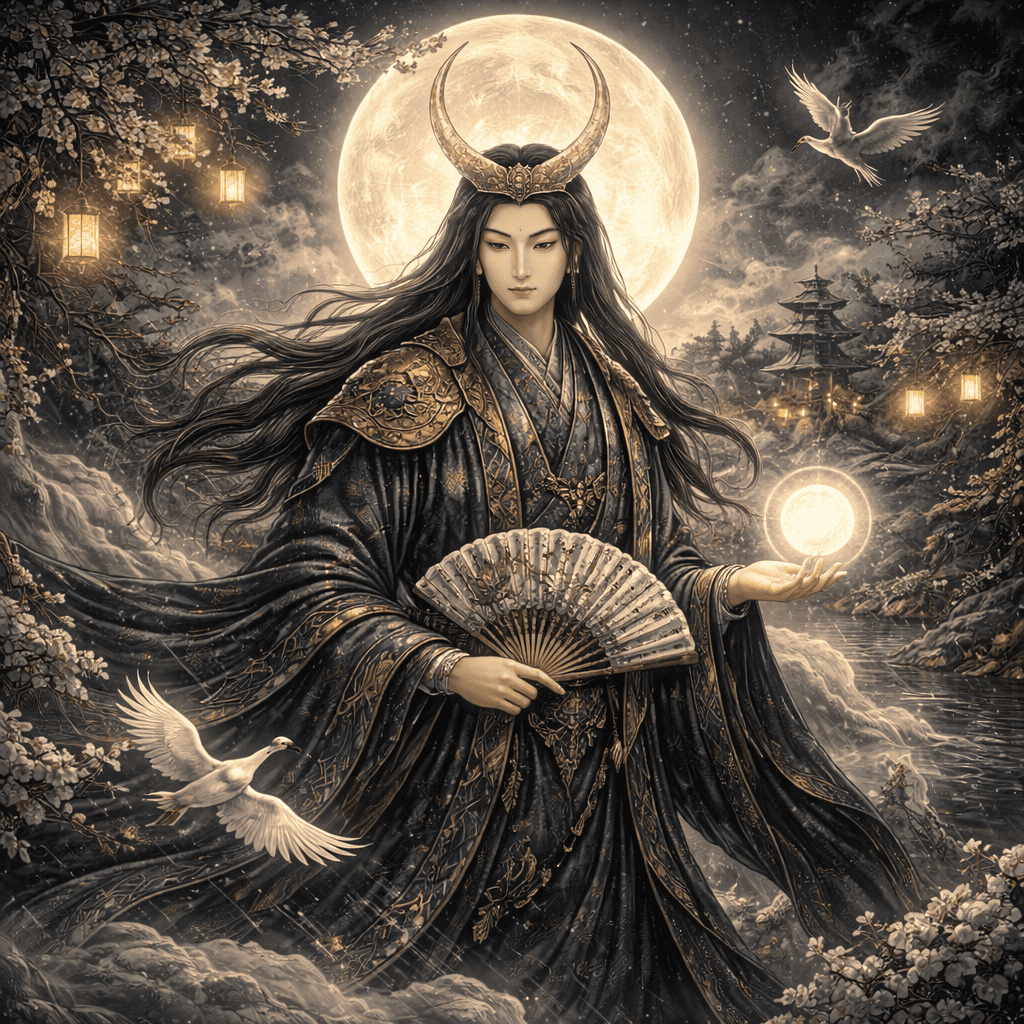
Of the three noble children born from Izanagi's purification — the sun, the moon, and the storm — Tsukuyomi is the one who slips most easily into shadow. Amaterasu blazes at the center of Shinto theology, her shrine rebuilt every twenty years, her name invoked in enthronement rituals. Susanoo rages through the myths, slaying serpents and founding kingdoms. But Tsukuyomi-no-Mikoto, the god of the moon, drifts through the ancient texts like a silver whisper, appearing in only a handful of passages before vanishing into the darkness he was born to rule. His absence is itself mythologically significant. The moon, after all, is defined by what it does not show.
And yet, within those few passages lies one of the most haunting episodes in all of Japanese mythology: a divine murder at a banquet, an act of violence so repugnant that the sun goddess severed all contact with her brother forever, creating the eternal alternation of day and night. Tsukuyomi's story is short, but its consequences are cosmic. Every sunset, every moonrise, every transition from light to dark re-enacts the moment Amaterasu turned her face from the moon in disgust. To study Tsukuyomi is to study the origins of night itself — and to understand that in Japanese mythology, even silence tells a story.
Who is Tsukuyomi?
Tsukuyomi-no-Mikoto (also written as Tsukiyomi or Tsuku-Yomi) is the Shinto deity of the moon and the night. His name is composed of the elements "tsuku" (moon) and "yomi" (reading or counting), which scholars have interpreted as "the counter of months" — a reference to the lunar calendar that governed agricultural life in ancient Japan. An alternative reading connects "yomi" to the land of the dead (Yomi no Kuni), suggesting a deeper association between the moon god and the underworld. The sinologist W.G. Aston noted this ambiguity in his 1896 translation of the Nihon Shoki, observing that "the moon, which waxes and wanes, which dies and is reborn, naturally lends itself to associations with death and resurrection."
According to the Kojiki (712), Tsukuyomi was born when Izanagi washed his right eye during his purification at Tachibana-no-Odo after his traumatic visit to the underworld. Amaterasu emerged from the left eye, Susanoo from the nose, and Tsukuyomi from the right eye. Izanagi assigned Tsukuyomi dominion over the realms of the night — the "Dominion of the Night" (Yoru no Osu-Kuni). Compared to the elaborate mythic cycles devoted to his siblings, Tsukuyomi's canonical appearances are remarkably sparse. He receives no serpent to slay, no cave to enter, no love poem to compose. His defining act is a single, catastrophic transgression.
What is the Origin Story of Tsukuyomi?
The central myth of Tsukuyomi is recorded primarily in the Nihon Shoki (720) rather than the Kojiki. Amaterasu sent Tsukuyomi to the mortal realm as her representative to visit the food goddess Ukemochi-no-Kami (also known as Ogetsu-hime in the Kojiki variant). Ukemochi prepared a magnificent banquet for the moon god, but the means of preparation were revolting: she produced food by turning toward the ocean and spitting out fish, turning toward the forest and disgorging game from her mouth, turning toward the rice paddies and vomiting forth rice and grain. Each dish was exquisite, but each had been generated from the goddess's own body in a manner that Tsukuyomi found deeply impure.
Overcome by disgust, Tsukuyomi drew his sword and struck Ukemochi dead. But from her corpse, life itself poured forth in abundance. From her head grew cattle and horses. From her forehead emerged millet. From her eyebrows came silkworms. From her eyes grew rice. From her belly sprang wheat and beans. Her death was the most fertile act in the mythological cycle — the ultimate sacrifice that feeds all of human civilization. This motif, known as the Hainuwele-type myth (after the Indonesian parallel identified by Adolf Jensen), appears across multiple cultures and represents the idea that agricultural abundance requires a primordial killing.
When Amaterasu learned what Tsukuyomi had done, she was horrified. "Thou art a wicked deity," she declared. "I will not meet with thee face to face" (Nihon Shoki, 720, Aston translation). From that moment, Amaterasu and Tsukuyomi were separated — the sun and the moon would never again share the sky at the same time. Day and night were born not from a cosmic accident but from a moral rupture, a severing of kinship caused by an act of violence against a generous host. The alternation of light and darkness is, in Japanese mythology, the visible scar of a family torn apart.
This myth is remarkable for several reasons. First, it gives moral weight to the structure of the cosmos: the day-night cycle is not neutral physics but the ongoing consequence of ethical failure. Second, it establishes Tsukuyomi as a figure defined by contamination anxiety — his violence stems from a horror of impurity that, ironically, makes him the most impure of the three siblings. Third, it positions the moon as a symbol of isolation, exile, and the cold beauty of solitude. Where Amaterasu's cave exile was temporary and ended in joyful reunion, Tsukuyomi's exile is permanent and silent.
Which Shrines Are Dedicated to Tsukuyomi?
Despite — or perhaps because of — his marginal status in the mythological texts, Tsukuyomi is venerated at several important shrines across Japan. The most significant is Tsukiyomi Shrine (Tsukiyomi-no-Miya) within the Ise Grand Shrine complex in Mie Prefecture. This subsidiary shrine sits in the Geku (Outer Shrine) area and serves as a quiet counterpoint to the solar brilliance of the Naiku (Inner Shrine) dedicated to Amaterasu. Visitors often pass it without realizing its significance, which is, in its way, perfectly appropriate for a moon god.
The Tsukiyomi Shrine on Iki Island in Nagasaki Prefecture claims to be the original seat of Tsukuyomi worship and predates even the Ise complex. Iki Island, located in the strait between Kyushu and the Korean Peninsula, was an important waypoint for ancient maritime trade and diplomacy. The island's association with the moon god may reflect the practical reality that sailors navigated by moonlight and lunar tides. Tsukuyomi, in this context, was not merely an abstract deity but a functional guardian of nighttime travel and the oceanic rhythms that governed fishing and commerce.
The Matsunoo Taisha in Kyoto also has a subsidiary Tsukuyomi shrine, and various smaller Tsukiyomi shrines dot the countryside of western Japan. Moon-viewing (tsukimi) ceremonies, held annually during the autumn equinox, are not explicitly Tsukuyomi festivals, but they draw on the same cultural reverence for lunar beauty that his mythology encodes. Offerings of dango (rice dumplings) and susuki (pampas grass) are made to the full moon — a gentle, domestic ritual that echoes the ancient connection between the moon, agriculture, and the cycle of life and death that Tsukuyomi's myth so violently inaugurated.
Which Anime and Manga Feature Tsukuyomi?
In Masashi Kishimoto's Naruto (Studio Pierrot, 1999), Tsukuyomi is the name of one of the most terrifying genjutsu (illusory techniques) in the series. Wielded by Itachi Uchiha through his Mangekyo Sharingan, Tsukuyomi traps the victim in an alternate dimension where the caster controls space, time, and matter absolutely. In the space of a single second in the real world, the victim can experience seventy-two hours of psychological torture — pain, isolation, and horror calibrated with surgical precision. When Itachi first uses Tsukuyomi against Kakashi Hatake, the legendary Copy Ninja is reduced to a catatonic state, hospitalized for weeks by a technique that lasted less than a heartbeat.
The brilliance of Kishimoto's adaptation is that it captures the essential quality of Tsukuyomi's mythology: the moon god's power is not physical destruction but perceptual manipulation. Just as the mythological Tsukuyomi's single act of violence restructured the entire cosmos — redefining the relationship between day and night — the technique Tsukuyomi restructures the victim's perception of reality itself. It is a power rooted not in strength but in control, not in light but in the absence of light. The technique's visual signature — a red moon in a black sky — is an iconic image in anime history.
Beyond Naruto, Tsukuyomi appears in the Persona series (Atlus) as a powerful Persona, and lunar deities inspired by him feature in numerous manga and light novels. The anime Tsukuyomi: Moon Phase (Shaft, 2004) plays on the name's gothic connotations, telling the story of a vampire girl whose powers are tied to the lunar cycle. In Noragami by Adachitoka, the interplay between celestial deities echoes the Amaterasu-Tsukuyomi dynamic. The moon god's cultural footprint, while smaller than his siblings', is disproportionately atmospheric — wherever darkness, isolation, or psychological depth is required, Tsukuyomi's shadow falls.
Why Does Tsukuyomi Still Matter Today?
Tsukuyomi matters because he represents the parts of existence that resist the light — not evil, necessarily, but the necessary darkness that gives light its meaning. In a cultural tradition that reveres Amaterasu as the supreme deity of radiance, Tsukuyomi holds the complementary position: the god of reflection, introspection, and the cyclical nature of time. Without his separation from Amaterasu, there would be no night, no seasons marked by the waxing and waning moon, no poetic tradition of moon-viewing that has produced some of the most beautiful verses in Japanese literature.
The moon holds a privileged position in Japanese aesthetics. The concept of mono no aware — the bittersweet awareness of impermanence — is perhaps nowhere more perfectly embodied than in the full moon, which is most beautiful at the precise moment it begins to wane. Tsukuyomi's mythology provides the theological underpinning for this aesthetic: the moon is beautiful because it is estranged, because it carries the weight of a transgression that can never be undone, because its light is not its own but borrowed from the sun it can never again face. In Japanese poetry from the Man'yoshu to modern haiku, the moon is always slightly melancholy, and that melancholy traces its lineage directly to Tsukuyomi's exile.
In an age of light pollution and digital screens, the darkness that Tsukuyomi represents becomes paradoxically more precious. The Japanese tradition of tsukimi — moon-viewing — is experiencing a revival among younger generations seeking analog beauty in a hyperconnected world. When they sit on their verandas and gaze at the autumn moon, they are, whether they know it or not, communing with a god whose crime was caring too much about purity and whose punishment was an eternity of solitary brilliance. Tsukuyomi endures because the night endures — and because the human soul, like the moon, has a side it never shows.
Conclusion
Tsukuyomi is the silence between the notes, the pause between breaths, the darkness that makes the stars visible. Born from Izanagi's right eye, banished by Amaterasu's righteous fury, he drifts through Japanese mythology like a silver presence felt more than seen. His murder of Ukemochi gave the world its harvests. His exile gave the world its nights. His solitude gave Japanese poetry its most enduring subject. He is the god who proves that in mythology, as in music, what is left unsaid can be more powerful than what is spoken. The moon rises. The moon reflects. The moon remembers what the sun has chosen to forget.
This is The Yokai Files.
Support The Yokai Files
Enjoyed this deep dive into Japanese folklore?
The Yokai Files is reader-supported. Your support helps us research deeper, write more, and keep the darkness alive.