The Split Rocks: How Demon Slayer Is Making New Folklore
Published: September 15, 2026
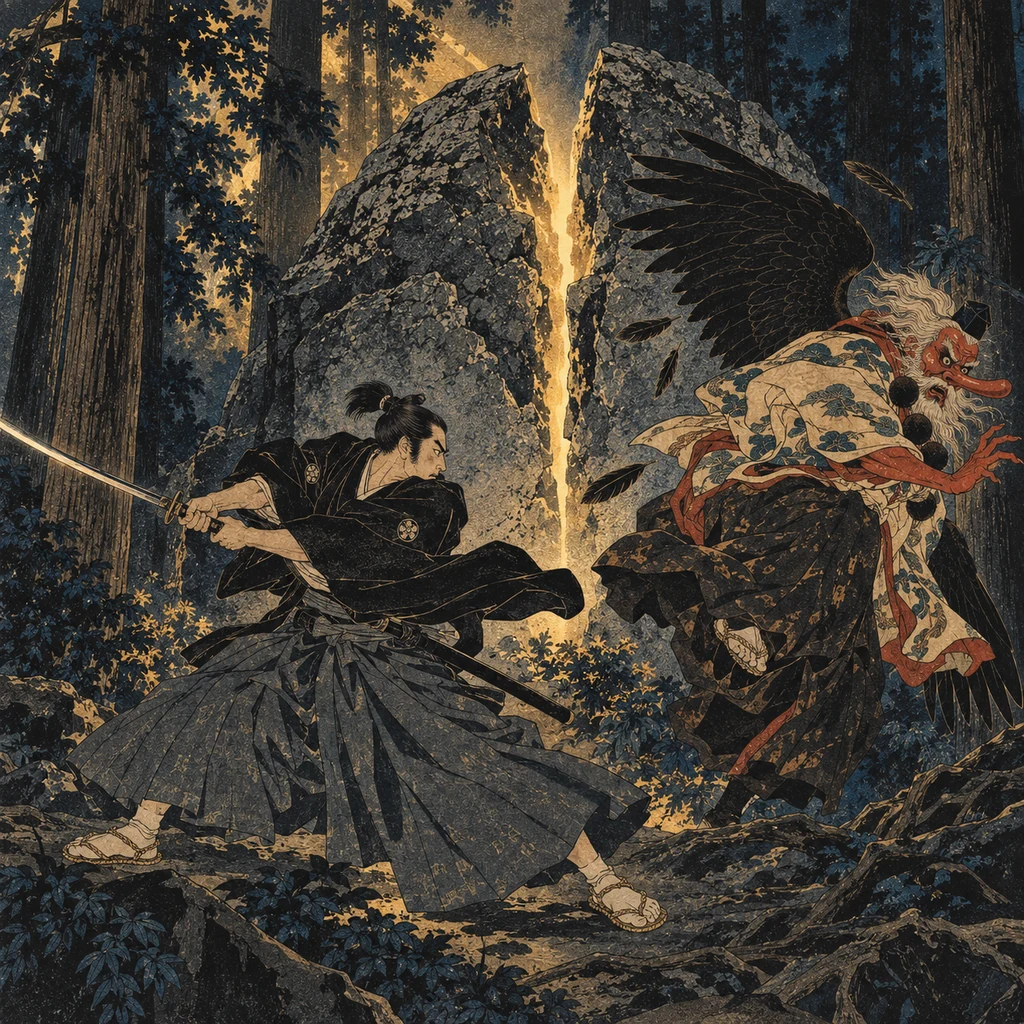
An artist’s impression of the legend, not a photograph of the rock. Nara City tells it this way: Yagyu Muneyoshi cut at a tengu, and found he had cut the mountain.
The Rock Everyone Is Looking For
In the hills east of Nara, about seven hundred metres up a forest path from a small temple, there is a granite boulder roughly seven metres across that has been split cleanly down the middle. It is called Itto-seki — the one-stroke stone. It sits in a valley called Toiwadani, behind a shrine named Ama-no-Iwatate, and on most weekends since 2020 there has been a queue of people waiting to photograph themselves standing in the gap with a sword raised.
They are there because of a page in a comic book. But the story attached to the rock is four centuries older than that, and almost every English-language article about Itto-seki gets it slightly wrong.
The version told by Nara City and by the Nara City Tourism Association is this. Yagyu Muneyoshi — better known as Sekishusai, founder of the Yagyu Shinkage school of swordsmanship, one of the oldest surviving schools in Japan — was training in these hills. During that training he fought a tengu, one of the long-nosed mountain spirits that Japanese tradition has always associated with superhuman swordsmanship. He cut it down with a single stroke. And when he looked, the tengu was gone and the boulder behind it lay in two pieces.
That is the legend: not a man training by cutting a rock, but a man cutting at a spirit and finding he had cut the mountain instead. The distinction matters, because the version that circulates in English — swordsman trains by splitting boulder — happens to be precisely the plot of the manga. The real legend is stranger, older, and has a tengu in it. If you want the background on why a mountain spirit is the one teaching swordsmanship in the first place, we have written about tengu and the martial arts at length.
So we have a rock with a legend, and a manga with a scene, and they resemble each other. The interesting question is not which came first — the legend is obviously older — but what happens to an old legend when a much louder new story arrives and lands on top of it. As of 2026, that question has an answer, and the answer has been published in a peer-reviewed journal.
Why This Scene, and Not the Others
The scene itself occupies the last page of Episode 5, in the first collected volume of Demon Slayer, published in 2016. Tanjiro has spent six months in training for the Final Selection, and the last task set for him is to cut a boulder in half with a sword. On that final page, he does it.
Tsuyoshi Ito, a geologist at the Geological Survey of Japan within the National Institute of Advanced Industrial Science and Technology, took the trouble to describe the drawing with a specialist’s precision. Measured against Tanjiro’s height on the page, the boulder is close to spherical and approximately two metres in diameter. It is drawn whitish. The rock type is unclear.
That level of care matters, because Ito’s next observation is the one that explains everything else: this is not a rare scene in Japanese comics. He lists four others. Goku shifts a boulder as part of his training in Dragon Ball. Dai cuts one in Dragon Quest: The Adventure of Dai. Sagara Sanosuke shatters one with a newly mastered technique in Rurouni Kenshin. Roronoa Zoro cuts one in One Piece. Moving or breaking a rock that no ordinary person could move or break is simply how Japanese comics have always shown that a character has crossed a threshold.
So why did this particular boulder send people up a mountain path in Nara? Two reasons, and neither is about the rock.
The first is scale. Demon Slayer was animated in 2019 and the film followed in 2020, taking 40.32 billion yen at the Japanese box office and becoming the highest-grossing film in the country’s history. A survey conducted in November 2020 put general awareness of the series at 81 percent of the Japanese public, rising above 90 percent among men aged fifteen to twenty-nine. A scene does not need to be unusual to become a landmark. It needs to be seen by everyone.
The second is placement. The split rock is not a panel in the middle of a chapter. It is the closing image of an episode, given a full page. Ito argues that this emphasis is part of why the image lodged where the others did not.
And then there is the timing, which is the part of the story that has nothing to do with anime at all. The boom arrived during the COVID-19 pandemic, in a country already dealing with a declining birthrate and depopulating rural towns, at the exact moment the tourism industry was in crisis. Local governments were looking for anything at all that might bring people back. A famous scene that could be recreated for free, using a rock the town already had, was an unusually good answer.
The Ten Split Rocks of Japan
Ito’s method was deliberately narrow. He searched news media on the web for the Japanese words for Demon Slayer together with rock or stone, and collected what he found. Sixteen articles, from the Sankei, the Asahi, the Mainichi, the Chunichi, the Shinano Mainichi, the Kobe Shimbun, the Yomiuri, a local paper in Kanagawa and a broadcaster in Kochi. Personal and corporate blogs and social media posts were excluded on purpose, for what he calls referentiality — a blog can vanish, and a newspaper can be cited. He is explicit that the resulting list is not exhaustive, and that a wider survey including social media remains to be done.
Those sixteen articles describe ten rocks, and Ito sorts them into three kinds.
| Rock | Locality | Type | Stone | Who split it, by tradition |
|---|---|---|---|---|
| Itto-seki 一刀石 | Nara City, Nara | Named | Granite (Yagyu Granite) | Yagyu Muneyoshi, with a sword |
| Ryu no Wareishi 竜の割石 | Suzaka City, Nagano | Named | Neogene intrusive rock | A natural fall, some seventy years ago |
| Taikoishi 太閤石 | Karatsu City, Saga | Named | Basalt (Kitamatsuura Basalts) | Toyotomi Hideyoshi, by sheer spirit |
| Wareishi 破石 | Ise City, Mie | Named | Sanbagawa crystalline schist | Unknown |
| Meotoiwa 夫婦岩 | Tambasasayama City, Hyogo | Named | Andesite (Hiraki Welded Tuff) | Unknown |
| Benkei no Wareishi 弁慶の割石 | Ashikaga City, Tochigi | Named | Biotite granodiorite | Benkei, by strength |
| Unnamed — | Kyotango City, Kyoto | Unnamed | — | Unknown |
| Unnamed — | Mizunami City, Gifu | Unnamed | — | Unknown |
| Honkomatsu stone 本小松石 | Manazuru Town, Kanagawa | Artificially placed | Dacite and rhyolite | A local stonemason, in 2021 |
| Oshima stone 大島石 | Nankoku City, Kochi | Artificially placed | Granite | A local stonemason, in 2021 |
The named rocks already had stories. Itto-seki had its tengu. Benkei no Wareishi in Ashikaga was attributed to the warrior monk Benkei. Taikoishi, at Tajima Shrine in the fishing port of Yobuko in Karatsu, is credited to Toyotomi Hideyoshi, who according to the legend thrust his spear at the rock while praying for victory and split it with the force of his spirit. Two of the named rocks — Wareishi in Ise and Meotoiwa in Tambasasayama — have names but no recorded origin at all. Nobody knows who is supposed to have split them, or whether anyone was ever supposed to have.
The unnamed rocks are exactly that: a split rock at Kamitani Shrine in Kyotango, and another in Oniiwa Park in Mizunami. No names, no origins, no legends. They were simply large rocks that had cracked, standing in places that had more or less stopped noticing them, until 2020 gave everyone a reason to look again.
The artificially placed rocks are the ones that make the pattern impossible to miss. In Manazuru in Kanagawa, a local stonemason took a block of Honkomatsu stone — the dacite and rhyolite the town has quarried for generations — and set it up, split, as a recreation of the scene. In Nankoku in Kochi, another stonemason did the same with Oshima granite from neighbouring Ehime, and children queued up to be photographed cutting it. Nobody is pretending these are ancient. They were made in 2021, by craftsmen, for their towns.
Ito notes, drily, that no relationship has been recognised between the type of rock and the type of story. Granite, basalt, schist, andesite, granodiorite. The geology has nothing to do with it. What the rocks have in common is that they are broken, and that people find broken rocks worth explaining.
The Day Benkei Lost His Rock
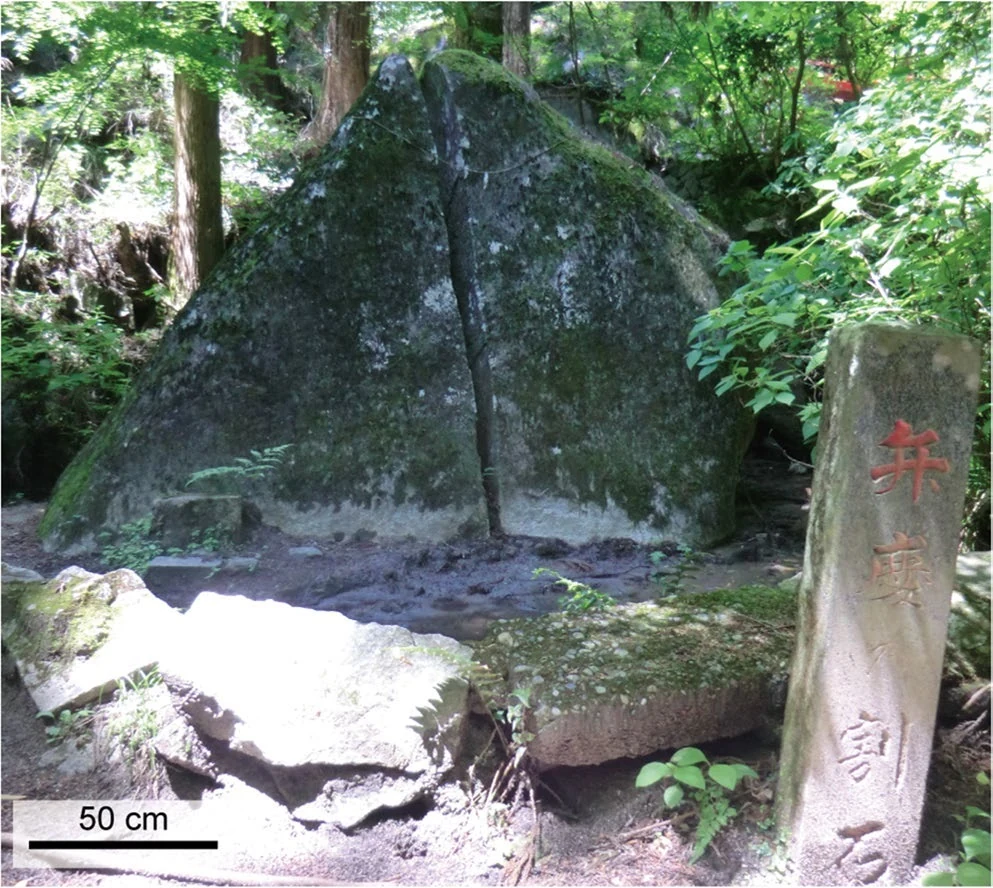
In Ashikaga, in Tochigi Prefecture, there is a cluster of enormous boulders called the Nagusa Megaliths, designated a national natural monument. They lie deep in the grounds of Itsukushima Shrine, in a hollow called Bentenzawa, and they are granite showing the onion-skin weathering the city’s cultural properties division considers academically notable. One of the boulders is split, and it is named for Benkei — the warrior monk who served Minamoto no Yoshitsune in the late twelfth century and who is remembered, above all, for being strong.
The name is not quite fixed, which turns out to be part of the story. Ashikaga City’s own cultural properties page calls it Benkei no Tewari-ishi, Benkei’s hand-split stone. The research literature and the newspapers both call it Benkei no Wareishi, Benkei’s split stone. We use the second here because that is the form under which it has entered the wider record — while noting that the city, which has looked after the site longest, uses the first.
Ashikaga is the case that makes Ito’s argument, and it does so because of what the town did not do.
Everywhere else, the local government leaned in. Nara City made a promotional video recreating the scene with a locally born actor, and the tourist association set aside a space where cosplayers could change. Suzaka used its rock in city publicity. Ise and Tambasasayama did the same with rocks whose origins nobody knew. In Ashikaga, according to Ito, the local government and other organisations were rarely supportive of attaching the new story to Benkei’s rock at all.
It happened anyway, and it happened through the press. In October 2024, thieves stripped the copper sheeting from the roof of the shrine standing on the same ground as the split rock — more than sixteen hundred sheets, valued at around 650,000 yen. Both the Yomiuri and the Asahi covered the theft. Both of them, in the headline, identified the location not as the Nagusa Megaliths, not as Nagusa Itsukushima Shrine, and not as Benkei’s rock, but as a Demon Slayer holy site.
Ito’s reading of this is the sharpest sentence in the paper: it seems that the priority was to attract the attention of the press rather than the wishes of the local government.
This is what he means by overwriting — creating a new legend where an old one already exists. Not a town choosing to rebrand its rock. A national newspaper, reporting a crime, reaching for the identifier its readers would recognise, and in the process telling several million people that a boulder associated with a twelfth-century warrior monk is a landmark from a comic published in 2016. Benkei did not lose an argument. He was simply not the most useful thing to call the place any more.
Benkei Never Split It Either
And here the story doubles back on itself in a way that is genuinely difficult to think about clearly.
Benkei was, as far as we can tell, a real person. But as Ito points out, citing the scholarship on the subject, very few documents from his own period record the deeds attributed to him, and most of the anecdotes known today are believed to have been invented by later generations. The image of Benkei — the immovable giant, the loyal retainer, the man who could break things nobody else could break — is substantially a construction of the centuries that followed him.
Which means that the legend being overwritten in Ashikaga was not an ancient truth displaced by a modern fiction. It was an older invention being displaced by a newer one. At some point, somebody looked at a split boulder in the Nagusa hills, reached for the strongest man they could name, and attached him to it. That is the identical move that a newspaper sub-editor made in October 2024. The only differences are the speed and the medium.
Ito draws one distinction, and it is worth keeping. Past legends could be believed. Demon Slayer is unambiguously a creation, it is documented as such across every kind of media, and neither the scene nor the characters are likely to be taken for real even far in the future. Benkei was a real person whose legends were invented; Tanjiro is an invented person whose legend is being attached to real places. Whether that difference will still be legible in three hundred years is not a question anyone can answer.
His own formulation is careful, and we will not improve on it: we may be witnessing the birth of a new folklore.
The Town That Leaned In
If Ashikaga shows overwriting happening to a town, Suzaka in Nagano shows a town doing it to itself, cheerfully and in public.
The rock is called Ryu no Wareishi, the dragon’s split stone, and it sits in a community woodland on Mount Sakata. Unlike almost every other rock in this article, its origin is not mysterious in the slightest. Ito states it plainly: the rock rolled down a mountain slope more than seventy years ago, and the impact of the fall cracked it. There is no legend. There is a hillside and gravity.
That did not slow anything down. In November 2020, the Shinshu Suzaka Tourist Association wrote on its own blog that fans had started arriving to take commemorative photographs because the rock “closely resembles the rock in the famous scene from the popular anime Demon Slayer” — the tourist association itself making the connection, in public, in writing. The city’s newsletter for January 2021 ran a feature on the site under a headline borrowing the series’ own vocabulary of total concentration and dragon breathing. The Mainichi covered it. The Chunichi covered families making a day of it. And a local wagashi craftsman designed and sold a Japanese sweet shaped like the split rock, which the Shinano Mainichi thought worth an article of its own.
There is a temptation to be sniffy about this, and it should be resisted. A town with a declining population, in the middle of a pandemic, found that it owned something people suddenly wanted to see, and it responded by making a confectionery about it. Every legend that anybody now considers authentic began with a community deciding that a particular feature of its landscape was worth telling a story about. Very few of them were more solemn at the outset than this.
Is This Real Folklore?
The framework Ito is working in is called geomythology, a field proposed in 1968 and concerned with the stories that pre-scientific cultures told to explain geological features — volcanoes, earthquakes, fossils, and strange rocks. The classic example is Devils Tower in Wyoming, geologically the eroded remnant of a larger body, and in the accounts of Native peoples living nearby a formation raised by a god to save humans from a giant bear, its columnar jointing read as claw marks.
A split rock invites the same move. A boulder broken cleanly in half does not look like something that happened on its own, so people supply an agent: a swordsman, a warrior monk, a warlord’s spirit. Ito calls this a kind of folk explanation of a notable geological feature, and the point of his paper is that the process did not stop when geology was invented. It is running right now, in the present tense, with sources we can cite and dates we can check.
That is the honest answer to the question in this section’s heading. “Is this real folklore” assumes that real folklore is a category of thing that was completed in the past, and that what happens now is a lesser imitation. But nothing in the historical record supports that. Legends have always attached themselves to landscapes through whatever medium was loudest — a travelling storyteller, a temple’s founding narrative, a popular play, a woodblock print series. Newspapers and a hit anime are doing what those did.
What is genuinely new is the documentation. Nobody recorded the decade in which a rock in Ashikaga became Benkei’s. For the rocks in this article we have the dates, the publications, the headlines, the tourist association’s own blog post, the city newsletter, and the name of the confectioner. For the first time, the birth of a folk tradition is fully sourced while it is still happening.
For more of where modern storytelling meets actual Japanese tradition, see our guide to the real folklore behind Demon Slayer, and our account of the real all-night kagura behind the Hinokami dance, which runs into the same problem from the opposite direction — a case where fans are certain there is a source, and no official source has ever been named.
Visiting Without Breaking Anything
Itto-seki, Nara. The address is 789 Yagyu-cho, Nara City. From JR or Kintetsu Nara Station, take a bus bound for Yagyu, get off at the Yagyu stop, and walk about twenty-five minutes. There is no parking at the site; the nearest is the paid Yagyu tourist car park, a fifteen-minute walk away. The rock stands behind Ama-no-Iwatate Shrine, about seven hundred metres from Hotokuji temple, in the Toiwadani valley. It is a forest path, not a promenade. The shrine is a shrine.
Everywhere else. Several of these rocks sit on shrine land — Kamitani Shrine in Kyotango, Tajima Shrine in Yobuko, Nagusa Itsukushima Shrine in Ashikaga. The Nagusa Megaliths are a designated national natural monument, which carries legal protection. Ryu no Wareishi is in a community woodland reached by a ten-minute walk from a small car park. None of these places has the infrastructure of a managed tourist attraction, and most were not expecting visitors at all until about five years ago.
The conduct that actually matters. Do not climb on the rocks or wedge anything into the splits. Do not move stones, leave offerings where none are invited, or mark anything. If there is a collection box, use it. If you have brought a prop sword for photographs, be aware of where you are swinging it and who is behind you, and put it away inside shrine buildings. And remember Ashikaga: the shrine there lost its roof to thieves two years ago, and the residents read a national newspaper describe their sacred grove as a location from a cartoon. Visitors who behave well are the best argument that the attention was worth having.
Frequently Asked Questions
Is the rock Tanjiro cuts in Demon Slayer based on a real place?
No source says so. Neither Gotouge Koyoharu, nor Shueisha, nor Aniplex, nor ufotable has ever identified a real rock as the model for the boulder Tanjiro splits at the end of Episode 5. What can be described precisely is the drawing itself: judged against Tanjiro’s height on the page, the rock is close to spherical and roughly two metres across, and it is drawn whitish, with no indication of what kind of stone it is meant to be. Every real split rock now treated as a Demon Slayer site acquired that status after 2016, through news coverage and local promotion, not through any statement by the people who made the series. This matters, because the direction of the relationship is the whole story: the manga did not come from these rocks. The rocks came to the manga.
Which split rock is the “real” one?
There isn’t one, and the question itself is a product of the phenomenon this article describes. A 2026 study in the journal Geoheritage identified ten split rocks across Japan that news media have linked to Demon Slayer, in localities from Kanagawa to Saga. Six of them have names and pre-existing legends of their own; two are simply large split rocks with no recorded name or origin; and two were deliberately placed by local stonemasons in 2021 to recreate the scene. Itto-seki in Nara is the most visited and the most heavily promoted — Nara City produced a PR video for it, and the local tourist association set aside a place for cosplayers to change — but that reflects the energy of the promotion, not a claim to authenticity. The author of the study also notes that his list is not exhaustive: he restricted it to newspaper and broadcast reporting, deliberately excluding personal blogs and social media, so other rocks are certainly being associated with the series in places the study did not count.
Is it disrespectful to visit these rocks as an anime fan?
Not in itself — several of these towns actively invited it, and in Suzaka a local confectioner went so far as to create a sweet shaped like the rock. But the sites are not theme parks. Most of them stand on shrine land or in forest managed by a community, and some are working places of worship where the rock is an object of veneration rather than a photo opportunity. Ashikaga is the cautionary case. In October 2024, more than sixteen hundred copper sheets were stripped from the roof of the shrine that stands on the same grounds as Benkei’s split rock, and the newspapers covering the theft led with the words “Demon Slayer holy site.” The attention that a place receives is not always the attention it asked for. Go, look, photograph the rock, and leave the shrine as you found it.
Conclusion
Ten rocks. Sixteen news articles. Two of the rocks placed by stonemasons in 2021 and nobody pretending otherwise; two with no name at all; one that fell down a hill seventy years ago and now has a cake shaped like it; and one, in a protected grove in Tochigi, that belonged to Benkei until a theft report decided it belonged to someone else.
None of this was planned, and none of it is fake. It is simply what the formation of folklore looks like when you are close enough to see the machinery: a striking landscape feature, a story loud enough to reach everyone at once, a community with a reason to want visitors, and the press reaching for whichever name will be recognised. The only unusual thing about the split rocks of Japan is that a geologist happened to be standing there with a notebook while it happened.
We intend to keep watching this one. Ito’s survey deliberately left out social media, and he says plainly that a broader study is still to be done — which means there are almost certainly split rocks acquiring new legends right now that no newspaper has reached yet. When they do, we will add them here.
For related reading, see our guide to the tengu shrines of Japan, or browse the full Pop Culture archive.
This is The Yokai Files.
Sources
Every factual claim in this article comes from one of the following. Where sources disagree, we have said so in the text rather than picking silently.
- Ito, T. (2026) “The Birth of a New Folklore from a Japanese Manga (Demon Slayer: Kimetsu no Yaiba): Legends of Split Rocks in Japan.” Geoheritage 18:69. Open access under CC BY 4.0. The source for the ten rocks, the three-part classification, the geology of each site, the reading of the Ashikaga case, and the discussion of Benkei’s legend. doi.org/10.1007/s12371-026-01299-2
- Nara City, official tourism page for Itto-seki (Japanese). The source for the address, access, the seven-metre dimension, and the wording of the tengu legend. city.nara.lg.jp/sightseeing/naraharu/111494.html
- Nara City Tourism Association, Itto-seki (Japanese and English). The source for the distance from Hotokuji, the Toiwadani valley, and the identification of Sekishusai as Yagyu Muneyoshi. narashikanko.or.jp/spot/detail_10118.html
- Shinshu Suzaka Tourist Association, official blog, 22 November 2020 (Japanese). The source for the tourist association’s own comparison to the anime, the name Ryu no Wareishi, and the access details. blog.suzaka.jp/kanko/2020/11/22/p38322
- Suzaka City newsletter, January 2021 issue (Japanese, PDF). The source for the city’s own feature on the site. city.suzaka.nagano.jp/material/files/group/3/shiho2101.pdf
- Ashikaga City, cultural properties pages for the Nagusa Megaliths (Japanese). The source for the setting within the grounds of Itsukushima Shrine, the onion-skin weathering, and the city’s own name for the rock, Benkei no Tewari-ishi. city.ashikaga.tochigi.jp/education/000029/000169/000627/p001270.html
- Newspaper reporting compiled in Table 1 of Ito (2026): Sankei Shimbun, Asahi Shimbun, Mainichi Shimbun, Chunichi Shimbun, Shinano Mainichi Shimbun, Kobe Shimbun Next, Yomiuri Shimbun, Town News and Kochi Sun Sun Broadcasting, published between February 2020 and October 2024.
A note on one small divergence. Ito’s summary of the Itto-seki legend states simply that Yagyu Muneyoshi split the rock with a sword, and does not mention the tengu. Nara City and the Nara City Tourism Association both give the fuller version, in Japanese and in English, in which he cut at a tengu and found he had cut the rock. We have followed the city’s wording.
Neither the author of Demon Slayer nor Shueisha, Aniplex or ufotable has ever identified any real location as the model for the split rock. No claim to the contrary is made anywhere in this article.
Support The Yokai Files
Enjoyed this deep dive into Japanese folklore?
The Yokai Files is reader-supported. Your support helps us research deeper, write more, and keep the darkness alive.