Jujutsu Kaisen and Japanese Curse Lore
Published: March 27, 2026
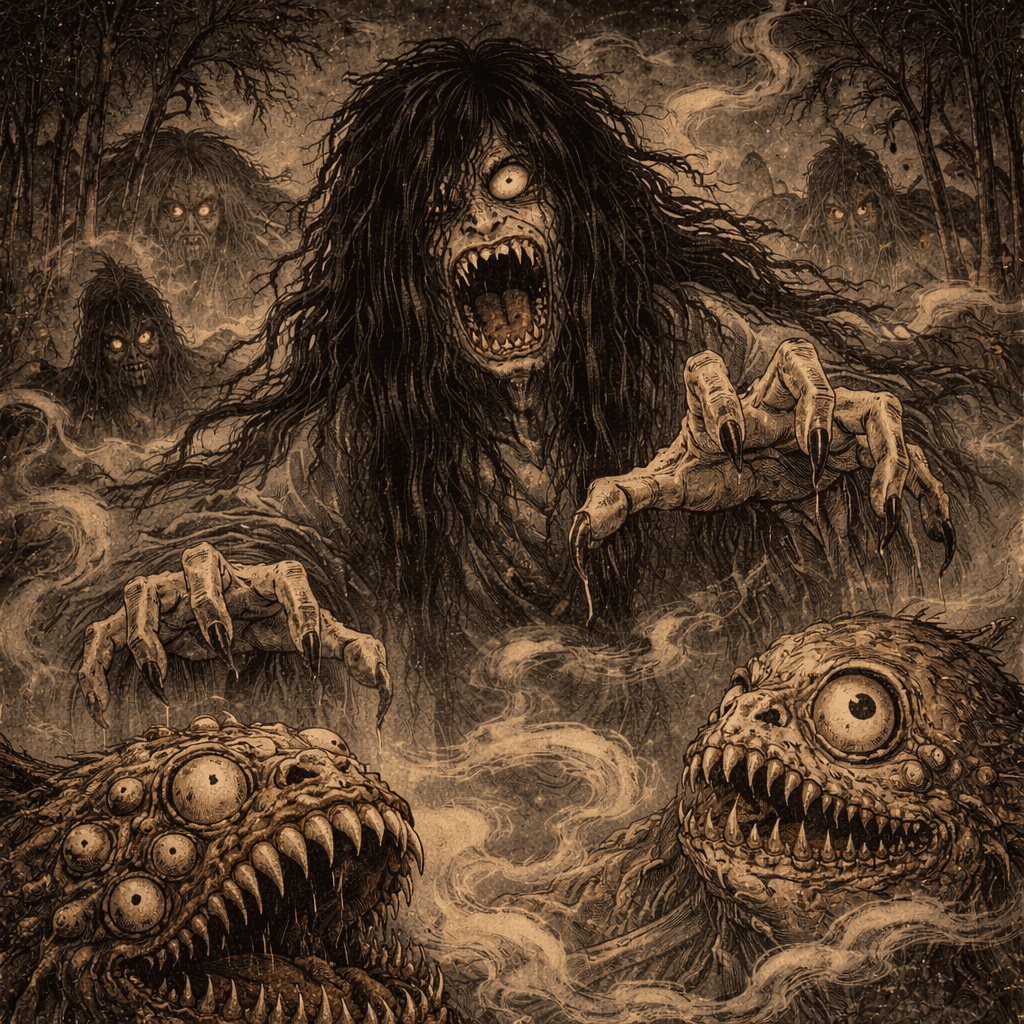
Somewhere beneath the crowded intersections of Shibuya, in the fiction of Gege Akutami and in the spiritual memory of Japan itself, something old and terrible is stirring. It has no body of its own. It was born from the accumulated dread of ten million commuters who fear the train platform at rush hour, from the grief of a mother who lost her child, from the rage of a worker who was broken by the system and discarded. It feeds on what humans refuse to face. It grows in the dark places where fear ferments into something solid, something hungry. In Jujutsu Kaisen, these entities are called cursed spirits, and they are as real to Japanese spiritual tradition as the shrines that still stand on every city block.
Jujutsu Kaisen is not merely a battle manga dressed in supernatural clothes. It is, at its foundation, a modern retelling of one of Japan's oldest and most persistent spiritual beliefs: that human suffering does not simply disappear. It accumulates. It thickens. It takes shape. And when enough of it gathers in one place, it becomes something that can look back at you. The curses of Jujutsu Kaisen are the inheritors of a tradition that stretches from Heian-period onmyodo courts through Edo-period ghost stories to the modern unease of a society that has buried its anxieties beneath concrete and fluorescent light. To understand why this series resonates so profoundly, one must first understand the Japan that exists beneath the pavement.
The connections between Jujutsu Kaisen and Japanese folklore presented in this article are based on historical research, official series lore, and widely-discussed fan analysis. Fan theories are clearly labeled as such throughout.
What Are Cursed Spirits in Japanese Folklore?
The Japanese word for curse is noroi, written with the character 呪い, and it occupies a position in Japanese spiritual thought that has no precise Western equivalent. A curse in the Japanese tradition is not merely a spoken malediction or a witch's hex. It is a force, a weight, a spiritual residue that adheres to people, places, and objects when the proper rituals of life and death have been violated. Curses in Japan are born from disrupted relationships: between the living and the dead, between humans and the kami, between a person and the community that has wronged them. They are the spiritual consequence of unresolved injustice.
The oldest documented Japanese curses appear in the Kojiki and Nihon Shoki, the twin chronicles of Japanese mythology compiled in the eighth century. When the goddess Izanami died giving birth to the fire god and descended to Yomi, the land of the dead, her husband Izanagi pursued her and broke the taboo of looking at her decaying form. In her rage and humiliation, Izanami cursed the living world, vowing to kill one thousand people every day. Izanagi countered by promising to build one thousand five hundred birthing huts. This primordial exchange established the template for Japanese curses: they arise from broken bonds, they are fueled by shame and rage, and they strike at life itself.
By the Heian period, the court of Kyoto had formalized curse management into a bureaucratic system. Onmyoji, practitioners of onmyodo or the Way of Yin and Yang, served the imperial household as curse specialists. The most famous of these, Abe no Seimei, became a figure of legend who could detect curses, identify the spirits responsible, and perform counter-rituals to neutralize them. The Heian aristocracy lived in genuine terror of curses. Political rivals hired onmyoji to curse each other. Jealous lovers sent vengeful spirits to torment their rivals. The Tale of Genji, often called the world's first novel, includes a pivotal scene in which the spirit of Lady Rokujo, consumed by jealousy, unconsciously leaves her body to curse and kill her rival. This was not fiction to Heian readers. It was a recognized spiritual phenomenon called ikiryou, the living ghost, and it was understood as the most dangerous form of curse because the sender did not even know she was sending it.
In Shinto theology, emotions and intentions carry spiritual weight. The concept of kegare, or spiritual pollution, holds that death, blood, disease, and moral transgression produce a tangible contamination that adheres to people and places. This contamination must be purified through ritual, typically involving water, salt, fire, or priestly incantation. If kegare is not cleansed, it accumulates and attracts further misfortune. Buddhism contributed its own layer to this understanding through the doctrine of the Six Realms, which teaches that beings are reborn into different planes of existence based on the dominant emotion of their final moments. Those consumed by rage are reborn in the Asura realm. Those consumed by desire become hungry ghosts. The emotional state at the moment of death physically determines what the deceased becomes.
Jujutsu Kaisen inherits this entire tradition. Its cursed energy is the modern name for the spiritual force that Japanese culture has recognized for more than a millennium. The series' central premise, that negative human emotions generate cursed energy that coalesces into malevolent entities, is not Akutami's invention. It is the logical extension of a belief system in which grief, rage, jealousy, and fear have always been understood as spiritually generative forces. The yurei of Japanese ghost lore, the vengeful dead who return because their emotions will not let them rest, are the direct ancestors of every cursed spirit in the series.
Ryomen Sukuna: From Ancient History to Anime
The King of Curses in Jujutsu Kaisen, Ryomen Sukuna, is not a fictional creation. He is drawn from one of the most enigmatic figures in early Japanese history. The Nihon Shoki, compiled in 720 CE, records that during the reign of Emperor Nintoku in the fifth century, a monstrous figure appeared in Hida Province, modern-day Gifu Prefecture. The chronicle describes this figure with striking specificity: he possessed two faces, one on the front and one on the back of his head. He had four arms and four legs but no knees, and two sets of eyes. Despite this anatomy, he moved with great speed. He defied the imperial court, terrorized the local population, and was ultimately subdued by a military commander named Takenouchi no Sukune dispatched from the capital.
The Nihon Shoki's description is remarkable because it reads less like myth and more like a military report. The chronicle does not call Sukuna a god or a demon. It calls him a person, albeit one with an extraordinary body. Some modern historians have proposed that the historical Sukuna may have been a set of conjoined twins whose unusual physical form was interpreted through the lens of the supernatural. Others suggest he was a powerful local chieftain whose resistance to imperial centralization was mythologized into monstrosity by court chroniclers who needed to justify military conquest of the Hida region.
But the Nihon Shoki's account is only one version of the story, and it is the version told by the victors. In the mountain communities of Hida, a completely different Sukuna was remembered. Local shrines venerate Ryomen Sukuna as a culture hero who cleared forests, built temples, fought off invaders, and brought Buddhist teachings to the remote mountain villages. Temples in the region, including Senkoji in Takayama, claim Sukuna as their founder. At Zuiryu-ji in nearby Takayama, a wooden statue depicts Sukuna with his two faces and four arms in a posture of Buddhist meditation, not menace. In this folk tradition, Sukuna was not a demon at all. He was a powerful local leader whose independence threatened the centralizing imperial court, which then demonized him in the official chronicle.
Gege Akutami's Sukuna draws primarily from the demonic reading but preserves the ambiguity. The Sukuna of Jujutsu Kaisen is undeniably monstrous, a being of overwhelming power who views humanity with contempt and regards other sorcerers as insects. Yet he possesses a strange code, an aesthetic appreciation for strength, a willingness to honor worthy opponents, and a complexity that prevents him from being a simple villain. This duality mirrors the historical split between the Nihon Shoki's monster and Hida's protector.
The detail of Sukuna's fingers as vessels of power also connects to Japanese spiritual tradition. In esoteric Buddhism, mudra, the ritual hand gestures performed during meditation and ceremony, channel spiritual energy through the fingers. Each finger position corresponds to a different cosmic force or deity. The idea that a being's spiritual power could be concentrated in, and distributed through, individual fingers would not have surprised a Heian-period monk. It is the logic of mudra taken to its darkest extreme: instead of channeling enlightenment, Sukuna's fingers channel destruction, and consuming one is not an act of devotion but an act of possession.
The Three Great Onryo: Japan's Most Powerful Vengeful Spirits
To understand the curse system of Jujutsu Kaisen at its deepest level, one must understand the Three Great Onryo of Japanese history: Sugawara no Michizane, Emperor Sutoku, and Taira no Masakado. These are not mythological figures. They are historical persons whose deaths were so unjust and whose posthumous rage was so terrifying that the Japanese state itself was forced to build shrines to appease them. They represent the most extreme expression of the belief that Jujutsu Kaisen dramatizes: that human suffering, when sufficiently intense and sufficiently wronged, does not merely linger. It strikes back.
Sugawara no Michizane was a brilliant scholar and statesman of the ninth century who rose to the rank of Minister of the Right before being falsely accused of treason by the rival Fujiwara clan and exiled to Dazaifu in Kyushu, where he died in despair in 903 CE. Within years of his death, Kyoto was struck by a series of catastrophes: lightning killed members of the Fujiwara family, plague swept the capital, the crown prince died, and the imperial palace itself was struck by thunderbolts. The court concluded that Michizane's spirit had become a vengeful onryo of unprecedented power. To appease him, they posthumously restored his rank, pardoned him of all charges, and enshrined him as Tenjin, the god of learning, at Kitano Tenmangu Shrine. This transformed one of Japan's most terrifying curses into one of its most beloved deities. In the world of Jujutsu Kaisen, Okkotsu Yuta's ancestry is linked to Sugawara no Michizane, and the series establishes Gojo Satoru as a descendant of the same lineage. This is not a throwaway detail. It connects the series' two most powerful sorcerers to the historical figure whose posthumous curse was so devastating that it reshaped Japanese religious practice.
Emperor Sutoku, forced to abdicate in 1142 and later exiled to Sanuki Province after a failed rebellion, is said to have bitten off his own tongue and written a curse in his blood, vowing to become the great demon king of Japan and drag the country into chaos for eternity. His death in exile in 1164 was followed by civil wars, plagues, and the fall of the Heian court system. He was enshrined at Shiramine Shrine in an attempt to pacify his wrath. To this day, new emperors send messengers to his shrine.
Taira no Masakado, a tenth-century warrior who declared himself the New Emperor and established a rival court in the Kanto region, was killed in battle in 940 CE. His severed head was brought to Kyoto for display, but legend holds that it flew back to the east, landing in what is now central Tokyo. His head mound in Otemachi, surrounded by modern skyscrapers, remains one of the most feared spiritual sites in Japan. Attempts to develop the land have been met with such consistent misfortune, including deaths and financial ruin, that major corporations simply leave the site untouched.
These three figures embody the principle that drives Jujutsu Kaisen's entire world: that the most powerful spiritual forces are born not from abstract evil but from specific, historical human injustice. Every cursed spirit in the series is, at some level, a descendant of the same process that turned Michizane into Tenjin and Sutoku into the Demon King. The mythology archive provides deeper context for the Shinto and Buddhist frameworks that make these transformations intelligible.
Fushiguro's Ten Shadows Technique and the Ten Sacred Treasures
Fushiguro Megumi's Ten Shadows Technique, which allows him to summon ten shikigami from shadows using hand signs, carries echoes of one of the most important ritual objects in Japanese religious history: the Tokusa no Kandakara, or Ten Sacred Treasures, described in the Sendai Kuji Hongi, also known as the Kujiki. This text, compiled in the early ninth century and attributed to legendary figures including Prince Shotoku, describes ten treasures bestowed by the deity Nigihayahi no Mikoto, each with specific spiritual powers including the ability to revive the dead, ward off evil, and control the forces of nature.
The Ten Sacred Treasures comprise two types of mirrors (Okitsu Kagami and Hetsu Kagami), two types of swords (Futsu no Mitama no Tsurugi and the shorter blade), four types of jewels (beads of life, beads of return, beads of plenty, and beads of road-turning), and two additional items (a garment and a scarf with protective properties). The Futsu no Mitama no Tsurugi, or the Sword of Subduing Spirits, is particularly relevant: it was a ritual blade used in purification ceremonies and was believed to have the power to cut spiritual corruption and exorcise evil. This sword is enshrined at Isonokami Shrine in Nara, one of the oldest Shinto shrines in Japan.
Fushiguro's technique mirrors this tradition in several ways. His ten shikigami each possess distinct abilities, echoing the specialized powers of the individual treasures. His use of shadow as a medium recalls the Japanese understanding that boundaries between light and dark are also boundaries between the physical and spiritual worlds. And his ultimate shikigami, Mahoraga, the Divine General, carries resonances with the concept of Daiitoku Myoo, one of the Five Wisdom Kings of esoteric Buddhism, a wrathful deity who was invoked to destroy evil and who was depicted riding a bull, just as Mahoraga wields a sword that adapts to any phenomenon.
The hand signs that Fushiguro uses to summon his shikigami also connect to the kuji-in, the nine ritual hand signs used in Shugendo and esoteric Buddhist practice. These signs, each a specific configuration of interlocked fingers, were believed to channel different aspects of spiritual power. Ninja folklore adopted the kuji-in as the basis of ninjutsu hand signs, and Jujutsu Kaisen continues this tradition by depicting hand signs as the physical mechanism through which sorcerers shape and direct cursed energy. The Sendai Kuji Hongi's description of the ten treasures includes instructions for shaking or waving them in a specific sequence to activate their power, a ritual action that parallels the sequential hand movements Fushiguro performs.
Cursed Spirits vs. Yokai: What's the Difference?
While Jujutsu Kaisen focuses almost exclusively on malevolent cursed spirits, traditional Japanese folklore encompasses a far richer and more ambiguous supernatural world. The yokai of classical Japan were not universally evil. Many were mischievous, some were protective, and others were simply strange. The oni could be terrifying demons or protective guardians depending on the shrine. The kitsune could be a divine messenger of Inari or a malicious trickster. The tanuki was a shape-shifting con artist who was also, somehow, lovable. The full breadth of the yokai tradition can be explored in our complete yokai archive.
Jujutsu Kaisen narrows this tradition to its darkest vein. By focusing exclusively on entities born from negative emotions, the series strips away the playfulness, the humor, and the ecological wonder that characterize much of yokai folklore and concentrates on the thread of pure malevolence that runs through onryo legends, tatari-gami curses, and the darkest corners of Buddhist hell-scroll imagery. This is a deliberate creative choice, and it gives the series its distinctive tonal weight. But it also means that Jujutsu Kaisen represents only one facet of a tradition that is, in its totality, far more varied and surprising than the manga suggests.
The special grade cursed spirits in particular, entities like Jogo, Hanami, Dagon, and Mahito, represent elemental fears (fire, forests, oceans, humanity itself) that in traditional folklore would more often be associated with kami, the divine spirits of Shinto. Mountains, rivers, forests, and oceans all have their kami in Shinto belief, and these kami are not inherently malevolent. They become dangerous only when disrespected or neglected. Jujutsu Kaisen inverts this by presenting these elemental forces as inherently cursed, born from human fear rather than divine presence. It is a modern, arguably pessimistic rereading of the old Shinto worldview, one that sees humanity's relationship with nature as fundamentally broken rather than fundamentally sacred.
Buddhist Influences: Domain Expansion and Sacred Geometry
Domain Expansion, the pinnacle technique in which a sorcerer manifests their inner world as a physical space where their abilities are absolute, is one of the most inventive concepts in Jujutsu Kaisen, and it is deeply rooted in Buddhist cosmology. In esoteric Buddhism, a mandala is a diagrammatic representation of a deity's spiritual territory, a bounded sacred space in which the deity's power is total and all phenomena conform to the deity's will. Monks enter mandalas through meditation, symbolically placing themselves within the deity's domain to receive teachings and power. A Domain Expansion is the dark mirror of this practice: instead of entering a deity's realm to receive wisdom, the opponent is dragged into the sorcerer's inner world to receive destruction.
The guaranteed hit within a Domain, the absolute authority of the caster within their space, mirrors the absolute authority of the deity within their mandala. In Shingon Buddhism, founded by Kukai in the ninth century, the Womb Realm Mandala and the Diamond Realm Mandala represent the two aspects of ultimate reality, the compassionate and the immutable. A practitioner who meditates within these mandalas achieves a state in which the distinction between self and cosmos dissolves, and all phenomena become expressions of the practitioner's enlightened awareness. Domain Expansion translates this into combat: the sorcerer's inner landscape becomes the external world, and within that space, their will is law.
Individual Domains also carry specific Buddhist references. Jogo's Coffin of the Iron Mountain (Gaikan Teppeki) references the Cakravada, the ring of iron mountains that in Buddhist cosmology surrounds the world and separates it from the outer void. This is not a casual naming choice. The iron mountain range in Buddhist thought is the boundary of reality itself, the wall beyond which existence gives way to nothingness. Jogo's Domain traps opponents within a volcanic landscape surrounded by an iron boundary that they cannot escape, mirroring the cosmological prison of the Cakravada.
Gojo Satoru's Infinite Void (Unlimited Void) resonates with the Buddhist concept of sunyata, or emptiness. In Mahayana philosophy, the ultimate nature of reality is empty of inherent existence, and all phenomena are separated by the void of dependent origination. Gojo's Domain floods the victim with infinite information, paralyzing them with the overwhelming fullness of emptiness itself. His Six Eyes, which allow him to perceive cursed energy at the atomic level, echo the Five Eyes of Buddhist tradition (physical, divine, wisdom, dharma, and buddha eyes), with a sixth eye of universal awareness that perceives all phenomena simultaneously. The connection between spiritual sight and martial power runs deep in Japanese tradition, from Miyamoto Musashi's teaching that true mastery requires seeing with the mind rather than the eyes, to the Zen understanding that meditation produces awareness beyond conscious thought.
Fan Theories
Note: The following are fan theories and interpretations. None have been officially confirmed by the author Gege Akutami. They are presented as speculative analysis.
One widely discussed theory links the special grade cursed spirits to the disaster deities of Shinto tradition. Jogo, born from the human fear of fire and volcanoes, mirrors the destructive aspect of Kagutsuchi, the fire god whose birth killed Izanami and whose death at Izanagi's hands produced numerous warrior deities. Dagon, born from the fear of the ocean, echoes the sea deities whose domain in Japanese myth is simultaneously the source of life and the realm of death. In this reading, the special grade cursed spirits are not merely powerful monsters. They are the shadow images of kami, the gods as they appear when filtered through human terror rather than human reverence. The same force that produced a benevolent sea god when approached with respect produces a malevolent ocean curse when approached with fear.
Another theory connects the Gojo clan's lineage to the historical onmyoji Abe no Seimei, the legendary sorcerer of the Heian period whose powers of spiritual perception and manipulation were said to exceed those of any practitioner in Japanese history. The theory proposes that the Six Eyes and Infinity are modern manifestations of the same powers attributed to Seimei in court records and folk legend: the ability to see spirits invisible to others, to manipulate the boundaries between spaces, and to counter any curse with superior spiritual technique. If the Gojo and Okkotsu bloodlines both trace to Sugawara no Michizane, and if Michizane's spiritual legacy encompasses both the most devastating curse and the most powerful protection in Japanese history, then the sorcerer clans of Jujutsu Kaisen map onto historical lineages that the Japanese have been tracking for a thousand years.
A third theory reads the Culling Game arc as a vast ritual modeled on the concept of utaki, sacred spaces in Ryukyuan religion where spiritual transactions must be completed before participants can leave. The barriers erected during the Culling Game, which trap sorcerers inside designated colonies and force them to fight, mirror the ritual boundaries of sacred spaces where offerings, prayers, and sometimes sacrifices must be concluded before the boundary opens. In this reading, the Culling Game is not merely a tournament. It is a ceremony of purification through violence that echoes the oldest Japanese traditions of spiritual boundary-making.
Why Jujutsu Kaisen Resonates Globally
Japan is one of the most technologically advanced societies on earth, and it is also one of the most anxious. Overwork culture, social isolation, declining birth rates, the lingering trauma of natural disasters, and the silent epidemic of loneliness that haunts its aging population produce a collective emotional residue that the old spiritual vocabulary was designed to address. When a Heian courtier felt inexplicable dread, they called an onmyoji. When a Taisho farmer buried a child, they prayed to dispel the curse. Modern Japan has largely abandoned these rituals, but the emotions that produced them have not diminished. If anything, they have intensified.
Jujutsu Kaisen gives these emotions form. It tells its audience that the dread they feel on a crowded platform, the grief they carry from losses they cannot discuss, and the rage they suppress beneath the demands of social harmony are not nothing. They are something. They are spiritually real. They accumulate. And if left unaddressed, they become entities that feed on the living. This is not a new message in Japanese culture. It is the oldest message, repackaged for a generation that reads manga on smartphones instead of listening to ghost stories by candlelight.
The series also resonates because it insists that confronting these emotions requires sacrifice. Jujutsu sorcerers do not defeat curses by ignoring them or by wishing them away. They enter the darkness, absorb the curse's malice into their own bodies, and fight at a cost that is always physical and often fatal. This mirrors the Japanese spiritual tradition of kegare absorption, in which priests and ritual specialists took pollution upon themselves to cleanse others, often at great personal cost. The itako blind mediums of northern Japan, the yamabushi mountain ascetics who walked through fire, and the onmyoji who handled the dead all served as spiritual lightning rods, drawing danger toward themselves so that ordinary people could live in peace. Jujutsu sorcerers are the modern heirs of this tradition, and the toll it takes on them, the shortened lifespans, the broken bodies, the isolation from ordinary society, is the price Japan has always known that spiritual guardianship demands.
Conclusion
Jujutsu Kaisen is not merely an action manga with a supernatural paint job. It is a contemporary vessel for one of the deepest and most persistent beliefs in Japanese spiritual history: that human suffering is not passive, that it does not dissipate harmlessly into the air, that it thickens and takes form and eventually looks back at you with hungry eyes. The cursed spirits that stalk modern Tokyo in Akutami's pages are the same forces that Heian onmyoji battled in the imperial court, that Edo-period exorcists confronted in haunted inns, and that Shinto priests still purify at festivals held under fluorescent lights in twenty-first-century shrine halls.
Ryomen Sukuna, the King of Curses, was documented in the Nihon Shoki fifteen centuries ago. The Three Great Onryo reshaped the political and religious landscape of Japan with their posthumous wrath. The Ten Sacred Treasures of the Sendai Kuji Hongi provided the ritual framework for controlling spiritual forces that Fushiguro's technique echoes. The Buddhist mandalas that inform Domain Expansion are older still. The curses born from human dread are the same curses that Japan has been naming, classifying, and fighting since before it had a written language. What Jujutsu Kaisen offers is not invention but inheritance, a modern translation of an ancient conversation between the Japanese people and the darkness that lives beneath their feet, beside their beds, and behind the eyes of every person who has ever been afraid and refused to say so.
This is The Yokai Files.
Support The Yokai Files
Enjoyed this deep dive into Japanese folklore?
The Yokai Files is reader-supported. Your support helps us research deeper, write more, and keep the darkness alive.