The Real Japanese Mythology Behind Naruto
Published: March 27, 2026
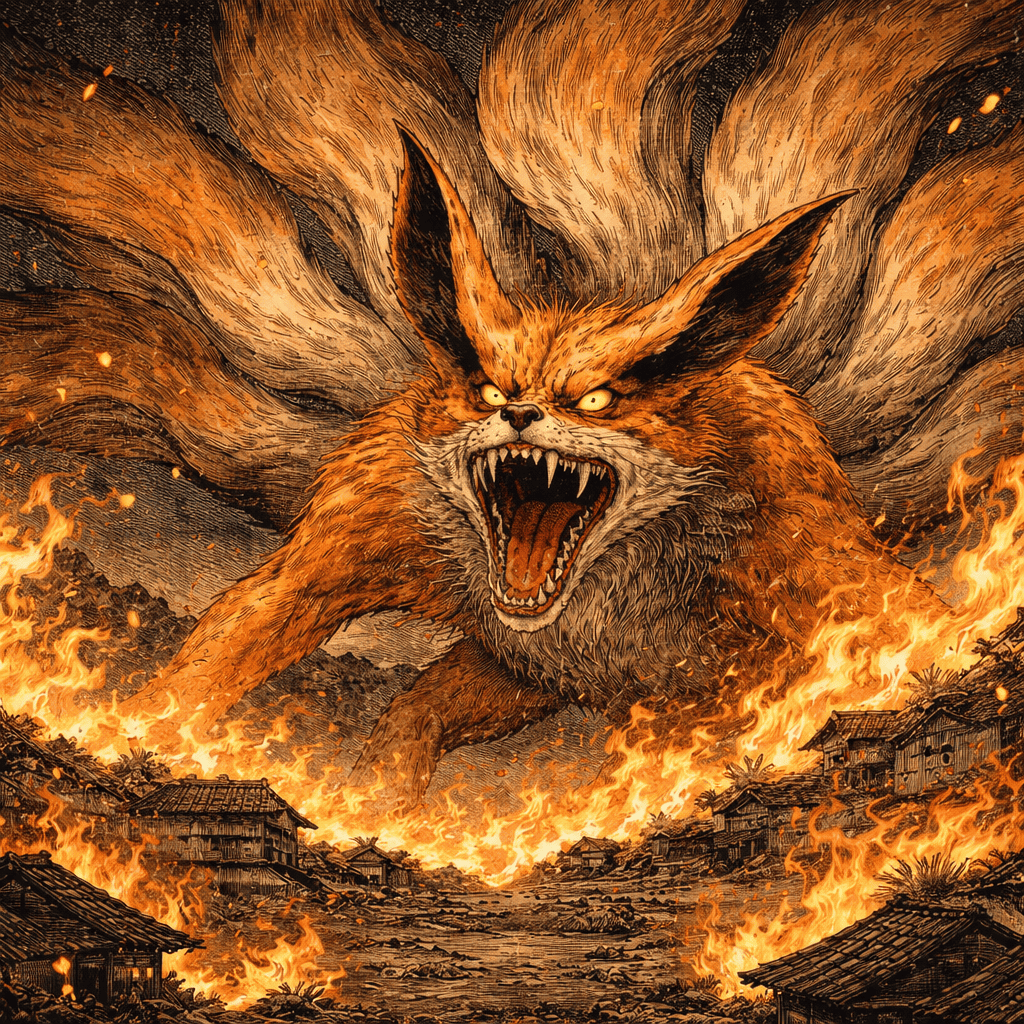
Before Naruto Uzumaki ever channeled the Nine-Tailed Fox's chakra, before Sasuke Uchiha first awakened his Sharingan, before a single hand sign was formed in the Hidden Leaf Village, the stories that would become Naruto already existed. They existed in the eighth-century chronicles of Japan's creation. They existed in the firelit tales of fox spirits that seduced emperors and destroyed kingdoms. They existed in the mountain temples where ascetic monks trained for decades to hear the voice of nature itself, and in the Shinto shrines where priests maintained contracts with divine animals that served as messengers between the human and spirit worlds.
Masashi Kishimoto did not merely borrow names from Japanese mythology. He absorbed an entire cosmology and rebuilt it as a ninja world. The result is a series that, beneath its explosive fight choreography and its coming-of-age drama, carries the weight of genuine religious tradition, authenticated folklore, and the deep structural logic of a culture that has been telling stories about the relationship between humans and supernatural forces for more than fifteen hundred years. Naruto endures because its foundation is not invention. It is inheritance.
The connections between Naruto and Japanese mythology presented in this article are based on historical research, official series lore, and widely-discussed fan analysis. Fan theories are clearly labeled as such throughout.
The Nine-Tailed Fox: Kurama and Real Kitsune Lore
The kitsune, the fox spirit of Japanese folklore, is one of the most complex and enduring figures in the country's supernatural tradition. Unlike Western foxes, which are typically associated with simple cunning, the Japanese kitsune is a spiritual being of immense power whose nature shifts between divine messenger and dangerous trickster depending on its age, temperament, and allegiance. In Shinto belief, foxes serve as messengers of Inari, the deity of rice, fertility, and prosperity, and stone fox statues guard the entrances of Inari shrines across Japan. There are more than thirty thousand Inari shrines in Japan, each flanked by fox statues, making the kitsune-Inari relationship one of the most visible expressions of animal-deity bonding in any world religion.
The power of a kitsune is measured by its tails. A young fox spirit possesses a single tail. As it ages and accumulates spiritual energy over centuries, additional tails grow, each representing a quantum leap in supernatural ability. A fox with five tails can see across great distances and predict the future. A fox with seven tails can manipulate weather and fire. A fox with nine tails, the kyuubi no kitsune, has transcended the boundary between spirit and god. It has lived for at least a thousand years, and its power rivals that of the greatest deities. It can create illusions indistinguishable from reality, possess human bodies, cause earthquakes and storms, and destroy entire nations.
The most famous nine-tailed fox in Japanese legend is Tamamo-no-Mae, who appeared at the court of Emperor Toba in the twelfth century as a woman of extraordinary beauty and intelligence. She captivated the emperor with her knowledge of poetry, history, and the classics, but court onmyoji eventually detected the fox spirit hiding within her human form. When exposed, she fled and transformed into the Sessho-seki, the Killing Stone, a boulder that emitted poisonous gas and killed anything that approached it. Our detailed article on the Tamamo-no-Mae legend explores this story in full.
Kurama in Naruto inherits all of these traits. He is ancient, impossibly powerful, capable of destroying mountains with a single swipe of his tails, and his relationship with his human host oscillates between hostile possession and genuine partnership. The arc of Naruto and Kurama's relationship, from mutual hatred through grudging respect to genuine friendship, mirrors the broader kitsune tradition in which foxes and humans can form bonds of extraordinary depth when trust is earned rather than demanded. The sealing of Kurama within Naruto echoes the folk practice of binding fox spirits within physical objects or human vessels, a practice documented in historical accounts of kitsune-tsuki, or fox possession, that persisted in rural Japan into the twentieth century.
The connection to Inari worship adds another dimension. In villages across Japan, the kitsune was not merely feared. It was honored, fed, and propitiated. Farmers left offerings of fried tofu (abura-age) at fox dens, believing that a well-treated fox would protect their rice harvest and bring prosperity. A mistreated fox, however, would bring ruin. Naruto's journey from being shunned by his village because of the fox inside him to being celebrated as a hero mirrors the broader cultural arc of kitsune in Japanese religion: the transition from feared pest to honored guardian, from curse to blessing, depending entirely on the quality of the relationship between human and fox.
The Tailed Beasts: Bijuu and Japanese Mythological Creatures
The nine Tailed Beasts of Naruto, the Bijuu, each represent a fusion of real mythological creatures from Japanese and broader East Asian folklore. Shukaku, the One-Tail, is a tanuki, the shape-shifting raccoon dog of Japanese legend that is simultaneously one of the most feared and most beloved yokai in the tradition. Real tanuki inhabit Japanese forests, but their folklore counterparts can transform into anything, from teapots to temples, and are famous for their enormous bellies, their love of sake, and their association with commerce and good fortune. Shukaku's madness and unpredictability reflect the darker side of tanuki legends, in which these tricksters drive travelers insane with their illusions.
Matatabi, the Two-Tails, takes the form of a flaming cat, echoing the bakeneko and nekomata of Japanese folklore, supernatural cats that grow additional tails as they age and develop the ability to raise the dead, control fire, and speak human language. Isobu, the Three-Tails, resembles a giant turtle, connecting to the tradition of divine sea turtles in Japanese mythology and the enormous sea spirits that capsize ships. Son Goku, the Four-Tails, draws from the Chinese literary tradition of Sun Wukong, the Monkey King, reflecting the deep cultural exchange between Chinese and Japanese mythology that shaped much of Japan's supernatural bestiary.
Gyuki, the Eight-Tails, takes the form of a giant ox-octopus hybrid that resonates powerfully with the ushi-oni, the bull-headed sea demon of western Japanese coastal legend. The ushi-oni is one of the most feared yokai in the maritime provinces, a creature that emerges from the ocean to attack fishermen and coastal villages. Its combination of terrestrial and aquatic features, the bull's head and the spider or octopus body, represents the terror of the boundary between land and sea, a boundary that Japanese coastal communities have always treated with spiritual caution. Gyuki inherits this dual nature and this coastal menace.
And at the center of them all stands Kurama, the Nine-Tails, the kitsuneat the apex of its power. Each Bijuu, in its way, connects to a thread in Japan's vast tapestry of beast mythology. Kishimoto drew not from a single source but from the entire tradition, selecting creatures that represented different aspects of Japan's relationship with the natural and supernatural worlds and binding them together in a system that is both internally consistent and mythologically authentic.
Susanoo: From Ancient God to Sharingan Technique
The three ultimate techniques of the Sharingan, Amaterasu, Tsukuyomi, and Susanoo, are named directly after the three most important deities in the Shinto pantheon, and their connection to the mythology is far deeper than simple naming. According to the Kojiki and Nihon Shoki, the primordial creator god Izanagi, after escaping from Yomi, the land of the dead, performed a purification ritual in a river to cleanse the spiritual pollution of death from his body. As he washed his left eye, Amaterasu, the Sun Goddess, was born. As he washed his right eye, Tsukuyomi, the Moon God, was born. As he washed his nose, Susanoo, the Storm God, was born.
In Naruto, these three techniques are similarly born from the eyes of the Uchiha clan. Amaterasu manifests as inextinguishable black flames, a dark inversion of the sun goddess's purifying light. Tsukuyomi creates an illusory world in which the caster has absolute control over time and space, mirroring the moon god's dominion over the night, the realm of dreams and deception. And Susanoo manifests as a colossal spectral warrior that surrounds and protects the user, reflecting the storm god's legendary role as both destroyer and protector.
The mythological Susanoo is one of the most complex figures in Japanese religion. After being banished from heaven for his violent and unruly behavior toward Amaterasu, he descended to the province of Izumo, where he encountered an elderly couple weeping over the impending sacrifice of their last daughter to an eight-headed serpent called Yamata no Orochi. Susanoo devised a plan, set out eight vats of sake, waited for the serpent to drink itself into stupor, and then slew it. From one of the serpent's tails he drew the legendary sword Kusanagi no Tsurugi, one of the three Imperial Regalia of Japan. In a single arc, Susanoo transformed from banished troublemaker to culture hero, from destroyer to savior.
This trajectory, the violent outcast who becomes a protector through a single act of selfless courage, is the template for nearly every major character arc in Naruto. Naruto himself is the outcast who becomes the village's greatest defender. Sasuke is the destructive force who ultimately returns to protect. Itachi is the apparent villain whose true nature was self-sacrifice all along. Kishimoto embedded the structural logic of the Susanoo myth into the DNA of his narrative, and the result is a story that carries the emotional weight of a cycle that the Japanese have been telling for thirteen centuries.
Sage Mode and Japanese Mountain Ascetics
Sage Mode, the advanced technique in which a ninja learns to absorb natural energy from the environment and blend it with their own chakra, is a direct reflection of one of Japan's oldest and most authentic spiritual traditions: shugendo, the way of mountain asceticism. Shugendo practitioners, known as yamabushi, retreated to sacred mountains to undergo extreme physical and spiritual training, including meditation beneath freezing waterfalls, fasting for weeks, walking barefoot over hot coals, and spending extended periods in isolated mountain caves. The goal was to transcend the boundary between human and natural world, to absorb the spiritual power of the mountain itself and return to civilization with supernatural abilities.
The tengu, the fearsome bird-like mountain spirits of Japanese folklore, are intimately connected to this tradition. In many legends, tengu are either the guardians of mountain ascetic knowledge or the corrupted spirits of yamabushi who became too proud of their supernatural achievements. The tengu taught martial arts to the legendary warrior Minamoto no Yoshitsune, just as the toads of Mount Myoboku teach Sage Mode to Naruto. The parallel is precise: a young warrior travels to a sacred mountain, trains under the tutelage of supernatural beings who are both teachers and threats, and returns with powers that transcend ordinary human ability.
The physical transformation that accompanies Sage Mode, the toad-like features that appear around Naruto's eyes and the stone-like rigidity that threatens to consume practitioners who lose focus, also echoes shugendo beliefs. Yamabushi who failed in their training were said to become corrupted by the mountain's power, transforming into tengu or other monstrous beings. The discipline required to absorb natural energy without being consumed by it mirrors the discipline required of real mountain ascetics who balanced on the edge between enlightenment and madness, between gaining the mountain's power and being swallowed by it.
The word sennin, used in Naruto for the sage tradition, is the Japanese reading of the Chinese xianren, the Daoist immortal who has achieved transcendence through communion with nature. In Japanese folk tradition, sennin live on remote mountain peaks, possess powers over the elements, and are recognizable by their aged appearance, their animal companions, and their detachment from human affairs. Jiraiya, Naruto's teacher who bears the title of Toad Sage, is directly based on the character Jiraiya Goketsu Monogatari, a nineteenth-century literary figure who was himself a sennin trained in toad magic. Mount Myoboku, the toad sage mountain, is a version of the sacred mountains like Koya-san, Dewa Sanzan, and Omine-san where yamabushi have trained for more than a millennium. These mountains were understood not as mere geography but as living spiritual entities, places where the boundary between the human world and the spirit world was thinnest.
Summoning Jutsu and Japanese Spiritual Traditions
The summoning system in Naruto, in which a ninja signs a blood contract with a species of animal and can thereafter call upon them in battle, maps directly onto the Shinto concept of shinshi, divine messengers. In Shinto belief, specific animals serve as intermediaries between kami and humans. Foxes serve Inari. Deer serve the kami of Kasuga Shrine. Monkeys serve the mountain kami. Snakes serve water deities. These animals are not mere symbols. They are spiritual agents with their own will and their own relationships to the humans who honor them. The bond between a Shinto deity and their animal messenger is contractual and reciprocal.
Naruto's summoning contracts function identically. A ninja cannot simply summon any animal. They must first locate the contract scroll, sign it in blood, and demonstrate sufficient chakra and spiritual compatibility to earn the summoned creature's respect. Jiraiya's toads, Orochimaru's snakes, and Tsunade's slugs are not pets or tools. They are autonomous beings with their own societies, hierarchies, and codes of honor. They choose to fight alongside their summoners, and they can refuse if the relationship is violated. This is the logic of Shinto shinshi translated into a ninja combat system.
The blood element of the contract is also significant. In Japanese folk religion, blood carries spiritual power and creates bonds that transcend ordinary social contracts. Blood oaths, blood offerings at shrines, and the use of blood in purification rituals all appear in historical Japanese spiritual practice. The summoning contract's requirement that a ninja sign in blood elevates the agreement from a mere technique to a spiritual covenant, binding the human and the animal in a relationship that carries the weight of sacred obligation.
The three great summoning animals of the Sannin, toads, snakes, and slugs, also carry mythological weight. The toad is associated in Japanese folklore with transformation, water magic, and the ability to navigate between worlds. The snake is the oldest sacred animal in Japanese religion, associated with water, fertility, and the underworld, and the great serpent Yamata no Orochi is one of the most important figures in the Kojiki. The slug, associated in Japanese folk medicine with healing and regeneration, connects to the ancient belief that certain creatures possess the ability to restore what has been damaged. Together, the three represent a complete cycle: the toad mediates between worlds, the snake destroys, and the slug heals.
Chakra and Ki: The Energy of Life
The concept of chakra in Naruto, while borrowing its name from the Hindu-Buddhist tradition of energy centers in the body, draws heavily from the broader East Asian concept of ki (qi in Chinese), the vital life force that flows through all living things. In Japanese religious and martial tradition, ki is not an abstract philosophical concept. It is a tangible force that can be cultivated, directed, and weaponized through proper training and spiritual discipline.
In Japanese martial arts, ki is the foundation of power that transcends mere physical strength. Aikido, literally the way of harmonizing ki, is built entirely on the principle that a practitioner can redirect an opponent's ki rather than opposing it with brute force. Kendo, the way of the sword, teaches that the decisive moment in combat is not the physical cut but the kiai, the explosive release of ki through vocalization that breaks the opponent's will before the blade touches flesh. Judo, karate, and every traditional Japanese martial art incorporate ki as a fundamental principle, and the concept extends beyond combat into medicine, calligraphy, tea ceremony, and flower arrangement.
In Shinto theology, the kami themselves are understood as concentrations of ki, spiritual energy that pervades the natural world and intensifies in certain locations, objects, and living beings. A sacred mountain possesses powerful ki. An ancient tree radiates ki. A waterfall generates ki through the ceaseless motion of water over stone. The yamabushi mountain ascetics of shugendo tradition trained specifically to absorb and channel the ki of sacred natural sites, developing abilities that seemed supernatural to ordinary observers. When Naruto enters Sage Mode and absorbs natural energy from his surroundings, he is performing the same practice that yamabushi have pursued for more than a millennium.
Buddhist tradition added the concept of the body as a map of spiritual energy. The chakra system, introduced to Japan through esoteric Buddhist texts, posited that specific points in the body served as gates through which spiritual energy entered and exited. The hand signs used by Naruto characters to mold chakra derive directly from the mudra of esoteric Buddhist practice, the same ritual hand gestures used by Shingon and Tendai monks to channel spiritual power during meditation and ceremony. The tenketsu, the chakra points that the Hyuga clan targets with their Gentle Fist technique, correspond to the tsubo pressure points of traditional Japanese acupuncture and Chinese medicine, points where ki concentrates and where its flow can be blocked or released.
Fan Theories
Note: The following are fan theories and interpretations. None have been officially confirmed by the author Masashi Kishimoto. They are presented as speculative analysis.
One compelling theory connects the Rinnegan, the most powerful dojutsu in the series, to the Buddhist concept of the Six Realms of reincarnation. The Rinnegan's Six Paths technique grants dominion over six different types of power, one for each of the Buddhist realms: the Deva Path (heaven), the Asura Path (demigods), the Human Path (humanity), the Animal Path (beasts), the Preta Path (hungry ghosts), and the Naraka Path (hell). Each path corresponds precisely to the traditional Buddhist cosmological schema, suggesting that the Rinnegan is not merely a powerful eye technique but a representation of complete mastery over the cycle of death and rebirth.
Another theory reads the entire Uchiha clan history as a retelling of Susanoo's mythological arc. Just as Susanoo was banished from heaven for his violence, the Uchiha were marginalized by the Hidden Leaf Village. Just as Susanoo's grief over Amaterasu's withdrawal into the cave caused the world to fall into darkness, the Uchiha's grief over their persecution led them toward the darkness of the planned coup. And just as Susanoo redeemed himself by slaying the eight-headed serpent and saving the maiden, Sasuke ultimately redeemed himself by fighting alongside Naruto to save the world. The clan's very name, Uchiha, is a near-homophone for uchiwa, the paper fan that in Shinto ritual is used to fan sacred fires, connecting the clan's fire-based techniques to their role as keepers of sacred flame.
A third theory proposes that the Sage of Six Paths, Hagoromo Otsutsuki, is modeled on Prince Shotoku, the semi-legendary seventh-century regent who is credited with introducing Buddhism to Japan and creating its first constitution. Both figures are presented as wise lawgivers who established the philosophical foundations of their respective worlds. Both are associated with peace, wisdom, and the reconciliation of opposing forces. And both left behind legacies that their descendants struggled to maintain, eventually fracturing into competing factions that fought wars in their name. Whether Kishimoto consciously intended this parallel remains unconfirmed, but the structural similarity is striking.
Why Naruto's World Feels Authentically Japanese
Naruto's global success has sometimes obscured the fact that it is, at its core, a profoundly Japanese story. The ninja villages are modeled on historical clan structures that governed pre-modern Japan. The ranking system from genin to kage mirrors the hierarchical social structures of feudal Japanese society. The emphasis on duty, sacrifice, and the subordination of individual desire to communal need reflects the Japanese ethical framework of giri and ninjo, the tension between obligation and personal feeling that drives classical Japanese drama.
The concept of the Will of Fire, the philosophical core of the Hidden Leaf Village, draws from the Japanese concept of ikigai, the reason for living that gives meaning to existence, combined with the Buddhist notion of dharma transmission, in which a teacher's wisdom is passed to a student not through words alone but through the lived example of a life dedicated to service. Each Hokage passes the Will of Fire to the next generation, just as a Zen master transmits enlightenment to a student through years of shared practice. The lineage from Hashirama to Naruto is a dharma lineage, spiritual inheritance disguised as political succession.
The series' treatment of death also reflects distinctly Japanese sensibilities. Unlike Western hero narratives, which often treat death as a failure to be avoided, Naruto consistently portrays death as a meaningful transition that gives weight to the choices made in life. Characters who die in Naruto do not simply vanish. They continue to influence the living through memory, through inherited technique, and sometimes through literal spiritual intervention. This reflects the Japanese concept of ancestor veneration, the belief that the dead remain present in the lives of the living and that the boundary between death and life is permeable rather than absolute.
Conclusion
Naruto is a story about a lonely boy who befriends a fox, trains on a sacred mountain, masters the elements, and saves his village. It is also a story that Japan has been telling, in various forms, for more than a thousand years. The nine-tailed fox that terrorized the imperial court now lives inside a blond teenager in an orange jumpsuit. The storm god who slew the eight-headed serpent now manifests as a spectral warrior summoned by spinning red eyes. The mountain ascetics who trained beneath freezing waterfalls now sit in meditation on the backs of giant toads. The foxes that guard the shrines of Inari now lend their power to a boy the village once despised. The ki that flows through every martial art and every sacred mountain now bears the name chakra and flows through hand signs borrowed from esoteric Buddhist monks. The forms have changed. The story has not.
Masashi Kishimoto built Naruto on a foundation of authentic Japanese mythology, and that foundation is why the series endures. Strip away the jutsu classifications and the fight choreography, and what remains is the same narrative that the Kojiki told in the eighth century: the world was born from the interaction of opposing forces, harmony requires sacrifice, power without compassion leads to destruction, and even the most monstrous being can be redeemed through the bond between one soul and another. These are not universal truths. They are Japanese truths, shaped by Shinto, refined by Buddhism, tested by a millennium of history, and carried forward into the twenty-first century by a manga that, beneath its explosive exterior, is one of the most faithful retellings of Japanese myth ever drawn.
This is The Yokai Files.
Support The Yokai Files
Enjoyed this deep dive into Japanese folklore?
The Yokai Files is reader-supported. Your support helps us research deeper, write more, and keep the darkness alive.