Princess Mononoke Spirits Explained
Published: March 27, 2026
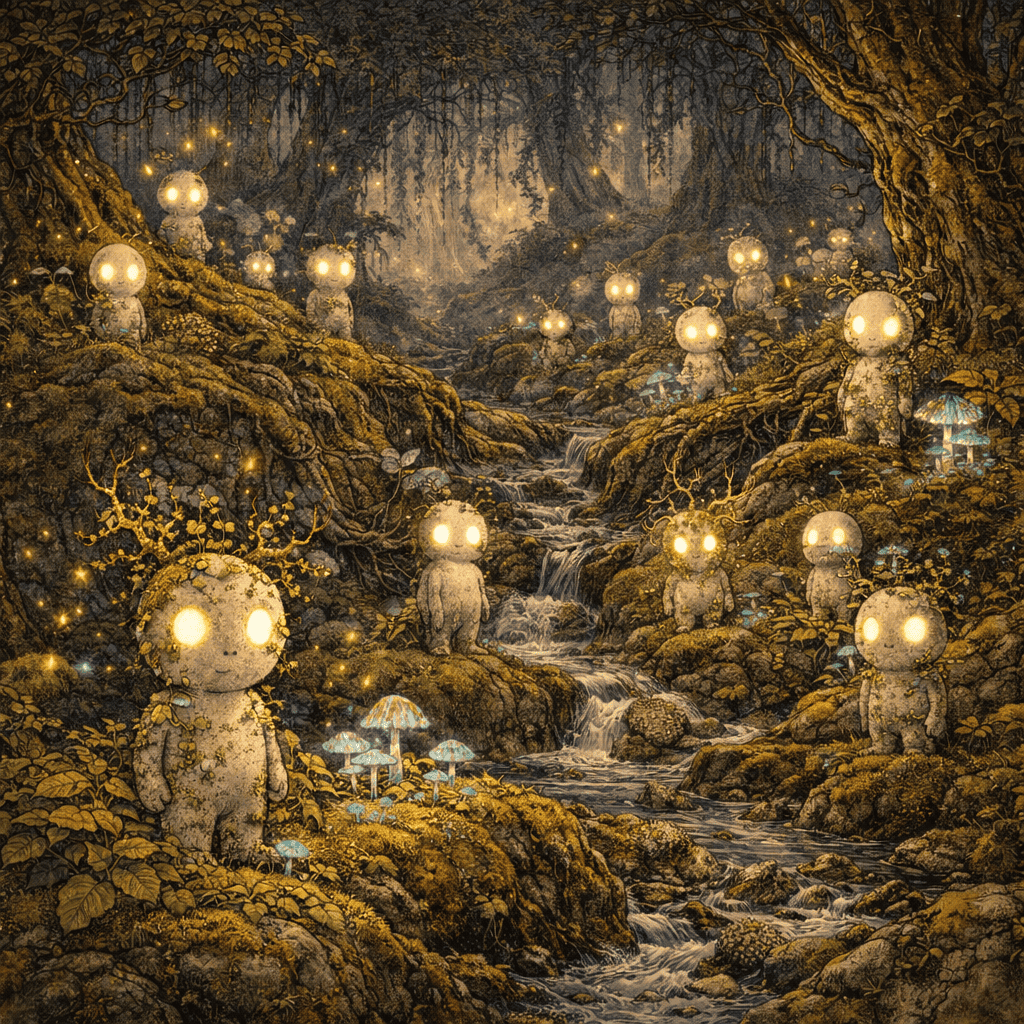
In the ancient forests of the Shirakami Mountains, where beech trees older than the samurai age lock their canopy against the sky and streams run clear over stones that have not been moved by human hands, there is a silence that feels inhabited. It is the silence of a place where something is listening. It is the silence that Hayao Miyazaki heard when he began researching what would become his masterpiece, and it is the silence that Princess Mononoke asks its audience to hear beneath the clash of swords and the screams of wounded gods.
Princess Mononoke is the most mythologically dense film ever produced by Studio Ghibli, and arguably the most faithful cinematic treatment of Japanese animist belief ever made. Every spirit in the film, from the towering Shishigami to the rattling kodama to the cursed boar god Nago, draws from genuine Japanese folklore, Shinto theology, and the ecological spirituality that governed Japan's relationship with its forests for millennia before industrialization tore that relationship apart. To watch the film is to enter a world that is simultaneously fictional and deeply, historically real. This article explores the spirits of Princess Mononoke one by one, tracing each back to its source in the living tradition of Japanese folk religion.
The connections between Princess Mononoke and Japanese folklore presented in this article are based on historical research, Miyazaki's documented statements, and scholarly analysis of the film's source traditions.
What is Mononoke? The Real Japanese Concept
The word mononoke, written 物の怪, is one of the most ancient and troubling terms in the Japanese supernatural vocabulary. It appears in Heian-period court literature, most famously in The Tale of Genji, where it describes spirits of extraordinary malevolence that possess and kill without being seen. The word breaks down into mono, meaning thing or entity, and ke, an archaic term for strange or supernatural force. A mononoke is not a ghost in the Western sense. It is not the transparent shade of a dead person rattling chains. It is a spiritual force, often originating from a living person's uncontrollable emotions, that separates from its source and acts as an independent predatory entity.
The concept of mononoke is deeply rooted in the Heian period (794-1185 CE), an era when the aristocracy of Kyoto lived in genuine terror of spiritual attack. Court ladies fell mysteriously ill and died. Babies sickened without explanation. Political rivals suffered inexplicable misfortune. The cause, in the understanding of the time, was mononoke: spiritual forces generated by the intense emotions of the living or the unresolved grievances of the dead. Buddhist exorcists and onmyoji (practitioners of the Way of Yin and Yang) were regularly summoned to the bedsides of afflicted courtiers to identify and expel the mononoke responsible.
In The Tale of Genji, Lady Rokujo's intense jealousy toward her romantic rival generates a mononoke so powerful that it leaves her body during sleep, travels to her rival's bedside, and causes a fatal illness. Lady Rokujo does not know she is sending this spirit. She does not control it. It is her rage given autonomous form, and it kills with a single-mindedness that horrifies even its unwitting creator. This understanding of mononoke as emotion made lethal, as the weaponization of human feeling against the person who provoked it, is central to the Japanese concept and it is central to Miyazaki's film.
In Princess Mononoke, the title character San is called Mononoke Hime, the Princess of the Vengeful Spirits. She is not a spirit herself. She is a human girl abandoned by her parents and raised by the wolf goddess Moro. But she has aligned herself entirely with the enraged spirits of the forest, absorbing their fury at human encroachment until she has become, in human eyes, indistinguishable from the mononoke themselves. San is both the mononoke's daughter and their weapon. She carries their rage in her body just as Lady Rokujo's spirit carried jealousy. The full breadth of supernatural entities in Japanese folklore, including many that inform the film's spirit ecology, can be explored in our comprehensive yokai archive.
The Shishigami: Forest God and Japanese Nature Worship
The Shishigami, the Forest Spirit, is the theological center of Princess Mononoke. It appears as a great deer with branching antlers that resemble bare trees, a human-like face with calm, knowing eyes, and hooves that cause flowers to bloom and wither with each step. By night it transforms into the Deidarabotchi, the Nightwalker, a translucent giant of cosmic proportions that walks above the forest canopy, dripping luminous fluid that gives life to whatever it touches while simultaneously signaling the approach of death.
The Shishigami draws from several interconnected traditions in Japanese folk religion. The deer, or shika, holds a position of sacred reverence in Shinto that few other animals share. At Kasuga Grand Shrine in Nara, founded in 768 CE, deer have been venerated as divine messengers for more than twelve centuries. According to shrine legend, the deity Takemikazuchi arrived at Kasuga riding a white deer, and ever since, the deer of Nara have been considered sacred, protected by law, and allowed to roam freely through the city. Killing a deer in Nara was once punishable by death. The shrine traditions of Japan, including those explored in our guide to shrines and temples, preserve these ancient bonds between animals and the divine.
The Shishigami's dual nature as both life-giver and death-bringer reflects the Shinto understanding that kami are not benevolent in the Western sense. They are forces of nature, and nature does not distinguish between creation and destruction. The same rain that nourishes rice paddies causes floods that destroy villages. The same mountain that provides timber and water also produces landslides and eruptions. Kami embody this totality. They are not good or evil. They are complete. The Shishigami's ability to heal a wound with one touch and inflict death with the next is not a contradiction. It is the purest possible expression of what a nature kami actually is: the cycle itself, indifferent to human preference, operating according to laws that predate and will outlast human civilization.
The Nightwalker form connects to the tradition of yama no kami, mountain gods who change their nature between seasons and between day and night. In many Japanese folk traditions, the god of the mountain descends to become the god of the rice field in spring and returns to the mountain in autumn. This cyclical movement between forms reflects the agricultural understanding that the same divine force governs both the wild mountains and the cultivated plains. The Shishigami's transformation into the Nightwalker is this tradition rendered visible: the daytime deer god of the forest floor becomes the nighttime cosmic giant that walks above the trees. This idea of divine transformation also connects to broader transformation myths in Japanese folklore, where gods and spirits regularly shift between forms, from the fox who becomes a woman to the dragon who becomes a storm. The Shishigami's day-night metamorphosis is the most profound example: not a disguise or a trick, but a revelation that the same divine being contains both the intimate and the cosmic, the gentle and the terrifying.
Kodama: Tree Spirits in Japanese Folklore
The kodama of Princess Mononoke, those small, white, bobble-headed figures that rattle as they turn their heads and gather in silent crowds on the branches of ancient trees, have become one of the film's most iconic images. They appear fragile and harmless, childlike in their movements, almost comical in their simplicity. But their presence in the film carries a weight that connects to one of the deepest beliefs in Japanese folk religion: that trees are alive not merely biologically but spiritually, and that the oldest trees are inhabited by conscious beings that must be respected.
The word kodama, written 木霊, translates literally as tree spirit or tree echo. The earliest recorded references to kodama appear in the Heian period, but the belief itself is certainly older, predating written history and rooted in the animist foundation of Shinto. In the oldest understanding, every tree possessed a spirit. Young trees had young spirits, easily displaced. But as a tree aged, its spirit deepened and strengthened until, after centuries, the kodama became a powerful entity capable of blessing those who honored it and cursing those who harmed it.
Japanese forestry developed elaborate ritual practices around kodama belief. Before felling a large or ancient tree, woodcutters performed ceremonies that included placing offerings of sake, salt, and rice at the base of the tree, reciting prayers of apology, and sometimes waiting for a sign that the kodama had consented to the cutting. If these rituals were neglected, the kodama was believed to cause illness, accidents, or misfortune to the woodcutters and their families. Even today, shimenawa, the sacred ropes of braided rice straw, are tied around especially ancient or impressive trees throughout Japan to mark them as spiritually inhabited. The practice of Inari worship at forest shrines often intersected with kodama reverence, as both traditions recognized the spiritual agency of natural spaces.
In Princess Mononoke, Miyazaki uses kodama as a living barometer of the forest's spiritual health. When the forest is whole and the Shishigami walks freely, kodama appear in abundance, filling the branches like luminous fruit. As the forest is threatened by Lady Eboshi's ironworks, the kodama thin out, their numbers declining in direct proportion to the trees being felled. When the Shishigami is beheaded and the forest dies, the kodama fall from the trees like snow, their small bodies dissolving as they hit the ground. It is one of the most devastating images in the film, and it works because Miyazaki understood that in the Japanese tradition, the death of kodama is not merely the loss of cute forest creatures. It is the death of the forest's soul. A forest without kodama is not merely a collection of dead wood. It is a sacred space that has been desecrated, a temple whose gods have been driven out.
San and the Wolf Gods: Okami Worship in Japan
Moro, the great white wolf goddess who raises San as her own daughter, is one of the film's most powerful figures, and her mythological roots run deep into a tradition that modern Japan has almost entirely lost. The Japanese wolf, Canis lupus hodophilax, was once found throughout the Japanese archipelago. It was smaller than its continental relatives, closer in size to a large dog, and it lived in the mountain forests that covered most of pre-modern Japan. For centuries, the wolf occupied a sacred position in Japanese folk religion. It was venerated as a messenger of the mountain god, a protector of travelers, and a guardian of crops who kept deer and boar from destroying the rice harvest.
Wolf shrines, known as okami-sha, dotted the mountain landscape. The word for wolf in Japanese, okami, is written with the characters 大神, meaning great god, and this was not considered a coincidence. The wolf was the great god of the mountains, and the mountain people maintained a reverent relationship with wolf packs that balanced fear and gratitude. Hunters left offerings for wolves. Farmers thanked them for protecting fields. Travelers prayed to wolf spirits for safe passage through mountain roads.
Two real shrines in Japan preserve this wolf-worshipping tradition with particular intensity. Mitsumine Shrine in Chichibu, Saitama Prefecture, founded according to legend by the mythological hero Yamato Takeru, enshrines the wolf as its primary divine messenger. Stone wolf statues flank the shrine's entrance instead of the fox statues found at Inari shrines, and worshippers still pray to the wolf spirit for protection against fire, theft, and disease. Musashi Mitake Shrine, perched atop Mount Mitake in western Tokyo, similarly venerates the okami as a protective deity, and visitors can receive wolf-themed charms and amulets. These shrines stand as living testimony to a religious tradition that once extended across the entire mountain spine of Japan.
The Japanese wolf was declared extinct in 1905, a casualty of rabies epidemics, government-sponsored poisoning campaigns, and the deforestation that destroyed its habitat during the Meiji period's rapid industrialization. The loss was not merely ecological. It was spiritual. When the wolves disappeared, an entire layer of Japanese folk religion lost its living referent. The wolf shrines remained, but the gods they honored were gone. Moro in Princess Mononoke is, among other things, an elegy for this loss. She is the last of her kind, fighting against the same forces of industrialization and deforestation that destroyed the real wolves of Japan. Her rage at humanity is not arbitrary. It is historically specific, directed at the exact processes that drove her real-world counterparts to extinction.
Moro's relationship with San also reflects a documented motif in Japanese folklore: the divine animal that raises a human child. Stories of children raised by wolves, foxes, bears, and birds appear throughout Japanese folk tradition, and these stories almost always carry a theological meaning. The child raised by an animal spirit becomes a bridge between the human and natural worlds, possessing human intelligence and animal instinct, human speech and animal loyalty. San is precisely this kind of bridge figure, and her refusal to choose between her human nature and her wolf upbringing is the film's central emotional conflict.
The Tatari-gami: Cursed Gods in Shinto
The cursed boar god Nago, whose transformation into a writhing mass of black tentacles opens the film with such unforgettable horror, introduces the concept of tatari-gami, the cursed or wrathful deity. This concept is fundamental to understanding both the film and the Shinto theology that underpins it. In Shinto, kami are not inherently good or evil. They are morally neutral natural forces that can be either nigi-mitama, their gentle, harmonious aspect, or ara-mitama, their violent, destructive aspect, depending on how they are treated and what circumstances they face.
A kami that has been offended, neglected, or driven to rage transforms from nigi-mitama to ara-mitama, becoming a tatari-gami, a cursing god. The transformation is not a change of identity. It is the same god, expressing a different aspect of its nature. A mountain god whose forest is treated with respect manifests as a benevolent protector. The same mountain god whose forest is clear-cut and polluted manifests as an earthquake, a landslide, a plague, or a monstrous apparition. The tatari is not punishment in the Western religious sense. It is consequence. It is the natural response of a violated spiritual ecosystem, as automatic and as impersonal as gravity.
This concept connects to the broader tradition of Japanese mythology, in which the gods' wrath is not capricious but responsive. The same framework governs the Three Great Onryo of Japanese history, where the unjust deaths of Sugawara no Michizane, Emperor Sutoku, and Taira no Masakado produced posthumous curses so powerful that the state itself was forced to build shrines to appease them. The tatari-gami of Princess Mononoke operates on the same principle, but directed from nature rather than from human ghosts.
Nago the boar god has been shot with an iron ball from Lady Eboshi's forge, and the combination of the physical wound and the spiritual pollution of industrial iron has transformed him from a noble guardian of the wild boar tribes into a mass of writhing, worm-like darkness that kills everything it touches. The visual language of his transformation, the dark, ropy tendrils that consume his body, mirrors classical Japanese depictions of spiritual pollution, the kegare that adheres to people and places that have been contaminated by death, disease, or moral transgression. Nago's tatari is not merely his personal rage. It is the forest's accumulated grief and violation manifesting through the body of its most powerful defender.
The curse that Ashitaka receives from touching Nago operates by the same logic. In Shinto purification theology, kegare is contagious. Physical contact with a source of spiritual pollution transfers that pollution to the person who touches it. Ashitaka's cursed arm is not a magical plot device. It is a textbook case of kegare transmission, exactly as it would have been understood by a Heian-period Shinto priest. The curse spreads through his body, grants him supernatural strength, but also drives him toward death. The only cure would be to address the source of the pollution itself, which is why Ashitaka must journey west to the forest where Nago was wounded, to find the Shishigami who governs the cycle of life and death, and to heal the breach between human civilization and the natural world that caused the tatari in the first place.
The Emishi and Historical Accuracy
Ashitaka is identified as the last prince of the Emishi, a choice that carries profound historical weight. The Emishi were the indigenous inhabitants of northeastern Japan, a people who lived outside the boundaries of the Yamato state and who resisted imperial expansion for centuries before being gradually conquered, absorbed, and erased from official history. They were not a single unified people but a collection of communities that the Yamato Japanese grouped together under a name that meant barbarians, much as the Romans used the word for anyone beyond their borders.
Historical records, primarily written by their conquerors, describe the Emishi as skilled horseback archers and fierce warriors who used the mountainous terrain of northeastern Honshu to devastating tactical advantage. The Yamato court waged intermittent campaigns against the Emishi from the seventh through the ninth centuries, establishing military outposts and offering land grants to settlers willing to move into Emishi territory. The campaigns culminated in the appointment of Sakanoue no Tamuramaro as sei-i taishogun, literally the barbarian-subduing generalissimo, a title that would later become the basis of the shogunate system that governed Japan for seven centuries.
Miyazaki's choice to make his protagonist an Emishi prince is a deliberate act of historical recovery. By placing an Emishi hero at the center of his story, Miyazaki forces his Japanese audience to confront a history that mainstream Japanese culture has largely forgotten or ignored. Ashitaka carries himself with a dignity and a moral clarity that the film presents as rooted in his Emishi identity, in a way of life that existed before the centralized Yamato state imposed its hierarchies on the archipelago. His village's reverence for the natural world, their ceremony before the cursed boar god, their willingness to send their prince on a journey to understand the cause of the spiritual disturbance rather than simply to fight it, all reflect an approach to the spirit world that Miyazaki implicitly contrasts with the industrial violence of Lady Eboshi's Irontown.
Miyazaki has acknowledged in interviews that his research for Princess Mononoke drew heavily on the work of folklorist Kunio Yanagita, whose early-twentieth-century field studies documented surviving animist beliefs in rural Japan. Yanagita traveled to remote mountain villages where communities still maintained practices and beliefs that the modernizing Meiji state had sought to eliminate, and his work revealed a Japan far older and stranger than the official narrative of a unified, homogeneous culture suggested. Miyazaki also studied medieval Japanese ironworking, visiting the remains of tatara smelting operations and consulting with historians about the ecological impact of charcoal production on Japan's forests. The tatara ironworks depicted in the film is based on real technology, and the deforestation it caused was real. Every tree that fell to feed a tatara furnace was a tree whose kodama was displaced and whose kami was potentially enraged.
Why Princess Mononoke Still Matters
Nearly three decades after its release, Princess Mononoke remains the most important film ever made about the spiritual dimension of environmental destruction. Other films have depicted ecological collapse. Other films have mourned the loss of wilderness. But Princess Mononoke is the only film that frames environmental destruction as a theological crisis, as the violation of a sacred covenant between humanity and the spiritual forces that sustain the natural world. In Miyazaki's vision, cutting down a forest is not merely an economic or ecological act. It is a spiritual act. It drives out the kodama. It enrages the animal gods. It turns nigi-mitama into tatari-gami. It sickens the Shishigami. And when the Shishigami dies, everything dies, not because of a magical plot contrivance, but because in the Shinto worldview, the forest spirit is the forest. There is no distinction between the god and the ecosystem it governs.
At the heart of this worldview lies a Buddhist-Shinto concept that Miyazaki embodies without ever stating explicitly: sanzen-somon-shitsu-u-bussho, the idea that mountains, rivers, grasses, and trees all possess Buddha-nature. This teaching, which entered Japanese Buddhism through the Tendai school in the ninth century and profoundly shaped Japanese environmental ethics, holds that the capacity for enlightenment is not limited to sentient beings. Trees have it. Rivers have it. Mountains have it. The rocks beneath the forest floor have it. If this is true, then destroying a forest is not merely an ecological crime. It is a spiritual one, an act of violence against beings that possess the same fundamental nature as the humans who destroy them. Princess Mononoke is, at its deepest level, a dramatization of this teaching.
This theological framing gives the film a power that purely secular environmentalism lacks. When a scientist tells us that deforestation causes biodiversity loss, we understand the argument intellectually. When Miyazaki shows us kodama falling from dying trees and dissolving before they reach the ground, we feel the loss in our bodies. The film speaks in the language of sacred violation, which is a language that human beings respond to at a depth that policy papers cannot reach. It tells us that the world is not merely a resource to be managed but a community of spiritual beings with whom we share a covenant that we have broken.
The film's ending, in which the Shishigami's death releases a wave of both destruction and renewal, and the forest begins to grow back but in a diminished form, is Miyazaki's most honest moment. The old forest, the primal forest of giant trees and ancient gods, is gone forever. What returns is something smaller, younger, less sacred. The kodama reappear, but tentatively, a single one rattling its head in the silence of a recovering landscape. It is a hopeful ending, but it is a diminished hope. The covenant has been broken. What grows back will never be what was lost. This is not a Western happy ending. It is a Japanese one, informed by mono no aware, the gentle sadness of impermanence, the recognition that beauty and loss are inseparable, and that the best we can hope for is not restoration but continuance.
Conclusion
Princess Mononoke is not a fantasy film. It is a documentary of a spiritual world that Japan once inhabited and has largely abandoned. The Shishigami still walks in the ancient forests that survive on remote islands and protected mountain slopes, but its domain has shrunk to a fraction of what it once was. The kodama still rattle in the canopies of old-growth trees, but most of those trees have been replaced by industrial timber plantations where no spirits dwell. The wolf gods are gone entirely, extinct for more than a century, and the shrines that once honored them, at Mitsumine and Musashi Mitake and scattered mountain peaks across the country, stand as memorials to a bond between humans and wolves that industrialization severed.
Miyazaki made Princess Mononoke because he understood that these losses were not merely ecological. They were spiritual. Every forest that falls takes its gods with it. Every species that vanishes removes a thread from the web of sacred relationships that once connected the Japanese people to the land they inhabited. The film asks its audience to see the world the way the Japanese once saw it: as a place where every tree has a spirit, every river has a guardian, every mountain has a god, and every human act of destruction reverberates through a spiritual ecosystem that is as real and as fragile as the physical one. Sanzen-somon-shitsu-u-bussho. Mountains, rivers, grasses, and trees all possess Buddha-nature. And when they die, something in us dies with them.
The single kodama that appears at the end of the film, small and alone in a recovering forest, is not a symbol of hope. It is a question. Will we learn to hear the rattling of the spirits again? Will we remember that the world is alive in ways that transcend biology? Or will we continue to cut and burn and build until the last kodama falls and the silence of the forest becomes truly, irreversibly empty?
This is The Yokai Files.
Support The Yokai Files
Enjoyed this deep dive into Japanese folklore?
The Yokai Files is reader-supported. Your support helps us research deeper, write more, and keep the darkness alive.