Yokai Watch: The Real Japanese Folklore Behind the Game
Published: April 6, 2026
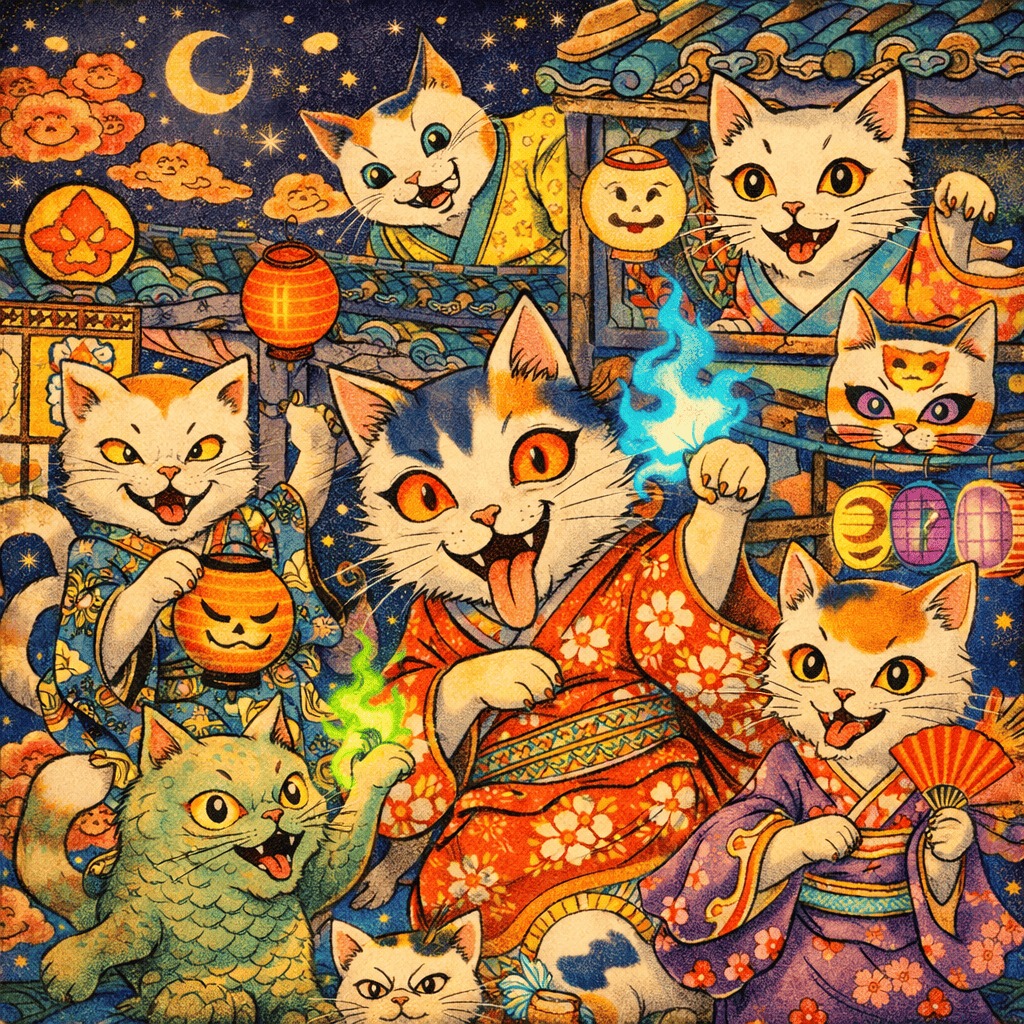
There is a device in the fiction of Yokai Watch that allows a child to see what adults cannot: the invisible spirits that live in every corner of Japan, behind vending machines and inside old shrines, under bridges and within the walls of ordinary houses. The child puts on the watch, presses a button, and the veil lifts. Suddenly the world is full of creatures, some absurd, some mischievous, some ancient and dangerous, all of them real in the spiritual vocabulary of a civilization that has been naming these beings for more than a thousand years. What appears on the surface to be a cheerful children's game about collecting cartoon monsters is, at its foundation, an introduction to one of the oldest and most complex supernatural traditions on earth. The yokai of Yokai Watch are not inventions. They are inheritances.
Beneath the bright colors, the friendly character designs, and the catchy theme songs, Yokai Watch carries the DNA of something far older and far darker than most players realize. The game's central premise, that the world is populated by invisible spirits who influence human behavior and can only be perceived by those with special spiritual sight, is not a game mechanic invented by a design team. It is the foundational belief of Japanese folk religion, a belief that shaped the construction of every shrine, the practice of every festival, and the fear that kept travelers off mountain roads after dark for centuries. To play Yokai Watch is to walk, unknowingly, through the front door of Japanese spiritual history.
This article explores the real Japanese folklore that inspired Yokai Watch. Game-specific lore is clearly distinguished from historical folklore throughout.
What is Yokai Watch?
Yokai Watch is a multimedia franchise developed by Level-5, a Japanese video game company, that launched in 2013 with a Nintendo 3DS game and rapidly expanded into anime, manga, toys, and a cultural phenomenon that rivaled Pokemon in Japan during its peak years. The franchise centers on a young boy named Keita Amano (Nathan Adams in the English localization) who discovers a capsule machine in the woods that releases Whisper, a yokai butler who gives him the titular Yokai Watch, a wristwatch-like device that allows the wearer to see the yokai that inhabit the world around them. With this power, Keita befriends yokai, resolves conflicts between the spirit world and the human world, and gradually assembles a network of supernatural allies.
The franchise became a genuine social phenomenon in Japan between 2014 and 2016. At its height, Yokai Watch merchandise outsold Pokemon, the anime drew massive television audiences, and the Yokai Watch medals, physical tokens that children could scan into the game, created a collecting frenzy that emptied store shelves within hours of restocking. Three theatrical films were produced, multiple sequel games were released across Nintendo platforms, and the franchise spawned spinoffs, crossovers, and a dedicated following that persists today. The international release, while commercially successful, never replicated the volcanic intensity of the Japanese reception, in part because the yokai concepts at the franchise's core are so deeply embedded in Japanese cultural knowledge that they require translation not just of language but of an entire spiritual worldview.
What sets Yokai Watch apart from other monster-collecting franchises is its explicit grounding in Japanese folklore. While Pokemon draws from a global menagerie of inspirations, Yokai Watch draws almost exclusively from the Japanese supernatural tradition. Its creatures are not generic fantasy monsters. They are yokai, the specific class of supernatural beings that Japanese culture has catalogued, illustrated, feared, worshipped, and told stories about for over a millennium. Understanding the real folklore behind these characters transforms the game from a simple children's diversion into a gateway to one of the world's richest mythological traditions.
The Real Yokai Behind the Characters
Jibanyan and the Bakeneko
Jibanyan, the franchise's mascot and most recognizable character, is a red cat yokai who haunts an intersection where he was killed by a car. In the game's narrative, he endlessly fights oncoming traffic in a futile attempt to overcome the manner of his death. This backstory, played for comedy in the franchise, carries a surprisingly dark resonance with the real folklore of the bakeneko, the monster cat of Japanese legend.
The bakeneko tradition holds that ordinary household cats can transform into supernatural beings under specific conditions. A cat that lives for an unusually long time, typically thirteen years or more, a cat that grows to a certain size, or a cat that licks lamp oil (a common behavior in the era of fish-oil lamps) was believed to undergo a transformation into something no longer fully animal. Bakeneko could walk on their hind legs, speak human language, manipulate fire, and even assume the form of their deceased owners. In the most disturbing legends, a bakeneko would kill its owner, consume the body, and then shape-shift into the owner's form to live among the family undetected. The Nabeshima bakeneko disturbance of the seventeenth century, one of the most famous supernatural incidents in Japanese history, tells of a cat that killed a lord's favorite concubine, took her form, and slowly drained the lord's life force until a loyal retainer discovered the deception and slew the creature.
Jibanyan preserves the essential identity of the bakeneko, a cat that has crossed the boundary between animal and spirit, while stripping away the terror. His death by traffic accident echoes the folk belief that traumatic or unjust death is a primary catalyst for yokai transformation. His persistence at the intersection, fighting the cars that killed him, mirrors the concept of onryo attachment, the idea that spirits are bound to the place or circumstance of their death until their grievance is resolved. The game transforms this from horror into humor, but the bones of the folklore remain intact. It is worth noting that Jibanyan also carries subtle echoes of the kappa tradition in one specific regard: like the kappa, who can be befriended through offerings and mutual respect despite being a dangerous predator, Jibanyan becomes an ally through emotional connection rather than force, reflecting the broader Japanese folk principle that yokai relationships are negotiated, not conquered.
Whisper and the World of Yurei
Whisper, the self-proclaimed yokai butler who serves as Keita's guide to the spirit world, is presented in the game as a knowledgeable but often comically unreliable companion. His design, a white, ghostly figure who floats rather than walks, draws directly from the visual tradition of yurei, the ghosts of the Japanese dead. The classic yurei appearance, codified in Edo-period art and kabuki theater, features a white figure with indistinct lower body, often trailing off into mist rather than possessing legs. Whisper's design echoes this template precisely.
In Japanese folklore, yurei are not casual ghosts. They are the spirits of the dead who are bound to the living world by powerful unresolved emotions, most commonly rage, jealousy, sorrow, or the desire for vengeance. The yurei tradition encompasses some of the most terrifying figures in Japanese supernatural history, from Oiwa, the disfigured wife whose ghost drove her murderous husband to madness in the kabuki masterpiece Yotsuya Kaidan, to the unnamed vengeful women of countless regional ghost stories who return from death to claim the lives of those who wronged them. Whisper domesticates this tradition entirely, transforming the yurei archetype from an avatar of posthumous rage into a bumbling supernatural assistant. Yet his role as a mediator between the human world and the spirit world preserves the function that yurei serve in folklore: they are reminders that the dead are not gone, that the boundary between this world and the next is permeable, and that unfinished business does not simply disappear.
Komasan and the Sacred Guardians
Komasan, the lion-dog yokai who arrives in the city from the countryside, is based on the komainu, the paired stone guardian figures that flank the entrances of Shinto shrines throughout Japan. These figures, which combine features of lions and dogs, serve as spiritual sentinels, warding off evil spirits and protecting sacred spaces. Their origins trace to the lion guardians of Chinese Buddhism, which themselves descended from the lion imagery of Central Asian and ultimately Indian religious art. By the time they reached Japan, they had been transformed into uniquely Japanese protectors, one with an open mouth (pronouncing "a," the first sound) and one with a closed mouth (pronouncing "un," the last sound), together symbolizing the beginning and end of all things.
Komasan's connection to Inari, the Shinto deity of rice, foxes, fertility, and prosperity, runs through the broader tradition of animal guardians at Japanese shrines. While komainu guard shrine gates, the fox messengers of Inari, the sacred kitsune, guard Inari shrines specifically. Komasan's displacement from the countryside to the city in the game mirrors a real cultural anxiety in modern Japan: the abandonment of rural shrines as populations concentrate in urban centers, leaving the guardian spirits without the communities they were meant to protect. This is not merely a game narrative. It reflects a genuine crisis in Japanese religious life, as thousands of rural shrines lose their caretakers and fall into disrepair, their guardian figures standing watch over empty grounds.
Noko and the Tanuki Tradition
Noko, the rare snake-like yokai in Yokai Watch that players prize for its elusiveness, carries echoes of the tanuki, the shape-shifting raccoon dog that is one of the most beloved figures in Japanese folklore. While Noko's visual design diverges significantly from the tanuki, its narrative role as a lucky, elusive creature that brings good fortune to those who encounter it draws from the tanuki tradition. The tanuki is a master of transformation, capable of assuming any form, and is associated with prosperity, trickery, and the unpredictable generosity of the natural world. Tanuki statues, with their straw hats, sake bottles, and famously exaggerated anatomy, stand outside restaurants and businesses across Japan as symbols of good luck and welcome.
The tanuki tradition is one of the most complex in Japanese folklore because tanuki are simultaneously dangerous and endearing. They can trick travelers into eating horse dung disguised as a feast, lead people off cliff edges with illusory pathways, or transform leaves into gold coins that revert to their true form after the trickster has escaped. Yet they are also celebrated as symbols of resilience, adaptability, and joy. The Studio Ghibli film Pom Poko depicts tanuki as tragic heroes fighting the destruction of their forest home, and the folk songs about tanuki emphasize their carefree, generous nature even as they acknowledge their capacity for mischief. Yokai Watch captures this duality in its rare and lucky yokai, presenting creatures that are both desirable and unpredictable, generous and elusive.
The Yokai Watch Concept: Seeing the Invisible
The central mechanic of Yokai Watch, the device that allows the wearer to perceive spirits invisible to ordinary eyes, is not a game invention. It is a direct translation of one of the oldest concepts in Japanese spiritual practice. The ability to see yokai and other spirits has been attributed throughout Japanese history to specific categories of people: onmyoji, the yin-yang masters of the Heian court who could perceive spiritual forces and manipulate them; miko, the shrine maidens who served as intermediaries between the human and divine worlds; itako, the blind spirit mediums of northern Japan who could channel the voices of the dead; and yamabushi, the mountain ascetics who gained spiritual sight through extreme physical ordeals in the sacred mountains.
The historical Abe no Seimei, the most famous onmyoji in Japanese history who served the imperial court in the tenth century, was said to possess the ability to see spirits, demons, and curses that were invisible to everyone around him. Court records describe him identifying the spiritual causes of illness, detecting the presence of hostile yokai in the imperial palace, and perceiving the movements of vengeful spirits that threatened the emperor. This ability was not understood as a superpower in the modern sense. It was understood as a heightened sensitivity to the spiritual dimension that exists alongside the physical world, a dimension that most people cannot perceive because they lack the training, the innate talent, or the ritual tools to open their eyes to it.
Yokai Watch translates this tradition into a consumer product: a watch that any child can wear to gain the spiritual sight that historically required years of ascetic training or inborn talent. This democratization of spiritual perception is itself a commentary on modern Japan's relationship with its folk traditions. Where once only specialists could see the invisible world, now a toy can do it. The game simultaneously preserves the concept and trivializes it, making the profound accessible at the cost of its depth. Yet the underlying message remains: the world is more than what ordinary eyes can see, and the beings that inhabit the unseen dimension are real, present, and deeply involved in human affairs.
Yokai as Everyday Spirits: Japan's Animistic Worldview
One of Yokai Watch's most faithful representations of Japanese folklore is its insistence that yokai are everywhere, not confined to haunted houses or sacred mountains but woven into the fabric of daily life. In the game, yokai cause everyday inconveniences: they make people forget things, cause arguments between friends, inspire laziness, trigger sudden cravings, and create the minor misfortunes that punctuate ordinary existence. This is not a game simplification. It is an accurate reflection of the traditional Japanese understanding of yokai's role in the world.
The concept of yaoyorozu no kami, the eight million gods, encapsulates the Shinto worldview in which every aspect of the natural and human world is inhabited by spiritual beings. Rivers have their kami, mountains have their kami, trees have their kami, and the boundary between the sacred and the mundane is not a line but a membrane through which spiritual forces constantly pass. Yokai exist within this framework as the spirits of the margins, the liminal spaces, the moments between sleep and waking, the crossroads, the abandoned houses, the old tools that have been used for too long and acquired something like consciousness. The mythology of Japan does not separate the spiritual from the material. They coexist, overlap, and continuously influence each other.
Yokai Watch captures this worldview with surprising fidelity. The game's yokai are not confined to dungeons or boss arenas. They are in bedrooms, schoolyards, convenience stores, and public parks. They are behind the unexplained feelings, the sudden mood shifts, the inexplicable bad luck that everyone experiences. This is exactly how traditional Japanese folklore understood yokai: as the spiritual explanations for the small mysteries of daily life. When food spoiled unexpectedly, a yokai was responsible. When a child misbehaved, a yokai was influencing them. When a traveler lost their way on a familiar road, a yokai was redirecting them. The game's genius is recognizing that this aspect of yokai folklore, the integration of the supernatural into the mundane, is the most authentic and the most engaging element of the tradition.
How Yokai Watch Simplifies Real Folklore
For all its faithfulness to certain aspects of the tradition, Yokai Watch necessarily simplifies and sanitizes the darker dimensions of Japanese yokai folklore. The real bakeneko did not merely haunt intersections with comic frustration. They devoured their owners, assumed their victims' identities, and were associated with death, disease, and the uncanny disruption of domestic life. The real kappa did not merely play pranks. They drowned children, extracted a mythical organ called the shirikodama from their victims' anuses, and were feared as genuine threats to anyone who approached water carelessly. The real yurei were not bumbling butlers. They were manifestations of murderous rage, their white funerary robes and lank black hair the visual signature of a fury that transcended death itself.
This simplification is neither accidental nor inappropriate for the franchise's audience. Yokai Watch is designed for children, and presenting yokai as friendly, collectible companions is a valid creative choice. But it is important for adult fans and scholars to recognize what has been removed. The yokai tradition in its full form is not cute. It is a sophisticated system for understanding the dangerous, unpredictable, and morally ambiguous forces that the Japanese perceived in their environment. Yokai could be befriended, yes, but they could also kill, deceive, possess, and destroy. The tension between danger and potential alliance is what gives the tradition its richness, and Yokai Watch, by resolving that tension almost entirely in favor of friendship, presents a yokai world that is emotionally safer but spiritually flatter than the original.
The treatment of death is perhaps the most significant simplification. In traditional folklore, yokai are frequently connected to death: they are created by death, they cause death, they haunt the places where death occurred, and they serve as reminders that the boundary between life and death is permeable and unstable. Yokai Watch acknowledges death in Jibanyan's backstory but generally avoids the existential weight that death carries in the tradition. The real folklore forces its audience to confront mortality, the meaninglessness of suffering, and the possibility that the dead are watching. The game replaces this confrontation with collection, friendship, and problem-solving, which makes it accessible but also removes the philosophical core that has sustained the yokai tradition for centuries.
Yokai Watch vs. Pokemon: A Folklore Perspective
The comparison between Yokai Watch and Pokemon is inevitable, and from a folklore perspective, it is illuminating. Pokemon draws from a global pool of inspirations: its creatures reference Japanese mythology, Western folklore, world biology, science fiction, and pure fantasy in roughly equal measure. A Pikachu is not a yokai. It is an electric mouse designed to be universally appealing across cultures. Pokemon's deliberate cultural neutrality is part of its global success; the creatures belong to no specific tradition and therefore can belong to everyone.
Yokai Watch takes the opposite approach. Its creatures are specifically, intentionally, and exclusively Japanese. Understanding them fully requires knowledge of Japanese folklore, Japanese religious practice, Japanese social customs, and Japanese humor. A Jibanyan is not just a cat monster. It is a bakeneko, and knowing what a bakeneko means in Japanese cultural history transforms the character from a cute mascot into a commentary on death, transformation, and the spiritual life of animals. A Whisper is not just a funny ghost. It is a yurei, and understanding the yurei tradition adds layers of meaning to every scene in which he appears.
This cultural specificity is both Yokai Watch's greatest strength and its greatest limitation in the international market. In Japan, where children grow up hearing yokai stories, visiting shrines guarded by komainu, and participating in festivals where yokai imagery is ubiquitous, the game's references land instantly and deeply. The humor works because the audience already knows what a tanuki is, what a kappa does, and why a cat that comes back from the dead is simultaneously funny and frightening. Outside Japan, these references require explanation, and explanation is the enemy of the immediate emotional connection that drives franchise success. Pokemon succeeded globally by requiring no cultural context. Yokai Watch succeeded in Japan by requiring all of it.
Why Yokai Watch Matters for Folklore Preservation
Despite its simplifications, Yokai Watch has performed an invaluable service for the preservation and transmission of Japanese folklore. An entire generation of Japanese children was introduced to yokai concepts through the franchise, many of them encountering these creatures for the first time in a game rather than in a grandmother's story or a shrine visit. The franchise revived interest in yokai culture at a time when traditional folk knowledge was declining in urban Japan, where children are increasingly disconnected from the rural landscapes and seasonal rituals that historically sustained yokai traditions.
This is not a new phenomenon. The great yokai scholar Mizuki Shigeru, creator of GeGeGe no Kitaro, spent his career doing precisely what Yokai Watch does at a different register: translating traditional yokai into popular media forms that contemporary audiences could access and enjoy. Mizuki's manga introduced postwar Japan to yokai at a time when rapid modernization was eroding folk traditions. Yokai Watch continues this lineage for the digital generation. The medium changes, the manga becomes a game, the hand-drawn illustration becomes a 3D model, but the cultural function remains the same: keeping the old beings alive in the minds of the young.
Museums, shrine associations, and folklore societies in Japan have noted increased interest in yokai culture following the Yokai Watch boom. Children who encountered bakeneko in the game visited the bakeneko exhibitions at folk museums. Families who played the game together visited the Mizuki Shigeru Road in Sakaiminato, where bronze statues of yokai line the streets. Teachers reported that students showed greater interest in traditional folk tales and regional legends during the franchise's peak years. Whether or not Level-5 intended it, Yokai Watch became a vector for cultural transmission, carrying ancient knowledge through a modern medium into minds that might never have encountered it otherwise.
For the Adult Fan: Going Deeper Than the Game
If Yokai Watch opened a door into Japanese folklore for you, the real tradition waiting on the other side is vast, dark, beautiful, and far more complex than any game can convey. The bakeneko that inspired Jibanyan is a creature of genuine horror whose stories explore the relationships between humans and the animals they live with, the spiritual consequences of neglect and cruelty, and the terrifying possibility that the familiar face across the dinner table is no longer what it appears to be. The yurei that inspired Whisper are among the most powerful figures in Japanese supernatural literature, their stories probing the depths of human grief, rage, and the refusal of the dead to accept injustice.
The yokai archive on this site explores these beings in their full complexity, without the simplifications that a children's franchise requires. The bakeneko article traces the monster cat from its earliest appearances in medieval literature through the Nabeshima incident to its modern cultural legacy. The kappa article examines the water demon in all its contradictions: child-killer, cucumber-lover, sumo wrestler, and unlikely ally. The tanuki article reveals the shape-shifting trickster as a symbol of Japan's complicated relationship with nature, commerce, and transformation. And the mythology archive provides the Shinto and Buddhist frameworks that make the entire yokai tradition intelligible, from the creation myths of Izanagi and Izanami to the agricultural blessings of Inari.
Yokai Watch is a beginning. The real folklore is the journey. And the beings you will meet along the way are older, stranger, and more meaningful than any game can contain.
Conclusion
Yokai Watch is not merely a children's game dressed in supernatural clothes. It is a modern vessel for one of the oldest spiritual traditions in human civilization. The bakeneko that became Jibanyan has been haunting Japanese households since the Kamakura period. The yurei that became Whisper has been returning from the dead to settle scores since before Japan had a written language. The komainu that became Komasan has been guarding sacred spaces since Chinese Buddhist lion imagery crossed the sea and was transformed by Japanese religious imagination into something new and uniquely powerful. The tanuki that echoes through Noko has been tricking travelers, rewarding the generous, and punishing the greedy since the forests of Japan were young.
What Level-5 achieved with Yokai Watch was not the creation of a new mythology but the translation of an ancient one into a language that a new generation could understand. The simplifications are real, and the darkness that gives the tradition its depth has been softened for young audiences. But the core remains: the world is full of beings that ordinary eyes cannot see, these beings are real and present and deeply involved in human life, and the relationship between humans and spirits is the central spiritual question of Japanese civilization. Every child who picked up a Yokai Watch game and wondered whether the creatures in it were real was asking the same question that Japanese people have asked for a thousand years. The answer, in the vocabulary of the tradition, is yes. They are real. They have always been real. And they are still watching.
This is The Yokai Files.
Support The Yokai Files
Enjoyed this deep dive into Japanese folklore?
The Yokai Files is reader-supported. Your support helps us research deeper, write more, and keep the darkness alive.