Dragon Shrines of Japan: Where the Serpent Gods Still Rule the Waters
Published: April 10, 2026
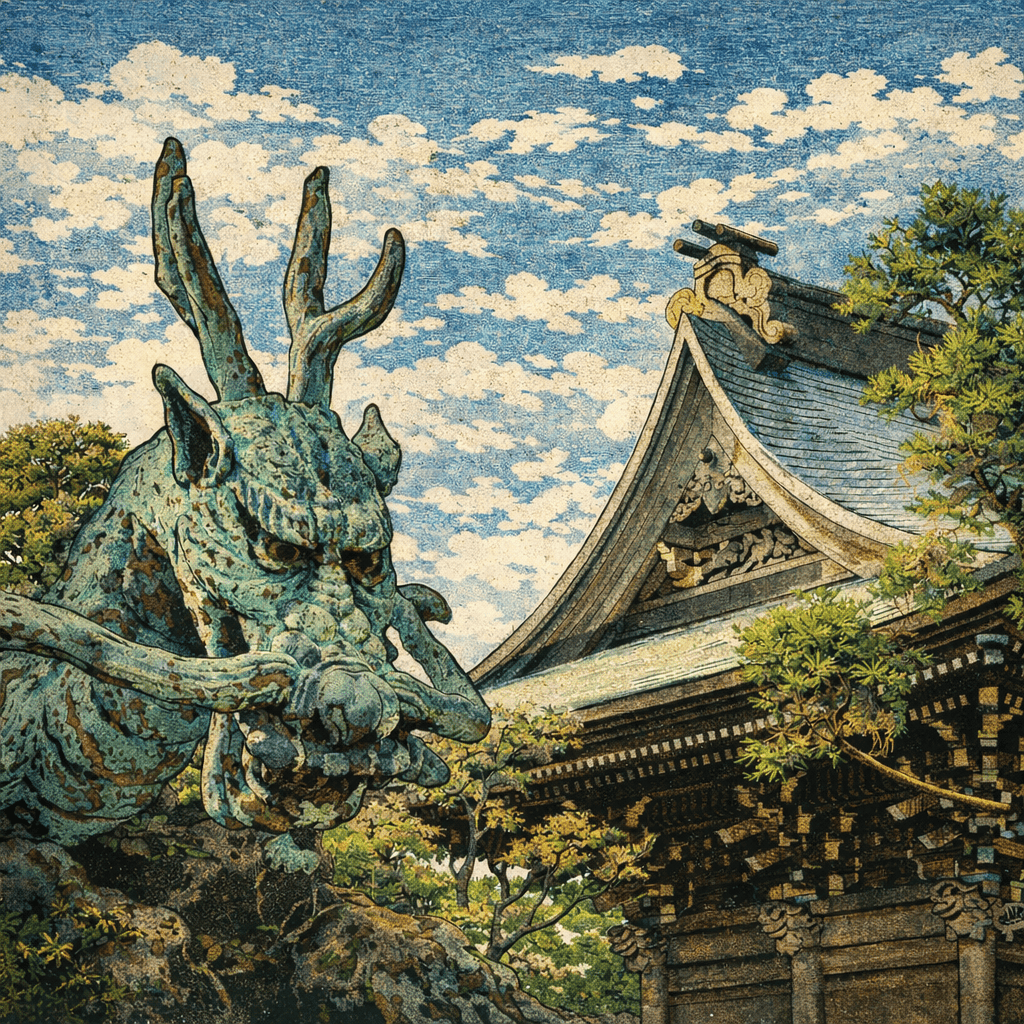
Wherever water moves in Japan, a dragon is assumed to be coiled somewhere near it. The country's sacred landscape is mapped not just by mountains and forests but by a hidden hydrology of serpent gods, each river mouth and mountain spring and volcanic lake understood as the lair of a presence older than the islands' written history. Waterfalls are dragon tongues. Springs are dragon eyes. The mist that rises from a valley floor before a summer storm is dragon breath made visible. To live on the Japanese archipelago has always meant living downstream from a dragon, and the shrines built to honor these serpent gods are not tourist destinations but bargaining tables, places where rice farmers and fishermen and emperors have come for fifteen centuries to ask the dragons for rain, for safe passage, for mercy from the waters that sustain them and could destroy them in a single night.
Walk into any Shinto shrine in Japan and your first ritual act will be to wash your hands and rinse your mouth at the chozuya, the water pavilion near the entrance. Look up at the spout the water flows from, and nine times out of ten, you will find yourself face to face with a dragon. A bronze or stone serpent, its mouth open, pouring clear water into the basin below. This is not decoration. This is the oldest and most widespread dragon shrine in Japan, replicated thirty thousand times across the archipelago, a quiet declaration that the water you are about to cleanse yourself with is not ordinary water but water that has passed through the mouth of a dragon, and is therefore sacred. Most visitors pass this dragon without ever seeing it. Those who look are rewarded with a glimpse of the underlying logic of Japanese religion: every purification is a dragon's gift.
The Japanese dragon is not an enemy. It is not the adversary of knights or the hoarder of treasure. In almost every surviving legend of the Japanese dragon's relationship with human beings, the dragon begins as a terror — a flood, a famine, a serpent in the rice field, a monster at the bottom of a lake — and is transformed, through the intervention of a holy figure or an act of devotion, into a guardian. The Japanese dragon is not slain. It is subjugated, and then honored, and then worshipped. It is a fearful force that has been persuaded, through centuries of ritual and prayer, to stand on the side of the people who feared it. The shrines in this guide are the physical expression of that bargain. Enter them knowing that the dragon is still there, still listening, still the source of the water that keeps you alive. This is The Yokai Files, and these are the six dragon shrines where the serpent gods still rule.
Why Dragons Became Gods
Before visiting the six sites, it is worth pausing to understand why the dragon, of all creatures, became one of the most venerated beings in Japanese religious tradition. The answer lies in a confluence of three separate spiritual streams that merged on the Japanese islands during the first millennium of the common era, each contributing a different layer to the composite figure we now call the Japanese dragon. Without this background, the shrines are merely picturesque. With it, they become what they actually are: architectural responses to a question about water that every Japanese community has had to answer since the first rice seed was planted in the first flooded paddy.
The Origins of the Japanese Dragon
The Japanese dragon is a hybrid creature with three ancestors. The first is the indigenous serpent-and-water kami of pre-Buddhist Japan, the folk spirits that populated the animist landscape before any organized religion arrived from the continent. These beings were not dragons in the iconographic sense but simply great snakes, mizuchi and orochi, powerful water serpents believed to inhabit rivers, pools, and flooded fields. They were dangerous, capricious, and often required human sacrifice to appease, as the famous legend of the Yamata no Orochi, the eight-headed serpent slain by Susanoo, makes clear. In the Kojiki and Nihon Shoki, the oldest surviving chronicles of Japanese mythology, Orochi demands maidens as tribute until the storm god intervenes, gets the monster drunk on rice wine, and hacks it apart to find the sacred sword Kusanagi hidden in its tail. The dragon, in this earliest layer, is something to be killed, or at best contained.
The second ancestor arrived from China. Chinese dragon lore, brought to Japan through trade, scholarship, and Daoist texts from at least the fourth century onward, introduced a radically different conception of the serpent: the long, a benevolent celestial being associated with the emperor, the rain, the four seasons, and cosmic order. The Chinese dragon was not a monster to be slain but a symbol of divine authority and natural harmony, the very embodiment of yang energy in motion. Japanese aristocrats, hungry for the prestige of continental culture, adopted the Chinese dragon wholesale for imperial regalia, courtly art, and architectural decoration. The writhing carved dragons that decorate shrine gates and temple ceilings across Japan are direct descendants of these Chinese imports, and the shift they introduced — from serpent as threat to dragon as guardian — was one of the great conceptual transformations in Japanese religious history.
The third ancestor was Buddhism. When Buddhist missionaries arrived in Japan in the sixth century, they brought with them a vast cosmology populated by beings from the Indian religious imagination, including the naga, serpent deities that protect the Buddhist teachings and rule the underwater realms. The most powerful of these, the eight great naga kings (hachi dai ryu-o), were integrated into Japanese Buddhist theology as protectors of the dharma and guardians of sacred sites. The naga were explicitly dragons in Japanese understanding, and their assimilation created the final synthesis: Japanese dragons became simultaneously indigenous water serpents, Chinese cosmic dragons, and Buddhist naga kings, all at once, depending on the context. This triple identity is why Japanese dragons can appear in a Shinto shrine, a Zen temple, and a fisherman's folk tale without any sense of contradiction. They have always been all three things.
For the farmers and fishermen who did the actual work of worshipping these beings, the theological distinctions mattered less than the practical reality: the dragon controlled the water. It could send rain or withhold it. It could flood the fields or leave them parched. It could stir the sea into a typhoon or allow a safe voyage home. The dragon was the god of survival in a civilization built on rice and coastal fishing, and the shrines dedicated to dragons were not abstract monuments to cosmology but concrete negotiations with the force that held the community's life in its jaws. Every drop of rain that fell on a rice paddy was understood as a gift that had been granted, not given, and the shrines were the receipts.
The Pattern of Subjugation
If you read the origin stories of Japan's major dragon shrines side by side, a striking pattern emerges. The legend almost always begins with a terror: a poisonous dragon ravaging a region, a serpent demanding human sacrifice, a flood that destroys the harvest, a beast at the bottom of a lake whose presence curses the surrounding villages. Then a figure arrives — sometimes a Buddhist monk, sometimes a Shinto priest, sometimes an emperor or a hero — and through prayer, ritual, or spiritual confrontation, subdues the dragon. Crucially, the subjugation is almost never lethal. The dragon is not killed. It is transformed. It accepts the bargain offered by the holy figure, swears an oath of protection, and from that moment forward becomes the guardian of the very community it once terrorized. A shrine is then built on the site, and the dragon receives offerings for the rest of recorded history.
This pattern, repeated at shrine after shrine across the archipelago, is the Japanese religious response to natural catastrophe. Rather than casting water disasters as random or malicious, the tradition interprets them as the actions of a powerful being that can, through the proper intervention, be enlisted as a protector. Drought becomes a dragon that has not been properly honored. Flood becomes a dragon that has been offended. Typhoon becomes a dragon that has not yet been tamed. The subjugation legend provides a template for reconciliation: whatever the water did to you, it can be persuaded to do the opposite if you build it a home and bring it offerings. The dragon shrines of Japan are, in this sense, the architectural embodiment of an ancient negotiation strategy, a cultural technology for turning enemies into allies.
There is something profoundly optimistic in this pattern, and something profoundly humble. It assumes that natural forces are intelligent enough to be reasoned with, and that human beings are small enough to need the help of a holy intermediary. It also assumes that the relationship between a community and its environment is not one of conquest but of ongoing negotiation, renewed at every festival, every prayer, every drop of water that flows from the chozuya dragon into the visitor's cupped hands. The dragon remembers the bargain. So, in theory, do the people.
The Dragons of the Chozuya
Return now to the water pavilion at the entrance of any Shinto shrine, and look again at the dragon whose mouth the water flows from. The reason it is a dragon, and not a fish or a turtle or a generic spout, is now clear. The dragon is there because water, in the Japanese religious framework, is a substance that only becomes sacred when it has passed through a dragon. The chozuya dragon is performing a transformation: ordinary water enters its mouth, and dragon-water comes out. When you rinse your hands and mouth, you are not washing yourself with water but with the concentrated essence of the dragon, the same divine fluid that rises from Mount Kurama in Kyoto and falls as rain on the rice fields of Niigata and crashes on the cliffs of Izumo.
This is why the chozuya ritual is mandatory before approaching the inner sanctuary. You cannot enter a sacred space with your ordinary body. You must first be touched by the dragon, even momentarily, even at the very edge of your fingertips and lips. The dragon's water burns away your impurity, the accumulated static of everyday life, and makes you briefly fit to stand before the kami. Every shrine entrance in Japan is, in effect, an outpost of the dragon gods, and every visitor passes through the dragon's mouth before they are allowed to approach anything more sacred. That most people do not know this changes nothing. The ritual works on the unknowing as well as on the initiated, and the dragon does not require belief to grant its blessing. It requires only the water, and the gesture, and the willingness to be purified.
The Six Sacred Dragon Sites of Japan
The six sites described below are among the most spiritually potent dragon shrines in Japan, selected to represent the full geographic and theological range of Japanese dragon worship. They include an island shrine built on a sea cave where the dragon's roar is said to still echo, a mountain shrine sealed above the cold waters of a volcanic lake, a Kyoto sanctuary whose inner chamber sits directly above a sacred dragon hole, a Tokyo shrine arranged according to the five-element cosmology with a different colored dragon at each compass point, a cliff-face temple whose main hall is fused into a living rock wall, and a forgotten corner of Japan's most famous Inari shrine where stone dragons take the place of foxes at the gate. Together, they form a map of how the Japanese imagination has housed its dragons, and how the dragons, in return, have agreed to be housed.
Location: Fujisawa, Kanagawa Prefecture
Dragon Connection: Gozuryu, the Five-Headed Dragon
Enoshima Shrine stands on a small tidal island off the Shonan coast south of Tokyo, a place where the boundary between land and sea has always been understood as unusually thin. The shrine was founded in 552 CE by imperial command of Emperor Kinmei, making it one of the oldest recorded religious sites in the Kanto region, and its founding legend is the most vivid dragon-subjugation story in Japanese folk memory. A monstrous five-headed dragon, the Gozuryu, had long terrorized the villages of the nearby Kamakura plain, demanding child sacrifices and ravaging the coastline with storms. Then one day the heavenly maiden Benzaiten descended from the clouds and raised Enoshima Island out of the sea in a single miraculous gesture. The dragon, upon seeing her, was consumed by love. He begged to marry her. Benzaiten refused until the dragon swore to abandon his evil ways, and when he agreed, she accepted his devotion. The dragon kept his oath. When he died of grief at their eventual parting, his body transformed into Katase-yama, the hill that rises across the narrow channel from Enoshima, where it still watches the island to this day.
The shrine is in fact a complex of three sub-shrines (Hetsunomiya, Nakatsunomiya, and Okutsunomiya) spread across the island, each dedicated to one of the three Munakata goddesses and collectively known as Enoshima Shrine. The entrance is the Zuishinmon, a vermillion gate modeled on the legendary undersea palace of Ryugu, the dragon king's residence beneath the waves. Walking through it is a deliberate evocation of descending into the dragon's realm. The main hall of Hetsunomiya is called Wadatsumi no Miya, the "Shrine of the Sea God," a direct acknowledgment that Enoshima exists under the dragon's jurisdiction. Benzaiten, now syncretized with the Shinto goddess Ichikishima-hime, is enshrined in her famous Hadaka Benten form inside the Hoanden hall, a rare naked statue carved in the Kamakura period.
The true heart of Enoshima, however, lies at its western tip, where the Iwaya sea caves open into the cliff face above the crashing surf. The Iwaya consist of two caves: Dai-ichi Iwaya, extending 152 meters into the rock, and Dai-ni Iwaya, which terminates in a small chamber housing a dragon altar. Visitors enter by candlelight, carrying small lanterns handed out at the entrance, and proceed in near darkness through passages that twist and narrow until the sound of the sea outside becomes muffled and the only light comes from the flickering flame in your hand. At the farthest point of Dai-ni Iwaya, the dragon shrine waits. A life-sized stone dragon coils in the chamber, and at regular intervals, a recorded roar amplified by the cave acoustics fills the space with a sound that feels less like a recording than like something the rock itself is producing. A projection mapping display illuminates the dragon every fifteen minutes, bathing it in shifting blue and gold light. The effect is theatrical, but it is also something older than theater. It is the dragon being seen, for a moment, in the last place on the island where the candlelight reaches.
Outside the caves, a short walk brings you to the Ryuren no Kane, the "Dragon's Love Bell," where couples ring the bronze bell and attach padlocks to the surrounding fence in reenactment of Gozuryu's devotion to Benzaiten. The view from this point sweeps across the Sagami Bay toward Kamakura and, on clear days, Mount Fuji, a panorama that frames the entire dragon legend in its original geography. The dragon still lives here, or so the local fishermen will tell you. They just call him by a different name now.
Access: Odakyu Line to Katase-Enoshima Station, then 15 to 23 minutes on foot across the Benten Bridge and through the main approach.
Location: Hakone, Kanagawa Prefecture
Dragon Connection: Kuzuryu, the Nine-Headed Dragon of Lake Ashi
Kuzuryu Shrine, "Nine-Headed Dragon Shrine," stands on the shore of Lake Ashi in Hakone, and its founding legend is one of the most famous dragon-subjugation stories in Japanese Buddhist history. During the Nara period, the ascetic monk Mangan Shonin traveled to Hakone, a region of volcanic hot springs and caldera lakes where a monstrous nine-headed dragon had long preyed on the local villagers. The dragon demanded human sacrifices from the communities around the lake, and the waters of Ashi were believed to be poisoned by its venom. Mangan Shonin confronted the beast in a feat of spiritual warfare that lasted days, binding it with sutras and sealing it beneath a sacred rock on the lakeshore. Rather than destroying the dragon, however, he converted it. He extracted an oath from the subdued serpent, bound it into the service of the Hakone deities, and from that moment the Nine-Headed Dragon became the guardian spirit of Lake Ashi and the protector of everyone who crossed its waters.
The shrine complex is divided into two parts: the Hongu (main shrine) on the wooded shore of Lake Ashi, reached by a thirty-minute walk through the Kuzuryu no Mori forest or by a dedicated shrine boat, and the Shingu (new shrine) in the grounds of the larger Hakone Shrine complex, established for visitors who cannot make the longer pilgrimage. Both are dedicated to the same subdued dragon. At the Shingu, nine stone dragon heads continuously pour water from their mouths into a large stone basin. This water, known as Ryujin-sui or "dragon god water," is drinkable and is collected by pilgrims in bottles brought specifically for the purpose. The water is said to grant blessings for love and relationships, and many visitors make the journey here specifically to fill empty bottles at the nine dragon spouts before praying at the main hall.
The Hongu, the original shrine on the remote shore, is a simpler structure that rewards the longer walk with a profound sense of isolation. Here the lake is close at hand, Mount Hakone rises into the clouds to the west, and the famous Heiwa no Torii, the floating "Torii of Peace," can sometimes be glimpsed through the trees, red against the grey-blue of the water. On clear mornings, Mount Fuji is reflected in the lake's surface with a stillness that explains immediately why this place has been considered holy for over a thousand years. The monthly Tsukinamisai ritual, held on the thirteenth of every month, is the shrine's most significant observance. During Tsukinamisai, a flotilla of pilgrim boats crosses the lake at dawn to the Hongu for a dedicated ceremony invoking the Nine-Headed Dragon's blessings, a tradition that has drawn worshippers including Minamoto no Yoritomo in the twelfth century and Tokugawa Ieyasu in the seventeenth. Both of these men came here before unifying Japan, and both credited the dragon with protecting their campaigns.
Hakone is also a geological reminder of why the dragon was installed here in the first place. The entire region sits inside the caldera of an ancient volcano, and the surrounding mountains still steam and hiss with hot springs, sulfurous vents, and the occasional minor earthquake. Lake Ashi itself was formed by the eruption that collapsed the original peak. In this landscape, the choice of a water dragon as guardian is not metaphorical. The volcanic heat beneath the lake is the dragon's breath. The sulfur smell from the vents of Owakudani is its scent. The shrine is the place where this elemental danger has been contained by a thousand years of continuous prayer.
Access: Hakone-Yumoto Station, then bus approximately one hour and five minutes to Motohakone-ko. The Shingu is a short walk from the Hakone Shrine precincts; the Hongu requires an additional 30 minutes on foot through the Kuzuryu no Mori or a shrine boat during the monthly festival.
Location: Sakyo Ward, Kyoto
Dragon Connection: Takaokami no Kami and Kuraokami no Kami, the high and hidden dragon gods of water
Kifune Shrine is the head shrine of approximately two thousand subordinate water shrines across Japan, and arguably the most important water-related sanctuary in the entire Shinto system. Its founding date is unknown, lost in the prehistoric layers of Japanese folk religion, but tradition holds that it was established in the age of Emperor Jinmu, the legendary first emperor of Japan. The origin legend tells of Tamayori-hime, a princess of the sea, who sailed in a yellow boat from Naniwa (modern Osaka) up the rivers toward the mountains, following a current that led her deeper and deeper into the forested valleys north of Kyoto. She came to rest at a spring where the river began, and declared that a shrine should be built there. The name Kifune is said to derive from ki-fune, "yellow boat," or alternately from ki-no-ne, "the root where ki energy is born." Either etymology points to the same essential truth: this is the place where the sacred water begins.
The deities enshrined here are the two forms of the dragon god of water. Takaokami no Kami, the "high Okami," is the dragon of the high places, the rains that fall on mountain peaks and feed the streams. Kuraokami no Kami, the "dark Okami," is the dragon of the hidden places, the waters that flow underground through the valleys before emerging as springs. Together they govern the entire hydrological cycle, and together they are the reason Kifune is considered the spiritual source of the Kamo River, which flows through the heart of Kyoto all the way to the sea. For over a thousand years, whenever drought struck the capital, imperial envoys were dispatched to Kifune to pray for rain, offering a black horse on the altar as a symbol of storm clouds. When floods threatened, a white horse was offered instead, asking the dragons to hold back the waters. These offerings are the direct ancestors of the modern ema, the wooden prayer plaques sold at every shrine in Japan today. The ema tradition begins here, at the shrine of the dragons of rain.
The shrine complex is divided into three sanctuaries arranged along the valley. The Honguu, the main hall, is the point of entry, and its approach — a steep stone staircase lined with vermillion lanterns that burn softly against the dark green of the forest — is one of the most photographed religious images in all of Japan. The Yui-no-yashiro, the middle shrine, is dedicated to matchmaking and enduring relationships. The Oku-no-miya, the innermost sanctuary, is where the deepest secret of Kifune lies hidden. Directly beneath the main hall of the Oku-no-miya is a large cavity known as the Ryuketsu, the "Dragon Hole," a natural fissure in the earth that is said to be the actual dwelling place of the dragon god. The Ryuketsu has never been opened for inspection. Tradition forbids it. The one recorded attempt, during a renovation in the medieval period, reportedly ended when the workers were driven back by a supernatural wind and a roaring sound from the depths. The hall above was rebuilt, the hole remains sealed, and the dragon remains inside.
In summer, Kifune is famous throughout Japan for the kawadoko, wooden platforms built directly over the cold mountain river, where diners eat elaborate multi-course meals while the water flows inches beneath their feet. It is the most literal possible expression of the shrine's relationship with the dragon: you eat, you drink, you rest, and the dragon's river carries the heat of the day away beneath you. In winter, the same path is sometimes blanketed in snow, and the red lanterns against the white create an image of such stillness that the valley itself seems to be listening for the dragon's breath. Few sacred places in Japan are as complete in every season.
Access: Eizan Electric Railway to Kibune-guchi Station, then approximately 20 minutes on foot up the valley road (buses available during peak season).
Location: Fushimi Ward, Kyoto
Dragon Connection: Ryuto Daijin, Hachidai Ryuo Daijin, Hakuryu Daijin — the dragon kings of the mountain above Fushimi Inari
Fushimi Kandakara Shrine is one of the strangest and most overlooked sacred sites in Kyoto, a small sanctuary hidden in the forest above the thronging vermillion corridors of Fushimi Inari Taisha. The shrine predates its more famous neighbor: it was already established on the slopes of Mount Inari when the Hata clan enshrined Inari at what is now the Taisha in 711 CE. Most of the millions of tourists who climb the torii path toward the mountain's summit never find Kandakara. Those who do discover something unique in the entire country: a shrine where stone guardian dragons take the place of the more familiar komainu (guardian lion-dogs) or foxes. Kandakara is, in the most literal sense, "the shrine of the koma-ryu."
The main hall (honden) enshrines a trinity of deities: Amaterasu Omikami, the sun goddess; Inari no Okami, the rice deity; and the Tokusa no Kandakara, the "ten sacred treasures," a set of divine objects from ancient Japanese mythology said to possess powers of healing and resurrection. But the shrine's true identity is revealed when you look to the left of the main hall. There, built into a small auxiliary sanctuary, is the shrine of Ryuto Daijin, the "Great Dragon Head God," with a carved dragon statue presiding over the altar. A little further along the path are two additional dragon shrines: Hachidai Ryuo Daijin, the "Great Eight Dragon King God," and Hakuryu Daijin, the "Great White Dragon God." Taken together, the Kandakara precinct contains more dragon deities in close proximity than any other shrine in the Fushimi area, and quite possibly in all of Kyoto.
To reach Kandakara, you must first climb the main torii path of Fushimi Inari, passing through the initial senbon torii and continuing up to the Okusha Hohaijo, the outer worship hall. From there, a small side path branches off to the left, leading deeper into the forest. The signage is minimal, and most visitors walk past without noticing the diversion. If you take it, you will find yourself on a quiet forest trail lined with older, weathered stones, far from the tourist currents of the main approach. A short walk brings you to a landmark called the Neagari no Matsu, the "Root-Risen Pine," and directly opposite it, tucked against the slope of the mountain, is Kandakara. The silence here is striking after the bustle of the lower shrine. The dragons guarding the entrance look at you as if they are used to being alone.
Visitors who approach Kandakara often come for a specific purpose. The shrine is famous in Japanese esoteric circles for its amulets tied to dragon energy, and for a particular goshuin (shrine seal) that features a magnificent hand-painted dragon. The head priestess, when in residence, personally inks the dragon design onto the goshuin-cho of pilgrims who arrive during open hours, and the result is considered one of the most beautiful shrine stamps available in Kyoto. The combination of solitude, rare iconography, and hidden location makes Kandakara a pilgrimage destination for those who seek out the quieter corners of Japanese religious geography. It is a reminder that even at Fushimi Inari, the most photographed shrine in Japan, there are still sacred precincts where the foxes have stepped aside and let the dragons take the gate.
Access: JR Nara Line to Inari Station, then climb the main torii path of Fushimi Inari Taisha to the Okusha Hohaijo (approximately 15 minutes), then follow the side path to the left past the Neagari no Matsu.
Location: Nishi-Tokyo, Tokyo
Dragon Connection: Five dragon gods of the five elements and five directions
Tanashi Shrine is the only dragon shrine in Japan where all five of the cosmological dragon colors are simultaneously enshrined, each in its own sanctuary oriented toward the compass direction it governs, according to the Chinese wuxing (five-element) theory that permeated esoteric Buddhism and later Shinto thought. Founded in the Kamakura period and originally venerated as Joden Daigongen, the shrine was a local religious center in what was then the rural farming community of Tanashi, west of Edo. Over the centuries the shrine absorbed multiple waves of influence — Shinto folk religion, esoteric Buddhism, Chinese geomancy, onmyodo divination — and by the late Edo period had crystallized into something unique: a working cosmological diagram, a shrine in which the dragon has been divided into five forms and deployed across the grounds to protect the center by holding the four quarters of the world.
The configuration works like this. At the exact center of the shrine, housed within the main hall, is the Kinryu, the Golden Dragon God, who governs fortune in matters of business, competition, and financial success. The Golden Dragon is the supreme figure of the five, the axis around which the others revolve. To the east stands the Seiryu, the Azure Dragon, whose element is wood and whose blessings concern health, vitality, and the freshness of youth. To the south is the Sekiryu, the Red Dragon, whose element is fire and whose domain is love, passion, and the warmth of human relationships. To the west is the Hakuryu, the White Dragon, whose element is metal and whose authority covers craftsmanship, artistic expression, and skilled labor. And to the north is the Kokuryu, the Black Dragon, whose element is water and whose blessings concern longevity, wisdom, and the depth of knowledge that comes with age.
Each of the five dragons is represented by a statue colored in its signature hue, placed at its corresponding point of the grounds, and each has its own set of offerings and amulets. The shrine sells five-colored o-mamori (protective charms), five-colored omikuji (fortune slips), and a complete set of five-dragon goshuin stamps that together form a compass map of blessings. Visitors often perform a circuit pilgrimage, walking from the center outward to each of the four directions in turn, greeting each dragon in sequence, and completing the journey back at the Golden Dragon in the center. The effect is of walking through a mandala on the surface of the earth, the shrine functioning as a three-dimensional diagram of the cosmos with the worshipper at its spiritual core.
The power of Tanashi Shrine is not the drama of Enoshima's sea cave or the isolation of Kifune's valley. It is conceptual: a working model of how the Japanese religious imagination organizes reality. And because Tanashi sits only a short ride from central Tokyo, it is the most accessible of the major dragon shrines for residents of the capital and for travelers whose itineraries will not reach further afield. You can visit Tanashi in a morning, walk its mandala from center to east to south to west to north and back again, and carry home a complete set of five-colored charms to hang in the five corresponding corners of your home. It is, in effect, a portable cosmology. And the dragons, patient and colorful, are waiting to be deployed.
Access: Seibu Shinjuku Line to Tanashi Station, then approximately 8 minutes on foot.
Location: Takasaki, Gunma Prefecture
Dragon Connection: The dragon spirits of Mount Haruna and Lake Haruna
Haruna Shrine, founded in the sixth century during the reign of Emperor Yomei, is the most architecturally extraordinary dragon shrine in Japan, and possibly the most dramatically sited shrine of any kind in the country. It stands in the deep forests of Mount Haruna in Gunma Prefecture, a dormant volcano whose crater lake, Lake Haruna, is considered one of the most sacred bodies of water in the Kanto region. The shrine honors multiple deities including Honoikazuchi no Kami, the fire-thunder kami, and Haniyama-hime no Kami, the earth-mountain goddess, but it is understood by local tradition and popular belief as the dwelling place of the Haruna dragon, the guardian spirit who connects the volcanic heat beneath the mountain with the cold deep water of the lake above.
The approach to Haruna is an experience in itself. From the outer torii, a path nearly a kilometer long winds through a gorge so narrow that the cliff walls rise vertically on both sides, pressing the pilgrim into a single route like a narrow birth canal cut into the mountain. Along this path, sacred features appear one after another: the Misogi-bashi, a small bridge where visitors pause to symbolically purify themselves before continuing; the Heishi no Taki, a slender waterfall whose name means "Sake Bottle Falls" for the shape of the vessel it resembles; the towering Hoko-iwa and Eboshi-iwa, two natural stone pillars named for the spears and courtier caps they recall; and the Sekison-iwa, an enormous boulder wedged between cliff faces that locals call one of the most powerful points of spiritual energy in all of Gunma. The entire approach is a slow accumulation of sacred pressure, each element adding to the sense that the space you are entering is not ordinary ground.
The shrine's main hall, rebuilt in 1806 and designated as an Important Cultural Property of Japan, is where the architecture achieves something without parallel. The honden is fused directly into the base of a colossal stone formation called the Mimochi-iwa, the "Body-Holding Rock," which rises vertically behind the hall like a stone wave frozen in mid-crash. The structural wooden elements of the shrine are physically embedded into the cliff face, so that the hall and the mountain are, in the most literal architectural sense, one continuous body. Where other shrines stand before their sacred mountain, Haruna is the sacred mountain, expressed in carved wood and tiled roof where the stone permits, and expressed in bare rock where it does not. The dragon said to inhabit this precinct is not imagined as a creature that visits the shrine. The shrine is the dragon, or at least the dragon's visible surface. The rest is hidden in the stone.
Haruna also preserves one of the more haunting local legends of dragon transformation, the tale of Kibe-hime. A young woman from the village beneath the mountain fell in love with a mysterious stranger who appeared only at night, and discovered that her lover was in truth a dragon of Lake Haruna who had assumed human form to court her. When the secret was uncovered and the lovers could no longer meet, Kibe-hime threw herself into the lake, where the dragon accepted her as his bride, and the two have remained joined in the deep water ever since. On clear days, when the light strikes the lake from the right angle, locals say you can still see the couple's shadow beneath the surface. The story belongs to the same ancient pattern of dragon-human intimacy that shaped Enoshima's founding legend, and its presence at Haruna adds one more layer to a shrine that is already dense with meaning.
Access: JR Takasaki Station, then bus approximately 80 minutes to the Haruna Jinja-mae stop, then a short walk through the approach gorge to the main hall.
How to Read the Dragon
Number of claws:The most immediate visual distinction between the Japanese dragon and its continental cousins is the number of claws on each foot. The imperial Chinese dragon, reserved historically for the emperor's use, has five claws. The Korean dragon typically has four. The Japanese dragon has three, and occasionally four in later depictions influenced by continental art. This is not an accident of carving but a deliberate iconographic rule, and it reflects the Japanese sense that their dragon is simpler, more primal, and closer to the original serpent form than its more politically elaborated relatives across the sea. When you see a three-clawed dragon carved into the pillars of a Japanese shrine, you are looking at an indigenous form that has held its shape against a thousand years of continental pressure.
The jewel (nyoi-hoju):The round or teardrop-shaped gem often held in a dragon's claw, displayed on an altar, or perched atop a ceiling carving, is the nyoi-hoju, the wish-fulfilling jewel adapted from Indian Buddhist tradition via the cintamani. It represents the dragon's authority to grant any desire, and it is also understood as a vessel for the dragon's concentrated spiritual essence, analogous to the hoshi-no-tama of the fox spirits. A dragon holding the nyoi-hoju is a dragon displaying its full divine power. Ask accordingly.
Open and closed mouths (A-Un):Paired dragon statues at shrine entrances often follow the A-Un convention familiar from komainu guardian dogs: one figure with its mouth open, forming the sound "a" (the first syllable of the Sanskrit alphabet), and the other with its mouth closed, forming the sound "un" (the last syllable). Together they enclose the entire universe of speech, meaning, and existence between them. The open-mouthed dragon represents the beginning of all things. The closed-mouthed dragon represents their end. Standing between them, you are, for a moment, inside the complete sphere of creation.
Water-spouting dragons: The dragons that pour water from the chozuya at nearly every shrine in Japan are the most common dragon image in the country, encountered by more people every day than any other religious icon. Their role is to transform ordinary water into sacred water, the liquid instrument of purification that every visitor must touch before approaching the inner precincts. Once you have met the great dragons of Enoshima, Hakone, Kifune, Kandakara, Tanashi, and Haruna, the chozuya dragon becomes legible in a new way: it is the same being, scaled down, repeated endlessly, quietly doing the work that keeps the whole Japanese religious system running. For related traditions on animal guardians at shrine entrances, see our guide to Kitsune Shrines of Japan, and for the mountain spirit tradition that often overlaps with dragon worship, visit the full guide to Kurama Temple.
Conclusion
The dragon did not vanish from Japan. It was persuaded, argued with, bound by sutras, sealed into lakes, enshrined in cliffs, and divided into five colors pointing at the four corners of the world. Every one of those bargains is still in force. The water still flows from the chozuya. The nine dragon heads at Hakone still pour their cold clear blessing into the stone basin. The sealed Ryuketsu beneath Kifune's Oku-no-miya has never been opened, and the rock at Haruna has never given up its embedded honden. The subjugation legends at each of these sites are not quaint folk stories retained for tourist appeal. They are active treaties, re-ratified every time a priest rings a bell, every time a visitor claps their hands before the altar, every time a drop of water passes through a dragon's mouth on the way to a pilgrim's cupped hands.
To visit these shrines is to step, for a moment, into the older logic of the Japanese landscape, the one in which mountains have moods and rivers have memories and the things that live in water are not to be trifled with. You do not need to believe in literal dragons to feel the force of this logic. You only need to stand on the cliff at Enoshima with the sea wind in your face, or follow the vermillion lanterns up the gorge at Kifune, or place your hand on the cold stone of Haruna's embedded hall, and recognize that something older than you has been watching this spot for longer than any human civilization can account for. The serpent is in the water. The water is in the land. The land is alive. This is The Yokai Files.
This is The Yokai Files.
Support The Yokai Files
Enjoyed this deep dive into Japanese folklore?
The Yokai Files is reader-supported. Your support helps us research deeper, write more, and keep the darkness alive.