Enoshima Shrine: Where the Five-Headed Dragon Fell in Love with a Goddess
Published: April 10, 2026
There is a small island at the southern edge of Kanagawa Prefecture where the sea remembers a love story older than any reliable date in Japanese history. The island rises abruptly from the waters of Sagami Bay, a rocky mass crowned with forest and ringed with sea caves that the Pacific has been carving for millennia. The name is Enoshima, and every inch of it, from the vermillion gate at the entrance to the cold dragon altar at the back of the deepest cave, belongs to a shrine that was founded in 552 CE by imperial decree and has never closed since. It is one of the oldest continuously operating religious sites in the Kanto region, and its entire identity is built around the memory of a five-headed dragon who was persuaded, by the love of a goddess, to stop being a monster.
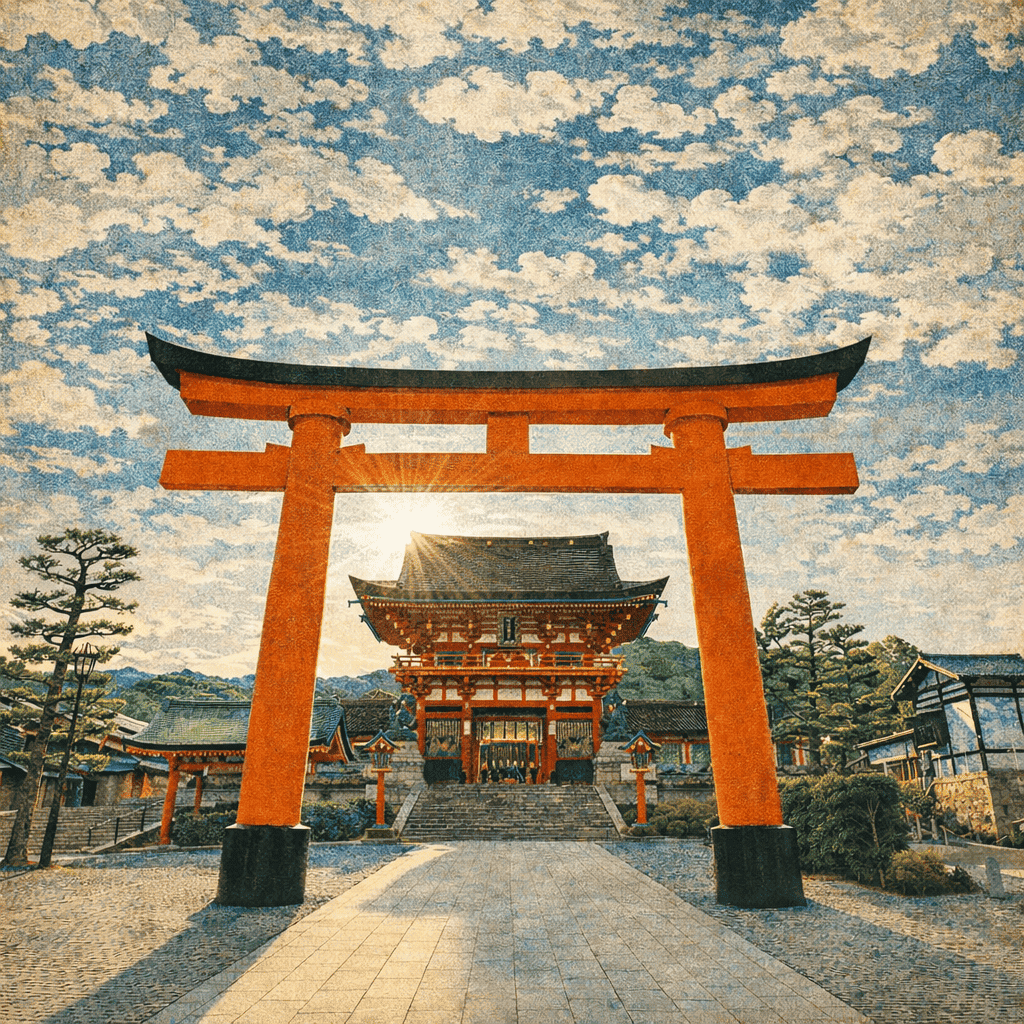
Most visitors to Enoshima never learn why the island exists. They come for the views, the seafood restaurants, the summer beaches across the bridge, the Samuel Cocking botanical garden at the summit, the observation tower with its panorama of Mount Fuji on clear mornings. They pass beneath the vermillion gate of the shrine, pause for a photograph, and continue on to whatever brought them here. But the gate is not decorative. It is called Zuishinmon, and it is modeled on the undersea palace of the dragon king. To walk through it is to descend, symbolically, into the realm of the sea serpent whose oath of protection still binds this coast to the shrine that enshrines his beloved.
This guide will take you through Enoshima Shrine the way it was meant to be experienced: as a pilgrimage along the length of a dragon's memory. You will meet Benzaiten, the goddess who descended from heaven to raise the island out of the sea. You will walk the paths of the three sub-shrines that collectively form Enoshima Jinja. And at the far end of the island, where the land falls away into the surf, you will enter the Iwaya sea caves by candlelight and stand at the dragon's altar, where the rock itself still roars.
The Yokai Connection
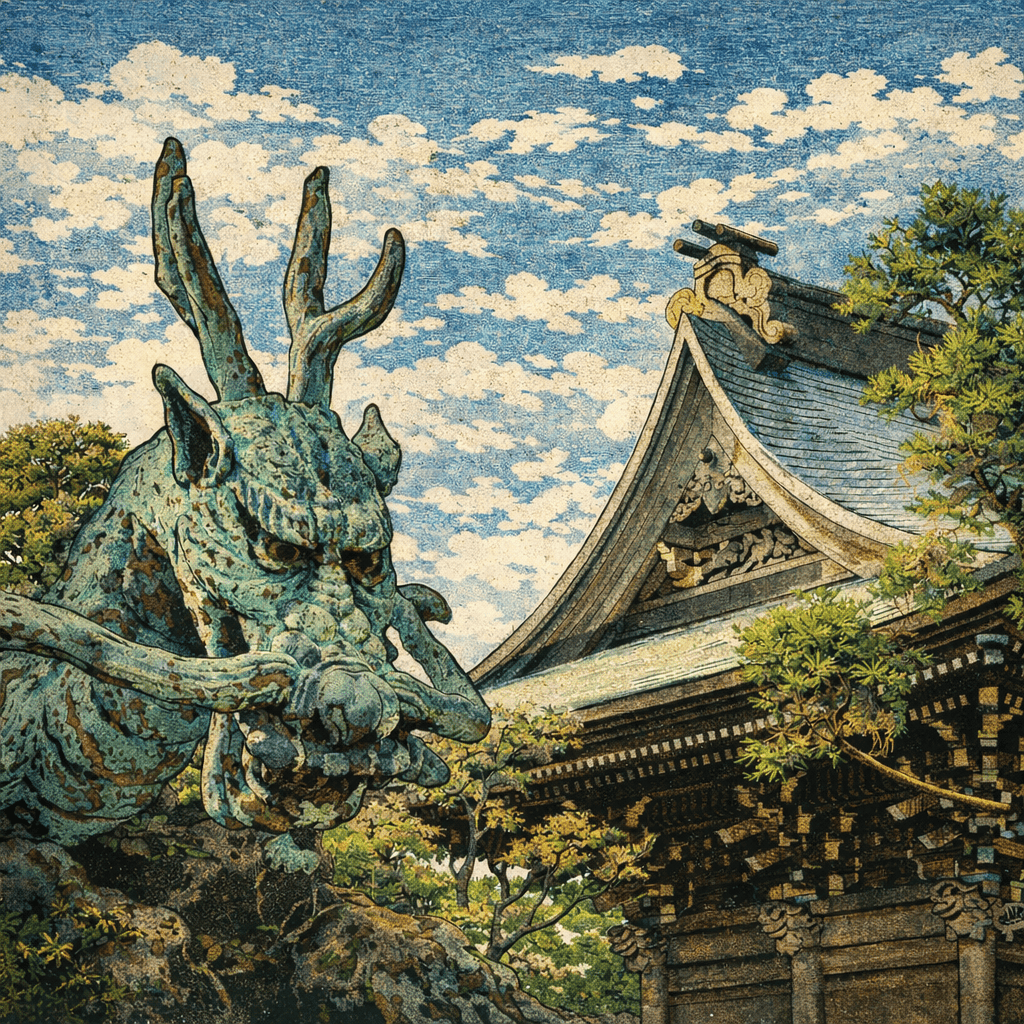
The dragon of Enoshima is called Gozuryu, the Five-Headed Dragon, and he is one of the most vividly remembered water serpents in all of Japanese folklore. In the earliest layers of the legend, he is not a guardian but a terror. He prowls the bay and preys on the villages of the Kamakura plain, demanding child sacrifices and stirring typhoons against the fishing boats. He is described as a single body with five monstrous heads, a creature so large that his coils could darken the entire sea. The people of the region lived in fear of him for generations. Then the goddess Benzaiten, the heavenly maiden who in Japanese tradition became syncretized with the Shinto deity Ichikishima-hime, descended from the clouds. With a single miraculous gesture, she raised Enoshima Island from the seabed, and upon it she stood.
Gozuryu saw her and fell in love. The monster who had taken so many lives begged the goddess to become his bride. Benzaiten refused, telling him that a being who devoured children could never be her consort. Gozuryu then did the thing that makes the story one of the most important in Japanese religious history: he renounced his evil ways. He swore an oath, on every one of his five heads, to protect the villages he had once terrorized, to hold back the storms he had once summoned, and to serve as guardian of the coast for as long as the sea kept moving. Benzaiten, moved by his sincerity, accepted his devotion. When Gozuryu eventually died of grief at their parting, his body transformed into Katase-yama, the hill that still rises across the narrow channel from Enoshima, and where he lies, he still watches.
This pattern — the dangerous serpent converted by holy intervention into a guardian god — is the single most important pattern in Japanese dragon worship. For a deeper exploration of how this logic shaped sacred sites across the archipelago, see our full guide to Dragon Shrines of Japan. Enoshima is where that pattern is most vividly inscribed into the physical geography: the goddess above, the dragon below, the island between, the hill on the far shore where the dragon's body became the land itself.
History
Enoshima Shrine was founded in 552 CE, according to tradition, by imperial command of Emperor Kinmei, the twenty-ninth sovereign of Japan. The emperor is said to have been directly inspired by the Gozuryu legend and ordered the establishment of a sanctuary at the sea caves where the dragon's oath had been sworn. This makes Enoshima one of the very oldest recorded religious sites in the entire Kanto region, predating the capital at Kamakura by nearly seven centuries and the city of Edo by more than a thousand years. For most of its history, the shrine was a syncretic institution in which Shinto worship and Buddhist devotion to Benzaiten existed in perfect unity, a common arrangement in pre-modern Japan that was only formally separated during the Meiji restoration.
The shrine rose to national prominence during the Kamakura period (1185–1333), when the military government of the Minamoto clan elevated Enoshima into one of the most important spiritual sites in eastern Japan. Minamoto no Yoritomo, the first shogun of the Kamakura bakufu, made pilgrimages to the island and commissioned the famous Hadaka Benten statue, a rare naked figure of Benzaiten still enshrined in the Hoanden hall of the shrine today. The statue is considered one of the three great Benzaiten images of Japan, and it is a masterpiece of Kamakura-period wood carving whose elegance still stops visitors in their tracks more than eight hundred years after it was made.
Over the subsequent centuries, the shrine survived earthquakes, typhoons, warfare, and the violent religious reorganizations of the Meiji period, when Buddhist and Shinto elements were forcibly separated across Japan. At Enoshima, this separation meant a reorganization of the shrine complex into its three current sub-shrines — Hetsunomiya, Nakatsunomiya, and Okutsunomiya — each dedicated to one of the three Munakata goddesses who were officially identified with the previously syncretized Benzaiten figure. The dragon cult, however, was never displaced. It remained central to the shrine's identity throughout every institutional change, and today the serpent is arguably more visible in the shrine's iconography and tourism than at any previous moment in its history.
What to See
Enoshima Shrine is not a single building but a sacred network spread across the entire island. A complete pilgrimage begins at the foot of the slope, climbs past the first sub-shrine, continues through the middle shrine, reaches the inner sanctuary near the summit, and finally descends to the sea caves at the far side of the island, where the dragon waits.
The first major structure the pilgrim encounters on Enoshima is the Zuishinmon, a vermillion two-story gate that stands at the base of the climb to the shrine. The gate is a deliberate architectural reference to Ryugu, the legendary undersea palace of the dragon king. Its ornate eaves, its bright red lacquer, its curving roofline — all are designed to evoke the moment when a human being walks out of the ordinary world and into the realm of the water gods. Passing beneath it, you are symbolically leaving the mainland and entering a sacred space where the dragon's jurisdiction applies.
Just beyond the gate, the main hall of the first sub-shrine, Hetsunomiya, is known by a second and more telling name: Wadatsumi no Miya, the "Shrine of the Sea God." Wadatsumi is the ancient Japanese kami of the ocean, and the naming is a direct acknowledgment that Enoshima exists under the authority of the sea deities. Inside the hall, Benzaiten is enshrined in her Hadaka Benten form, the naked Kamakura-period statue that Minamoto no Yoritomo commissioned eight centuries ago. To stand before her is to stand in front of the goddess who tamed the dragon whose bones became the hill across the water.
The true heart of Enoshima, and the place every serious pilgrim makes the effort to reach, is the Iwaya sea caves on the far western tip of the island. The caves are carved into the cliff face above the crashing Pacific surf, and they come in two parts. Dai-ichi Iwaya extends approximately 152 meters into the rock and contains historical religious artifacts, carved Buddhist statues, and interpretive displays that trace the cave's centuries of use as a place of meditation and ascetic training. Dai-ni Iwaya, the second cave, is shorter but infinitely more atmospheric, terminating in a chamber that houses the dragon altar at the very end of the Enoshima pilgrimage route.
Visitors enter the caves by candlelight. Small lanterns are distributed at the entrance, and the passage narrows immediately into a dark, winding corridor where the only source of illumination is the flickering flame in your hand and the slow drip of water from the ceiling. The sound of the sea outside becomes muffled, then distant, then almost entirely gone. At the farthest point of Dai-ni Iwaya, the dragon shrine waits. A life-sized stone dragon coils in the chamber, its carved scales wet with cave moisture, its open mouth suggesting either a warning or a song. At regular intervals, a recorded dragon roar amplified by the cave acoustics rolls through the chamber, and every fifteen minutes a projection mapping display bathes the statue in shifting blue and gold light. The effect is theatrical, but it is also something older than theater: it is the dragon being seen, for one moment, in the last place on the island where the candlelight reaches.
Bring your own candle, your own sense of occasion, and whatever prayer you have brought with you to the island. This is where the pilgrimage concludes and where the oath the dragon swore fifteen hundred years ago is most palpably still in force.
A short walk from the Iwaya caves brings visitors to the Ryuren no Kane, the "Dragon's Love Bell," a small bronze bell hanging in a stone pavilion on a cliff high above the sea. The bell exists to commemorate the moment in the Gozuryu legend when the dragon and Benzaiten accepted each other, and local tradition holds that couples who ring the bell together will be bound to each other as surely as the dragon was bound to the goddess. The fence surrounding the pavilion is hung with thousands of small padlocks inscribed with lovers' names, a practice that has become one of the defining images of Enoshima in contemporary Japanese popular culture.
The view from this point is one of the most sweeping panoramas on the island, arcing across Sagami Bay toward Kamakura and, on clear days, to the snow-capped cone of Mount Fuji on the western horizon. It is the frame in which the entire dragon legend was originally set, and standing at the bell with the wind in your face, you can see every landmark of the story at once.
Enoshima Shrine is not one shrine but three, collectively known as the Sanja Meguri, the "Three Shrine Pilgrimage." Hetsunomiya, the shore shrine, stands near the base of the climb and enshrines Tagitsuhime no Mikoto, one of the three Munakata sea goddesses. Nakatsunomiya, the middle shrine, is halfway up the island and is dedicated to Ichikishimahime no Mikoto, the goddess most directly associated with Benzaiten and the one whose authority most closely overlaps with the original dragon-taming legend. Okutsunomiya, the inner shrine, sits near the top of the island and is dedicated to Tagirihime no Mikoto, the eldest of the three sisters.
Visitors are encouraged to pray at all three shrines in sequence, completing the full pilgrimage as a single unified act. Each shrine sells its own distinct goshuin stamp, and the collection of all three in a pilgrim's goshuin-cho is considered a formal completion of the Enoshima devotion. The path between the three is well maintained, and the entire circuit, including stops for prayer and views, can be completed in about ninety minutes. It is the best way to feel the shrine as a single sacred organism rather than as a series of isolated photo opportunities.
Location
Nearby Attractions
On the island (5 min walk)
Samuel Cocking Garden & Sea Candle
A subtropical botanical garden established by a British merchant in the Meiji period, now crowned by the Enoshima Sea Candle observation tower. The tower offers 360-degree views of Sagami Bay, Mount Fuji, the Izu Peninsula, and the Boso Peninsula, and is especially beautiful at sunset and during winter illumination events.
15 minutes by Enoden to Kamakura
Kamakura Great Buddha (Kotoku-in)
The Great Buddha of Kamakura is one of the most iconic religious images in all of Japan — an 11.4-meter bronze statue of Amitabha Buddha cast in 1252 and seated serenely in the open air since the Kamakura period. The temple is easily reached from Enoshima via the scenic Enoden Line.
10 min walk from the bridge
Katase-Nishihama Beach
The most popular swimming beach in the Shonan region, stretching along the mainland coast directly opposite the island. In summer it becomes one of the busiest beaches in Japan; in winter it is a quiet stretch of sand with views of Enoshima and, on clear days, Mount Fuji.
25 minutes by train
Tsurugaoka Hachimangu
The spiritual center of the medieval Kamakura shogunate, Tsurugaoka Hachimangu is one of the most historically important shrines in the Kanto region. Its long approach of torii gates, lotus ponds, and central staircase leads to a main hall that was patronized by the Minamoto and Hojo clans at the height of their power.
Visitor Tips
Related Articles
Support The Yokai Files
Enjoyed this deep dive into Japanese folklore?
The Yokai Files is reader-supported. Your support helps us research deeper, write more, and keep the darkness alive.
Conclusion
Enoshima is one of those rare places where a legend is not merely remembered but physically present in every feature of the landscape. The island is the goddess's pedestal. The hill across the channel is the dragon's body. The caves at the back of the island are the throat of the sea serpent, and the bell on the cliff is the echo of a vow that has held for fifteen centuries. To walk the pilgrimage is to trace, step by step, a bargain between a monster and a goddess, and to arrive at the dragon altar at the end of the candlelit cave is to stand, however briefly, inside a story that refuses to become fiction.
Visit in winter if you can, when the Pacific light is sharpest and the cave is quiet enough for the recorded roar to sound like it is coming from the rock itself. Bring an empty goshuin-cho for the three stamps of the Sanja Meguri. Climb slowly. Stop at the Ryuren no Kane and look west across the bay toward Mount Fuji. When you descend into the Iwaya caves and the flame in your hand is the only thing you can see, do not speak. Let the dragon listen first. The oath he swore is still in force.
This is The Yokai Files.