Fushimi Kandakara Shrine: The Dragon-Guarded Sanctuary Hidden on Mount Inari
Published: April 10, 2026
Every year, millions of tourists climb the vermillion torii tunnel at Fushimi Inari Taisha in southern Kyoto. They photograph the gates, feed the stone foxes with coins, buy a fortune slip, and descend. Of those millions, only a small fraction ever continue beyond the Okusha Hohaijo, the outer worship hall where the tourist current begins to thin. Of those, only a handful take the small, unmarked side path that branches off into the forest to the left. And of those, only a few ever find what waits at the end of it: a small, ancient shrine where stone dragons sit in the positions normally occupied by foxes, where three dragon kings are enshrined in close proximity, and where the silence of the Kyoto forest presses in from every direction.
The shrine is called Fushimi Kandakara Jinja, and it is one of the strangest and most overlooked sacred sites in the entire city. It predates the founding of Fushimi Inari Taisha in 711 CE, which means it was already established on the slopes of Mount Inari when the Hata clan enshrined Inari at the main shrine below. In a religious landscape that has been continuously rearranged for thirteen hundred years, Kandakara has somehow kept its identity: not an Inari shrine, not a fox shrine, but a dragon shrine, hidden on the mountain that is more famous for every other reason.
This guide will explain what Kandakara actually is, how to find it, and why its dragon guardians make it one of the most distinctive shrines in Kyoto. If you are visiting Fushimi Inari, this is the detour that will change how you think about the entire mountain.
The Yokai Connection
Kandakara enshrines not one dragon but three, a trinity of dragon deities that makes the shrine one of the most concentrated dragon cult sites in Kyoto. The three are Ryuto Daijin, the Great Dragon Head God; Hachidai Ryuo Daijin, the Great Eight Dragon King God, whose name refers to the eight great naga kings of Buddhist cosmology; and Hakuryu Daijin, the Great White Dragon God, a distinct deity associated with purity and transformation. Each of the three has his own small altar on the slope behind the main hall, and taken together they form a complete dragon sanctuary in miniature.
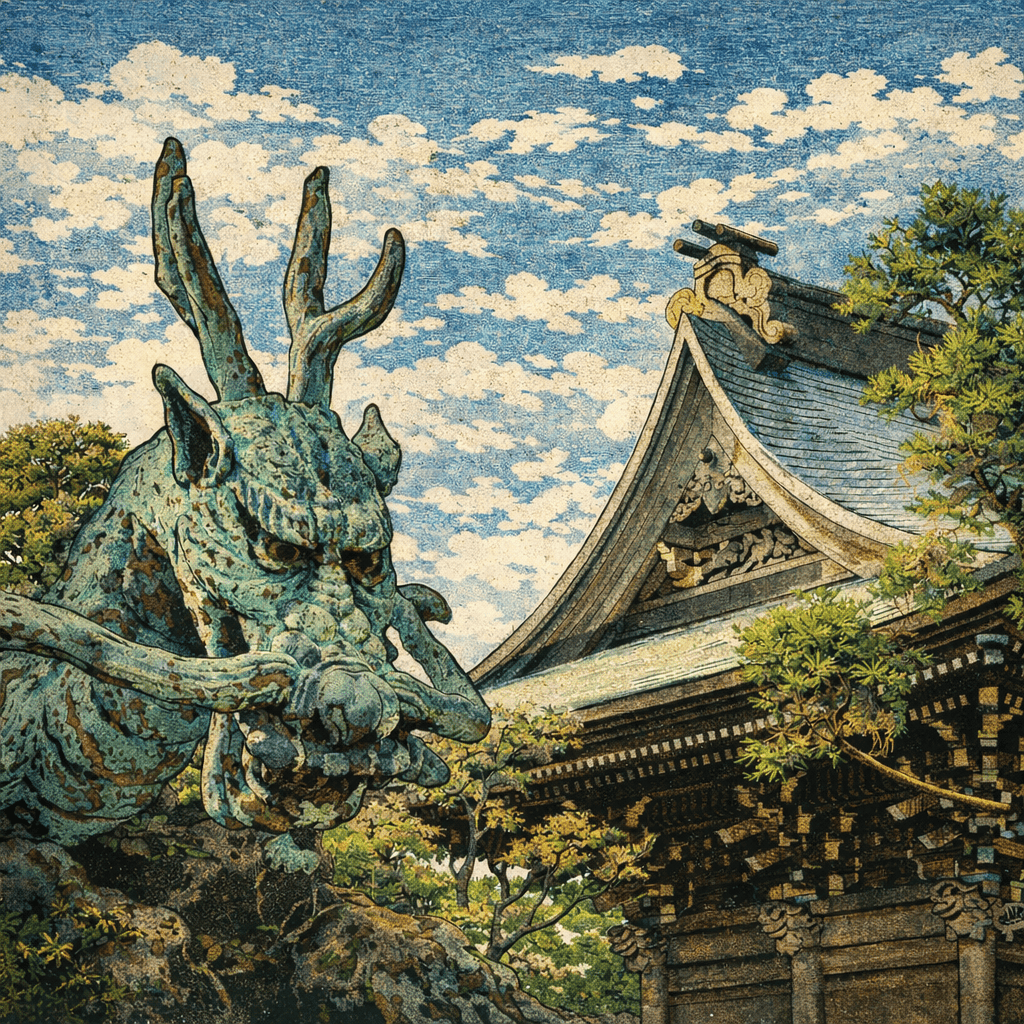
The most visually distinctive feature of Kandakara, however, is the pair of stone dragons that guard the entrance to the main hall. At every other shrine in Japan, the entrance is flanked by guardian statues: either komainu, the leonine lion-dogs that derive from Korean and Chinese antecedents, or at Inari shrines, kitsune, the sacred foxes of the rice god. At Kandakara, these familiar guardians have been replaced by koma-ryu, stone dragons that perform the same protective function. This is an extremely rare iconographic choice, and it is the reason the shrine is sometimes called "the shrine of the koma-ryu." For a broader exploration of how dragons function as guardian figures across Japan, see our full guide to Dragon Shrines of Japan.
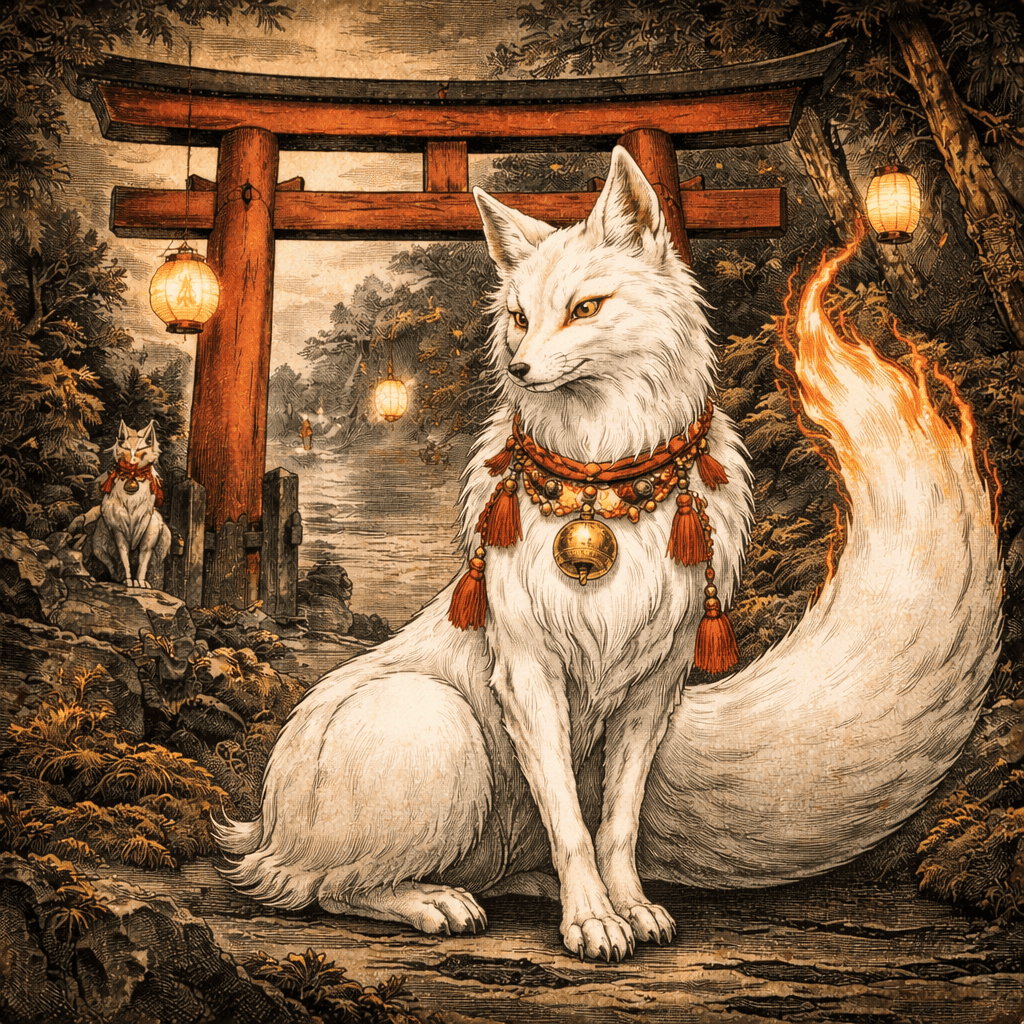
The proximity of Kandakara to the more famous Fushimi Inari Taishacreates a fascinating theological juxtaposition. The main shrine below is the headquarters of fox worship in Japan. The hidden shrine above is a small but distinct enclave of dragon worship. The two traditions coexist on the same mountain, and Kandakara's survival across thirteen centuries of religious reorganization is testimony to how deeply the dragon cult was rooted in this specific place before Inari arrived.
History
The exact founding date of Kandakara is unknown, but local tradition holds that it was already established on the slopes of Mount Inari when the Hata clan founded Fushimi Inari Taisha in 711 CE. This makes Kandakara one of the oldest shrine sites in the Fushimi area, predating the largest shrine in the region by an unknown number of centuries. The shrine's original focus was apparently the enshrinement of the Tokusa no Kandakara, the "ten sacred treasures" of ancient Japanese mythology, a set of divine objects mentioned in the Kojiki and Nihon Shoki as possessing powers of healing and resurrection. The name "Kandakara" literally means "divine treasures" and refers directly to these ancient objects.
The main hall of the shrine enshrines three principal deities: Amaterasu Omikami, the sun goddess and highest-ranking deity of the Shinto pantheon; Inari no Okami, the rice deity whose much larger shrine stands at the base of the mountain; and the Tokusa no Kandakara themselves. This triple enshrinement reflects the shrine's complex layered history, in which the oldest level of worship (the ten sacred treasures) was joined by later associations with Amaterasu and eventually with Inari as the surrounding religious landscape evolved.
The dragon cult at Kandakara appears to be one of the oldest layers of the shrine's identity, predating even the formal enshrinement of the sacred treasures in their current configuration. The koma-ryu stone guardians and the three dragon kings enshrined in auxiliary sanctuaries behind the main hall testify to a continuous dragon tradition at this specific location that has survived every reorganization of the surrounding religious landscape. Even when the broader Mount Inari system was being formalized into the Inari cult during the Heian and medieval periods, Kandakara retained its distinct dragon identity. The reason for this exceptional persistence is not fully explained in the historical record, but the result is clear: Kandakara is the only shrine on Mount Inari where the primary religious iconography is that of dragons rather than foxes.
What to See
Kandakara is a small shrine, and a full visit takes only 15 to 30 minutes on its own. But within that compact area, the shrine contains several features that exist nowhere else on Mount Inari and that justify the detour off the main pilgrim route.
The two stone dragons that flank the entrance to the main hall are the visual signature of Kandakara and the feature that distinguishes it from every other shrine in the Fushimi Inari system. They are carved in the classic A-Un convention familiar from komainu statues: one dragon with its mouth open, forming the Sanskrit syllable "a" (the first sound of the alphabet), and the other with its mouth closed, forming "un" (the last sound). Together the pair encloses the entire universe of speech and meaning between them. Standing between the two dragons at the entrance of the shrine places the visitor, for a moment, inside the full sphere of creation as the Japanese religious imagination understands it.
The dragons themselves are carved in a style that is more serpentine than the elaborate Chinese-influenced dragons seen in Buddhist temples. Their bodies are slender, their scales simple, their eyes wide and watchful. They are not ornamental but functional: they are guardians. Every worshipper who approaches the main hall must first pass between them, and the understanding of the shrine tradition is that they protect the precinct from malevolent influences in the same way that stone foxes protect the rest of Mount Inari.
Behind the main hall, a small path leads past three auxiliary sanctuaries dedicated to the three dragon kings. The first is Ryuto Daijin, the Great Dragon Head God, whose altar is marked by a carved dragon statue presiding over the sanctuary. The Dragon Head is understood as the senior dragon of the Kandakara complex, the one whose name appears most frequently in the shrine's devotional literature.
A little further along the path is Hachidai Ryuo Daijin, the Great Eight Dragon King God, whose name is drawn directly from the Buddhist tradition of the eight great naga kings (hachi dai ryu-o), the serpent deities who protect the Buddhist dharma and rule the underwater realms of Indian cosmology. The Japanese incorporation of these beings into Shinto shrines is one of the clearest examples of the syncretic blending of Shinto and Buddhist traditions that characterized Japanese religion for most of its history.
The third sanctuary is dedicated to Hakuryu Daijin, the Great White Dragon God, a deity associated with transformation, purification, and spiritual ascent. Together the three form a complete dragon trinity — head, king, and transformer — that covers the full range of dragon powers in Japanese religious understanding. Walking past all three and pausing at each is one of the most concentrated dragon pilgrimages available in Kyoto.
Kandakara is famous in Japanese esoteric circles for one very specific reason: its goshuin, the stamp and calligraphy impression that shrine-stamp collectors receive in their dedicated goshuin-cho notebooks. Unlike the mass-produced stamps at most shrines, the Kandakara goshuin features a full hand-painted dragon, inked in color by the resident priestess of the shrine when she is present. Each goshuin is therefore a unique work of art, painted in real time by a religious specialist in direct response to the pilgrim's request.
Collectors travel to Kyoto specifically to obtain a Kandakara goshuin, and the shrine has become one of the most sought-after stamps in the entire Kyoto goshuin-collecting community. If your visit coincides with the priestess's presence and she is not too busy, you can watch her ink the dragon onto your page with quick confident strokes — an experience that transforms the simple act of collecting a shrine stamp into something much closer to a ritual encounter.
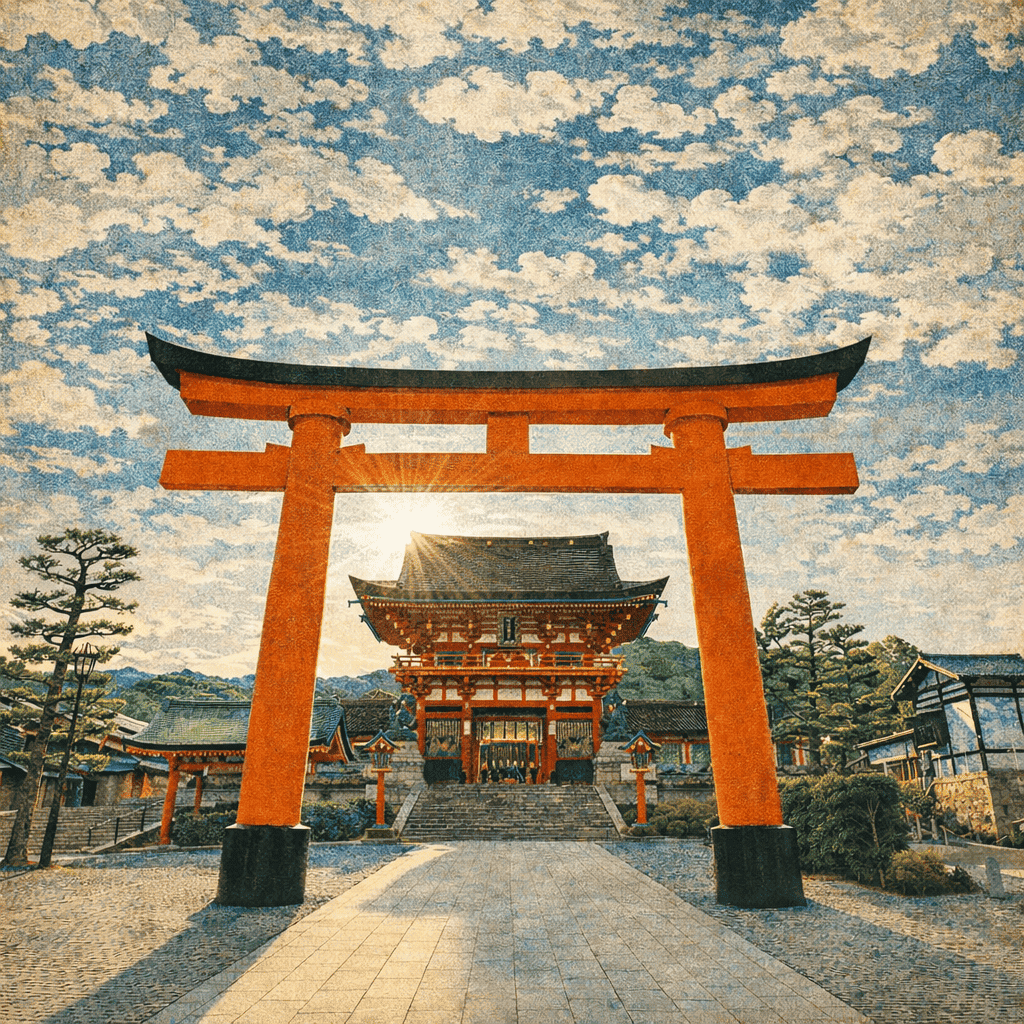
Getting to Kandakara requires navigating one of the most deliberately understated side paths in the entire Fushimi Inari complex. From JR Inari Station, walk directly into the main entrance of Fushimi Inari Taisha and climb the central approach through the Romon tower gate and past the main hall. Continue into the Senbon Torii, the famous tunnel of vermillion gates, and follow the path upward until you reach the Okusha Hohaijo, the outer worship hall where most first-time visitors pause to take photographs of the dense wall of votive torii.
At the Okusha Hohaijo, most pilgrims continue straight ahead along the main path toward the Yotsutsuji intersection higher up the mountain. To reach Kandakara, instead take the smaller side path that branches off to the left. The signage is minimal, and if you are moving quickly you will walk right past it. Follow this quieter path away from the main torii tunnel for a few minutes, keeping an eye out for a landmark called the Neagari no Matsu, the "Root-Risen Pine," a famous tree whose exposed roots have been venerated as a power spot in their own right. Directly opposite the Neagari no Matsu, tucked against the slope of the mountain under cover of older cedars, is Kandakara.
The total walking time from the entrance of Fushimi Inari to Kandakara is approximately 20 minutes at a steady pace. The difference in atmosphere between the two shrines, however, is enormous: where the main shrine is crowded almost to the point of congestion on most days, Kandakara is often completely empty, and the only sounds are the wind in the cedars and the distant rustle of foxes — or dragons — moving through the forest above.
Location
Nearby Attractions
Adjacent (the parent mountain)
Fushimi Inari Taisha
Japan's most visited shrine and the headquarters of the forty thousand Inari shrines across the country. A visit to Kandakara is almost always combined with the main Fushimi Inari pilgrimage, since the two share the same mountain and the same approach path.
15 min walk south
Tofuku-ji Temple
One of Kyoto's great Zen temples, renowned for its autumn foliage. The Tsuten-kyo Bridge offers views over a valley of blazing maples considered one of the finest autumn scenes in all of Japan.
10 min by taxi
Fushimi Sake District
One of Japan's most famous sake-brewing districts, home to legendary breweries including Gekkeikan and Kizakura. The pure spring water of Fushimi has been prized for brewing since the Edo period.
30 min by JR Nara Line
Byodoin Temple, Uji
The Phoenix Hall of Byodoin, depicted on the Japanese 10-yen coin, is a UNESCO World Heritage Site and one of the finest surviving examples of Heian-period architecture.
Visitor Tips
Related Articles
Support The Yokai Files
Enjoyed this deep dive into Japanese folklore?
The Yokai Files is reader-supported. Your support helps us research deeper, write more, and keep the darkness alive.
Conclusion
Kandakara is the shrine that Fushimi Inari's millions of visitors almost never find. It is the dragon's corner of the mountain, preserved across thirteen centuries of Inari worship in a small, quiet, fiercely distinct sanctuary where stone dragons guard the gate and three dragon kings are enshrined within a few steps of one another. Walking the side path to Kandakara is the fastest way to discover that Mount Inari is not one shrine but many, and that the fox cult below coexists with older, stranger, more hidden traditions on the slopes above.
Climb through the Senbon Torii. Turn left at the Okusha Hohaijo. Walk past the Root-Risen Pine until the forest opens into the Kandakara precinct. Bow twice between the koma-ryu. Ring the bell. Make your prayer. If the priestess is there, ask for the hand-painted dragon goshuin and watch her ink it onto the page. Then descend the way you came, and notice, on your way back down through the tunnel of torii gates, that you have been changed by the small shrine above in a way that the larger one below cannot quite match.
This is The Yokai Files.