Hakone Kuzuryu Shrine: Where a Monk Tamed the Nine-Headed Serpent of Lake Ashi
Published: April 10, 2026
Hakone is one of the most dramatic volcanic landscapes in Japan, a collapsed caldera ringed by steep forested mountains, pierced by steaming vents, and filled at its lowest point by the long dark expanse of Lake Ashi. The water is cold and deep. The surrounding peaks are often wrapped in mist. Sulfur hangs in the air above the Owakudani valley like a warning. And in the middle of this geologically restless region, tucked into a quiet stretch of lakeshore reached only by forest path, stands one of the most quietly powerful dragon shrines in Japan: Hakone Kuzuryu Jinja, the Shrine of the Nine-Headed Dragon.
The shrine exists because of a legend that follows the classic pattern of Japanese dragon worship: a terror, a holy figure, a subjugation, a conversion, and a bargain that has held for over a thousand years. In the Nara period, the Buddhist ascetic Mangan Shonin is said to have traveled to Hakone, where a nine-headed dragon had long preyed on the villages around the lake. The dragon demanded sacrifices. The waters of Ashi were believed to be poisoned by its breath. Mangan Shonin confronted the beast with sutras and prayer, and over the course of a lengthy spiritual battle, he bound the dragon beneath a rock on the lakeshore. Rather than kill it, he converted it. He bound it into the service of the Hakone deities, and from that moment the Nine-Headed Dragon became the guardian of Lake Ashi and the protector of everyone who crossed its waters.
Today, the shrine is visited by pilgrims who come seeking blessings for love, partnerships, and successful relationships, but the legend behind it is older and stranger than contemporary matchmaking culture would suggest. The dragon is still there. The rock that sealed it is still on the lakeshore. The sulfur still rises from the vents at Owakudani. To visit Kuzuryu is to step into one of the most clearly mapped dragon-subjugation sites in Japan, where the geology, the legend, and the ritual calendar all point to the same hidden presence beneath the lake.
The Yokai Connection
Kuzuryu, the Nine-Headed Dragon, is one of the most distinctive serpent deities in Japanese folk religion. The nine heads are a deliberate echo of the great naga kings of Buddhist cosmology, whose rulers in Indian tradition were often multi-headed beings dwelling in underwater palaces. In the Japanese religious imagination, the nine heads represent the dragon's power to govern all directions, all seasons, and all forms of water. A single-headed dragon rules one river. Kuzuryu rules the entire caldera.
The legend of his subjugation by Mangan Shonin is one of the core stories in the Japanese pattern of dragon-conversion, a recurring theme in which the monster is not destroyed but transformed through ritual intervention into a guardian. For a wider survey of how this pattern shaped the sacred geography of Japan, see our full guide to Dragon Shrines of Japan. Kuzuryu is the exemplar of the type: a terror made servant, a curse made blessing, a venom made into sacred water. The water that pours from the nine dragon heads at the Shingu today is the literal descendant of the water that the dragon once poisoned, now purified by a thousand years of prayer.
The shrine's association with love and relationships is a modern devotional layer built on top of the older cosmological foundation. The logic is this: if the dragon can be bound by an oath and remain loyal for a thousand years, then the dragon knows something about commitment. Pilgrims come asking for that knowledge to be transferred to their own partnerships. It is a practical application of a cosmic principle, and it is the reason Kuzuryu is today one of the most popular shrines in eastern Japan for young couples and those seeking marriage.
History
The founding of Kuzuryu Shrine is traditionally dated to the Nara period, when Mangan Shonin is said to have completed the subjugation of the nine-headed dragon and established a small sanctuary on the lakeshore to enshrine the bound serpent. The shrine was closely associated from its earliest days with the nearby Hakone Shrine, the larger institution that stands on the edge of Lake Ashi and dominates the religious landscape of the region. For most of its history, Kuzuryu functioned as a subsidiary of Hakone Jinja, with the Hongu on the remote shore serving as the primary cult site for those who made the pilgrimage on foot through the forest.
The shrine rose to national prominence during the Kamakura and Edo periods, when it attracted the attention of some of the most powerful figures in Japanese political history. Minamoto no Yoritomo, founder of the Kamakura shogunate, is said to have prayed at Hakone and Kuzuryu before launching the campaigns that would unify eastern Japan under his rule. Tokugawa Ieyasu, the first Tokugawa shogun, also made pilgrimages to the region, and his reverence for the Hakone deities was part of the reason the Tokaido road was routed through Hakone's steep pass. Both men credited the dragon with protecting their campaigns, and both left donations and ritual protections at the shrine. The pattern of warriors praying to Kuzuryu before battle continued into the Edo period, by which time the shrine had become one of the most venerated warrior sanctuaries in the country.
In modern times, the shrine has been reorganized into its two-part configuration: the original Hongu on the remote forested shore and the Shingu, established within the grounds of the larger Hakone Shrine complex, for visitors who cannot make the longer pilgrimage. Both are dedicated to the same subdued dragon, and both continue to receive offerings and prayers on an unbroken monthly schedule.
What to See
A complete visit to Kuzuryu involves at least three distinct locations: the Shingu at Hakone Shrine, the original Hongu on the lakeshore, and the Heiwa no Torii that stands in the waters of Lake Ashi itself. Each has its own character, and each contributes to the overall shape of the dragon's modern cult.
The Hongu is the original shrine of Kuzuryu, and it stands on a quiet, forested stretch of the Lake Ashi shoreline within a grove known as Kuzuryu no Mori, the "Forest of the Nine-Headed Dragon." It is reached by a 30-minute walk along a wooded path from the main Hakone Shrine precincts, a route that passes through old-growth cedar and follows the rising and falling of the shoreline. The walk is almost part of the ritual: by the time you arrive, the noise of the tourist crowds at the main shrine has faded completely, and the sound you hear is the soft lapping of the lake against the stones below the main hall.
The Hongu itself is a modest structure, a single wooden hall in the classic Japanese shrine style, painted in muted colors and set back from the water by only a few meters. A small torii gate stands between the hall and the lake. Behind the shrine, the forest rises into the misty slopes of the caldera. In front of it, the lake stretches toward Hakone's outer mountains. On calm mornings, Mount Fuji can be seen reflected on the surface of the water in the distance. The rock that Mangan Shonin used to seal the dragon is said to be nearby, though its exact location has been kept deliberately vague in modern times to discourage curiosity. The important point is this: the dragon is still bound. The shrine is still the seal.
Visitors who make the longer walk to reach the Hongu are rewarded with an experience that the Shingu cannot match: the feeling of having arrived at the original site of a thousand-year-old bargain, in a place where almost no sound from the modern world reaches.
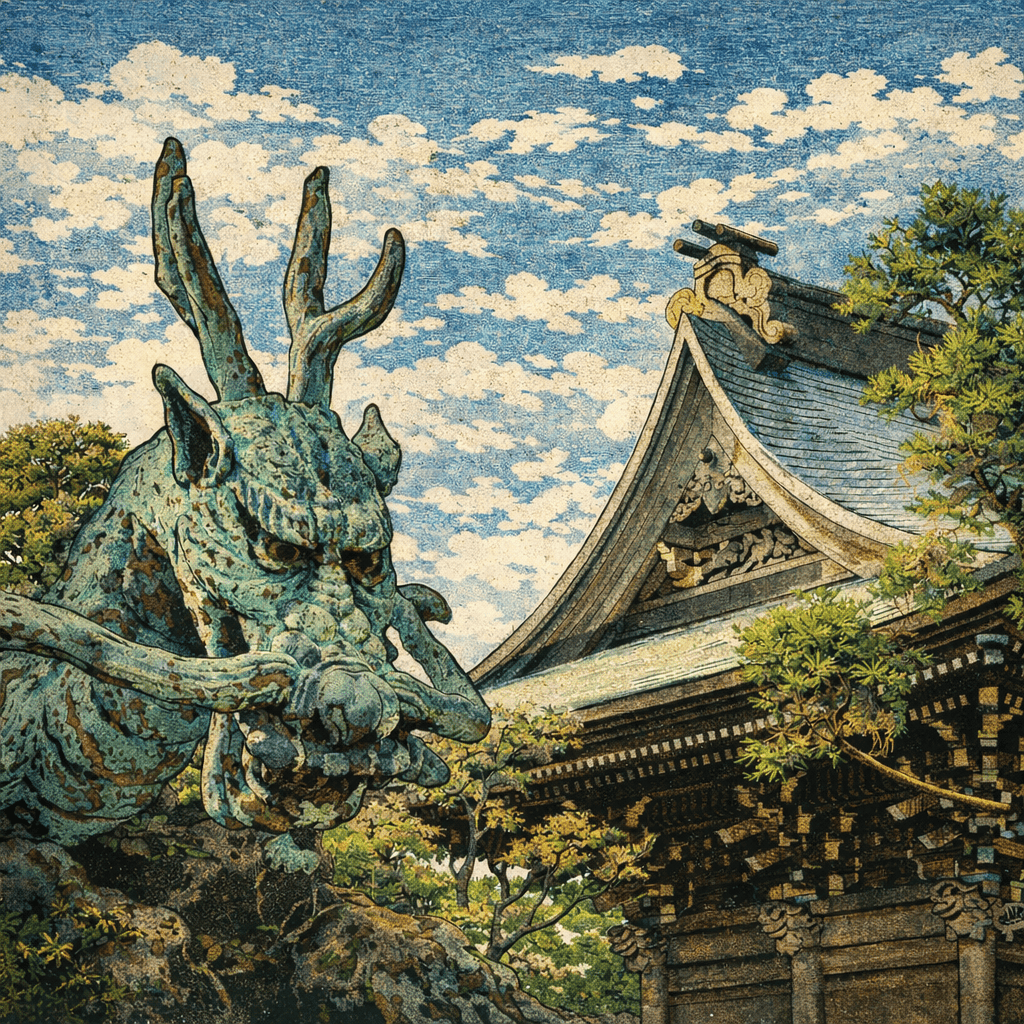
Within the grounds of Hakone Shrine, a short walk from the main hall, stands the Shingu, the new shrine, established to provide a more accessible place of worship for visitors unable to walk to the distant Hongu. The Shingu is smaller than its parent shrine but architecturally striking, and its most remarkable feature is a large stone water basin surrounded by nine carved dragon heads. Each head pours a continuous stream of clean, cold water into the basin below. This water, known as Ryujin-sui, is considered sacred and is widely collected by pilgrims.
Visitors bring empty bottles to fill with Ryujin-sui, which is said to grant blessings for love, partnership, and the endurance of relationships. The water is drinkable and is often used in household rituals, offered on personal altars, or simply carried home as a tangible connection to the shrine. On weekends and during the monthly Tsukinamisai, the queue at the basin can be considerable, and you will see pilgrims from all over Japan patiently waiting their turn at the nine dragons.
One of the most iconic religious images in all of Japan is the Heiwa no Torii, the "Torii of Peace," which stands directly in the waters of Lake Ashi a short walk from the main Hakone Shrine. The gate appears to float on the surface of the lake, its vermillion color reflecting in the dark water, framed by mist on cold mornings and by Mount Fuji on clear ones. It was erected in 1952 to commemorate the signing of the San Francisco Peace Treaty, but its composition is timeless and its visual effect has made it one of the most photographed shrines in Japan.
From the Heiwa no Torii, the connection between the dragon and the lake becomes visually immediate. You are looking across water that the dragon once poisoned, now calm and sacred beneath a gate that has been dedicated to peace. If the view extends far enough to include Mount Fuji, the image contains every element of the Hakone legend: the caldera lake, the surrounding mountains, the sacred volcano on the horizon, and the shrine gate itself, standing in the water where the dragon agreed to become a guardian.
On the 13th of every month, Kuzuryu Shrine holds its most important recurring ritual: the Tsukinamisai. Pilgrims gather at Motohakone port at dawn, board a dedicated flotilla of shrine boats, and cross Lake Ashi to the Hongu on the far shore, where a formal ceremony invokes the blessings of the Nine-Headed Dragon. The ritual has been practiced for centuries and is the only regular occasion on which the Hongu is directly accessible by boat rather than on foot.
Attending Tsukinamisai is the most complete form of the Kuzuryu pilgrimage. The boat crossing at first light, with the surface of the lake reflecting the morning mist, is considered one of the most atmospheric shrine journeys in eastern Japan, and the monthly ritual itself draws pilgrims from across the country. If your travel schedule can be arranged to include the 13th of a month, this is the form of visit that the dragon is most clearly understood to honor.
Location
Nearby Attractions
Adjacent
Hakone Shrine
The larger parent shrine of Kuzuryu, founded in 757 CE and one of the most historically important sanctuaries in eastern Japan. Its long stone staircase through ancient cedar forest, its ornate main hall, and its famous Heiwa no Torii gate in Lake Ashi make it one of the most visually distinctive shrines in the country.
20 min by ropeway
Owakudani
The steaming sulfur vents of Owakudani, the "Great Boiling Valley," are the living heart of Hakone's volcanic landscape. The valley is famous for kuro-tamago, "black eggs" cooked in the sulfurous hot springs, which tradition holds can extend your lifespan by seven years per egg.
30 min by bus
Hakone Open-Air Museum
One of the finest sculpture parks in Japan, set in the forested Hakone hills and featuring works by Picasso, Henry Moore, Rodin, and Niki de Saint Phalle, alongside a remarkable collection of contemporary Japanese sculpture.
40 min by bus
Hakone Yumoto Onsen
The main onsen town of the Hakone region and the gateway station for most visitors arriving from Tokyo. The town is crowded with historic inns, bathhouses, and sake breweries, and it makes an excellent base for a multi-day exploration of the caldera.
Visitor Tips
Related Articles
Support The Yokai Files
Enjoyed this deep dive into Japanese folklore?
The Yokai Files is reader-supported. Your support helps us research deeper, write more, and keep the darkness alive.
Conclusion
Hakone Kuzuryu Shrine is one of those rare sacred sites where the geology, the legend, and the ritual calendar all converge on the same hidden presence. The caldera is alive. The lake is deep and cold. The sulfur rises from Owakudani in plumes that darken the afternoon sky. And beneath it all, bound by a thousand years of monthly ritual and the sutras of a Nara-period monk, the Nine-Headed Dragon continues to keep its oath. The shrine is the seal on the bargain, and the nine heads that pour water into the stone basin at the Shingu are reminders that the serpent is still there, still listening, still doing the work it agreed to do.
Visit on a clear morning in winter. Walk the forest path to the Hongu. Sit for a moment on the lakeshore and watch the light move across the water. Fill your bottle with Ryujin-sui and carry it home. The dragon does not require your belief. It requires only your attention, and the acknowledgment that something very old and very large is still living in the deep water of Lake Ashi, and that everything above the surface is in some small way a negotiation with that presence.
This is The Yokai Files.