Haruna Shrine: Where the Gods Carved a Shrine into the Cliff Itself
Published: April 10, 2026
In the mountains of Gunma Prefecture, a dormant volcano rises above the Kanto plain. Its slopes are covered in deep forest. Its crater holds a cold, dark caldera lake. And on its flanks, carved into a narrow gorge where cliff walls rise vertically on both sides of the path, stands what may be the most dramatically sited shrine in all of Japan: Haruna Jinja, a sixth-century sanctuary whose main hall is not merely adjacent to a cliff but physically fused into one. The structural wooden elements of the shrine are embedded directly into a massive stone formation called the Mimochi-iwa, the "Body-Holding Rock," and the effect is unlike any other shrine in the country. The building is the mountain. The mountain is the shrine. Where the wood stops, the stone begins, and there is no seam between them.
Haruna is one of the oldest surviving religious institutions in eastern Japan, traditionally dated to the sixth century during the reign of Emperor Yomei. Its deities include Honoikazuchi no Kami, the fire-thunder kami associated with volcanic eruption, and Haniyama-hime no Kami, the earth-mountain goddess who embodies the sacred ground itself. But for all the formal theology, the shrine is known in local tradition and popular belief as the dwelling place of the Haruna dragon, the guardian spirit who connects the volcanic heat beneath the mountain with the cold deep water of the lake above. The cliff-embedded architecture is not a stylistic choice. It is a statement about what kind of being the shrine is built to honor.
This guide will walk you through the gorge approach, past the sacred features that line the kilometer-long path, up to the main hall where the honden emerges from the cliff face, and into the folk memory of Kibehime, the young woman who fell in love with the dragon of Lake Haruna and followed him into the water. Haruna is the most architecturally extraordinary dragon shrine in Japan, and it rewards even a quick visit with images and impressions that do not fade.
The Yokai Connection
The dragon of Haruna is not singular in the way that Enoshima's Gozuryu or Hakone's Kuzuryu is singular. It is a more diffuse presence, associated simultaneously with the volcanic mountain above, the caldera lake at its summit, and the deep water where the lake's visible surface meets its hidden depths. In local tradition, the dragon is understood as the living spirit of the entire Mount Haruna system, and the shrine at its base is the point of contact where human prayer can reach the serpent that sleeps in the lake above.
The Kibehime legend is the most vivid expression of the shrine's dragon tradition. It follows the classic pattern of dragon-human romance that appears in Japanese folklore: a human lover is visited at night by a mysterious stranger, the lover discovers that the stranger is a dragon in human form, and the relationship ends in either tragedy or transformation. At Haruna, the story ends in transformation: Kibehime enters the lake and joins the dragon as his bride, and the two become a permanent presence beneath the water. For the broader pattern of how dragons become consorts, guardians, and intimates of human beings in Japanese religion, see our full guide to Dragon Shrines of Japan.
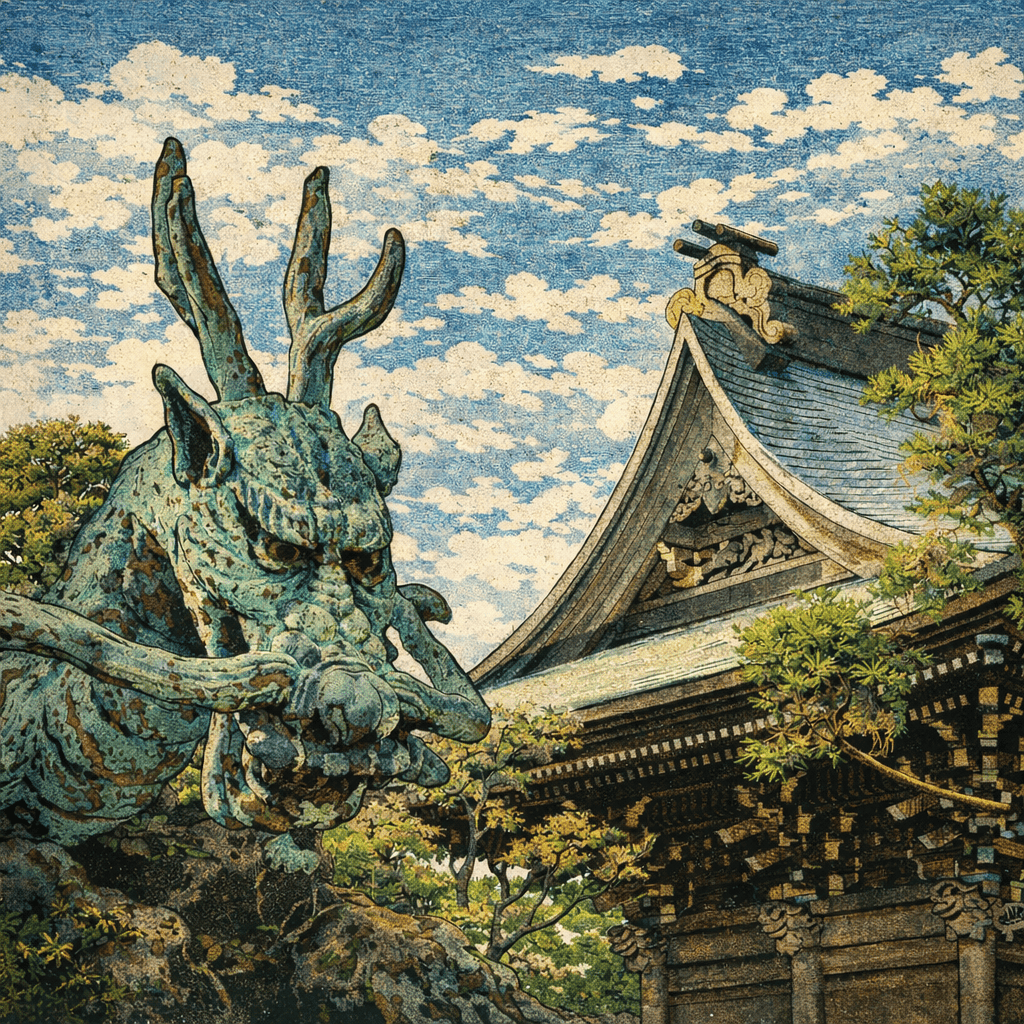
The shrine's architecture, finally, is itself a form of dragon worship. The honden fused into the Mimochi-iwa is understood as the visible surface of the dragon's body, with the rest of the serpent hidden in the stone behind it. Walking up to the main hall is therefore a form of approaching the dragon directly: the wall you eventually face is not a wall but a scale, and the hall is the dragon's mouth, opened just enough to receive your prayer.
History
Haruna Shrine was traditionally founded in the sixth century during the reign of Emperor Yomei (reigned 585–587), making it one of the oldest continuously active religious sites in eastern Japan. The mountain itself had been a site of folk religious practice long before the formal shrine was established; local animist traditions venerated Mount Haruna as a living being, and the caldera lake at its summit was considered a sacred body of water whose depths were inhabited by supernatural beings. The sixth-century foundation of the shrine was a formalization of these older practices under the emerging framework of organized Shinto worship.
The shrine rose to major prominence during the Heian and Kamakura periods, when it became one of the principal sacred sites of the Kanto region. Its remote mountain location, its dramatic cliff-integrated architecture, and its dragon associations made it a magnet for pilgrims from across eastern Japan. During the medieval period, Haruna was also an important center for mountain ascetic practice (shugendo), and yamabushi monks used the gorge approach and the surrounding peaks as a site for austerity training.
The current honden was rebuilt in 1806 during the late Edo period, and it is designated as an Important Cultural Property of Japan. The reconstruction preserved the cliff-embedded architecture of earlier versions, continuing a tradition of fusing the wooden structure directly into the Mimochi-iwa that appears to have been part of the shrine's design since its earliest days. The 1806 hall is therefore not merely a historical building but a living continuation of an ancient architectural conversation between the shrine carpenters and the rock face itself.
What to See
A visit to Haruna Shrine is really a visit to the approach gorge as much as to the main hall itself. The kilometer-long path from the outer torii gate to the honden passes through a sequence of sacred features, each of which contributes to the cumulative sense of ritual pressure that defines the shrine's atmosphere. The experience is less about arriving at a destination than about slowly accumulating sacredness along the route.
From the outer torii at the entrance to the shrine precincts, a stone path climbs nearly a kilometer through a gorge cut into the flank of Mount Haruna. The cliff walls rise vertically on both sides of the path, sometimes so close together that the route is compressed into a single narrow corridor between sheer rock faces. The effect is of passing through a natural gate, a tunnel of stone that funnels the pilgrim toward the honden above. Walking this approach is considered part of the shrine's spiritual experience: it is not a preparation for the shrine visit but the shrine visit itself, beginning the moment you pass beneath the outer gate.
Along the way, the path passes a series of named sacred features. The Misogi-bashi is a small bridge over a purification stream, where visitors pause to symbolically cleanse themselves before continuing. The Heishi no Taki is a slender waterfall whose name means "Sake Bottle Falls," for the shape of the vessel it is said to resemble; local tradition holds that sake brewed with water from this fall is especially blessed. The Hoko-iwa and Eboshi-iwa are two natural stone pillars named for the spears and courtier caps they recall, their towering forms framed against the sky at a bend in the path. The Sekison-iwa is an enormous boulder wedged between cliff faces that locals consider one of the most powerful spots of spiritual energy in all of Gunma.
At the top of the gorge approach, the main hall of Haruna Shrine appears suddenly against a backdrop of vertical stone. The first impression is of a normal wooden shrine hall painted in traditional red and gold. The second impression, which takes a few seconds to register, is that the back of the hall simply becomes the cliff. The roof tiles extend until they meet bare rock, and the structural beams of the building appear to grow directly out of the stone face behind them. There is no gap, no courtyard, no separation between architecture and mountain. The hall is the mountain, expressed in wood where the builders could reach with their tools, and in rock where they could not.
The current honden, rebuilt in 1806, is designated as an Important Cultural Property of Japan, and its Edo-period craftsmanship is remarkable in its own right. The carvings on the eaves include dragons, phoenixes, and floral patterns, and the polychrome painting on the beams is executed with a vividness that Edo-period shrine carpenters reserved for their most important commissions. But what draws the eye again and again is the meeting point between the wood and the stone. That is where Haruna differs from every other shrine in Japan.
The stone formation into which the honden is fused is called the Mimochi-iwa, which translates roughly as "Body-Holding Rock" or "Honorable Body Rock." The name is theological: the rock is the body of the mountain god, and the hall at its base is the place where that body can be approached and addressed. Walking around the side of the honden (where the paths permit) reveals the full vertical face of the Mimochi-iwa rising behind the building like a frozen wave of stone. The rock is massive, textured, and visually overwhelming, and its presence dominates the rear of the shrine precinct.
In local tradition, the Mimochi-iwa is understood as the visible skin of the Haruna dragon, the part of the serpent that has emerged from the mountain into the world of human beings. The rest of the dragon, tradition holds, continues downward through the bedrock and upward into Mount Haruna's summit, connecting the honden to Lake Haruna and to the volcanic systems beneath. The shrine is not a monument to the dragon; it is a small window into the dragon's body, placed at the one point where the stone permits contact.
The folk memory of Haruna is anchored by the legend of Kibehime, a young woman from the village beneath Mount Haruna who fell in love with a mysterious stranger. The stranger visited her only at night, always arriving after dark and departing before dawn, and always careful to conceal his origins. Kibehime grew curious and eventually discovered, against her lover's warnings, that he was in truth a dragon of Lake Haruna who had taken human form to court her. The secret, once uncovered, could not be put back. The lovers could no longer meet in the human world. Kibehime, unwilling to live without him, climbed the mountain to the lake and threw herself into the deep water, where the dragon accepted her as his bride, and the two have remained joined beneath the surface ever since.
The legend is one of the most haunting in the entire Japanese folk tradition of dragon-human romance, and its presence at Haruna adds another dimension to the shrine's already rich atmosphere. On clear days, local tradition says, when the light strikes Lake Haruna from a particular angle, you can still see the couple's shadow beneath the water. Visitors who make the drive up to the crater lake often pause to watch for the shadow. Whether they see anything or not depends, as with all such legends, on how willing they are to look.
Location
Nearby Attractions
15 min by car/bus
Lake Haruna (Haruna-ko)
The sacred caldera lake at the summit of Mount Haruna, and the home of the dragon in the Kibehime legend. The lake is surrounded by walking paths, small boat rentals in summer, and lookout points offering views across the water to the distant Kanto plain.
40 min by bus
Ikaho Onsen
One of Gunma's most famous hot spring towns, built along a long stone staircase that climbs the hillside. Ikaho's golden waters are said to be restorative for travelers, and the town makes an excellent overnight stop after a visit to Haruna Shrine.
1 hr by bus
Kashozan Ryugein
A remote mountain temple in Gunma where the Kasho Tengu is believed to dwell among the peaks, and one of the most important tengu sites in the entire Kanto region.
80 min by bus to Takasaki
Takasaki City
The main railway hub for Gunma Prefecture and a convenient base for exploring the region. Takasaki is famous for its enormous white Byakue Daikannon statue and as the birthplace of the daruma doll tradition.
Visitor Tips
Related Articles
Support The Yokai Files
Enjoyed this deep dive into Japanese folklore?
The Yokai Files is reader-supported. Your support helps us research deeper, write more, and keep the darkness alive.
Conclusion
Haruna is the shrine that does not stand apart from its mountain. It is the mountain, carved where the stone permits and completed in wood where the mountain could not carve itself. Walking the kilometer-long gorge approach is a slow accumulation of sacred pressure, each cliff face and waterfall and natural stone pillar adding another layer to the building sense that you are moving through a precinct whose ground is alive. By the time you reach the honden and see for the first time where the wood of the hall meets the living rock of the Mimochi-iwa, the distinction between the two has become almost meaningless. The shrine was never built onto the cliff. The cliff became a shrine.
Take the bus from Takasaki. Walk up through the gorge without rushing. Pause at the Misogi-bashi to wash your hands. Stop beneath the waterfalls. Touch the stone pillars that tradition has named for spears and hats. When you arrive at the honden, stand for a long minute at the place where the roof tiles vanish into the rock. Make your prayer. Then climb back down and take the bus to Lake Haruna, and look for Kibehime and her dragon in the shadow beneath the water. The shrine is the mountain. The mountain is the dragon. The dragon is still listening.
This is The Yokai Files.