Kifune Shrine: Where the Rivers of Kyoto Spring from the Body of a Dragon
Published: April 10, 2026
North of Kyoto, past the end of the Eizan Electric Railway line, a narrow valley cuts deep into the forested mountains where the Kamo River is born. The road follows the cold mountain stream upstream, climbing between steep walls of cedar and moss-covered rock, and the temperature drops perceptibly with every kilometer. Wooden machiya houses cling to the riverbank. Stone lanterns line the path. And at the far end of the valley, where the stream emerges from the living earth, stands Kifune Shrine — the head sanctuary of approximately 2,000 subordinate water shrines across the entire country, and the single most important water-related institution in the whole of Shinto tradition.
Kifune's founding date is unknown, lost in the prehistoric layers of Japanese folk religion, but tradition places it in the age of Emperor Jinmu, the legendary first emperor whose reign is conventionally dated to the seventh century BCE. The shrine has been continuously active for all of recorded Japanese history, and for over a thousand years it has been the place where the imperial court, the Buddhist temples of the old capital, and the private households of Kyoto have all come to negotiate with the dragon gods of water. Whenever drought struck, envoys were dispatched to Kifune with offerings. Whenever floods threatened, envoys were dispatched again, this time asking the same dragons for restraint. The shrine's entire history is a record of this continuous hydrological negotiation.
This guide will walk you up the valley from the first vermillion lantern to the deepest sanctuary of the shrine, the place where a natural cavity in the earth has been understood, for all of recorded memory, as the actual dwelling place of the dragon god of water. Kifune is not a shrine that illustrates a myth. It is a shrine that is built on top of one.
The Yokai Connection
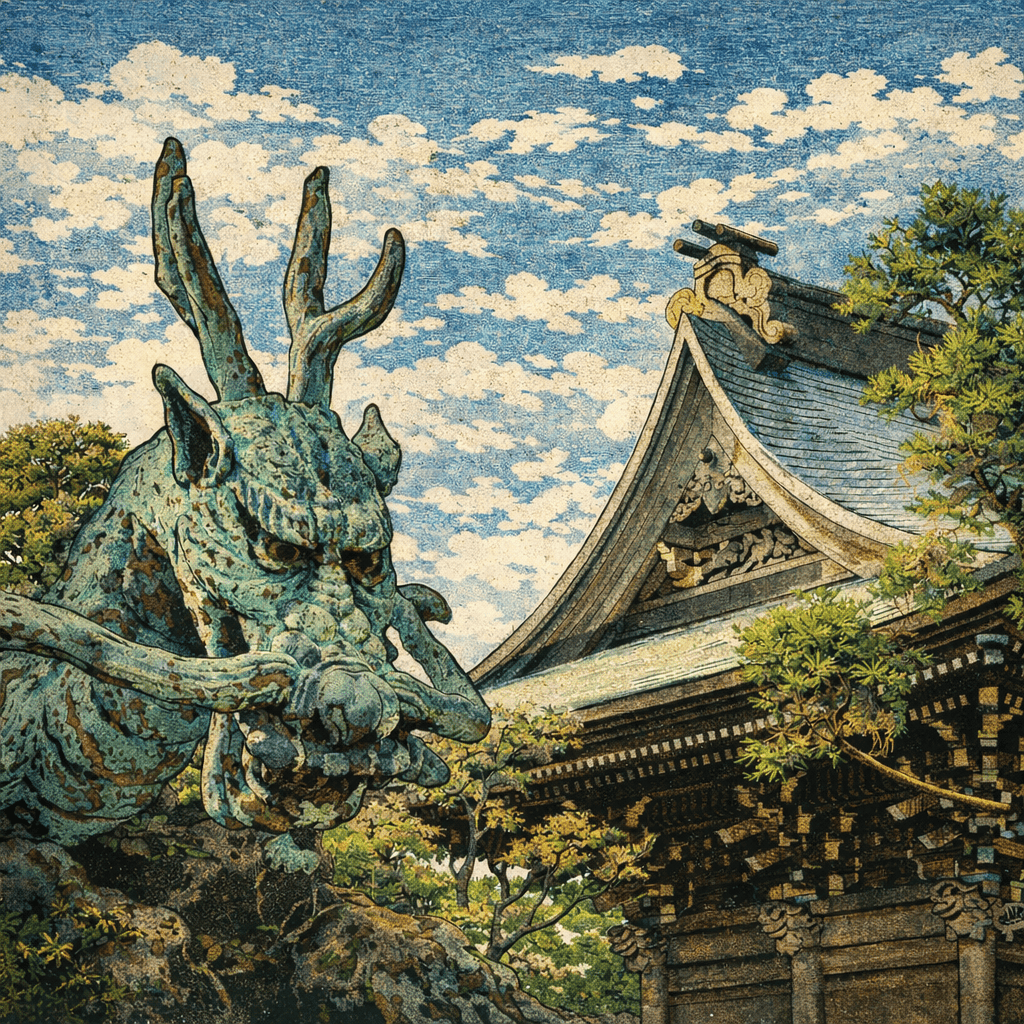
The dragon at Kifune is not singular but dual. The shrine enshrines Takaokami no Kami and Kuraokami no Kami, two complementary forms of the same ancient water deity, both understood as dragon gods of the Japanese folk religious tradition. Takaokami, whose name means "high Okami," is the dragon of the heights — the rains that fall on mountain peaks and the springs that emerge from cliff faces. Kuraokami, whose name means "dark Okami," is the dragon of the depths — the subterranean waters that flow hidden through the earth before emerging as cold spring water. Together, the two dragons cover the entire cycle of water in motion: from sky to peak to underground to spring to stream to river to sea, every stage is governed by one or the other.
The founding legend of the shrine connects its location to this dual cosmology through the story of Tamayori-hime, a princess of the sea who sailed in a yellow boat from Naniwa (modern Osaka) up the rivers of Japan until she came to rest at the source of a spring deep in the northern mountains. She declared that a shrine should be built where her boat had run aground, and that shrine is Kifune. The name is said to derive from ki-fune, "yellow boat," or alternately from ki-no-ne, "the root where ki energy is born." Either etymology points to the same essential truth: this is the place where sacred water begins.
For the broader pattern of how dragons became water gods in Japanese religion, see our full guide to Dragon Shrines of Japan. Kifune is the cosmic center of that pattern: not a shrine where a specific dragon was subjugated, like Enoshima or Hakone, but the shrine where the dragon is simply the ground on which the building stands.
History
The formal history of Kifune begins in the Heian period (794–1185), when the shrine became an institutional fixture of imperial religious life in the new capital at Kyoto. The Heian court, built on the banks of the Kamo River, depended absolutely on the river for drinking water, agriculture, and the ritual purity that the capital required to function as the ceremonial center of the nation. The Kamo flowed from the mountains north of the city, and at the head of the northern valleys stood Kifune, the shrine of the water god. It was therefore natural that the shrine came under direct imperial patronage, and by the Heian period Kifune had been formally ranked among the most important shrines in the country.
The tradition of horse offerings is the single most historically distinctive practice of Kifune's Heian-period worship. When drought threatened the capital, imperial envoys would be dispatched to Kifune with a black horse — black for the storm clouds that the shrine was being asked to bring. When floods threatened, a white horse would be offered instead — white for the clear sky the shrine was being asked to restore. These horse offerings, which were expensive and logistically complex, were eventually replaced during the medieval period with painted wooden plaques depicting horses. These plaques, known as ema, eventually shed their equine imagery and became the small wooden prayer tablets sold at every shrine in Japan today. Every ema hung at every shrine in the country is, in this sense, a direct descendant of the horses once sent to Kifune to plead with the dragon gods for rain.
The shrine has also been associated for centuries with the darker traditions of Japanese esoteric religion. The poet Izumi Shikibu is said to have visited Kifune to pray for the return of a wayward husband, and her poem of devotion is still quoted at the shrine today. In another, more chilling layer of tradition, Kifune was considered the headquarters of ushi-no-toki mairi, the "ox hour visit," a form of curse ritual in which a scorned wife would drive a straw effigy of her rival into a sacred tree at the hour of the ox (around 2 AM), using a hammer and iron nails. The practice is now purely legendary, but the association between Kifune and the dark water that can carry either blessing or destruction remains part of the shrine's identity.
What to See
Kifune is organized as three shrines strung along the course of the valley: the Hongu at the base, the Yui-no-yashiro in the middle, and the Okumiya at the head of the valley where the oldest sanctuary stands. Walking the full route in order is the traditional form of the pilgrimage, and is the best way to understand how the shrine fits into its mountain landscape.
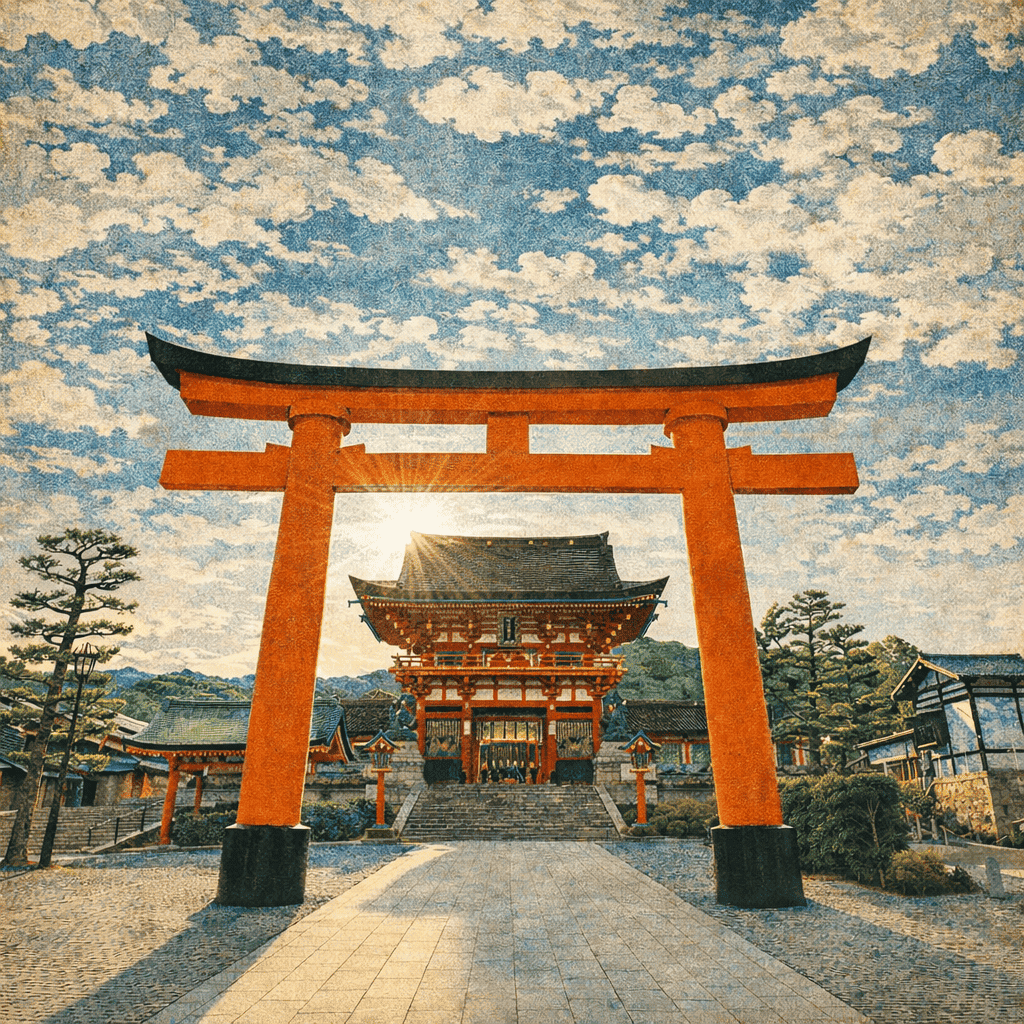
The Hongu is the primary point of entry and the most visually famous part of the shrine. Its approach is one of the most photographed religious images in all of Japan: a steep stone staircase lined with vermillion lanterns that burn softly against the dense green of the surrounding forest. In summer, the staircase is framed by brilliant maple leaves and the cold green moss of the valley. In autumn, the maples turn red and gold, and the lanterns seem to be burning alongside the trees themselves. In winter, fresh snow blankets the steps and the lantern posts, and the red and white combination is one of the most striking contrasts available in Japanese shrine photography.
At the top of the staircase, the Hongu itself is a traditional wooden structure dedicated primarily to Takaokami no Kami. The haiden (worship hall) stands directly in front of the main shrine, and it is here that most visitors make their prayers. The shrine is famous for its water-based omikuji: fortune papers that are blank when purchased but reveal their message only when dipped into the sacred spring that flows beside the Hongu. The ink is activated by the dragon's water, and the fortune emerges as if the spring itself were writing it.
About halfway up the valley, between the Hongu and the Okumiya, stands Yui-no-yashiro, the "Binding Shrine," dedicated to matchmaking and the formation of enduring relationships. The deity here is Iwanagahime, the elder sister of the famous Konohanasakuyahime, and she is understood as the goddess who binds lovers together for life. The middle shrine is smaller and quieter than the Hongu, set among old cedars in a small clearing, and it attracts a steady stream of visitors seeking its specific blessing for love and fidelity.
This shrine is where Izumi Shikibu is said to have prayed for the return of her wayward husband during the Heian period, and her visit has made Yui-no-yashiro one of the most historically celebrated matchmaking sites in Kyoto. The connection between water (the primary concern of Kifune as a whole) and human relationships is a subtle one: water is the element that flows, connects, and binds, and the dragon who controls it is understood to have authority over the unseen currents that draw human beings toward one another as well.
The Okumiya, the innermost sanctuary, stands at the head of the valley where the road ends and the forest begins to steepen. It is the original shrine of Kifune, the place where the founding goddess Tamayori-hime is said to have beached her yellow boat, and it retains the oldest and most numinous atmosphere of any part of the complex. The buildings here are simpler than those at the Hongu, and the setting is much wilder: the stream runs louder, the cedars press closer, and the visitor has often entered a silence that is very different from the bustle of the lower shrine.
Directly beneath the main hall of the Okumiya is the feature for which Kifune is spiritually most famous: the Ryuketsu, the "Dragon Hole." This is a natural cavity in the earth that tradition holds to be the actual dwelling place of the dragon god. No one alive has ever seen the interior of the Ryuketsu. The tradition forbids it. The one recorded medieval attempt to examine the hole during a shrine renovation reportedly ended when the workers were driven back by a supernatural wind and a roaring sound from the depths, and the hall above was rebuilt without any further investigation. The Ryuketsu is therefore one of the only religious sites in Japan where the inner sanctum is a hole in the ground that has never been looked into.
Standing on the ground above the Ryuketsu is considered one of the most powerful spiritual experiences available in Kyoto. The ground itself is the dragon's roof. You are standing, quite literally, on top of the water god. Visitors who come here often describe the atmosphere as something beyond ordinary reverence: a pressure, a density, a sense that whatever is beneath the earth is aware of the feet standing on it.
In summer, the Kifune valley becomes famous throughout Japan for the kawadoko, wooden dining platforms built directly over the cold mountain river. Restaurants along the approach road set up these platforms every year from late May through September, and diners eat elaborate multi-course meals — traditional kaiseki cuisine, chilled somen noodles, seasonal sashimi — while the water of the dragon god flows inches beneath their feet. The temperature on the platforms is noticeably cooler than the air above the valley walls, and the sound of the running water is a constant presence during the meal.
The kawadoko experience is more than a culinary tradition. It is the most literal possible expression of the relationship between Kifune and its dragon: you are being fed, sheltered, and cooled by the river that is the dragon's body. Prices for a kawadoko meal can be high, and reservations are required well in advance, but for visitors who time their trip to Japan during the summer months, it is one of the most distinctive dining experiences the country offers.
Location
Nearby Attractions
Over the ridge (30 min walk)
Kurama Temple
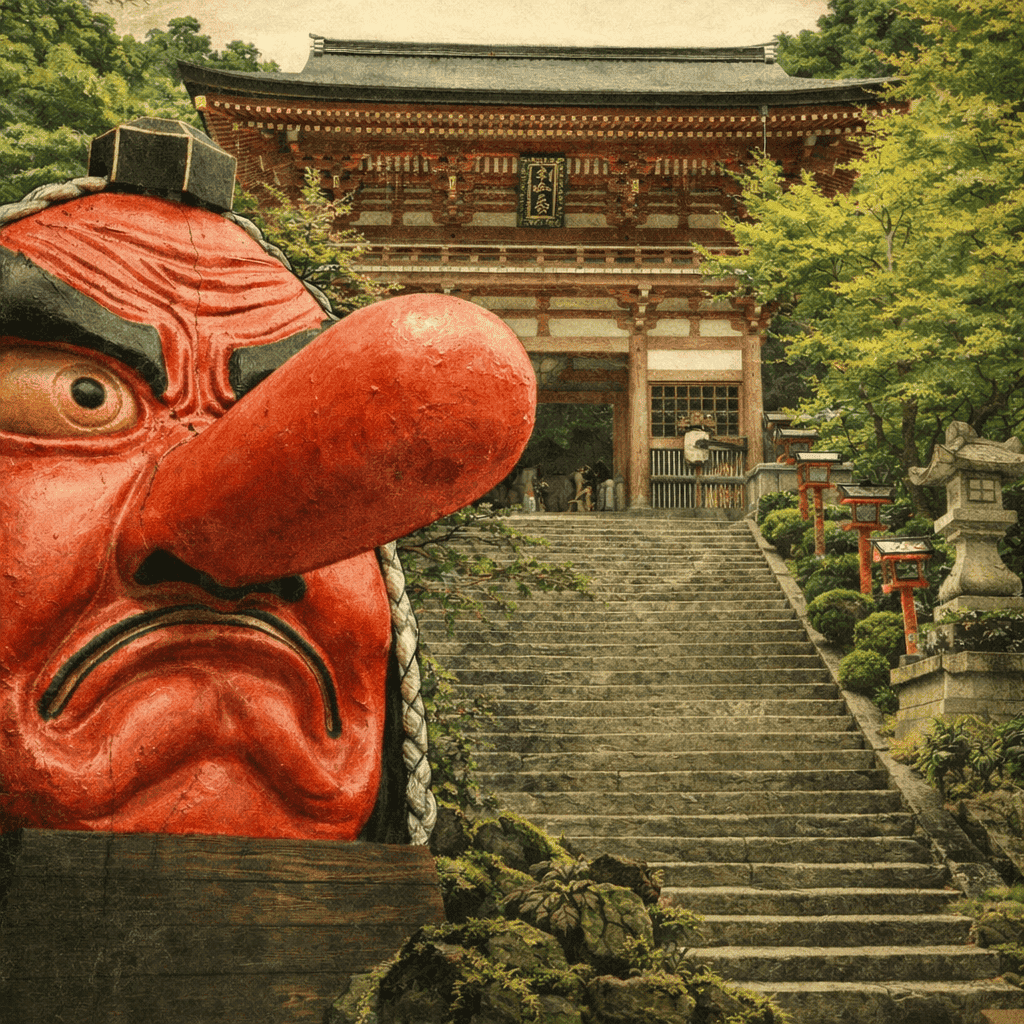
The legendary home of Sojobo, king of the tengu, and one of the most important mountain temples in the Kyoto region. A forest trail connects Kifune to Kurama over the ridge of Mount Kurama, and walking this path is one of the classic pilgrimages of northern Kyoto.
30 min by Eizan Railway
Shimogamo Shrine
One of the oldest shrines in Japan and a UNESCO World Heritage Site, Shimogamo sits at the confluence of the Kamo River, the same river whose sacred source is at Kifune. Its ancient forest, Tadasu no Mori, is one of the rare pieces of primeval forest still standing inside Kyoto.
45 min by Eizan Railway
Enryaku-ji (Mount Hiei)
The head temple of the Tendai school of Japanese Buddhism and one of the most historically important religious sites in the country. Mount Hiei has been a center of mountain ascetic practice for over a thousand years.
1 hr by train
Central Kyoto (Gion, Higashiyama)
The historic geisha district of Gion and the old temple neighborhoods of Higashiyama are within an hour by train from Kibuneguchi Station, and make a convenient base for extending a Kifune visit into a full day of Kyoto sightseeing.
Visitor Tips
Related Articles
Support The Yokai Files
Enjoyed this deep dive into Japanese folklore?
The Yokai Files is reader-supported. Your support helps us research deeper, write more, and keep the darkness alive.
Conclusion
Kifune is a shrine that is built on a hole. The hole has never been opened. Inside the hole, the tradition says, the dragon of water sleeps, and the entire hydrological system of the Kyoto basin flows from the place where the dragon rests. This is not a metaphor. It is the oldest and most literal statement of the relationship between Japanese religion and the physical earth: the water that keeps the city alive comes out of the ground where a god lives, and the shrine built over the god is the place where the city goes to ask, politely and perpetually, for the water to keep flowing.
Walk the full route. Buy a water omikuji at the Hongu and watch the ink appear. Stop at Yui-no-yashiro and think about whoever you want to be bound to. Continue up the valley to the Okumiya and stand above the Ryuketsu for as long as you need to. The dragon beneath your feet is the same dragon that feeds the Kamo River and every water shrine that has ever been built downstream from this valley. Kifune is where that lineage begins. The rest of Japan's water shrines are its children.
This is The Yokai Files.