Kitsune Shrines of Japan: Where Fox Spirits Still Walk Among Us
Published: April 6, 2026
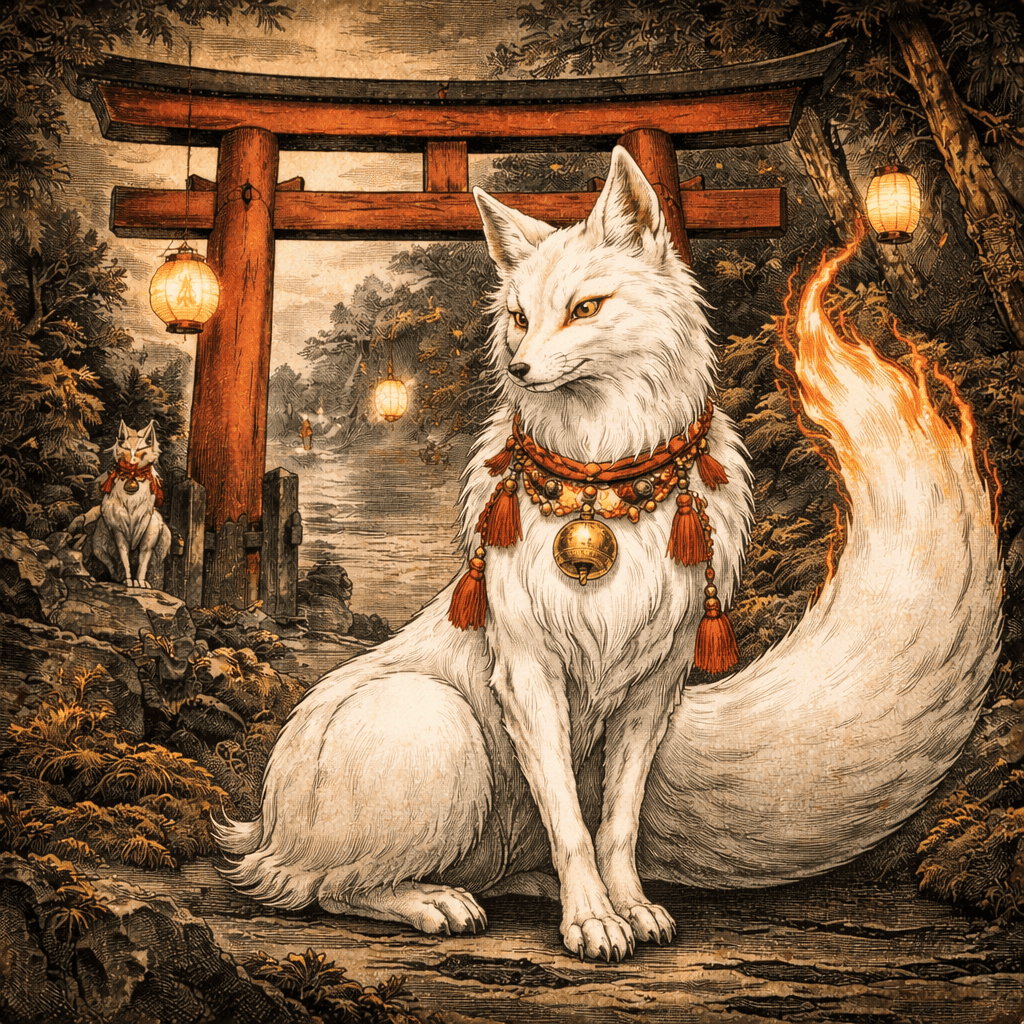
There are more than thirty thousand Inari shrines scattered across the Japanese archipelago, from the neon-drenched alleyways of Tokyo to the silent rice paddies of rural Shikoku, from windswept Hokkaido fishing villages to the subtropical hillsides of Okinawa. At every one of them, a pair of stone foxes stands guard at the entrance, their eyes fixed on the approach, their mouths holding objects whose meaning most visitors never think to question. These foxes are not decorative. They are not mascots. They are kitsune, the sacred fox spirits of Japanese folklore, and they have been standing watch at these gates for centuries, silent sentinels at the threshold between the human world and the divine. Walk past them without understanding what they are, and you have missed the most important thing the shrine has to tell you.
The relationship between the fox and the sacred in Japan is older than recorded history and more complex than any single article can fully contain. It is a relationship that encompasses agriculture and commerce, Buddhism and Shinto, imperial courts and peasant villages, genuine religious devotion and deep-rooted supernatural terror. The kitsuneis simultaneously one of Japan's most beloved spiritual figures and one of its most feared supernatural predators, a being that can bestow immense blessings or inflict devastating curses depending on its nature and its mood. To visit the shrines where these fox spirits are venerated is to enter a world where that duality is not a contradiction but a fundamental truth, where the same creature that brings prosperity to a merchant can drive a woman mad, and where the line between prayer and possession has never been entirely clear. This is the world of the kitsune shrines. Enter carefully.
The Fox and the Divine: Kitsune as Sacred Messengers
The fox became sacred in Japan through a process that unfolded over centuries, intertwining indigenous Shinto animism with continental Buddhist and Taoist influences into a spiritual tapestry of extraordinary complexity. In the earliest layers of Japanese folk belief, foxes were regarded with a mixture of admiration and unease. They were clever, elusive, and nocturnal, qualities that made them natural candidates for supernatural status in a culture that assigned spiritual significance to any animal that seemed to possess more than ordinary intelligence. Farmers observed foxes hunting in the rice paddies, and because rice was the foundation of Japanese civilization, the literal currency of the economy and the offering most pleasing to the gods, the fox's presence in the paddies was interpreted as a sign of divine favor. The fox was in the rice field, and the rice field was sacred. Therefore the fox was sacred.
This agricultural association eventually crystallized around Inari, the Shinto deity of rice, fertility, tea, sake, agriculture, industry, and general prosperity. Inari is one of the most important and widely worshipped kami in the entire Shinto pantheon, and understanding who Inari actually is requires dispelling a persistent misconception. Inari is not a fox. The deity enshrined at Inari shrines is Ukanomitama no Kami, a kami of foodstuffs and grains whose identity predates the fox association by centuries. In some traditions, Inari is also identified with other deities including Toyouke no Okami and Uka no Mitama, and the deity's gender has shifted across different periods and regions, sometimes appearing as a male god, sometimes as a female goddess, and sometimes as an androgynous or formless divine presence. The fox entered the picture not as the deity but as the deity's kenzoku, a divine servant or sacred messenger who acts as an intermediary between Inari and the human world.
The distinction between the deity and the messenger is crucial, and it is one that many Japanese people themselves sometimes blur. When someone says "Oinari-san" and points at a fox statue, they are technically pointing at the servant, not the master. The fox carries prayers from humans to the divine and delivers blessings from the divine to humans. It is a spiritual postman of immense power, a being that exists in the liminal space between the mortal and the immortal, trusted by both sides precisely because it belongs fully to neither. The stone foxes at shrine entrances are positioned in pairs not merely for aesthetic symmetry but because they represent the duality of the messenger's role: one fox faces outward to receive the prayers of those who approach, and the other faces inward to carry those prayers to the deity within.
The process of shinbutsu shugo, the syncretism of Shinto and Buddhism that characterized much of Japanese religious history, added further layers to the kitsune's sacred identity. When Buddhist theology merged with Shinto practice, Inari was associated with Dakiniten, a Buddhist deity adapted from the Indian dakini, who was depicted riding a white fox. This fusion meant that the fox was sacred in both the Shinto and Buddhist frameworks simultaneously, a remarkable achievement for an animal that in other cultural contexts is associated primarily with trickery and deception. The kitsune's dual nature, its ability to be both sacred messenger and supernatural trickster, both divine servant and wild animal, is a reflection of this layered religious history. It is not a contradiction. It is the natural product of a civilization that never demanded its spiritual beings be simple.
The Secret Language of Fox Statues: What They Hold in Their Mouths
Stand before any Inari shrine in Japan and look closely at the fox statues flanking the entrance. In their mouths or beneath their paws, they hold objects. Most visitors, even most Japanese visitors, glance at these objects without truly seeing them, registering them as generic religious paraphernalia no different from the lotus flowers held by Buddhist statues or the gohei wands held by Shinto priests. This is a mistake. The objects held by fox statues are a coded language, a system of symbols that tells you exactly what kind of blessings the shrine offers, what aspect of Inari's power is being invoked, and what the original worshippers who commissioned those statues were praying for. Learning to read this language transforms a visit to an Inari shrine from a pleasant sightseeing experience into a genuine encounter with the living symbolic tradition of Japanese spirituality. There are four primary objects, and each one carries centuries of meaning.
Ine (Rice Sheaf) — 稲穂
The most fundamental object held by Inari foxes is the ine, a sheaf of ripe rice. This is the oldest and most direct symbol in the kitsune vocabulary, and its meaning is as straightforward as Japanese symbolism ever gets: abundance, the blessing of a full harvest, the prayer that the rice will grow tall and heavy and that the granary will be full when winter comes. The word "Inari" itself is believed by many scholars to derive from "ine-nari" or "ine wo ninau," meaning "carrying rice" or "rice growing," an etymology that places the grain at the very root of the deity's identity. When a fox holds rice in its mouth, it is performing its most ancient function: delivering the promise of sustenance from the divine to the human, carrying the god's fundamental gift to the people who need it most.
In pre-modern Japan, rice was not merely food. It was currency, tax payment, social status, and spiritual offering. A good rice harvest meant survival. A bad one meant famine, debt, and death. The fox holding rice was therefore not a decorative motif but a deadly serious prayer, the visual equivalent of a farmer on his knees begging the universe to let his family live another year. At rural Inari shrines, particularly in the rice-growing regions of Niigata, Akita, and the Tohoku plain, the rice-bearing fox remains the dominant image, a direct and unbroken connection to the agrarian desperation and gratitude that gave birth to Inari worship in the first place.
Makimono (Scroll) — 巻物
The makimono, or scroll, represents wisdom, knowledge, and the sacred teachings that flow from the divine to those who seek them. This symbol emerged primarily during the period of shinbutsu shugo, when Shinto shrines and Buddhist temples were often the same institution and the distinction between kami and buddha was a matter of theological nuance rather than practical reality. The scroll held by the fox was understood to contain sutras, sacred Buddhist texts whose recitation could generate merit, ward off evil, and bring the practitioner closer to enlightenment. In the Shinto framework, the scroll represented the divine knowledge that Inari could bestow upon those who approached with sincere devotion, the secrets of successful enterprise, the wisdom to navigate the complexities of human commerce and social life.
The scroll-bearing fox is particularly common at Inari shrines that have strong connections to education, scholarship, and the arts. Students preparing for examinations, scholars seeking inspiration, and artists praying for creative breakthrough have traditionally been drawn to these shrines, where the fox's scroll promises that the divine has knowledge to share and is willing to share it with those who ask correctly. In modern Japan, the scroll-bearing fox has taken on additional associations with business wisdom and strategic insight, reflecting the evolution of Inari from a purely agricultural deity to a patron of commerce and industry.
Tama (Sacred Jewel) — 玉・宝珠
The tama, also called hoju or nyoi hoju (wish-fulfilling jewel), is perhaps the most mysterious and spiritually potent object in the fox's repertoire. Depicted as a round or teardrop-shaped gem, often with a flame-like protrusion at its apex, the tama represents the concentrated spiritual power of the divine, the raw essence of the sacred condensed into a single luminous object. In Buddhist theology, the nyoi hoju is the wish-fulfilling jewel, a magical gem that grants any desire to its possessor. In the Shinto-Buddhist synthesis that characterizes Inari worship, the tama carried by the fox is understood as a vessel of Inari's spiritual authority, the concentrated power of the kami made visible and portable.
The tama also connects to the broader Japanese tradition of spirit balls, the luminous spheres that kitsune are said to carry as repositories of their supernatural power. In folklore, a fox's hoshi no tama (star ball) contains its magic and possibly its life force, and a human who captures a fox's jewel gains power over the creature. This folk belief adds a layer of danger and intimacy to the tama symbol at Inari shrines: the fox is not merely holding a decorative object but displaying the very source of its power, offering it to the deity and, by extension, to the worshippers who come seeking blessings. It is an act of trust and vulnerability that mirrors the vulnerability of the worshippers themselves, who come to the shrine bearing their own most precious hopes and fears.
Kagi (Key) — 鍵
The kagi, or key, is the most practical and the most metaphorically rich of the four objects. On the literal level, the key unlocks the rice granary, the storehouse where the harvested grain is kept safe from rot, theft, and vermin. In an agricultural society, the granary key was one of the most important objects in the household, the physical token of food security and economic solvency. A fox holding the key to the granary is a fox that controls access to the fundamental necessities of life, a guardian who can open the door to abundance or keep it sealed shut.
On the metaphorical level, the key represents access to hidden things: locked doors, sealed knowledge, closed opportunities, and unrealized potential. The fox with the key is the fox that can open what has been shut, reveal what has been concealed, and make possible what has seemed impossible. For merchants and business owners, the key-bearing fox represented the unlocking of commercial success, the opening of new markets, the discovery of profitable opportunities. For individuals in personal distress, the key promised that the locked doors of their lives could be opened, that whatever was blocking their path forward could be removed by divine intervention carried on four swift paws. The key is perhaps the most human of the four symbols, the one that speaks most directly to the universal experience of standing before a closed door and praying for it to open.
No two fox statues are exactly alike. Each one is a unique offering, a silent prayer frozen in stone. The angle of the head, the set of the ears, the object in the mouth, the expression on the face — all of these are choices made by the sculptor, the commissioner, and the community that placed the statue at its post. To walk through an old Inari shrine and study its fox statues one by one is to read a record of human hopes and fears that stretches back generations, each stone fox a letter to the divine that was never intended to be opened by anyone but the god it addresses.
The Six Sacred Kitsune Sites of Japan
The following six sites represent some of the most significant and spiritually powerful Inari fox shrines in Japan. They span the country from the ancient capital of Kyoto to the backstreets of Tokyo, from the Zen temples of central Honshu to the ornate halls of Kyushu. Together they form a pilgrimage route through the living tradition of kitsune worship, a tradition that has survived the fall of the shogunate, the forced separation of Buddhism and Shinto during the Meiji era, two world wars, and the relentless modernization of the postwar period. Each site has its own character, its own history, and its own foxes, but all share a common quality: the unmistakable sense that something older and more powerful than human civilization is still present, still watching, still waiting at the gate.
A note on the "Three Great Inari Shrines" (Nihon Sandai Inari): there is no universally agreed-upon list. Fushimi Inari Taisha always occupies the top position, but the remaining two slots are claimed by different shrines depending on the region, the historical period, and who you ask. Toyokawa Inari, Kasama Inari, and Yutoku Inari all claim membership in the top three, and none of them is wrong. The disagreement itself is a testament to the depth and geographic breadth of Inari worship in Japan: there are simply too many great fox shrines for any list of three to be definitive.
Fushimi Inari Taisha (伏見稲荷大社)
Location: Fushimi Ward, Kyoto
Fushimi Inari Taisha is the head shrine of all Inari shrines in Japan, the source from which thirty thousand tributary shrines flow, and the single most important site in the world for understanding the relationship between the fox and the sacred. Founded in 711 CE when the Hata clan, powerful immigrants from the Korean peninsula who had established themselves as rice farmers in the Fushimi district, enshrined Inari on the slopes of Mount Inari (Inariyama), the shrine has grown over thirteen centuries into a vast complex that covers the entire mountain and draws over ten million visitors per year, making it consistently one of the most visited religious sites in all of Japan.
The shrine's most famous feature is the senbon torii, the "thousand vermillion gates" that create a continuous tunnel of lacquered wood winding up the mountainside. The name is a dramatic understatement: the actual number of torii at Fushimi Inari exceeds ten thousand, each one donated by a business, family, or individual seeking Inari's blessing. The torii range in size from towering structures large enough to drive a car through to miniature gates barely a meter tall, and they are packed so tightly along the mountain paths that walking through them is like passing through a luminous arterial vein of pure devotion, the concentrated prayers of thousands of supplicants made physical and architectural. The torii are inscribed with the donor's name and the date of dedication, and reading them is like reading a commercial history of modern Japan: corporate names jostle with family names, Tokyo addresses alternate with Osaka addresses, and the dates span from the Meiji era to last month.
But it is the foxes that concern us here, and Fushimi Inari has foxes like no other shrine in Japan. All four types of fox statues are present: foxes holding rice sheaves, foxes holding scrolls, foxes holding sacred jewels, and foxes holding keys. They appear in stone, bronze, ceramic, and wood. They stand at every intersection, guard every sub-shrine, and flank every torii gate along the mountain path. Some are ancient, their features worn smooth by centuries of weather and human touch. Others are brand new, their paint fresh and their expressions sharp. Together they form an army of the sacred, thousands of fox sentinels deployed across the mountain in a formation that has been continuously reinforced for over a thousand years.
The mountain itself, Inariyama, is considered sacred ground in its entirety. The hiking trail from the main shrine at the base to the summit is approximately four kilometers long and takes about two hours at a walking pace. Along the way, dozens of smaller sub-shrines (otsuka) dot the mountainside, each one tended by devotees who maintain them with offerings of rice, sake, candles, and the fox's favorite food: aburage, the fried tofu that is the basis of inari-zushi. The mountain is open twenty-four hours a day with no admission fee, and visiting at night, when the torii are lit by stone lanterns and the fox statues cast long shadows in the flickering light, is an experience that rewrites everything you thought you knew about the boundary between the sacred and the everyday.
Access: JR Nara Line to Inari Station (directly in front of the main gate) or Keihan Line to Fushimi-Inari Station (5-minute walk).
Toyokawa Inari / Myogon-ji Temple (豊川稲荷・妙厳寺)
Location: Toyokawa, Aichi Prefecture
Toyokawa Inari is one of the most important Inari worship sites in Japan, and it is also one of the most misunderstood. Despite being universally known as "Toyokawa Inari," the site is not a Shinto shrine at all. It is Myogon-ji, a Soto Zen Buddhist temple founded in 1441 by the monk Tokai Gieki. The "Inari" venerated here is not the Shinto kami Ukanomitama but Dakiniten, the Buddhist deity adapted from Indian tradition who rides a white fox and bestows worldly blessings upon her devotees. This distinction matters because it demonstrates the extraordinary flexibility of the fox's sacred identity in Japan: the kitsune is not confined to a single religious framework but operates across the full spectrum of Japanese spiritual practice, equally at home in a Zen meditation hall and a Shinto festival.
The temple's most extraordinary feature is the Reiko-zuka (Spirit Fox Mound), a hillside area within the temple complex that contains over one thousand stone fox statues. The statues have been donated by devotees over centuries, and they cover the hillside in a dense, silent crowd that is simultaneously beautiful and deeply unsettling. The foxes vary enormously in size, age, and style. Some are elegant, finely carved figures that could grace a museum. Others are crude, almost primitive in their execution, their features worn to near-abstraction by centuries of exposure. Some wear red bibs, a common Japanese practice for sacred statues that signifies the devotion of the offering and invokes protection for children. The overall effect is of a gathering, an assembly of fox spirits that has been convening on this hillside for half a millennium and shows no sign of adjourning.
Toyokawa Inari's historical significance is immense. The temple was patronized by some of the most powerful figures in Japanese history, including Oda Nobunaga, Toyotomi Hideyoshi, and Tokugawa Ieyasu, the three great unifiers of Japan, all of whom sought Dakiniten's blessing for their military and political ambitions. The temple also claims a connection to the origin of inari-zushi, the sweet fried tofu pouch stuffed with sushi rice that is one of Japan's most beloved comfort foods. According to local tradition, the dish was developed in the area around the temple as an offering to the fox spirits, and the name "inari-zushi" derives directly from the temple's association with Inari worship.
Access: JR Iida Line to Toyokawa Station or Meitetsu Toyokawa Line to Toyokawa-Inari Station, then 10-minute walk.
Kasama Inari Shrine (笠間稲荷神社)
Location: Kasama, Ibaraki Prefecture
Kasama Inari Shrine is one of the oldest Inari shrines in Japan, with a founding date traditionally given as 651 CE, making it older than Fushimi Inari itself by sixty years. If this dating is accurate, and the shrine's own records and local tradition maintain that it is, then Kasama represents one of the very earliest manifestations of organized Inari worship in the Japanese archipelago, a direct window into the formative period when the fox cult was still crystallizing from the raw material of folk belief into the structured religious tradition it would become. The shrine draws approximately 3.5 million visitors annually, placing it among the most visited Inari shrines in the country.
The architectural centerpiece of Kasama Inari is its main hall (honden), designated as an Important Cultural Property of Japan. The current structure dates to 1860, built during the final years of the Tokugawa shogunate, and it is a masterpiece of late Edo period religious architecture. The hall's exterior is covered in extraordinarily detailed woodcarvings that depict scenes from Japanese mythology, nature, and daily life with a precision and vitality that reward extended study. The most celebrated carving is the "Santou Happou Nirami no Ryu," the "Three-Headed Dragon Glaring in Eight Directions," a virtuosic piece of sculpture that writhes across the upper facade with a dynamism that seems to defy the limitations of wood as a medium. The dragon is said to watch over the shrine in all directions simultaneously, supplementing the foxes' vigilance with its own omnidirectional gaze.
Kasama is also famous for its wisteria trellises (fuji-dana), supported by trees estimated to be over four hundred years old. In early May, the wisteria blooms in cascading curtains of purple and white that transform the shrine grounds into one of the most photogenic destinations in the Kanto region. The combination of the ancient wisteria, the carved dragons, and the stone fox statues that guard every corner creates an aesthetic experience that is uniquely Japanese in its layering of natural beauty and spiritual symbolism. The shrine also hosts one of the largest chrysanthemum festivals in Japan each autumn, drawing flower enthusiasts from across the country.
Access: JR Mito Line to Kasama Station, then 20-minute walk or 10-minute bus ride.
Yutoku Inari Shrine (祐徳稲荷神社)
Location: Kashima, Saga Prefecture
Yutoku Inari Shrine is the largest and most spectacular Inari shrine in Kyushu, the southernmost of Japan's four main islands. Founded in 1687 by Manshi-in Keijuin, a noblewoman of the Kyoto imperial court who married into the Kashima domain's ruling Nabeshima clan, the shrine was built to house a sacred Inari image that Keijuin brought with her from Kyoto. The shrine draws approximately three million visitors per year, making it one of the most popular religious destinations in all of western Japan, and its ornate, brilliantly colored architecture has earned it the nickname "Chinzei Nikko," the "Nikko of the West," a comparison to the famously elaborate Toshogu shrine complex in Tochigi Prefecture.
The comparison to Nikko is apt. Yutoku Inari's main hall stands eighteen meters above the ground, elevated on a massive framework of wooden pillars that creates a dramatic stage-like structure reminiscent of Kyoto's Kiyomizudera. The hall is painted in vivid vermillion and gold, and its multi-layered roofline sweeps upward against the forested mountainside behind it in a composition that is architecturally thrilling and spiritually overwhelming. Visitors climb a long stone staircase through the shrine's lower precincts, passing through progressively more elaborate gates and halls, each one increasing the sense of ascent and anticipation, until the main hall reveals itself in all its gilded glory, floating above the valley floor like a palace in a dream.
Beyond the main hall, a mountain trail leads to the Okunoin, the innermost sanctuary at the summit of the mountain behind the shrine. The climb takes approximately thirty minutes and passes through dense forest populated by stone fox statues and miniature torii gates. At the top, the Okunoin offers a panoramic view of the Ariake Sea and the flat agricultural plain of the Saga lowlands, a landscape that explains immediately why Inari, the deity of rice and abundance, would choose this spot as a seat of power. The view encompasses some of the most productive rice-growing land in Japan, and on clear days, the shimmer of the flooded paddies in spring creates the impression that the entire plain is a single vast offering to the fox god's kingdom above.
Access: JR Nagasaki Main Line to Hizen-Kashima Station, then bus approximately 15 minutes.
Oji Inari Shrine (王子稲荷神社)
Location: Kita Ward, Tokyo
Oji Inari Shrine holds the title of "Kanto Inari Soja," the head Inari shrine of the entire Kanto region, a designation that once placed it at the apex of fox worship for the great eastern plain that includes modern-day Tokyo, Yokohama, and the surrounding prefectures. The shrine's history stretches deep into the medieval period, and its spiritual authority over the Kanto's Inari shrines reflects the era when Oji was a major religious center long before Edo, the future Tokyo, rose to prominence as the shogun's capital.
Oji Inari possesses one of the oldest pairs of komainu-style fox statues in the Kanto region, dedicated in 1764 during the middle of the Edo period. These guardian foxes, carved in a style that blends the traditional komainu (lion-dog) guardian form with the specific features of the kitsune, are remarkable both as works of art and as historical documents. Their weathered surfaces and archaic proportions distinguish them immediately from the more standardized fox statues produced in later periods, and they offer a glimpse of what Inari worship looked like in the decades before the great standardization of shrine architecture and iconography that occurred during the Meiji era.
The shrine's fame in the art world rests on its appearance in Utagawa Hiroshige's "One Hundred Famous Views of Edo" (Meisho Edo Hyakkei), one of the most important series of woodblock prints in Japanese art history. Hiroshige's print, titled "Oji Shozoku-enoki, Omisoka no Kitsunebi" (Fox Fires on New Year's Eve at the Shozoku Hackberry Tree, Oji), depicts a magical scene in which dozens of foxes gather beneath a great hackberry tree near the shrine on New Year's Eve, their bodies surrounded by mysterious fox-fire (kitsunebi) as they don ritual garments before proceeding to worship at the shrine. The legend holds that every fox in the Kanto region gathered at this spot on the last night of the year, and farmers would observe the pattern of the fox-fires to predict the coming year's harvest.
This legend lives on in the modern "Oji Fox Parade" (Oji Kitsune no Gyoretsu), held every New Year's Eve. Participants dressed in fox masks and costumes process through the streets of Oji to the shrine, re-enacting the mythical assembly of foxes depicted in Hiroshige's print. The event has grown from a small local revival into one of Tokyo's most beloved New Year's traditions, drawing thousands of spectators and participants who paint fox faces on their cheeks, wear fox ears, and carry paper lanterns through the cold December streets. It is a rare example of a yokai tradition that has not merely survived but actively flourished in the modern metropolis.
Access: JR Keihin-Tohoku Line to Oji Station, then 7-minute walk.
Higashi-Fushimi Inari Shrine (東伏見稲荷神社)
Location: Nishi-Tokyo, Tokyo
Higashi-Fushimi Inari Shrine was established as the "Eastern Fushimi Inari," a branch shrine designed to bring the spiritual authority of Kyoto's great Fushimi Inari Taisha to the Kanto region for worshippers who could not make the long journey west. The shrine's creation reflected a genuine spiritual need: in the early twentieth century, the devotion to Inari among Tokyo's commercial class was fervent, but the journey to Kyoto was expensive and time-consuming. By establishing a shrine that formally carried Fushimi Inari's divided spirit (bunrei), the religious authorities created a spiritual outpost that allowed eastern worshippers to access the same divine power without the pilgrimage.
The shrine's approach is lined with vermillion torii gates that evoke, in miniature, the famous senbon torii of its Kyoto parent. Walking through these gates on a quiet weekday morning, with the traffic noise of the Shin-Ome Kaido fading behind you and the shadows of the torii creating a rhythmic pattern of light and dark on the stone path, is an experience that justifies the shrine's existence entirely. The approach has a meditative quality that the crowded paths of Fushimi Inari can rarely offer, and the shrine itself, while smaller than its famous parent, possesses an intimacy and calm that many visitors find more spiritually satisfying than the overwhelming scale of the Kyoto original.
Higashi-Fushimi Inari is designated as one of the Shin Tokyo Hyakkei, the New One Hundred Views of Tokyo, a recognition of its aesthetic and cultural significance within the metropolitan landscape. The shrine specializes in blessings for commercial prosperity (shoubai hanjo), traffic safety (kotsu anzen), and success in the performing arts (geinoujoryu), reflecting the diverse needs of its urban congregation. The fox statues here are particularly well-maintained, their features sharp and expressive, and the shrine's smaller scale allows visitors to examine them closely in a way that is not always possible at larger, more crowded sites.
Access: Seibu Shinjuku Line to Higashi-Fushimi Station or Seibu-Yagisawa Station, then 12-minute walk.
The White Fox: Japan's Most Sacred Animal
Among all the foxes that populate Japanese spiritual tradition, one stands above the rest in sanctity and power: the byakko, the white fox. The white fox is not merely a color variant of the common red fox but a being of an entirely different spiritual order, a creature that has lived so long and accumulated so much spiritual energy that its fur has transcended the ordinary spectrum and become the color of purity, divinity, and otherworldly power. In Japanese folk belief, seeing a white fox is one of the most auspicious omens imaginable, a sign that the viewer has been singled out for divine attention and that extraordinary good fortune is imminent.
The white fox is Inari's most exalted messenger, the elite among the already sacred. When Inari appears in visions, dreams, and religious art, the deity is almost always accompanied by white foxes, and the most important fox statues at major Inari shrines are painted white to signify their supreme spiritual status. The connection between whiteness and sacredness in Japanese animal folklore extends beyond foxes to include white snakes, white deer, and white boars, all of which are regarded as divine messengers, but the white fox holds a special place because of its intimate and exclusive relationship with one of the most powerful and widely worshipped deities in the Japanese pantheon.
It is important to distinguish the sacred fox, whether white or otherwise, from the kitsune as yokai. In the folklore tradition, kitsune are shape-shifting tricksters who can assume human form, seduce unwary men, possess vulnerable women, and cause all manner of supernatural mischief. The fox that bewitches a traveler on a lonely road at night and the fox that guards the gate of an Inari shrine are, in the Japanese imagination, the same species of being operating in radically different modes. The sacred fox has placed its power in service of the divine. The yokai fox has kept its power for itself. The difference is not one of nature but of allegiance, and this ambiguity is what makes the kitsune the most fascinating and complex animal spirit in all of Japanese supernatural tradition.
Tips for Visiting Kitsune Shrines
Etiquette and purification:Upon arriving at a Shinto Inari shrine, use the temizuya (water basin) to purify your hands and mouth before approaching the main hall. At the offering box, throw a coin (five-yen coins are considered especially lucky because "go-en" is a homophone for "good fortune" or "divine connection"), bow twice, clap twice, make your prayer silently, and bow once more. At Toyokawa Inari, which is a Buddhist temple, the procedure differs: light incense, place it in the censer, and press your palms together in silent prayer without clapping. Respecting these differences shows that you understand the site you are visiting, and the regular worshippers around you will notice.
Aburage offerings:At many Inari shrines, you can purchase aburage (fried tofu) to leave as an offering to the fox spirits. This is the kitsune's legendary favorite food, and the custom of offering it is centuries old. Place the aburage on the designated offering stand near the fox statues, not on the statues themselves. Some shrines sell prepared offerings at stalls near the entrance; at others, you may bring your own. The act of offering food to the fox spirits is one of the most intimate and direct forms of devotion available at an Inari shrine, and participating in it connects you to a tradition that stretches back to the earliest days of fox worship in Japan.
Goshuin and omamori: All six sites in this guide offer goshuin (shrine stamps) and omamori (protective charms). Inari shrine omamori typically focus on commercial prosperity, safe travel, academic success, and general good fortune. The goshuin at Inari shrines often feature fox imagery and are among the most visually striking in the Japanese shrine system. Bring your goshuincho (stamp book) or purchase one at your first stop.
Photography:Outdoor photography is generally permitted at all six sites. Interior photography may be restricted at some locations; look for signs or ask before shooting inside halls. At Fushimi Inari, the torii tunnel paths are photogenic but can be extremely crowded during peak hours. For the best photographs, visit early in the morning (before 7 AM) or late in the evening. At Toyokawa Inari's Reiko-zuka, the thousand fox statues photograph beautifully in overcast light, which softens the shadows and brings out the textures of the weathered stone.
Best seasons:Inari shrines are compelling in every season, but certain times offer special experiences. New Year (January 1–3) brings massive crowds to major shrines for hatsumode, the first shrine visit of the year, when millions of Japanese people pray for good fortune. The Oji Fox Parade on New Year's Eve is a must-see. Spring brings cherry blossoms to many shrine grounds, and the wisteria at Kasama Inari peaks in early May. Autumn foliage at Fushimi Inari and Yutoku Inari is spectacular. Summer festivals (matsuri) at local Inari shrines feature processions, fireworks, and fox-themed celebrations throughout the country.
The Fox Lives On
In an age of convenience stores and bullet trains, of smartphones and social media, the fox still stands at the gate. Over thirty thousand Inari shrines still operate across Japan, and Fushimi Inari Taisha remains one of the most visited religious sites in the country, year after year, decade after decade. The fox's endurance is not a quirk of cultural inertia or tourist marketing. It reflects something deeper: a persistent human need for contact with the sacred, for places where the boundary between the visible and the invisible grows thin, for beings that mediate between the world we can see and the world we can only sense.
The kitsune fulfills this need with a specificity and intimacy that few other sacred figures can match. The fox is not abstract. It is not a philosophical concept or a theological proposition. It is a stone statue with a key in its mouth, standing at a specific gate on a specific street, guarding a specific shrine where specific prayers are offered for specific blessings. It is a flash of white fur glimpsed in the corner of your eye as you climb a mountain trail. It is a pair of amber eyes watching from the shadows beneath a torii gate at midnight. The fox is always somewhere, always present, always waiting for the next person who will stop, look closely, and understand what it is holding in its mouth.
To learn more about the kitsune's origins, powers, and place in Japanese supernatural tradition, visit our full Kitsune article. To explore the deity they serve, read our guide to Inari, the God of Rice and Prosperity. For more sacred sites and spiritual destinations across Japan, explore the Shrines & Temples section.
Conclusion
The six sites described in this guide are doors, not destinations. They are entry points into a tradition so vast and so deeply embedded in the Japanese landscape that no single lifetime could explore it all. Behind every vermillion torii gate, beside every stone fox, beneath every offering of fried tofu, there are centuries of accumulated prayer, hope, fear, and gratitude, the spiritual sediment of a civilization that has never stopped believing that the fox at the gate is more than stone. Whether you visit Fushimi Inari at dawn with ten thousand other pilgrims or find a tiny neighborhood Inari shrine on a backstreet in Osaka with no one else in sight, the fox will be there. It has always been there. It will be there long after the last torii has faded and the last prayer has been whispered and the rice fields have returned to whatever they were before humans planted the first seed. The fox is patient. The fox remembers. The fox is waiting.
This is The Yokai Files.
Support The Yokai Files
Enjoyed this deep dive into Japanese folklore?
The Yokai Files is reader-supported. Your support helps us research deeper, write more, and keep the darkness alive.