Murouryuketsu Shrine — Where a Dragon Lives in the Mountain
Published: April 29, 2026
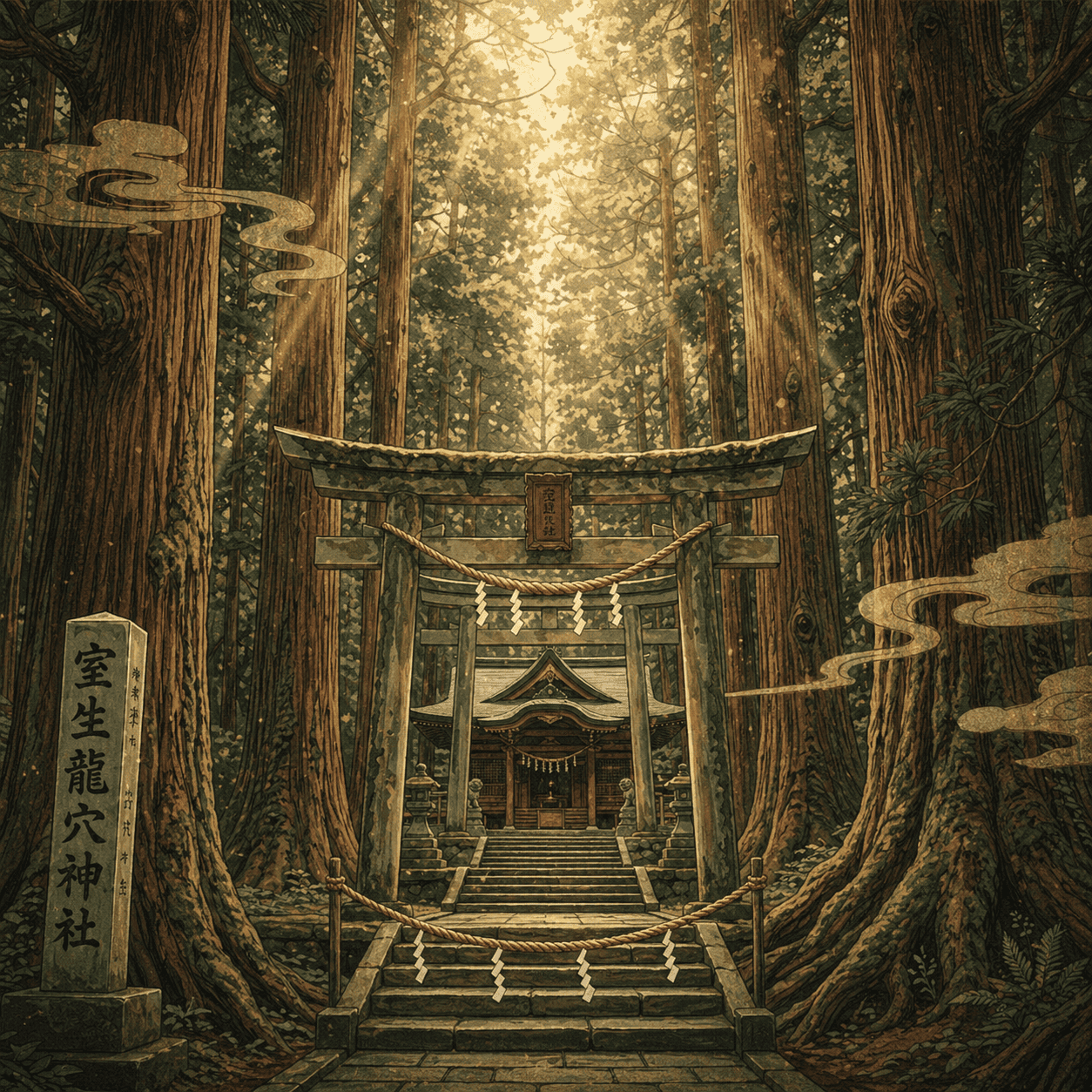
Beyond the rice paddies of Uda, where the road narrows into a green tunnel of cedars and the rivers run clear over flat black stones, there is a shrine that no one is quite sure how to date. It stands in a fold of the mountains south of the famous Muroji Temple, on a slope where the cedars grow so tall that the canopy closes over the torii like a vaulted ceiling, and where the air, even on the warmest summer afternoon, carries the cold breath of running water from somewhere deeper in. The shrine has no founding myth that anyone can prove, no charter from an emperor that anyone has ever found, no dedication stone that anyone has been able to read. It was here when the temple beside it was built. It was here when the Heian court began sending envoys with horses to pray for rain. It was, by every available measure, here before there was a Japan to enshrine it in.
This is Murouryuketsu Shrine, and behind it, in the side of the mountain, is a cave. The cave is called the Yoshikichi Ryuketsu, the "Auspicious Dragon Hole," and it is one of the three great dragon caves of Japan. According to a tradition unbroken for over twelve hundred years, a dragon god lives inside it. No human being — not the head priest, not the abbot of the neighboring temple in any of its incarnations, not even the imperial messengers dispatched in times of catastrophic drought — has ever been permitted to look in. The cave is sealed by custom rather than by stone. The seal has held.
This is not a tourist attraction. It is a threshold. The crowds that fill Fushimi Inari and the foreign visitors who fill Kifune do not come here. The path to the shrine is too far from the train, too quiet, too narrow for buses, too inconvenient to fit into a day-trip itinerary. Those who do come walk through six-hundred-year-old cedars to reach a small wooden hall on the bank of a stream, then walk twenty minutes further into the forest to stand at the lip of a waterfall and listen, in silence, to the breathing of something that has been there longer than the country has had a name. This guide is for those who are willing to make that walk.
The Dragon Connection
The principal deity enshrined at Murouryuketsu is Takaokami no Kami, the high dragon god of water and rain. The name is written with the kanji 高龗神, and the central character — 龗 — is one of the most extraordinary characters in the entire Japanese writing system. It is essentially the rain radical (雨) stacked over three mouths (口) above the character for dragon (龍). The kanji is, in other words, a dragon under a sky of rain calling out three times. To write the name of this deity is to draw a picture of what the deity does. There is no separation between the word and the thing, between the dragon and the storm, between the god and the weather it produces.
What sets Murouryuketsu apart from the other great dragon shrines of Japan is the nature of the dragon itself. At many Japanese dragon shrines — Hakone Kuzuryu, the legends of Enoshima, the founding myth of Kifune— the dragon arrives in the story as something dangerous: a serpent that has been killing villagers, a five-headed beast that floods rice paddies, a cursed presence that must be subdued, pacified, or transformed before it can be worshipped. The shrine is built to contain the dragon, to mediate between its destructive power and the human world that needs the rain it brings. The dragon is, in a sense, a problem that worship has solved.
At Murouryuketsu, the dragon is not a problem. It is not a subdued serpent or a converted demon. It was, from the beginning, a god. There is no record of any battle, any sealing, any priest who tamed it. The earliest written references to the cave already treat it as the dwelling place of a divine being whose presence is older than the question of whether anyone wanted it there. This is one of the rarest forms of dragon worship in Japan: the dragon as originalresident of the land, not as foreign menace integrated through ritual but as the genius loci itself, the spirit that was always already in the mountain. The shrine was built around the cave because the cave was already sacred. The water it produces is the dragon's water. The rain that falls on Uda is the dragon's rain.
The pattern of dragon-water naming that flows from this theology can be traced across the entire archipelago. The Tenryu River (天竜川), which descends from the mountains of central Japan and runs through Nagano and Shizuoka, takes its name from the same word for "heavenly dragon" that hovers behind every prayer made at Murouryuketsu. Springs called ryuketsu, waterfalls called ryuso, ponds called ryuchi: the Japanese landscape is named, in places, for the dragon that lives beneath it. To learn this language is to read the country as a single long poem about water. For a fuller account of the network of dragon shrines that stretches from Kanto to Kyushu, see our guide to Dragon Shrines of Japan, and for the broader pantheon of deities into which Takaokami fits, our Mythology archive.
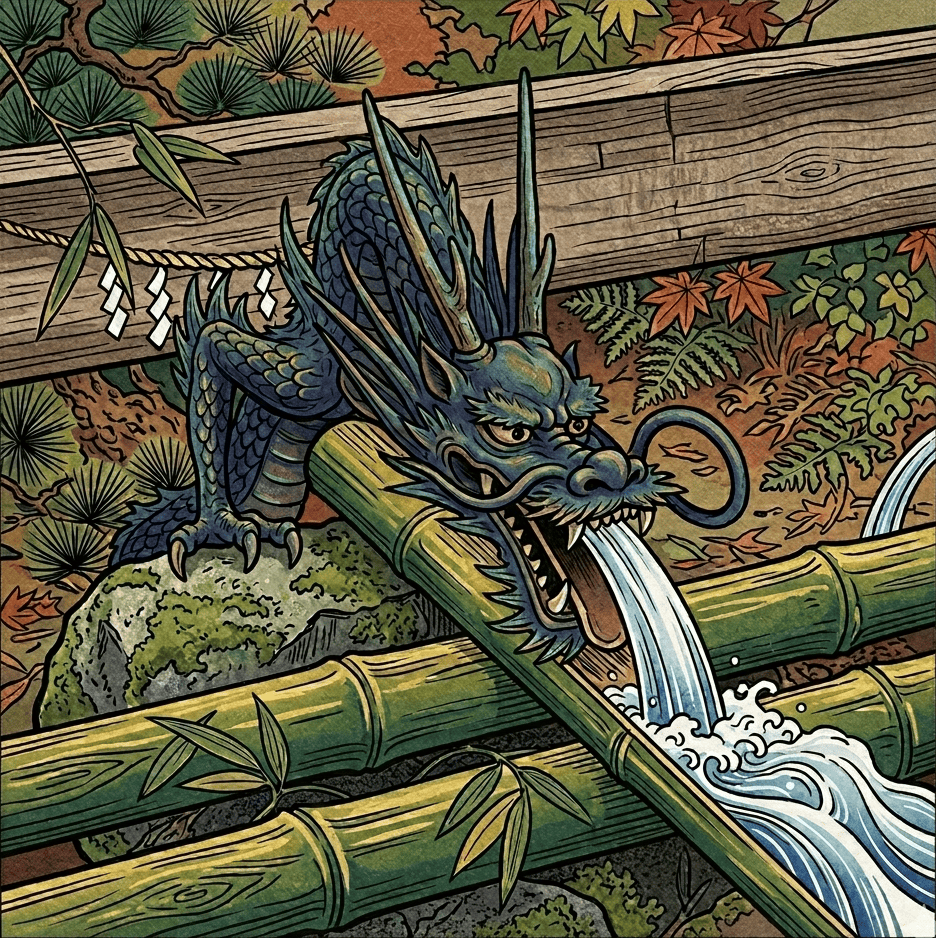
This theology is not merely abstract. It is built into the architecture of the shrine itself. At the entrance to the precincts, the chozuya— the water purification basin where every Shinto visitor rinses hands and mouth before approaching the kami — does not take the conventional form of a stone cistern. It takes the form of a dragon. Water spills from the open mouth of a carved serpent into a bamboo channel below, and every worshipper, before stepping onto the path to the main hall, receives the water of purification directly from the body of the deity they have come to greet. The dragon is not a symbol on a sign. The dragon is the spout.
History
The exact founding date of Murouryuketsu Shrine is unknown. It is older than the neighboring Muroji Temple, which was itself founded in the late eighth century, and the consensus among scholars is that the shrine, or at least the cult of the dragon cave, predates any written record that survives. The shrine appears in the historical record not at the moment of its founding but at the moment when the imperial court of Japan first turned to it for help.
In the eighth century, the future Emperor Kanmu — then known as Prince Yamabe, the son of Emperor Konin — fell gravely ill. Imperial physicians failed to heal him, and the court, exhausting the conventional remedies, dispatched a delegation of priests to the cave at Muro to perform rites of healing on his behalf. The episode is recorded in the Nihon Kiryaku, the abbreviated history of Japan compiled in the late Heian period from earlier official records. The prayers, according to the chronicle, were successful. The prince recovered. He was eventually enthroned as Emperor Kanmu in 781 CE, and it was Kanmu who would, less than a decade and a half later, move the imperial capital to a new city he ordered built at the meeting place of the Kamo and Katsura rivers, a city he named Heian-kyo, and which we now know as Kyoto. The dragon of Murouryuketsu, in other words, is recorded as having played a role in the recovery of one of the most consequential emperors in Japanese history.
After this episode, Murouryuketsu became a fixture of the imperial calendar. From the Heian period onward, whenever drought threatened the rice harvest in the Yamato basin, the court dispatched envoys with offerings to the cave. The standard offering was a horse: a black horse for rain, a white horse for the sun. These offerings were not mere gestures. They were obligations. The horses were given because the dragon, properly addressed, was understood to control the weather, and the weather, properly addressed, was understood to determine whether the people of the capital would eat that year. This system of imperial dispatch — chokushi, the sending of an imperial messenger to a sacred site — persisted for centuries, and Murouryuketsu was one of the regular destinations.
The relationship between the shrine and Muroji Temple, which sits a fifteen-minute walk down the valley, was once so close that the temple was sometimes referred to as Ryuoji, the "Dragon King Temple," reflecting its function as the jinguji — the Buddhist guardian temple — of the older Shinto shrine. In the syncretic religious landscape of medieval Japan, before the Meiji-era separation of Shinto and Buddhism, the two institutions worked as a single complex, with Buddhist priests performing rites at the shrine and the dragon of the cave being identified with Buddhist water-deities such as the nāga kings of Indian-derived cosmology. The Meiji separation forcibly divided the two, and they remain administratively distinct today, but the geography still tells the older story: the shrine and the temple sit on the same valley road, drink the same water, and were, for over a thousand years, the same place.
The current main hall of Murouryuketsu Shrine is not the original. Like nearly every Japanese shrine, the building has been replaced and rebuilt many times across its history. The structure that stands today was constructed in 1671 (Kanbun 11), during the early Edo period, when it was moved here from Kasuga Grand Shrine in Nara. It is, in other words, a Kasuga shrine that has lived for over three and a half centuries in the forest of Muro. The building has been designated a Cultural Property by Nara Prefecture, and the polychrome decorations and architectural details preserve the aesthetic conventions of the seventeenth-century shrine craft tradition. But the shrine's real antiquity does not lie in its buildings. It lies in the cave.
What to See
Murouryuketsu is not a single building but a sequence of sites distributed along a valley road and a mountain stream. The shrine itself stands among ancient cedars at the base; the dragon cave lies twenty minutes upstream through the forest. The following are the major sites every visitor should know about, in the order they are encountered on the approach.
Six-hundred-year-old cedar giants flank the torii — silent guardians of a shrine that predates the nation's written history. They were already mature trees when the current main hall was moved from Kasuga Grand Shrine in 1671. They were already saplings when the imperial envoys came on horseback to pray for rain in the Heian period. The trunks are wider than two adults can encircle with their arms, and the bark, blackened by centuries of rain and lightning, is etched with vertical fissures deep enough to hold a hand. The cedars at Murouryuketsu are not landscaping. They are part of the shrine. In Shinto thought, the boundary between a sacred tree and the deity that inhabits it is permeable, and the shimenawa rope tied around each of the largest trunks is not a decoration but a recognition: this tree, too, is a kami.
Walk slowly here. The temperature drops several degrees as soon as you pass under the canopy. The light filters through layers of needles to reach the ground in shifting columns of green and gold. The sound of the river, which is loud at the parking area, becomes muffled, distant, almost subterranean. This is the threshold, and the cedars are guarding it.
Each October, a sacred straw rope is hung in the cedar's branches — the path by which the dragon descends from heaven. The rope is woven fresh each year by the people of Muro using rice straw harvested from the local fields, in a ritual that has continued without interruption for as long as anyone in the village can remember. Once it is in place, suspended from the high boughs of the great cedar that stands beside the torii, the rope is recognized in local tradition as the descending path of the dragon, the means by which Takaokami no Kami arrives from the sky to receive offerings and depart again at the conclusion of the autumn rites. The rope is woven fresh each year. The dragon, they say, is not.
The autumn festival at which the rope is hung includes the performance of Muro no Shishimai, a regional lion dance that has been designated an Intangible Folk Cultural Property by Nara Prefecture. The dance, accompanied by flute and drum, is performed by masked villagers in the courtyard of the shrine, and is one of the few times in the year when the silence of the forest is broken by music. The combination of dance, dragon rope, and the autumn light filtering through the cedars makes the October festival the single most evocative moment in the shrine's ritual calendar, and one of the most unforgettable experiences a visitor to Nara can have if their travel dates align.
Two cedars that have grown together for centuries, known for blessings of marriage and family harmony. The trunks rise from a single base before separating just above ground level into two distinct trees, then arc outward and back inward as they climb, so that their crowns interlace in the canopy a hundred feet overhead. Couples who visit the shrine traditionally pause here to make a private prayer for the durability of their relationship; families bring children to be photographed at the foot of the trees. The shimenawa rope that encircles them is replaced annually, but the trees themselves have been performing this quiet, vegetative duet for what is estimated to be five hundred years or more.
Meoto Sugi is one of several "couple trees" that exist at shrines around Japan, and the symbolism is consistent: two trees, one root, one fate. But few are as massive as these, and few are situated in a forest as deeply quiet. Even the trees here, it seems, carry something older than their roots.
Moved from Kasuga Grand Shrine in 1671, the spring-style wooden hall is a Nara Prefectural Cultural Property. The structure was originally part of the Wakamiya complex of Kasuga Taisha, the great Fujiwara family shrine in the city of Nara, and it was relocated here during the wholesale renewal cycle that Kasuga performs every twenty years on its principal halls. Rather than dismantle the old hall when its replacement was built, the priests of Kasuga gave it to Murouryuketsu, where it was reassembled on the new site and rededicated to Takaokami no Kami. The result is a building whose architectural lineage runs directly back to one of the most prestigious Shinto institutions in Japan.
Note the roof line. Built to survive a thousand rains, the cedar-bark roof rises in a smooth curve and overhangs the building deeply on all sides, a profile designed to shed water from a forest sky that produces some of the heaviest rainfall in the Yamato basin. The vermillion paint, the carved transoms above the doors, and the metal fittings on the corners of the roof are all consistent with the Kasuga aesthetic of the seventeenth century. As you stand at the haiden in front of the main hall and make your offering, remember that the building you are looking at has stood through three and a half centuries of those Yamato rains, all of which the dragon in the cave behind you, in the local theology, sent.
A twenty-minute walk upstream from the shrine. The cave entrance is guarded by the Shoubaku waterfall. No one — not even the head priest — has ever looked inside. Approach from the observation point and listen to the waterfall. That sound is the dragon breathing.
The path to the Yoshikichi Ryuketsu leaves the main shrine grounds and follows the river upward through a narrow ravine. The trail is paved in places and earthen in others, with stone steps where the gradient steepens, and it crosses the stream twice over small wooden bridges. The forest closes in. The river grows louder. The light dims. After about fifteen minutes, the trail rounds a bend and the visitor is suddenly confronted with a small clearing, a wooden viewing platform, and a thunderous waterfall that descends from a vertical face of black rock into a deep pool below. This is the Shoubaku Falls (招瀑), the threshold of the cave.
The cave itself is not visible from the platform. It is set into the cliff face behind the falling water, and tradition forbids any closer approach. Visitors stand at the railing, ring the small bell that has been provided, make their prayer, and leave. There is no charge, no ticket, no priest stationed at the site. The Yoshikichi Ryuketsu is one of the three great dragon caves of Japan, and it is, in its absolute restraint, the most uncompromising of them. There is nothing to photograph but the waterfall. There is nothing to do but listen. The mountain does the rest.
Location
Nearby Attractions
15-minute walk
Muroji Temple
Known as the "Women's Koya-san" — a mountain temple that welcomed female worshippers when Mount Koya forbade them. Home to a five-story pagoda and national treasures. Once the dragon shrine's sister temple.
10-minute drive
Akino-yu Hot Spring
Nara's highest-alkaline hot spring, nicknamed the "beauty waters." Soak after the mountain trail — the dragon won't mind.
45-minute drive south
Tenkawa Daibenzaiten Shrine
One of Japan's most powerful water deity shrines, deep in the Yoshino mountains. For those drawn deeper into Nara's sacred geography.
Visitor Tips
Official Links
⛩️ Uda City Tourism — Murouryuketsu Shrine →Related Articles
Support The Yokai Files
Enjoyed this deep dive into Japanese folklore?
The Yokai Files is reader-supported. Your support helps us research deeper, write more, and keep the darkness alive.
Conclusion
There are shrines in Japan that overwhelm the visitor with grandeur, and there are shrines that compel the visitor with crowds, and there are shrines that demand attention through architectural ambition or imperial pedigree or sheer photographic spectacle. Murouryuketsu Shrine does none of these things. It does not announce itself. It does not seek the visitor. It simply persists, in a fold of mountain forest in southern Nara, around a cave that no one has ever seen the inside of, in service to a deity whose name is written with a kanji that depicts the deity's own activity. The shrine is the cave. The cave is the dragon. The dragon is the rain. The rain is what fed Yamato when Yamato was first becoming a country.
Visit on a weekday, in any season, after the morning train. Walk the quiet road from the bus stop. Pass under the cedars. Stand at the haiden and make your offering. Then walk twenty minutes upstream to the platform at the falls and listen, for as long as you have, to the water descending into the pool. Do not try to look into the cave. Do not try to photograph it. Some things in Japan are not preserved in spite of being unseen but precisely because of it. The Yoshikichi Ryuketsu is one of them. The dragon is sleeping. Let it sleep.
This is The Yokai Files.