Oni Shrines of Japan: Where Demons Are Worshipped as Gods
Published: April 6, 2026
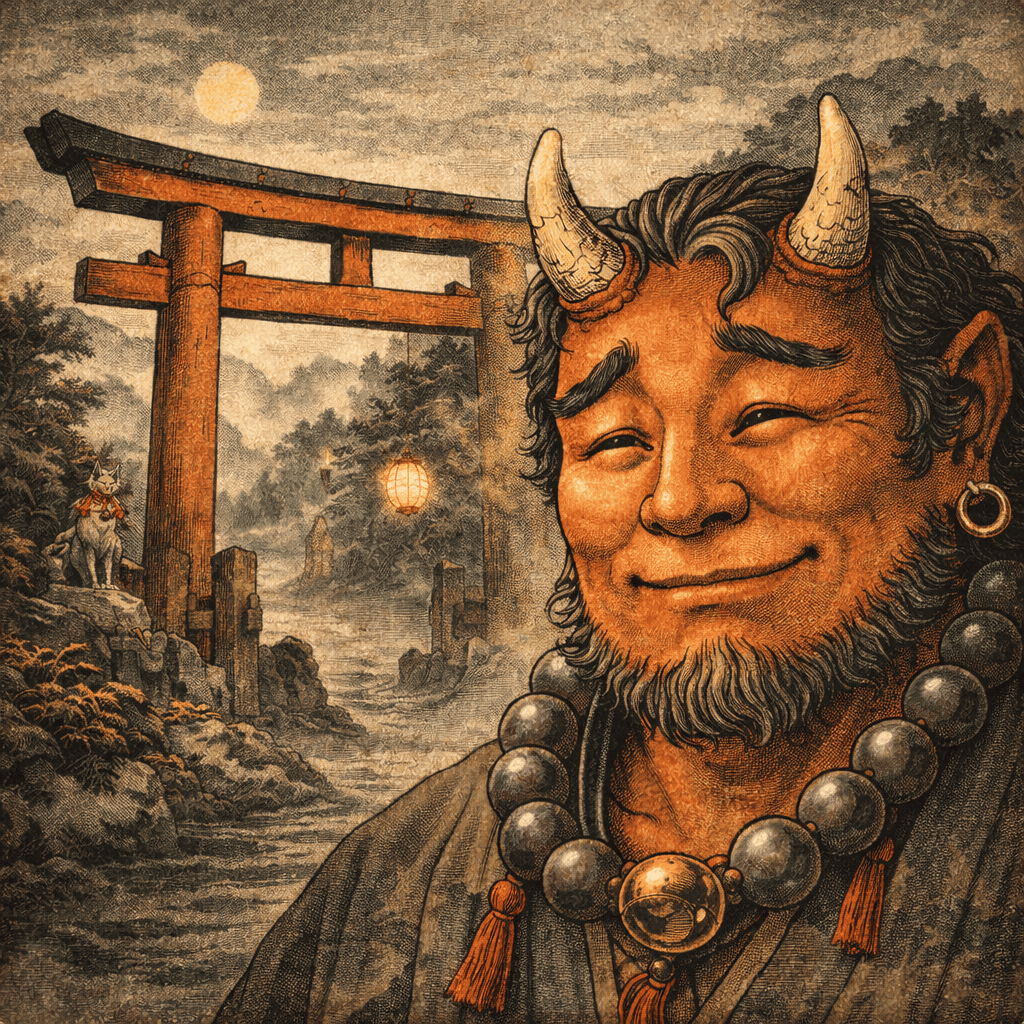
Every year on February 3rd, tens of millions of Japanese families perform the same ancient ritual. They open their front doors, grab fistfuls of roasted soybeans, and hurl them into the darkness while shouting "Oni wa Soto! Fuku wa Uchi!" — "Demons out! Fortune in!" It is one of Japan's most recognizable traditions, a cheerful exorcism performed with the earnest enthusiasm of children and the patient indulgence of adults who remember doing exactly the same thing when they were small. The message is clear and universal: evil beings must be expelled, and good fortune must be invited inside. But in a handful of extraordinary places scattered across the Japanese archipelago, the ritual is performed in reverse. The doors open, the beans are thrown, and the chant that echoes through the cold February air is not "Oni wa Soto" but "Oni wa Uchi" — "Demons, come in." These are the shrines that welcome the Oni. And they have been doing so for centuries.
To an English-speaking audience raised on the clear moral geography of Western mythology, where demons are fallen and angels are risen and the boundary between the two is absolute, the idea of a shrine that worships demons is either shocking or incomprehensible. But Japan has never drawn its spiritual boundaries with such confidence. The Oni, the horned, club-wielding ogre-demons that populate Japan's oldest myths and its most modern pop culture, are not simply villains in a cosmic morality play. They are forces of nature, embodiments of power so immense that it can destroy or protect depending entirely on the relationship between the Oni and the humans who stand before it. To worship an Oni is not to worship evil. It is to acknowledge that the most terrifying powers in the universe can be turned to your defense — if you have the wisdom to invite them inside rather than the foolishness to turn them away. This is the story of five sacred sites where Japan does exactly that.
The Oni You Think You Know (And the One You Don't)
In the Western imagination, the Oni has been flattened into a simple archetype: a red-skinned, horned brute wielding an iron club, the Japanese equivalent of a medieval European demon. Video games cast it as a mid-level boss. Anime uses it as visual shorthand for raw, mindless aggression. English translations default to "demon" or "ogre," words that carry centuries of Christian moral weight and reduce the Oni to a one-dimensional figure of evil. This understanding is not wrong, exactly. The Oni certainly can be a figure of terror. But it is so incomplete as to be misleading, and it conceals the far more interesting reality of what the Oni actually represents in Japanese spiritual and cultural life.
The Japanese Oni is, fundamentally, a creature of duality. In the oldest texts, Oni were invisible spirits of disease, disaster, and death — formless malevolences that drifted through the world causing suffering wherever they passed. The word "Oni" itself may derive from "onu,quot; meaning "to hide," suggesting a being that exists just beyond the threshold of human perception. Over the centuries, as Buddhism and native Shinto traditions wove together in the complex tapestry of Japanese religion, the Oni acquired its familiar physical form: the horns, the fangs, the wild hair, the tiger-skin loincloth, the iron club called a kanabo. But it also acquired something else — a paradoxical capacity for protection and benevolence that sits alongside its capacity for destruction like two sides of a coin that can never be separated.
This duality manifests in dozens of ways across Japanese culture. Oni roof tiles (onigawara) have been placed on the ridges of Japanese buildings for centuries, their fearsome faces turned outward to repel evil spirits — fighting fire with fire, as it were, using the Oni's terrifying visage as a shield against the very kind of supernatural malice that the Oni itself embodies. The Namahage of Akita Prefecture, men dressed as Oni who visit households on New Year's Eve to discipline lazy children and drive out evil influences, are feared by the young and welcomed by their parents as bringers of good fortune and moral correction. The Oni is the bodyguard you hire precisely because he is the most dangerous thing in the room. And in the shrines described in this article, that bodyguard has been given a permanent post, enshrined and venerated as a guardian deity whose terrible power serves those who show it the proper respect.
To understand why Japan worships its demons, you must first abandon the assumption that "demon" means "evil." In the Japanese framework, the Oni is powerful. Power is dangerous. But power, properly channeled, is also the greatest protection against danger. The shrines that welcome the Oni understand this paradox instinctively, and they have built their entire spiritual practice around it.
"Oni wa Uchi": The Shrines That Welcome Demons In
The standard Setsubun chant is one of the most deeply embedded phrases in the Japanese cultural lexicon. "Oni wa Soto, Fuku wa Uchi" — "Demons out, Fortune in" — is taught to every Japanese child before they can read, performed in every household and school and office across the country on February 3rd, and reinforced by television specials, supermarket displays, and the seasonal appearance of Oni masks and roasted soybeans at every convenience store in the nation. The ritual is simple and satisfying: you throw beans at the Oni, the Oni flees, and fortune takes its place. Good triumphs over evil. The cosmos is set right for another year.
But then there are the dissenters. At a small number of shrines across Japan — only four are widely recognized — the Setsubun chant is performed with a crucial modification. The priests and worshippers gather, the soybeans are prepared, and the chant that rings out through the winter air is "Fuku wa Uchi, Oni wa Uchi, Akuma Soto" — "Fortune in, Demons in, True evil out." The distinction is subtle but profound. These shrines draw a line between the Oni, a powerful supernatural being capable of both destruction and protection, and "akuma," a term that more closely approximates the Western concept of absolute evil. The Oni is welcomed inside. Only the truly irredeemable is cast out.
The logic behind this reversal reveals something essential about the Japanese spiritual worldview. If every household in Japan is shouting "Oni wa Soto" on Setsubun night, then where are the exiled Oni supposed to go? They are being driven from every doorstep, expelled from every threshold, chased from every room in the nation. The shrines that chant "Oni wa Uchi" provide the answer: they offer refuge. They open their gates to the cast-out Oni and welcome them inside, not out of perversity or rebellion, but out of a deep spiritual compassion that recognizes even fearsome beings deserve a place to belong. This is not devil worship. It is hospitality extended to the supernatural, a gesture of inclusion that transforms a potential enemy into a powerful ally.
There is also a pragmatic dimension to this practice that should not be overlooked. The shrines that enshrine Oni do so because they want the Oni's power on their side. The Oni's strength is legendary — the phrase "Oni ni kanabo" ("giving an iron club to an Oni") is the Japanese equivalent of "gilding the lily," describing something already strong being made even stronger. By welcoming the Oni into the shrine, the priests and worshippers claim that strength as their own. The Oni becomes a guardian of the shrine's territory, a supernatural sentry whose fearsome reputation deters all other forms of spiritual danger. This is particularly significant in the context of kimon, the "demon gate," the northeast direction from which evil influences are believed to enter in Japanese geomancy. Several Oni shrines were deliberately positioned to guard the kimon of castles, temples, or cities, turning the Oni's own nature against the forces it was once believed to represent.
The fact that there are only four widely recognized Oni-enshrining shrines in all of Japan makes these sites extraordinarily rare and spiritually significant. In a country with over eighty thousand Shinto shrines and seventy-seven thousand Buddhist temples, the handful of places that have chosen to welcome the Oni rather than expel it represent a tiny but fascinating minority, a spiritual counterculture that has persisted for centuries against the overwhelming tide of "Oni wa Soto." These are not eccentric outliers. They are keepers of an alternative tradition, one that understands the Oni not as an enemy to be defeated but as a force to be embraced, honored, and turned toward the protection of those wise enough to open their doors.
The Five Sacred Oni Sites of Japan
The following five sites represent the most significant Oni-related sacred places in Japan. They span the archipelago from the mountains of Tohoku to the peaks of Kyushu, and each one preserves a distinct aspect of the Oni's complex spiritual legacy. Some are formal shrines where the Oni is enshrined as a deity. Others are landscapes so deeply saturated with Oni legend that the boundary between history and myth has dissolved entirely. Together, they form a map of Japan's demon-worshipping tradition that reveals the full depth and sophistication of the country's relationship with its most fearsome supernatural beings.
Kijin Shrine (鬼鎮神社)
Location: Ranzan, Hiki District, Saitama Prefecture
Kijin Shrine is the most famous Oni shrine in the Kanto region and one of the most important Oni-enshrining sites in all of Japan. Founded in 1182, during the turbulent final years of the Heian period, the shrine was established as a guardian of the kimon — the dreaded "demon gate" northeast corner — of Sugaya Castle, the fortress of Hatakeyama Shigetada, one of the most powerful warrior lords of the Kamakura period. The positioning was deliberate and strategic: by enshrining the Oni at the point from which evil was believed to enter, Shigetada transformed the demon from a source of danger into the castle's first line of supernatural defense. The Oni was not being placated or appeased. It was being enlisted, recruited as a spiritual soldier whose very nature made it the perfect guardian against the dark forces it personified.
The shrine's Setsubun ceremony is the defining expression of its spiritual identity. While the rest of Japan chants "Oni wa Soto," the priests and worshippers of Kijin Shrine gather each February 3rd to proclaim "Fuku wa Uchi, Oni wa Uchi, Akuma Soto" — "Fortune in, Demons in, True evil out." The ceremony draws visitors from across the Kanto region who come specifically to participate in this reversal, to experience the thrill of welcoming demons rather than casting them out. The atmosphere during Setsubun at Kijin Shrine is electric with a kind of holy defiance, a communal act of spiritual rebellion against the orthodoxy of demon expulsion that has defined Japanese folk religion for centuries.
The shrine's architecture announces its allegiance unmistakably. The roof tiles of the main worship hall (haiden) are adorned with Oni face motifs, their horned, grimacing visages staring down at visitors from above. Inside the shrine grounds, devotees offer votive kanabo — miniature iron clubs, the Oni's signature weapon — as expressions of gratitude and supplication. The practice of offering the Oni's own weapon back to it carries a symbolic weight that is hard to overstate: it is an act of arming the guardian, of strengthening the protector, of ensuring that the Oni who guards this place has everything it needs to fulfill its role.
The shrine offers a remarkable array of Oni-themed sacred goods that have made it a destination for collectors of Japanese spiritual ephemera. The Oni Mikuji (demon fortune slips) come in small Oni-shaped containers whose scowling faces conceal the paper fortunes inside. The Oni-gao Ema (demon face prayer tablets) allow worshippers to write their wishes on wooden plaques painted with Oni visages. And the Kanabo Omamori (iron club amulets) are protective charms shaped like the Oni's weapon, marketed specifically to students facing examinations and athletes preparing for competitions. The shrine's primary blessings are victory in competition, success in examinations, and the strength to overcome obstacles — all attributes derived directly from the Oni's legendary physical and spiritual power.
Access: Tobu Tojo Line to Musashi-Ranzan Station, west exit, approximately 10 minutes on foot.
Inari Kio Shrine (稲荷鬼王神社)
Location: Kabukicho, Shinjuku, Tokyo
Of all the Oni shrines in Japan, none occupies a more improbable location than Inari Kio Shrine. It stands in the heart of Kabukicho, Shinjuku's notorious entertainment district — a neon-drenched labyrinth of bars, nightclubs, host clubs, and love hotels that is widely regarded as the most hedonistic square kilometer in the entire country. And yet here, tucked between the flashing signs and the late-night revelry, is a shrine whose name contains the characters for "Oni King" (鬼王), making it the only shrine in all of Japan to bear that extraordinary title. The juxtaposition is so perfect it feels like fiction: the Demon King's shrine, standing sentinel in the one neighborhood that might actually need a demon king's protection.
The shrine enshrines a trio of powerful deities collectively known as Kio Gongen (鬼王権現): Tsukuyomi-no-Mikoto, the moon god; Onamuchi-no-Mikoto (another name for Okuninushi, the great land deity); and Ame-no-Tajikara-o-no-Mikoto, the god of physical strength who famously pulled open the cave door behind which Amaterasu had hidden, plunging the world into darkness. The combination is deliberate and potent: celestial authority, earthly sovereignty, and raw divine power, unified under the banner of the Oni King. The shrine's spiritual lineage traces back to the Kumano faith and the syncretic traditions of medieval Japanese religion, where the boundaries between Buddhist, Shinto, and folk deities were fluid and permeable in ways that modern categorization struggles to capture.
The shrine is particularly renowned for its connection to healing and disease prevention. A persistent tradition holds that a feudal lord's child was cured of a severe illness through devotion at this shrine, establishing Inari Kio as a place of miraculous healing. This reputation gave rise to one of the shrine's most distinctive customs: "tofu-dachi," or "tofu abstinence." Worshippers seeking the shrine's healing blessings would voluntarily give up eating tofu as a form of devotion and sacrifice, a dietary oath that demonstrated their sincerity to the enshrined deities. The practice may seem quaint to modern visitors, but it reflects the same spiritual logic that underlies all ascetic practice: by surrendering something of value, the worshipper proves their earnestness and opens a channel for divine intervention.
Among the shrine's most striking physical features is a stone statue of an Oni bearing a sword wound across its back. The figure is carved in a posture that suggests both suffering and defiance, its muscular form twisted to display the gash while its face remains set in an expression of fierce determination. The statue embodies the shrine's entire theological position in miniature: the Oni is wounded but unbroken, dangerous but devoted, a being whose own pain has been transmuted into protective power. Visitors touch the statue's back for luck and healing, and the stone has been worn smooth by centuries of hopeful hands.
Despite its extraordinary spiritual significance, Inari Kio Shrine is small — easy to miss if you do not know where to look, which is perhaps fitting for a shrine dedicated to beings that exist at the edges of perception. It stands as a reminder that the sacred in Japan does not require grand architecture or mountaintop isolation. It can exist anywhere, even in the middle of Kabukicho, even surrounded by karaoke bars and pachislot parlors, because the power it enshrines has nothing to do with its surroundings and everything to do with what it contains.
Access: Approximately 10 minutes on foot from JR Shinjuku Station, east exit.
Oeyama — The Demon King's Mountain (大江山・日本の鬼の交流博物館)
Location: Oe, Fukuchiyama, Kyoto Prefecture
If the previous two sites are places where the Oni is worshipped, Oeyama is the place where the Oni lived and died — or at least, where Japan's most famous Oni legend is rooted in the physical landscape with a vividness that no other location in the country can match. Oeyama, the "Great Mountain of Oe," is the setting of the Shuten-doji legend, the most celebrated Oni story in all of Japanese literature, the tale of the Demon King who built a palace of iron on a mountain peak and terrorized the capital until the warrior Minamoto no Raiko and his Four Heavenly Kings ascended the mountain, tricked Shuten-doji into drinking enchanted sake, and cut off his head while the demon slept. It is a story that has been retold in Noh theater, kabuki, emaki picture scrolls, novels, manga, and anime for nearly a thousand years, and Oeyama is where it all supposedly happened.
The mountain's connection to Oni lore predates the Shuten-doji legend considerably. Archaeological evidence and local oral tradition suggest that Oeyama has been associated with Oni-like beings since the Kofun period (3rd–6th century CE), when the mountain's remote interior was home to communities that existed outside the authority of the Yamato court. These marginalized groups — metalworkers, miners, bandits, and others who lived beyond the pale of "civilized" society — were frequently characterized as Oni by the court historians who wrote the official chronicles, their otherness rendered supernatural by the simple expedient of calling them demons. The Shuten-doji legend, in this reading, is not merely a fantasy about a monster on a mountain. It is a mythologized account of military conquest, a story in which the subjugation of an independent mountain community is transformed into a heroic dragon-slaying narrative for the edification of the capital's elite.
The centerpiece of the Oeyama Oni experience today is the Japan Oni Exchange Museum (日本の鬼の交流博物館), a museum dedicated entirely to the study, celebration, and preservation of Oni culture from across Japan and around the world. The museum's collection spans the full breadth of Oni representation in Japanese art, from ancient Buddhist scrolls depicting Oni as agents of hell to modern manga and anime where Oni have been reimagined as everything from romantic leads to comedic sidekicks. The museum also houses Oni-related artifacts from other cultures — masks, carvings, and ceremonial objects from across Asia that demonstrate how the concept of the horned demon or ogre recurs in traditions far beyond Japan's borders. Outside the museum, the Oni-ga-kawara Park features enormous Oni statues and Oni roof tile sculptures scattered across a hillside, their massive forms gazing out over the valley below with expressions that hover between menace and welcome.
The landscape of Oeyama itself is essential to the Oni experience. The mountain's terrain is rugged and atmospheric, its slopes covered in dense forest that thins as you ascend toward ridges where the views stretch across the Tango Peninsula to the Sea of Japan. Hiking trails connect the various Oni-related sites, and walking them in autumn, when the mountain's maples turn the slopes into a palette of crimson and gold, it is easy to understand why generations of storytellers placed a demon king on this particular peak. The mountain has a presence, a weight and wildness that the flat narratives of guidebooks cannot convey, and that presence is inseparable from the Oni legend that has defined it for over a millennium.
Access: Kitakinki Tango Railway to Oe Station, then taxi approximately 15 minutes to the museum.
Kubote Mountain Oni Shrine (鬼神社・求菩提山)
Location: Buzen, Fukuoka Prefecture
Deep in the mountains of northern Kyushu, where the borders of Fukuoka and Oita Prefectures meet in a tangle of forested ridges and narrow valleys, Mount Kubote (求菩提山) rises 782 meters above sea level and carries within its slopes a demon legend that stretches back to the 6th century. The mountain was opened as a sacred site by the monk Mokaku Makubokusen, a figure of semi-legendary status who is said to have been one of the earliest Shugendo practitioners in the Kyushu region. According to the founding legend, when Mokaku first ascended the mountain to establish his practice, he found it inhabited by eight fearsome Oni who terrorized the surrounding villages from their mountain stronghold. Through a combination of spiritual power and physical courage, Mokaku subdued the eight demons and sealed them inside stone jars (kame), imprisoning them beneath the mountain where their power could be contained and redirected toward the protection of the surrounding land.
This legend — the subjugation and binding of demons for protective purposes — is one of the foundational narratives of Japanese mountain religion, repeated in various forms at sacred sites across the country. What makes Kubote's version distinctive is the physical evidence that the landscape provides. The mountain's primary approach is a stone stairway of approximately 850 steps known as the "Oni no Ishidan" — the "Demon's Stone Steps" — a punishing ascent through dense forest that functions as both a hiking trail and a spiritual ordeal. The steps are irregular in height and spacing, worn smooth by centuries of pilgrims' feet, and climbing them in the mountain's characteristic humidity, with the forest pressing in from both sides and the sound of running water echoing from somewhere unseen below, it becomes easy to understand why the people who first climbed this mountain believed they were entering a demon's territory. The stairway is not merely a path. It is a narrative, each step carrying the climber deeper into the Oni's domain, closer to the summit where the demons were bound and where their restless power still pulses beneath the stone.
Near the summit, visitors encounter the Oni's Handprint Stone (鬼の手形石), a rock formation bearing what local tradition identifies as the handprint of one of the eight sealed demons. The impression in the stone is suggestive rather than definitive — nature has carved it, not a sculptor — but in the context of the mountain's legend and atmosphere, the stone becomes something more than geology. It is evidence, a physical trace of the beings that once ruled this place, a reminder that the Oni of Kubote were not abstractions but presences that left their mark on the very rock of the mountain.
The shrine on Mount Kubote offers Oni-themed goshuin (temple stamps) that have become prized among collectors for their distinctive demon imagery and the remote difficulty of obtaining them. Unlike the easily accessible stamps of urban shrines, the Kubote goshuin requires a genuine physical commitment to obtain — you must climb the 850 stone steps to earn it, and there is no cable car or shortcut. This exclusivity, combined with the stamps' striking Oni designs, has given them a cult following among the dedicated goshuin-collecting community in Japan.
Access: JR Nippo Main Line to Usa Station, then bus or taxi to the mountain trailhead.
Oni Shrine, Hirosaki (鬼神社)
Location: Hirosaki, Aomori Prefecture
In the far north of Honshu, in the Tsugaru region of Aomori Prefecture, stands one of the rarest sacred sites in all of Japan: a shrine whose name is simply "Oni Shrine" (鬼神社, read as "Kijinja"), one of only four shrines in the country that directly enshrines the Oni as a deity. The shrine is located in the countryside near Hirosaki, the castle town famous for its cherry blossoms and its apple orchards, and it exists in a landscape that has been shaped by centuries of Oni folklore unique to the Tsugaru region. The Oni traditions of northern Tohoku differ significantly from those of the Kanto or Kansai regions. In Tsugaru, the Oni is less a fearsome invader to be repelled and more a familiar neighbor to be respected — a powerful local spirit whose presence in the landscape is as natural and unremarkable as the mountains themselves.
Information about the shrine's founding and specific ritual practices is limited in published sources, reflecting both the remoteness of the location and the deeply local character of its worship. What is known is that the shrine has maintained its dedication to the Oni across centuries during which the overwhelming cultural pressure has been to cast the Oni out, not invite it in. The shrine's survival as an active place of worship, in a region where winter lasts half the year and the population has dwindled with Japan's rural depopulation crisis, is itself a testament to the tenacity of local spiritual traditions and the depth of the bond between the Tsugaru people and their Oni.
For visitors willing to make the journey to northern Aomori, the Oni Shrine at Hirosaki offers something that more famous and better-documented sites cannot: an encounter with the quiet, understated end of Japan's Oni worship tradition, a place where the demon is not spectacular or touristic but simply present, woven into the fabric of daily life in a rural community that has never seen any reason to cast it out.
Access: Within Hirosaki city area, accessible by local transport from Hirosaki Station.
The Deeper Truth: Why Japan Worships Its Demons
The existence of Oni shrines forces a question that goes far deeper than folklore or tourism: why would any culture choose to worship the things it fears? The answer lies in a concept that is central to Japanese religion but has no direct equivalent in Western spiritual thought: tatari-gami, the "curse deity," a being of such terrifying power that the only safe response is not to fight it but to enshrine it, not to destroy it but to honor it, not to flee from it but to turn toward it with offerings and prayers and the quiet, persistent hope that its terrible strength can be redirected from destruction to protection.
The tatari-gami tradition is one of the oldest and most distinctive features of Japanese Shinto. Its most famous examples are not Oni but human spirits: Sugawara no Michizane, the brilliant scholar-statesman who was exiled from the imperial court on false charges and died in bitter disgrace, only to be enshrined as the deity Tenjin after a series of catastrophic natural disasters were attributed to his vengeful spirit. Taira no Masakado, the 10th-century rebel who declared himself the "New Emperor" and was beheaded for his treason, whose severed head is said to have flown back to Edo (modern Tokyo) and whose spirit is still worshipped at a small but intensely maintained shrine in the financial district of Otemachi, where office workers leave offerings and no developer has ever dared disturb the site. In each case, the logic is the same: a being of overwhelming power, made dangerous by suffering or injustice, is enshrined and venerated so that its destructive energy can be transformed into protective benevolence. The Oni shrines of Japan follow this same ancient logic. The Oni is not worshipped because it is good. It is worshipped because it is powerful, and power, properly respected, can be turned from curse to blessing.
There is also a psychological dimension to the Oni worship tradition that resonates beyond the boundaries of Japanese religion. The Oni has always functioned, at least in part, as a symbol of the aspects of human nature that civilized society would prefer to deny: rage, desire, selfishness, the capacity for violence, the hunger for power. To cast the Oni out, to shout "Oni wa Soto" and slam the door, is to perform an act of denial, to pretend that these aspects of the self can be expelled and left outside in the darkness. But the shrines that chant "Oni wa Uchi" suggest a different approach. They invite the demon inside. They acknowledge its presence. They make a place for it within the structure of the sacred, not because they approve of what it represents but because they understand that what is denied will return uninvited, while what is acknowledged and given a proper place can be managed, honored, and even transformed into a source of strength.
The original purpose of Setsubun itself points to this deeper understanding. The festival marks the boundary between winter and spring in the traditional Japanese calendar, and the Oni that are expelled represent not abstract "evil" but the specific dangers of the season: disease, cold, hunger, and the accumulated misfortune of the dying year. The Oni is a seasonal threat, a spirit of winter's darkness, and the bean-throwing ritual is an act of purification designed to clear the way for the renewal of spring. The shrines that welcome the Oni recognize that this purification need not take the form of expulsion. It can take the form of incorporation, of welcoming the darkness into the light and allowing it to be transformed rather than merely displaced. To explore the full complexity of the Oni and its place in Japanese mythology, the Oni's paradoxical nature as both destroyer and protector reveals itself as one of the most profound statements about the nature of power in any religious tradition.
Setsubun: The Festival of Driving Out (or Welcoming) Demons
Setsubun (節分), literally "the division of seasons," falls on February 3rd and marks the eve of Risshun, the first day of spring according to the traditional Japanese lunisolar calendar. The festival's origins lie in the Chinese concept of seasonal purification, imported to Japan during the Nara period (710–794) and gradually absorbed into the existing matrix of Japanese folk religious practice. By the Muromachi period (1336–1573), the ritual of mamemaki (bean throwing) had become firmly established as the central Setsubun practice, and its basic form has remained essentially unchanged for over five hundred years.
The ritual is deceptively simple. Someone in the household, traditionally the male head of the family or a person born in the corresponding zodiac year, puts on an Oni mask and plays the role of the demon. The other family members throw roasted soybeans (fuku-mame, "fortune beans") at the Oni while chanting "Oni wa Soto, Fuku wa Uchi." The Oni flees, the beans are scattered, and each person then eats the number of beans corresponding to their age (plus one for good luck in the coming year). In recent decades, the custom of eating ehomaki, an uncut sushi roll, while facing the year's lucky direction in complete silence has been added to the Setsubun repertoire, a tradition that originated in Osaka's merchant community and was aggressively marketed nationwide by convenience store chains in the 1990s.
At major temples and shrines, Setsubun is celebrated with large-scale mamemaki events where celebrities, sumo wrestlers, and local politicians stand on elevated platforms and hurl beans and small packets of fortune into cheering crowds below. These events are lively, raucous affairs that draw thousands of participants and receive extensive media coverage. But beneath the carnival atmosphere lies the original purpose of the ritual: the expulsion of evil influences at the most vulnerable moment of the year, when the old season is dying and the new season has not yet established its protective power, when the cosmic defenses are down and the Oni can slip through the cracks between one world and the next.
It is at this precise moment of vulnerability that the "Oni wa Uchi" shrines make their most radical statement. When every other sacred site in the country is performing rituals of expulsion, these shrines perform rituals of welcome. When every other household is slamming its doors against the darkness, these shrines open theirs. The contrast is deliberate and powerful, and it carries a message that transcends the specifics of Japanese folk religion: that the moment of greatest vulnerability is also the moment of greatest opportunity, that the thing you most want to shut out might be the thing you most need to let in, and that the boundary between protection and destruction is not a wall but a door — and the difference between the two depends entirely on which side of the door you choose to stand on.
Tips for Visiting Oni Sites
Etiquette and respect: Oni shrines are active places of worship, not tourist attractions. Follow standard shrine etiquette: purify your hands and mouth at the temizu basin, bow before and after praying, do not step on thresholds, and speak quietly within the shrine precincts. The fact that these shrines worship Oni does not make them casual or irreverent places. If anything, the rarity of their spiritual tradition makes respectful behavior even more important, as the priests and local worshippers are keenly aware that their practice is unusual and are sensitive to visitors who treat it as a novelty rather than a genuine expression of faith.
Best season — Setsubun (February 3rd):If your travel schedule permits it, visiting an Oni shrine during Setsubun is an experience without parallel. Kijin Shrine's "Fuku wa Uchi, Oni wa Uchi, Akuma Soto" ceremony is the highlight of the shrine's year and draws visitors from across the Kanto region. Arriving early is essential, as the ceremony attracts crowds that the small shrine is not designed to accommodate. Dress warmly — February 3rd falls in the depths of the Japanese winter, and shrine visits involve standing outdoors for extended periods. Outside of Setsubun, spring and autumn offer the most comfortable weather for visiting mountain sites like Oeyama and Mount Kubote.
Goshuin and sacred goods: All of the sites in this guide offer goshuin (shrine stamps), and the Oni-themed designs available at Kijin Shrine and the Kubote Mountain shrine are particularly sought after by collectors. Bring your goshuincho (stamp book) or purchase one at the first site you visit. The kanabo amulets, Oni mikuji, and demon face ema at Kijin Shrine make meaningful souvenirs that carry genuine spiritual weight. Remember that these items are sacred objects, not mere merchandise, and should be treated with appropriate respect.
Photography:Outdoor photography is generally permitted at all five sites, but always check for signs prohibiting cameras before photographing inside buildings or sacred precincts. Do not photograph worshippers without permission. At the Japan Oni Exchange Museum on Oeyama, photography policies may vary by exhibition — ask at the reception desk. When photographing Oni statues and sacred objects, remember that you are documenting religious art, not kitsch, and frame your images accordingly.
Accessibility: Kijin Shrine and Inari Kio Shrine are easily accessible by public transport and require minimal walking on flat ground. Oeyama and Mount Kubote are mountain sites that require significant physical effort to explore fully, particularly the 850 stone steps at Kubote. The Hirosaki Oni Shrine is accessible but remote, requiring travel to northern Aomori Prefecture. Plan transportation carefully for rural sites, as bus services may be infrequent.
Conclusion
The Oni shrines of Japan are not aberrations. They are not the eccentric projects of contrarian priests or the marketing inventions of rural tourism boards desperate for visitors. They are expressions of one of the deepest and most enduring currents in Japanese spiritual thought: the understanding that power is power, regardless of the face it wears, and that the wisest response to a terrifying force is not to flee from it or fight it but to make a place for it within the sacred, to honor it, to feed it, to give it a name and a home, and in doing so to transform its destructive potential into protective strength.
Every February 3rd, when the rest of Japan hurls soybeans into the darkness and shouts for the demons to leave, the priests of Kijin Shrine open their gates and call the demons in. It is a small act of spiritual defiance that has been repeated for over eight centuries, a tradition maintained by a handful of shrines against the overwhelming consensus of an entire civilization. And yet it persists. It persists because it is true — true in the way that only the oldest and most tested spiritual insights can be true, true in the way that the mountain is true and the wind is true and the darkness behind the door is true. The Oni is real. The Oni is here. And the shrines that welcome it understand something that the rest of us are still learning: that the door between terror and protection swings both ways, and the hand that opens it is always, always human.
For the full story of the Oni and its place in the Japanese supernatural tradition, explore our complete Oni article. For more sacred sites across Japan, visit the Shrines & Temples section.
This is The Yokai Files.
Support The Yokai Files
Enjoyed this deep dive into Japanese folklore?
The Yokai Files is reader-supported. Your support helps us research deeper, write more, and keep the darkness alive.