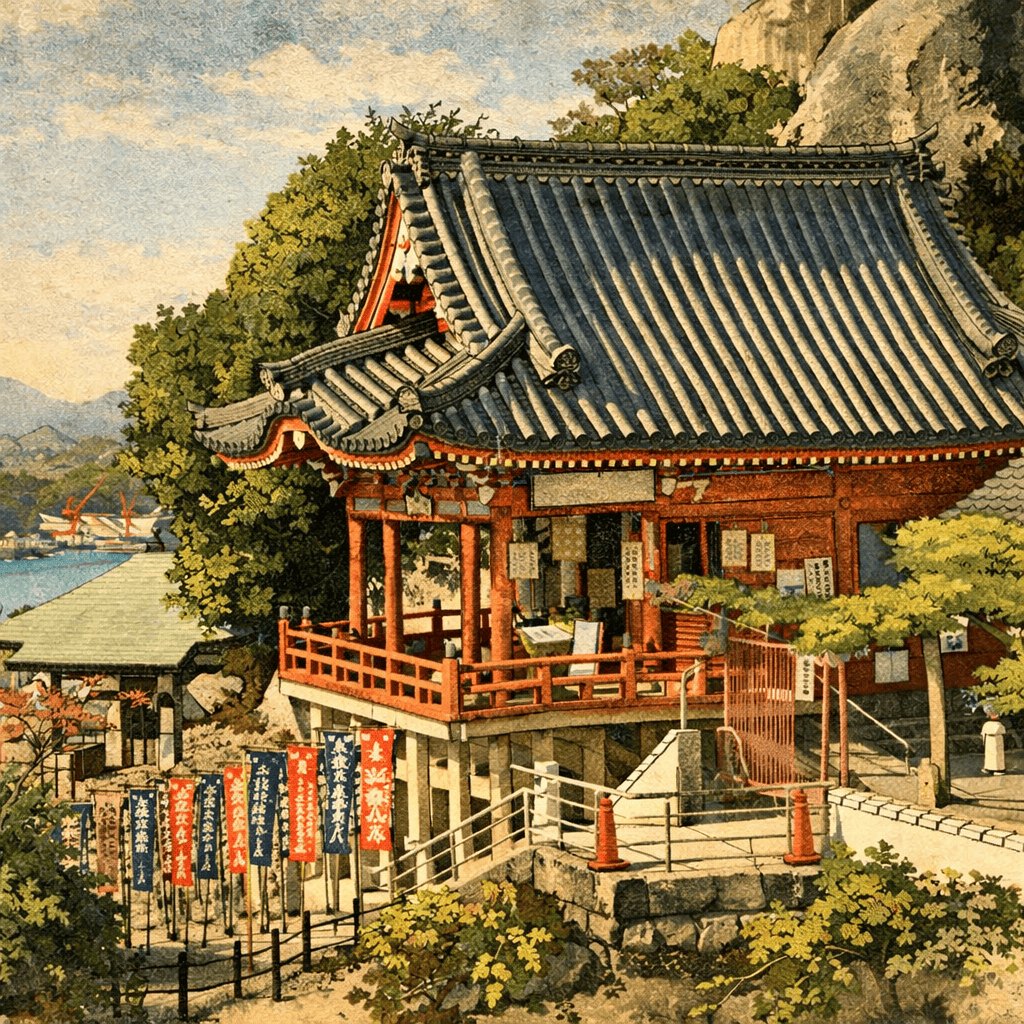
Senkoji Temple: The Mountain Temple Founded by Ryomen Sukuna
Published: April 16, 2026
On a forested ridge nine hundred meters above the town of Takayama, in the heart of the old province of Hida, stands a temple whose founding legend contradicts the official history of Japan. The Nihon Shoki, the imperially sanctioned chronicle compiled in 720 CE, describes a figure who appeared in Hida in the fourth century with two faces, four arms, and four legs, and who was subdued by a general dispatched from the capital. The chronicle calls him a monster. The temple on the ridge calls him its founder. Both statements refer to the same being, and that being is Ryomen Sukuna, the most ambiguous figure in early Japanese history and, through Gege Akutami's manga Jujutsu Kaisen, one of the most recognizable names in global popular culture.
The temple is called Hida Senkoji, formally Kesayama Senkoji, and it has been operating as a Koyasan Shingon institution on the same mountain for sixteen centuries by its own reckoning. For visitors who have encountered Sukuna only as the King of Curses, Senkoji offers something disorienting: a Sukuna who is not a villain, not a monster, and not an enemy of civilization, but the person who is said to have opened the mountains of Hida to prayer, built the first temple on the site, and guided the local people in defending their valleys against outsiders. The temple preserves this alternate Sukuna not as folklore trivia but as active religious memory, maintained through a functioning Shingon lineage that still performs ceremonies, still receives pilgrims, and still treats Sukuna as a figure to be venerated rather than feared.
This guide will explain the legend of Ryomen Sukuna as Hida remembers him, the history of the temple that preserves his memory, the extraordinary things that can be seen on its grounds — including a hall devoted specifically to Sukuna, one of the country's finest collections of Enku Buddhas, a thousand-two-hundred-year-old cedar tree, and a panoramic view of the Hida Mountains — and the practical information you need to make the journey. For fans of Jujutsu Kaisen, Senkoji is essential pilgrimage. For students of Japanese folklore, it is a living archive of an alternative history. For anyone with interest in the mountains of central Japan, it is simply one of the most atmospheric temples in the country.
The Yokai Connection
Ryomen Sukuna is the figure most modern audiences know as the King of Curses in Jujutsu Kaisen, where he is the four-armed, two-faced antagonist whose twenty severed fingers are scattered across Japan as cursed objects. Akutami's version draws directly from the historical description in the Nihon Shoki, which records that a being matching this physical profile appeared in Hida during the reign of Emperor Nintoku, resisted the imperial court, and was eventually subdued by the general Takenouchi no Sukune. The chronicle is explicit that Sukuna — his name means "Two-Faced Sukuna" — had two faces looking in opposite directions, four arms, and four legs without knees.
The Nihon Shoki tells the story from the perspective of the imperial court, which needed to justify its military conquest of the Hida region, a mountain province that had resisted centralization. The easiest way to justify conquest was to describe the conquered as less than human. But the people of Hida, who actually lived among the mountains the chronicle describes, remembered Sukuna differently. Local tradition records him not as a monster but as a leader: the figure who cleared forest paths, who fought off invaders, who built temples and brought Buddhist teachings to the remote mountain villages, and who stood as a guardian of the Hida valleys against the expansionist ambitions of the court. The Hida version of Sukuna is a culture hero, and the most important single piece of evidence for this reading is the existence of Senkoji Temple, which claims him as its founder and preserves his image as a figure of reverence.
The same temple tradition that names Sukuna as founder also describes him as a figure of genuine piety, a builder rather than a destroyer. On temple grounds and in the surrounding region, Sukuna is depicted with his two faces and four arms arranged in postures of Buddhist meditation, not combat. The faces themselves have been interpreted by some commentators as a symbol of vigilance — a guardian who can see in two directions at once — and by others as an echo of the esoteric Buddhist iconography of multi-faced, multi-armed deities, which was already present in Japan by the time the Sukuna legend was recorded. In either reading, the two-faced figure is a religious image, not a horror.
For the full exploration of how Jujutsu Kaisen translates this ambiguous historical figure into its King of Curses, see our article on the Japanese curse mythology behind Jujutsu Kaisen. Senkoji stands as a physical counterweight to the demonic reading Akutami emphasizes. Both readings are legitimate — the ambiguity is the point — but only one of them has a functioning temple on a mountain ridge in central Japan.
History
According to temple tradition, Senkoji was opened by Ryomen Sukuna in the fourth century, during the reign of Emperor Nintoku, as a place of prayer for the mountain-dwelling communities of Hida. The specific claim is that Sukuna selected the ridge on which the temple now stands for its sacred character and established the site as a center of ancient belief before the formal arrival of Buddhism. Whether this claim refers to a literal founding by a historical individual or to the retrospective naming of a pre-existing sacred site after a legendary figure is a question modern scholarship cannot resolve. What is clear is that the site has been treated as religiously significant for a very long time, long enough that its association with Sukuna was already fixed by the time the Nihon Shoki was compiled.
In its present form, Senkoji is a temple of the Koyasan Shingon school, the esoteric Buddhist lineage founded by Kukai on Mount Koya in the early ninth century. The principal image of worship is an Eleven-Headed Thousand-Armed Kannon (Juichimen Senju Kannon), a major bodhisattva figure in Shingon practice whose eleven faces and thousand arms allow her to perceive suffering in every direction and to respond with infinite compassion. The iconographic parallel with Sukuna — multiple faces, multiple arms, capable of perception and action in all directions at once — is striking, and some commentators have suggested that the selection of Juichimen Senju Kannon as principal image was deliberately harmonized with the temple's Sukuna tradition.
Over the centuries, Senkoji has accumulated layers of tradition and material culture. The most important of these is the temple's collection of Enku Buddhas, wooden statues carved in the seventeenth century by the wandering monk-sculptor Enku (1632–1695), who traveled through the mountains of central and northern Japan carving images from the trunks and branches of trees he encountered. Enku is said to have carved roughly 120,000 statues in his lifetime, of which several thousand survive. Senkoji's collection of sixty-four Enku works is one of the largest and most important in Japan, and the treasure hall that displays them is one of the principal reasons modern visitors come to the temple. The coincidence — or the continuity — between a seventeenth-century monk who carved thousands of statues of compassionate deities and a fourth-century legendary founder whose body was described as multiplied beyond the human is not lost on the people who have maintained the temple across the generations.
What to See
Senkoji is a working mountain temple, and its grounds are extensive. A full visit requires at least two to three hours and ideally longer if the weather permits walking the pilgrimage path. The following are the essential features that together define the Senkoji experience.
The Sukuna-do is a small hall on the grounds of Senkoji dedicated specifically to Ryomen Sukuna. From the outside it is an unremarkable building — a modest wooden structure on the mountain ridge — but its significance is immense. It is the only hall in Japan built expressly to honor Sukuna as a positive religious figure, and for visitors who have come to Senkoji specifically for the Sukuna connection, this is the destination that matters most. The exterior can be viewed at any time during normal temple hours.
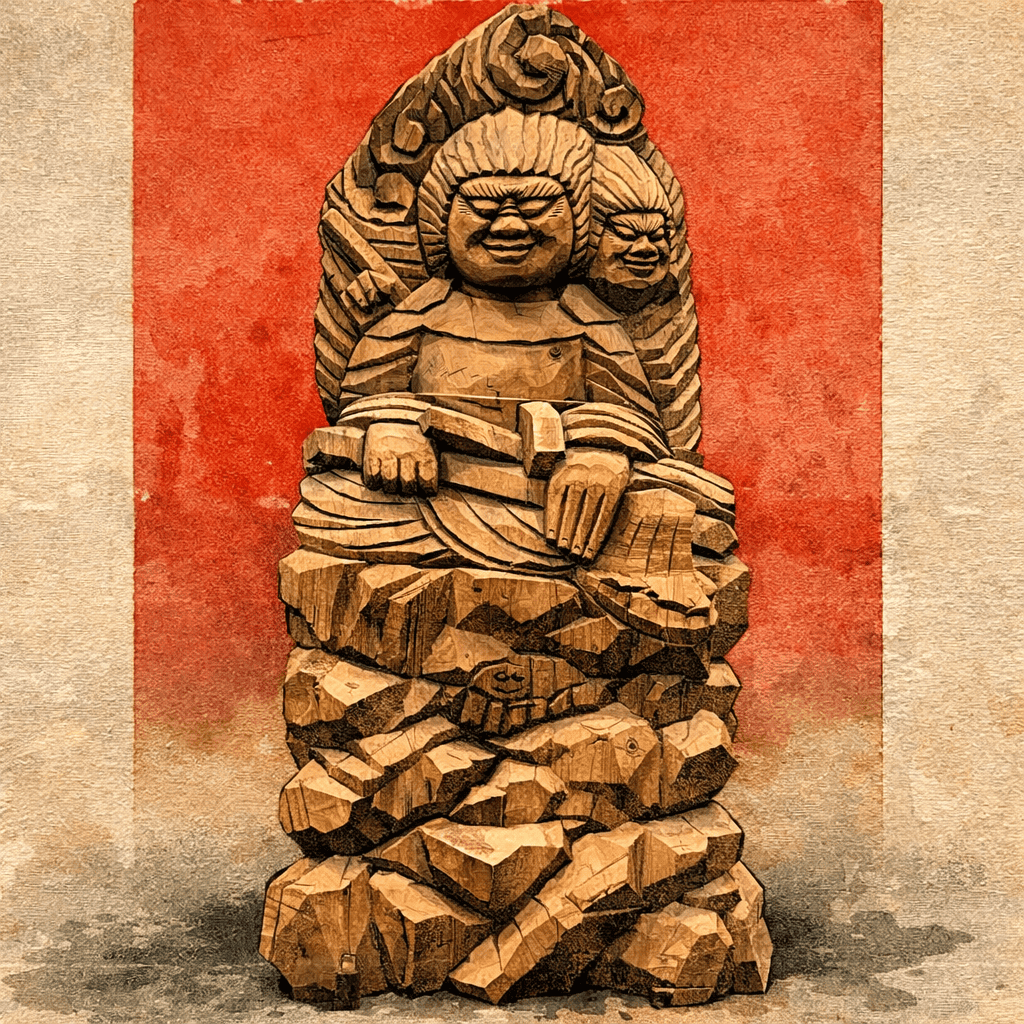
For part of the year, the interior of the Sukuna-do is opened for special viewing. From April through November, on Saturdays, Sundays, Mondays, and public holidays between 9:30 and 16:30, visitors can enter the hall itself on payment of a small additional fee (¥100). The interior houses a seated image of Sukuna in a posture of religious contemplation, with the two faces and four arms that the legend describes rendered not as a monstrous anatomy but as a harmonious iconographic whole. Standing before the image is the single most intense experience available at Senkoji for anyone who has encountered Sukuna only through the filter of modern pop culture; the figure in the hall is not the King of Curses but his older and quieter twin.
Enku was a seventeenth-century Buddhist monk and itinerant sculptor who carved an extraordinary number of wooden Buddhist images during his long life of wandering. His works are characterized by a distinctive rough-hewn aesthetic: statues cut from whole sections of tree trunk with a hatchet and a chisel, finished not by fine carving but by the deliberate preservation of the tool marks themselves, so that the resulting faces emerge from the wood with an immediacy that centuries of formal Buddhist sculpture had polished out. An Enku Buddha looks less like a finished statue than like a being that was always inside the tree and that Enku simply released.
Senkoji owns sixty-four Enku statues, a collection of national significance, and displays them in a dedicated treasure hall on the temple grounds. The collection is open to visitors from April 4 through November 30, on Saturdays, Sundays, Mondays, and public holidays (closed during the winter months). The admission fee is ¥500 for adults. Inside the hall, the sixty-four figures range from palm-sized to nearly life-sized, and they collectively form one of the finest concentrated encounters with Enku's art available anywhere in Japan. For visitors with any interest in Japanese religious sculpture, this is a destination worth traveling for on its own merits, quite apart from the Sukuna connection.
On the grounds of Senkoji stands a cedar tree known as the Gohon-sugi, the "Five-Trunk Cedar," which has been designated a national natural monument. The tree is believed to be over 1,200 years old and consists of five separate trunks rising from a single base, collectively forming one of the largest and most unusual cedars in the Hida region. The iconographic parallel with the legend of Sukuna — a body that is one and many at the same time — is not officially part of the temple's interpretation, but it is hard to stand at the base of the tree and not feel the connection.
The Gohon-sugi is easily accessible from the main temple grounds. A small path leads to its base, where visitors can stand beneath the five trunks and look up into the interlaced canopy above. The tree is not fenced or protected from close approach, and the experience of standing beneath it is part of what Senkoji offers that few urban temples can: unmediated physical proximity to a living thing that has been present on the same spot since the Heian period.
At roughly nine hundred meters of elevation, Senkoji sits high enough to command a panoramic view of the surrounding Hida peaks. From the upper grounds of the temple, visitors can see Mount Ontake, the great volcanic sacred mountain to the southeast, and Mount Norikura, the high peak of the northern Japanese Alps. On clear mornings the views extend across the full Hida valley system, and on the best days the full profile of the Alps can be made out along the western horizon.
Senkoji is also known as a reliable vantage point for the Hida sea of clouds, the phenomenon in which the valleys below the temple fill with fog while the peaks above remain clear, producing the appearance of a white ocean with mountain islands rising from it. The sea of clouds is most frequent in autumn and early morning, particularly during conditions of high atmospheric stability after cold nights. Visitors who arrive at Senkoji before dawn on suitable days have a reasonable chance of witnessing the phenomenon from the temple grounds. There is no charge to enter the grounds outside of main hall admission, and no formal restriction on pre-dawn arrival by visitors willing to make the drive.
Laid out across the temple grounds is an 88-station miniature pilgrimage path, a compressed replica of the famous 88-Temple Pilgrimage of Shikoku. Each station corresponds to one of the eighty-eight temples of the Shikoku route, and walking the full path at Senkoji is treated as a symbolic completion of the Shikoku pilgrimage itself, with the same associated blessings and accumulated merit. The path is deliberately integrated into the natural terrain of the ridge, so that walking it is also a walk through the Hida forest, past moss-covered stones, along sections of exposed rock, and through groves of old cedar.
The full circuit takes roughly an hour to walk at a steady pace, or two to three hours if you pause at each station. Sensible footwear is essential; the path includes climbs and descents, and sections of it are narrow or uneven. For visitors who cannot make the full Shikoku pilgrimage — which requires weeks of walking across an entire island — the Senkoji miniature version offers a genuine substitute that is completable in a single morning, and that can be combined with the rest of the temple visit for a complete half-day program.
Location
Nearby Attractions
20 min by car
Takayama Old Town (Sanmachi Suji)
The preserved Edo-period merchant district at the center of Takayama, lined with wooden townhouses, sake breweries, and craft shops. The most atmospheric historic streetscape in the Hida region, and the natural base for any Senkoji visit.
30 min by car
Hirayu Onsen
The oldest hot spring in the Okuhida region, with over a dozen public and private baths fed by abundant mineral waters from the volcanic ranges surrounding the village. An ideal stop for soaking after a day of temple-walking.
50 min by car (seasonal)
Mount Norikura Skyline
The high-altitude bus road that climbs the western flank of Mount Norikura to within walking distance of its 3,026-meter summit. Open only from May through October; closed to private cars, accessible by dedicated shuttle bus from Hirayu.
15 min by car
Hida Folk Village (Hida no Sato)
An open-air museum of traditional gassho-zukuri farmhouses relocated from across the Hida region, preserving the architectural heritage of the mountain villages. A natural complement to Senkoji's temple visit for anyone wanting the full picture of historical Hida.
Visitor Tips
Official Links
- Official website (senkouji.com) — current hours, access, and seasonal announcements
- Address: 〒506-2135 Gifu Prefecture, Takayama City, Nyukawa-cho Shimobo 1553
- Phone: 0577-78-1021
Support The Yokai Files
Enjoyed this deep dive into Japanese folklore?
The Yokai Files is reader-supported. Your support helps us research deeper, write more, and keep the darkness alive.
Conclusion
Ryomen Sukuna is the most ambiguous figure in early Japanese history, and Senkoji Temple is the most important single piece of physical evidence that the ambiguity is not merely literary. The Nihon Shoki called Sukuna a monster; the mountain villages of Hida called him their founder; and for sixteen centuries a temple on a ridge nine hundred meters above Takayama has maintained the second reading as active religious practice. The hall dedicated to him stands on the same grounds as sixty-four Enku Buddhas, a twelve-hundred-year-old cedar, and an 88-station pilgrimage path that compresses the sacred geography of an entire island into a single morning's walk.
Take a train to Takayama. Take a taxi up the ridge. Walk through the main gate, pay the small admission to the main hall, greet the Eleven-Headed Thousand-Armed Kannon. Then find the Sukuna-do. Look at the two faces and the four arms and consider, for a moment, that the same body was remembered in the capital as a monster and in the mountains as a founder, and that you have come to the one place in the world where the second reading has been preserved continuously for a millennium and a half. The King of Curses of Jujutsu Kaisenis a legitimate translation of the Nihon Shoki's Sukuna. The Sukuna of Senkoji is a legitimate translation of the other one. Both are real. Only one has a temple.
This is The Yokai Files.