Tanashi Shrine: The Five-Color Dragon Mandala in the Heart of Tokyo
Published: April 10, 2026
On the western edge of Tokyo, in the quiet suburban city of Nishi-Tokyo, stands a shrine that is unlike any other in Japan. It does not enshrine one dragon, or two, or three. It enshrines five — one for each of the five elements, one for each of the four cardinal directions plus the center — and it arranges them across its grounds in a configuration that is, in effect, a working cosmological diagram, a three-dimensional mandala of the wuxing system made physical in vermillion-lacquered wood and painted stone. The shrine is called Tanashi Jinja, and it is a twenty-minute ride from Shinjuku on the Seibu Line.
What sets Tanashi apart from every other dragon shrine in the country is its completeness as a cosmological instrument. Enoshima has one dragon. Hakone has one, though with nine heads. Kifune has the paired high and dark dragons. But Tanashi has five, and the five together cover the entire universe according to the ancient Chinese theory that classifies reality into elements, colors, directions, seasons, virtues, and organs of the body. To walk the grounds of Tanashi is to perform, step by step, a small but complete pilgrimage through the five-element cosmology, greeting each dragon in turn and receiving a different blessing from each.
This guide will explain the five dragons, the theory behind them, the history of the shrine that assembled them into a single configuration, and how to walk the mandala circuit as the shrine intends it to be walked. Tanashi is the most accessible serious dragon shrine in the entire Tokyo area, and for visitors with limited time it offers something that even the most famous dragon sites in Japan cannot match: a complete cosmology in a single morning.
The Yokai Connection
The five dragons at Tanashi are collectively known as Goryujin, the "Five Dragon Gods," and they are the deities of the five directions and five elements of the Chinese wuxing cosmology as adopted into Japanese esoteric religion. Each dragon corresponds to a color, a direction, an element, and a specific domain of blessing. The Golden Dragon (Kinryu) rules the center and governs fortune, business, and financial success. The Azure Dragon (Seiryu) rules the east and governs health and youth. The Red Dragon (Sekiryu) rules the south and governs love and passion. The White Dragon (Hakuryu) rules the west and governs craftsmanship and artistic expression. The Black Dragon (Kokuryu) rules the north and governs longevity and wisdom.
The configuration of four directional dragons surrounding a central dragon is a direct inheritance from Chinese cosmological thought, where the four cardinal directions were guarded by four celestial creatures (the Azure Dragon of the east, the Vermilion Bird of the south, the White Tiger of the west, and the Black Tortoise of the north). At Tanashi, this scheme has been adapted and extended: all four directional creatures have been replaced with dragons, and a fifth dragon has been added at the center to represent the element of earth (or in some systems gold), which was not originally one of the four directional creatures but is essential to the five-element theory. The result is a complete dragon cosmology that has no exact parallel elsewhere in Japan.
For the broader context of how Japanese dragons absorbed influences from Chinese and Indian cosmology to become the composite beings they are today, see our full guide to Dragon Shrines of Japan. Tanashi is the most elaborate expression in Japan of the Chinese contribution to Japanese dragon worship, and its mandala arrangement is a direct visual legacy of the Daoist and esoteric Buddhist traditions that shaped Japanese religious cosmology in the medieval period.
History
Tanashi Shrine was founded in the Kamakura period, in the twelfth or thirteenth century, as the local tutelary shrine of the rural farming community of Tanashi, west of what was then the small fishing village that would eventually become Edo and then Tokyo. The original name of the shrine was Joden Daigongen, the "Palace Hall Great Avatar," reflecting its original dedication to a composite Shinto-Buddhist deity in the syncretic tradition of medieval Japan. The shrine served the agricultural needs of the local community, receiving prayers for good harvests, protection from fires, and the general welfare of the villages that depended on the land it watched over.
Over the centuries, Tanashi absorbed multiple waves of religious influence. The Shinto folk traditions of the Kanto plain were joined by esoteric Buddhist practices imported from Chinese and Korean masters, by onmyodo divination derived ultimately from Chinese Daoism, and by local dragon-worship traditions that were already present in the region before any of these continental influences arrived. By the late Edo period (1603–1868), the shrine had crystallized into something unique: a complete cosmological working model, in which the dragon had been divided into five forms and deployed across the grounds to hold the four quarters of the world in balance around a central axis.
The shrine's modern configuration dates primarily to the Meiji and Taisho periods, when the five-dragon system was formalized and the five colored statues were installed at their current positions. During this period, Tanashi also became a regional center for the worship of the five dragons as a system rather than as individual deities, and the shrine's unique amulets and omikuji — sold in five colors to correspond with the five dragons — became one of its defining features. Today, Tanashi is one of the most visited dragon shrines in eastern Japan, and visitors come from across the country specifically to collect the full set of five-colored charms.
What to See
Tanashi Shrine is organized around the five dragons, and a complete visit means greeting each of them in turn. The shrine is compact enough that the entire circuit can be walked in thirty to forty-five minutes, but the meaning of the circuit is the same regardless of how quickly you move: a progression from the center outward to each direction and back to the center again.
At the exact center of Tanashi Shrine, housed within the main hall, is the Kinryu, the Golden Dragon God. The Golden Dragon is the supreme figure of the five, the axis around which the others revolve. He governs fortune in matters of business, competition, gambling, investment, and financial success, and he is the dragon that most visitors pray to first. The golden statue representing him is placed at the heart of the main hall, and the gold color refers not only to the Chinese fifth element of earth-as-gold but to the idea of the central dragon as the most materially prosperous of the five.
The traditional order of the Tanashi pilgrimage begins and ends at the Golden Dragon. Worshippers first approach him at the center, make their initial prayer, and then begin the circuit outward to the four directional dragons. After completing the circuit, they return to the center and address the Golden Dragon a second time, closing the loop with the blessing of the dragon who coordinates the other four. It is a small ritual, but it transforms the visit into a walking meditation on the structure of the cosmos.
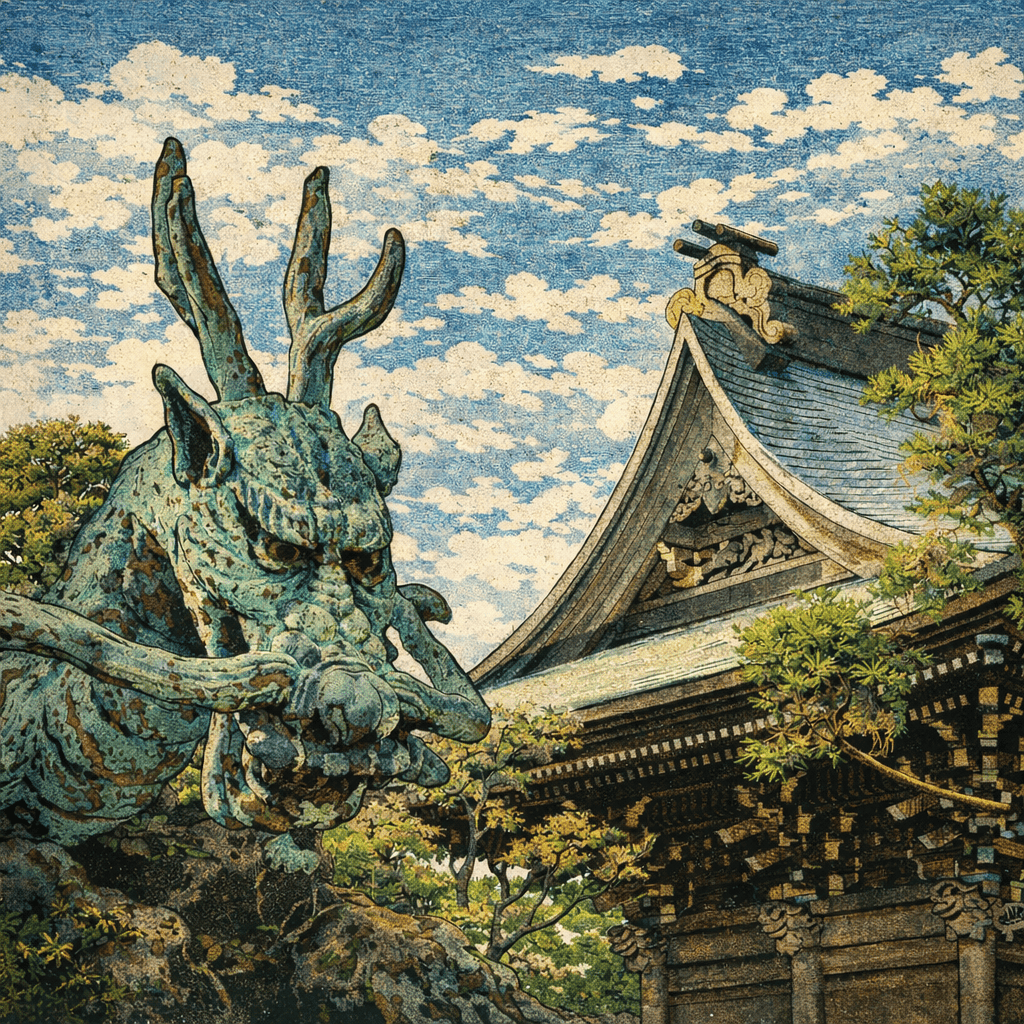
From the Golden Dragon at the center, the circuit proceeds to the east, where the Seiryu, the Azure Dragon, is enshrined. The Azure Dragon's element is wood, his color is blue-green, and his blessings concern health, vitality, and the freshness of youth. Visitors who have been ill or who are concerned about aging often come specifically to pray at the Azure Dragon's altar. The statue is painted in a vivid azure that stands out against the green of the surrounding forest.
From the east, the circuit turns south to the Sekiryu, the Red Dragon. His element is fire, his color is brilliant red, and his domain is love, passion, and the warmth of human relationships. Couples, single people seeking partners, and those hoping to repair broken relationships all come to the Red Dragon's altar, and the painted statue — bright against the temple courtyard — is one of the most photographed features of the shrine.
From the south, the circuit continues west to the Hakuryu, the White Dragon. His element is metal, his color is pure white, and his authority covers craftsmanship, artistic expression, and skilled labor. Writers, painters, musicians, and artisans of every kind come to the White Dragon to ask for the sharpening of their skills and the refinement of their work. The statue is carved in clean white stone, and its clarity is a deliberate reflection of the precision the dragon is said to bestow.
Finally, the circuit turns north to the Kokuryu, the Black Dragon. His element is water, his color is deep black, and his blessings concern longevity, wisdom, and the depth of knowledge that comes with age. The Black Dragon's altar is the final stop of the circuit before returning to the center, and his association with water and old age makes him the natural complement to the Azure Dragon's youth. The full set of four directional dragons together enclose the Golden Dragon at the center and hold the cosmos of Tanashi in perfect five-element balance.
One of the most distinctive features of Tanashi Shrine is its complete set of five-color devotional items, each tied to one of the dragons. The shrine sells five-color o-mamori (protective charms) that come in the five colors of the dragons, and that can be purchased individually (for blessing in one specific domain) or as a complete set (for comprehensive five-element protection). Five-color omikuji (fortune slips) are similarly available, with each slip drawn from a different-colored container and associated with one of the dragons.
The most ambitious collectors purchase the complete set of five goshuin stamps, one from each dragon's altar, and arrange them together in a goshuin-cho to form a complete dragon mandala in calligraphic form. The combined set, laid out on a single double-page spread, is considered one of the most beautiful goshuin arrangements available at any shrine in Japan, and it is the reason many serious goshuin collectors include Tanashi specifically in their Tokyo-area itineraries.
The full Tanashi pilgrimage is a walking mandala. Beginning at the Golden Dragon in the center, the worshipper proceeds to the east (Azure Dragon), then south (Red Dragon), then west (White Dragon), then north (Black Dragon), and finally back to the center to close the circuit. The order is the classic clockwise rotation of the wuxing cycle, and the effect of walking it is to trace, step by step, the structure of the universe as the shrine understands it.
The entire circuit can be completed in about thirty minutes if you walk steadily, or in an hour or two if you pause at each dragon to pray, photograph, and purchase the corresponding amulet or omikuji. Regardless of pace, the sequence is what matters. By the time you return to the Golden Dragon at the center, you will have walked a complete diagram of the cosmos in miniature, and the sense of structural completion that this gives is one of the most satisfying experiences available at any shrine in Tokyo.
Location
Nearby Attractions
5 min walk
Higashi-Fushimi Inari
A compact Kyoto-style Inari shrine transplanted into the Tokyo suburbs, with its own vermillion torii tunnel carved in miniature from the Fushimi Inari model. A short walk from Tanashi and an ideal companion visit.
20 min by train
Ghibli Museum, Mitaka
The museum of Studio Ghibli, Japan's most beloved animation studio, located in the forested Inokashira Park in Mitaka. Reservations are required far in advance, but the building itself — designed by Hayao Miyazaki — is a piece of living Ghibli architecture.
30 min by train
Inokashira Park
One of Tokyo's most beloved urban parks, with a large central pond, rowboats, a small zoo, the Benzaiten shrine on the pond, and long walking paths under cherry trees that are especially beautiful in spring.
30 min by train
Shinjuku
The beating heart of western Tokyo, with Kabukicho, the Tokyo Metropolitan Government observation deck, the Omoide Yokocho alleys, and Shinjuku Gyoen national garden all within easy reach of Shinjuku Station.
Visitor Tips
Related Articles
Support The Yokai Files
Enjoyed this deep dive into Japanese folklore?
The Yokai Files is reader-supported. Your support helps us research deeper, write more, and keep the darkness alive.
Conclusion
Tanashi is the closest thing in Tokyo to a complete dragon cosmology. It is not the most dramatic dragon shrine in Japan, and it does not have the sea caves of Enoshima or the cliff-fused architecture of Haruna. But it has something that none of them have: a complete five-element system, laid out on the ground, walkable in a morning, and offering a blessing from each of the five dragons in sequence. For visitors whose travel time is limited and whose base of operations is central Tokyo, Tanashi is the dragon shrine that fits.
Take the Seibu Line from Shinjuku. Walk from Tanashi Station to the shrine. Bow at the gate. Enter the main hall and greet the Golden Dragon. Walk the circuit clockwise: east, south, west, north. Pause at each colored statue. Purchase the five amulets or the five omikuji. Return to the Golden Dragon at the center and close the circuit. When you leave the shrine, the five dragons will continue their work whether you are watching or not. The Tokyo you return to will be the same city, but the cosmos you are walking in will be, for a little while, somewhat more orderly than before.
This is The Yokai Files.