Tengu Shrines of Japan: Where to Find the Mountain Demons in the Real World
Published: April 6, 2026
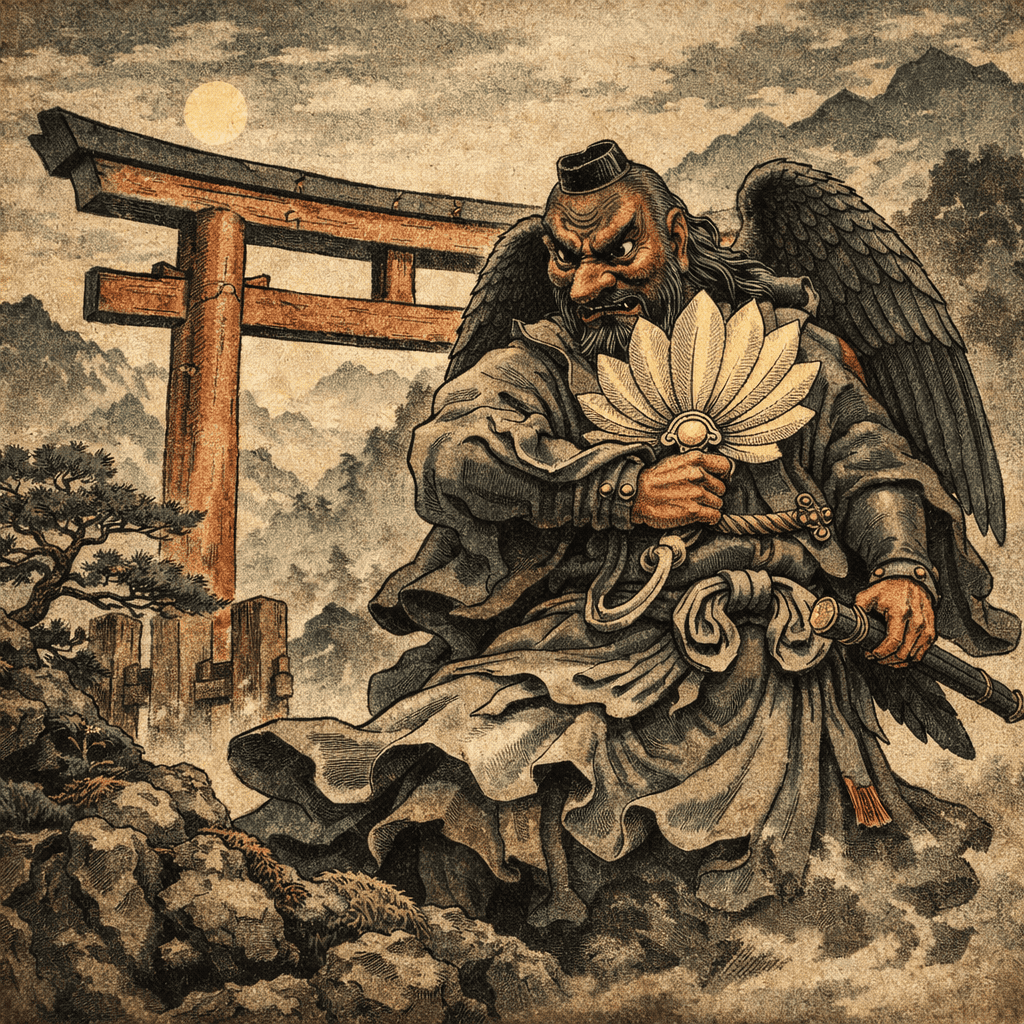
Deep in the cedar forests that blanket Japan's most ancient mountains, where mist coils between trees older than any living memory, the Tengu still reign. They are not merely characters in bedtime stories or decorative motifs on souvenir fans. They are enshrined. They are worshipped. They are feared. Across the Japanese archipelago, from the outskirts of Tokyo to the remote peaks of Kyushu, there exist shrines and temples where the long-nosed mountain demons of Japanese folklore are venerated as guardian deities, where their masks stare down from darkened halls with expressions that hover somewhere between benevolence and barely contained malice. These are not relics of a forgotten age. They are living sites of active worship, maintained by priests who still perform rituals to honor beings that most of the modern world has dismissed as myth.
The Tengu is one of the most complex and contradictory figures in all of Japanese supernatural tradition. Neither wholly divine nor wholly demonic, neither entirely benevolent nor entirely malicious, the Tengu occupies a liminal space in the Japanese spiritual landscape that mirrors the mountains themselves: wild, powerful, beautiful, and dangerous in equal measure. To visit a Tengu shrine is to step into a world where the boundary between folklore and faith dissolves entirely, where the carved wooden face of a mountain demon is not a museum piece but an object of genuine reverence, where the mountain wind that shakes the trees might carry something more than air. This is a guide to six of the most sacred Tengu sites in Japan, places where the mountain demons are not legends but neighbors, not stories but spiritual presences that the landscape itself seems to acknowledge.
What is a Tengu?
The Tenguis one of Japan's most iconic supernatural beings, a creature whose evolution across centuries of Japanese religious thought reflects the shifting relationship between humans and the wild mountain spaces they both feared and revered. The word Tengu is written with the characters for "heavenly dog" (天狗), a borrowing from Chinese mythology where the tiangou was a celestial canine associated with meteors and eclipses. But the Japanese Tengu bears almost no resemblance to its Chinese namesake. Over more than a thousand years of cultural development, the Tengu transformed from a Buddhist cautionary figure into one of the most powerful and ambiguous beings in the Japanese spiritual pantheon.
In early Japanese Buddhism, particularly during the Heian period (794–1185), Tengu were regarded as dangerous demons who haunted mountains and led Buddhist monks astray from the true path of enlightenment. They were associated with pride, vanity, and spiritual corruption. Monks who became arrogant in their learning, who mistook intellectual accomplishment for genuine spiritual attainment, were said to be reborn as Tengu after death. The Konjaku Monogatari, a collection of tales compiled in the late Heian period, is filled with stories of Tengu abducting monks, disrupting temple ceremonies, and creating elaborate illusions to test the faithful. In this early conception, the Tengu was essentially a warning: the mountains are not safe, and spiritual pride is the gateway to damnation.
But as the centuries passed, the Tengu underwent a remarkable transformation. Two distinct forms emerged in Japanese iconography. The Daitengu, or Great Tengu, is depicted as a tall, imposing humanoid figure with a dramatically elongated red nose, the face of righteous fury, often dressed in the robes of a yamabushi mountain ascetic and carrying a feathered fan called a hauchiwa that could command the winds. The Kotengu, or Lesser Tengu, also called Karasu Tengu (Crow Tengu), retains a more birdlike appearance with a beak, wings, and taloned feet, closer to the creature's earliest depictions. Both forms are associated with extraordinary martial prowess, supernatural speed, and the ability to fly.
The connection between Tengu and the yamabushi is central to understanding why Tengu shrines exist at all. The yamabushi were mountain ascetics who practiced Shugendo, a syncretic religion blending Shinto, Buddhism, and Taoist elements that centered on rigorous physical ordeals in mountain wilderness. They walked through fire, stood beneath freezing waterfalls, fasted for days, and traversed the most treacherous peaks of Japan in pursuit of spiritual power. The yamabushi were feared and respected by ordinary people, and their connection to the mountains inevitably linked them to the Tengu who were said to rule those same peaks. Over time, the Tengu shifted from being the enemy of the yamabushi to their patron and teacher. The most powerful Tengu were said to be enlightened beings who had transcended their demonic origins, becoming fierce protectors of the dharma and masters of martial arts who would bestow their skills upon worthy human pupils. This is the Tengu that is enshrined at the sites described below: not a demon to be exorcised, but a guardian to be honored, a master whose power protects those who approach the mountain with the proper reverence.
The Six Sacred Tengu Sites of Japan
The following six sites represent some of the most significant Tengu-related shrines and temples in Japan. Each has a distinct history and character, but all share a common thread: they are places where the boundary between the human world and the world of the mountain spirits grows thin, where the Tengu is not a curiosity or a mascot but a living spiritual presence embedded in the landscape, the architecture, and the daily rituals of worship. They span the length of Japan, from the Kanto plain to the mountains of northern Kyushu, and together they form a map of Tengu devotion that reveals just how deeply these beings are woven into the spiritual fabric of the nation.
Mount Takao Yakuoin Temple (高尾山薬王院)
Location: Hachioji, Tokyo Prefecture
Mount Takao Yakuoin Temple is arguably the most famous Tengu temple in all of Japan, and certainly the most visited. Founded in 744 CE by the monk Gyoki under imperial decree, the temple belongs to the Shingon Buddhist Chizan school and sits near the summit of Mount Takao, a 599-meter peak on the western edge of the Tokyo metropolitan area. The temple's principal deity is Izuna Daigongen, a syncretic figure who fuses Buddhist, Shinto, and Shugendo elements into a single fearsome form. Izuna Daigongen is depicted riding a white fox, wreathed in flames, and attended by Tengu who serve as the deity's messengers and protectors.
The Tengu presence at Yakuoin is impossible to miss. At the temple's main gate, enormous carved masks of the Daitengu and Kotengu flank the entrance, their expressions fierce enough to stop even the most casual tourist in their tracks. The Daitengu mask, with its towering red nose and glaring eyes, represents wisdom, power, and the subjugation of evil. The Kotengu mask, with its beaked face and sharp features, represents the swift execution of divine justice. Throughout the temple grounds, Tengu statues, Tengu carvings, and Tengu votive tablets appear at every turn. The mountain itself is considered the Tengu's domain, and the network of hiking trails that crisscross its slopes are understood, in the traditional framework, as paths through the Tengu's territory.
Mount Takao receives over three million visitors annually, making it one of the most-climbed mountains in the world. Yet despite the crowds, the upper reaches of the mountain and the inner precincts of the temple retain an atmosphere of genuine spiritual weight. The ancient cedar trees that line the approach, some of them centuries old with roots that grip the mountainside like the fingers of buried giants, create a natural cathedral that no amount of foot traffic can diminish. The temple's fire-walking ceremony, held annually, draws thousands of participants who walk barefoot across smoldering coals in a ritual that descends directly from Shugendo practice and the Tengu's association with mastery over the elements.
Access: Keio Takao Line to Takaosanguchi Station, then cable car or hiking trail (approximately 90 minutes from central Tokyo).
Kurama Temple (鞍馬寺)
Location: Sakyo Ward, Kyoto
If Mount Takao is the most accessible Tengu temple, Kurama Temple is the most legendary. Nestled on the slopes of Mount Kurama in the northern hills of Kyoto, this temple has been intertwined with Tengu lore for over a thousand years, primarily through its connection to one of Japan's most famous historical figures: Minamoto no Yoshitsune, the tragic hero of the Genpei War. According to legend, when Yoshitsune was a boy named Ushiwakamaru, he was sent to Kurama Temple to be raised as a monk. But the young warrior-to-be had other teachers. In the deep forests of the mountain, the great Tengu king Sojobo took the boy under his wing, literally, and taught him the arts of swordsmanship, strategy, and supernatural agility that would later make him the most brilliant military commander of his age.
The Kurama Tengu and Ushiwakamaru story is one of the foundational narratives of Japanese martial culture. It establishes the Tengu not as an enemy of human civilization but as its secret instructor, a being of terrifying power who chooses to transmit that power to a worthy human vessel. The story has been retold in Noh theater, kabuki, ukiyo-e prints, novels, manga, and anime for centuries, and Kurama Temple is the physical anchor of the entire tradition. The area known as Sojogatani (Sojobo's Valley) on the mountain is identified as the specific location where Yoshitsune trained with the Tengu, and walking through its moss-covered paths and towering cedars, it is not difficult to imagine why generations of storytellers placed a supernatural being in this exact spot.
At Kurama Station, the gateway to the temple, visitors are greeted by a towering statue of a Daitengu, its long red nose and fierce expression serving as both welcome and warning. This is actually the second-generation statue; the first was damaged when heavy snowfall in 2017 snapped its iconic nose, an event that made national news in Japan and was treated with a mixture of amusement and genuine unease. The replacement statue was reinforced to withstand future storms, a practical accommodation to the fact that even Tengu are subject to the weather.
The temple grounds contain several sites of particular interest to Tengu devotees. The Okunoin Mao-den, the inner sanctuary at the peak of the mountain, is where the temple's esoteric deity Mao-son is said to have descended from Venus six million years ago, a belief unique to Kurama's syncretic theology. The Kiinomiya Shrine, dedicated to the spirit of the ancient trees, stands among cedars that are hundreds of years old. The Okunoin Kiinokami-sha honors the forest spirits that inhabit the mountain. The site known as Kibune, on the far side of the mountain, connects Kurama to one of Kyoto's oldest water shrines and provides a hiking route that takes visitors through some of the most atmospheric mountain forest in the Kansai region.
It should be noted that the Kiichi Hogen Shrine (鬼一法眼社), a small shrine on the temple grounds associated with Kiichi Hogen, the legendary master who is sometimes identified with the Tengu Sojobo himself, is currently under reconstruction following typhoon damage in 2018. Visitors should check the temple's official communications for updates on its reopening status.
Access: Eizan Electric Railway to Kurama Station, then walking trail up the mountain (approximately 30 minutes from Demachiyanagi Station in central Kyoto).
Kashozan Ryugein Temple (迦葉山龍華院弥勒寺)
Location: Numata, Gunma Prefecture
Hidden in the mountains of northern Gunma Prefecture, Kashozan Ryugein Temple is home to what is believed to be the largest Tengu mask in all of Japan, and possibly the world. The mask, housed in the temple's main hall, measures approximately 6.5 meters from forehead to chin, with a nose extending 2.8 meters. Standing before it is an experience that transcends the merely visual. The sheer scale of the face, its painted features looming above visitors in the dim interior of the hall, creates a visceral impression of being observed by something vast and ancient and not entirely benign. The mask is not a modern tourist attraction. It is a ritual object, maintained and repaired by the temple over generations, and it is treated with the same reverence as any Buddhist icon.
The temple was founded in 848 CE and is classified as one of the Nihon Sandai Tengu, the Three Great Tengu Sites of Japan, a designation that reflects its deep historical significance in Tengu worship. The temple's founding legend tells of a monk named Chuho-son, a disciple of the temple's original abbot, who attained such profound spiritual realization through his mountain austerities that upon his death, or perhaps before it, he transformed into a Tengu and ascended into the sky. This transformation is understood not as a fall from grace, as the earlier Buddhist tradition would have interpreted it, but as an apotheosis, a transcendence of the human form into something more powerful, more enduring, and more intimately connected to the spiritual force of the mountain itself. Chuho-son's Tengu form is the deity that the temple enshrines and worships to this day.
The temple is also known for its distinctive custom of borrowing and returning Tengu masks. Visitors can borrow a small Tengu mask from the temple, take it home for a year for good fortune, and then return it the following year along with a new mask as an offering. This creates an ever-growing collection of masks that fills the temple's halls with hundreds of wooden faces, each one slightly different, each one representing a year of someone's prayers and hopes. The effect is extraordinary: corridors lined with Tengu faces of every size and expression, some serene, some ferocious, some weathered by decades of handling, all of them watching.
The approach to the temple winds through dense mountain forest along a road that narrows as it climbs. In autumn, the maples that line the route turn the mountain into a corridor of fire, and the temple grounds themselves become one of Gunma's most spectacular foliage destinations. But even in other seasons, the isolation of the location, far from any major city or tourist circuit, gives Kashozan a quality of undisturbed sanctity that more accessible sites cannot replicate. This is not a Tengu temple that has been polished for consumption. It remains wild, remote, and utterly sincere in its devotion.
Access: JR Joetsu Line to Numata Station, then bus to Kashozan (approximately 40 minutes by bus from the station). Limited bus service; check schedules in advance.
Furumine Shrine (古峯神社)
Location: Kanuma, Tochigi Prefecture
Furumine Shrine, often called "Tengu no Yashiro" (the Shrine of the Tengu), is one of the most visually dramatic Tengu worship sites in Japan. Located in the mountains west of Kanuma in Tochigi Prefecture, the shrine is both a center of Tengu devotion and the birthplace of the Nikko Shugendo tradition, the mountain ascetic practice that produced some of Japan's most powerful spiritual practitioners. The shrine's connection to Shugendo is not incidental. It is foundational. The yamabushi who trained in these mountains regarded the Tengu as their spiritual overlords, the masters of the mountain realm through which they sought enlightenment, and the shrine exists as a physical manifestation of that relationship.
What sets Furumine apart from other Tengu sites is the sheer density and variety of Tengu imagery within its precincts. The shrine's main hall contains Tengu statues and Tengu masks of every conceivable size and style, from enormous ceremonial pieces that dominate entire walls to small, intricately carved figures tucked into alcoves. The overall effect is one of being surrounded, of having entered a space that belongs entirely to the Tengu, where human visitors are tolerated guests rather than the primary inhabitants. The atmosphere is intensified by the shrine's mountain setting, the sound of rushing water from the nearby gorge, and the ancient trees that press close to the buildings on every side.
Furumine Shrine has gained particular fame in recent years for its extraordinary goshuin, the decorative calligraphic stamps that Japanese shrines and temples offer to visitors as proof of pilgrimage. The shrine offers over thirty different goshuin designs, many of them featuring elaborate Tengu illustrations hand-drawn by the shrine's priests. These goshuin have become collectible works of art in their own right, and some are so popular that visitors must join waiting lists months in advance. The designs change seasonally and for special occasions, making each visit potentially unique. For goshuin collectors, Furumine is a destination of almost mythical status, a pilgrimage within a pilgrimage.
The surrounding Furumine-en garden and the gorge below the shrine offer hiking trails through pristine mountain scenery. In early summer, the rhododendrons bloom across the mountainside in waves of pink and white. In autumn, the Japanese maples create canopies of gold and crimson that reflect in the clear mountain streams below. The shrine also operates a lodging facility where visitors can stay overnight and experience the mountain's atmosphere after the day-trippers have departed, when the silence and the darkness and the proximity of the forest give the Tengu masks inside a rather different character than they possess in daylight.
Access: Tobu Nikko Line to Shin-Kanuma Station, then bus to Furumine Shrine (approximately 75 minutes by bus). Bus service is limited; verify schedules before departing.
Saijoji Temple (大雄山最乗寺)
Location: Minamiashigara, Kanagawa Prefecture
Saijoji Temple, also known as Daiyuzan Saijoji, is one of the great Zen temples of the Kanto region and one of the most atmospheric Tengu sites in eastern Japan. Founded in the Muromachi period over six hundred years ago, the temple sits deep in the forested mountains of western Kanagawa, surrounded by towering cryptomeria trees whose trunks form dark columns that vanish into the canopy above. The approach to the temple follows a long stone stairway through this forest, ascending gradually through air that is thick with moisture and the scent of cedar, and the sense of entering a sacred space builds with every step.
The temple's connection to Tengu centers on the legend of Doryo Daishi, also known as Doryo Daibosatsu, a monk of extraordinary spiritual power who served the temple in its early years. According to the legend, Doryo was so devoted to the temple and so powerful in his spiritual practice that upon his death, he transformed into a Tengu to serve as the temple's eternal guardian. His Tengu form, known as Doryo Dai Satta, is the protective deity of Saijoji, and his presence is felt throughout the temple grounds in ways both subtle and unmistakable.
The most iconic symbol of Doryo's Tengu presence at Saijoji is the collection of enormous iron geta (traditional elevated wooden clogs) displayed at various points throughout the temple grounds. These oversized geta, some of them standing taller than a person, represent the Tengu's supernatural stride, the ability to cross mountains in a single step that is one of the Tengu's defining attributes. The largest pair, positioned near the Tengu hall, has become the most photographed feature of the temple, but smaller pairs appear throughout the grounds, tucked beside paths and nestled among tree roots, as if the Tengu might have kicked them off while alighting on a branch overhead.
The temple complex is vast, encompassing multiple halls, meditation gardens, pilgrim lodgings, and forest paths that extend deep into the surrounding mountains. The Tengu hall itself is the spiritual heart of the complex, where Doryo's Tengu form is enshrined and where visitors offer prayers for protection, health, and success. The hall's interior is dim and fragrant with incense, and the atmosphere is one of genuine monastic gravity. Unlike some Tengu sites that have embraced their tourist potential, Saijoji remains first and foremost a working Zen temple, and the rhythms of monastic life, the sound of bells, the sight of monks in their robes crossing the grounds at dawn, give the Tengu worship here a depth and seriousness that is deeply affecting.
Access: Daiyuzan Line to Daiyuzan Station, then bus or 20-minute walk to the temple entrance. Approximately 90 minutes from Shinjuku via Odawara transfer.
Takasumi Shrine / Mount Hikosan (高住神社・英彦山)
Location: Soeda, Tagawa District, Fukuoka Prefecture
Mount Hikosan, rising 1,199 meters above the border of Fukuoka and Oita Prefectures in northern Kyushu, is one of the most sacred mountains in western Japan and the seat of one of the Eight Great Tengu of Japanese tradition. The Tengu of Hikosan is known as Hikosan Buzenbo, and he ranks among the most powerful and revered Tengu in the entire Japanese pantheon. Unlike some Tengu who are associated with specific temples or legends, Hikosan Buzenbo is identified with the mountain itself, a being whose spiritual authority extends over the entire peak and whose presence permeates every ridge, valley, and waterfall within the mountain's domain.
Takasumi Shrine, located on the upper slopes of Mount Hikosan, is the primary center of worship for Hikosan Buzenbo. The shrine sits among enormous ancient trees, including the legendary Tengu Cedar (Tengu Sugi), a massive cryptomeria whose trunk measures over nine meters in circumference. The tree is believed to be the dwelling place of the Tengu, a physical anchor for a supernatural being whose roots in this mountain run as deep as the tree's own. Standing before the Tengu Cedar, with its massive trunk splitting into branches that reach into the canopy like outstretched arms, it is easy to understand how a culture intimate with the spiritual life of trees could identify this particular tree as something more than vegetable matter.
Mount Hikosan has been a center of Shugendo mountain asceticism for over a millennium, and at its peak, the mountain supported a community of more than three thousand yamabushi practitioners. The Tengu of Hikosan was the spiritual lord of this community, the supernatural authority to whom the yamabushi answered, and the being whose power they sought to channel through their extreme austerities. The mountain's Shugendo heritage was dealt a severe blow during the Meiji period, when the government's forced separation of Buddhism and Shinto (shinbutsu bunri) dismantled many of the syncretic institutions that had sustained mountain worship for centuries. But the Tengu worship survived, persisting in the shrines and folk practices that the government's reforms could not entirely eradicate.
The legend of the Tengu Taoshi (Tengu Overthrow) is one of the mountain's most famous stories. It tells of a yamabushi who challenged the Tengu of Hikosan to a contest of spiritual power and was flung bodily from the mountain for his arrogance. The tale serves as a reminder that the Tengu, for all its protective qualities, remains a being of overwhelming power that demands respect. The yamabushi understood this instinctively: they did not approach the Tengu as equals but as supplicants, and their extreme physical ordeals were understood as demonstrations of sincerity rather than displays of strength. The mountain teaches humility, and the Tengu enforces it.
Access: JR Hitahikosan Line to Hikosan Station, then bus to the mountain trailhead. Note that the Hitahikosan Line has been partially suspended due to flood damage; travelers should verify current service status and consider alternative bus routes from Soeda or Tagawa.
Tips for Visiting Tengu Sites
Visiting Tengu shrines and temples is a rewarding experience, but it requires a degree of cultural sensitivity and practical preparation that goes beyond the typical tourist checklist. These are not theme parks. They are active places of worship, and the people you will encounter at them, both priests and local devotees, take the spiritual significance of these sites seriously. Respecting that significance is not merely a matter of politeness. It is the price of admission to an experience that most visitors find genuinely moving.
Etiquette and respect: At Shinto shrines, follow the standard purification ritual at the temizu water basin before approaching the main hall: take the ladle in your right hand, pour water over your left hand, switch hands and rinse your right, then pour water into your cupped left hand to rinse your mouth (spit discreetly beside the basin, not back into it), and finally rinse the ladle handle by tilting it vertically. At Buddhist temples, you may light incense and place it in the censer, then waft the smoke toward yourself for purification. Bow before and after praying. Do not step on thresholds. Remove your hat when entering buildings. Speak quietly and move calmly. These gestures are not performances; they are genuine expressions of respect that the regular worshippers around you practice daily.
Best seasons:Spring (late March through May) and autumn (October through November) are the most rewarding seasons for visiting mountain Tengu sites. Spring brings cherry blossoms to the lower slopes and fresh greenery to the upper elevations, while autumn transforms the mountain forests into displays of color that have inspired Japanese art for a thousand years. Summer is beautiful but can be hot, humid, and crowded, particularly at accessible sites like Mount Takao. Winter offers solitude and a stark, austere beauty that matches the Tengu's character, but snow and ice can make mountain trails dangerous, and some facilities may be closed.
Goshuin collecting: If you are collecting goshuin (temple and shrine stamps), bring your goshuincho (stamp book) or purchase one at your first stop. Furumine Shrine, with its thirty-plus Tengu designs, is a highlight for collectors, but all six sites in this guide offer their own distinctive stamps. Note that goshuin are handwritten by priests and may involve waiting times during busy periods. The goshuin is not a souvenir. It is a record of your spiritual connection to the site, and it should be treated with respect, stored properly, and not thrown away when you return home.
Photography: Most Tengu sites permit photography in outdoor areas and on temple grounds, but photography inside main halls and sacred buildings is frequently prohibited. Look for signs indicating restrictions, and when in doubt, ask before shooting. Never use flash in dimly lit halls. Do not photograph people praying without their explicit permission. And at sites like Kashozan, where the giant Tengu mask is a major draw, remember that you are photographing a religious object, not a novelty. Frame your shots accordingly.
The Legend Lives On
It would be tempting to view Tengu worship as a picturesque remnant of premodern Japan, a charming folk tradition that has been preserved by rural communities and embraced by the tourism industry but stripped of its original spiritual content. This view would be wrong. The Tengu shrines and temples of Japan are not museums of a dead religion. They are living centers of worship where priests perform daily rituals, where local communities gather for seasonal festivals, and where individual devotees come to pray for protection, health, success, and guidance with the same sincerity that their ancestors brought to these same sites centuries ago.
The Tengu endures because it embodies something that Japan has never stopped believing: that the mountains are alive, that the wild places of the earth possess a spiritual power that civilized spaces do not, and that the boundary between the human world and the other world is not a metaphor but a geographical reality, located at specific elevations on specific peaks, guarded by specific beings whose names and faces have been known for a thousand years. In an era of urbanization and digital abstraction, the Tengu offers something increasingly rare: a direct, physical, bodily encounter with the sacred, mediated not by screens or texts but by stone steps, mountain air, cedar smoke, and the unblinking stare of a carved wooden face that has been watching the mountain path since before you were born.
To learn more about the Tengu's origins, powers, and place in Japanese supernatural tradition, visit our full Tengu article. For more sacred sites and spiritual destinations across Japan, explore the Shrines & Temples section.
Conclusion
The six sites described in this guide are gateways. They are points of entry into a Japan that exists beneath the modern surface, a Japan where mountain demons are not bedtime stories but spiritual authorities, where carved masks are not decorations but portals, and where the line between the sacred and the wild has never been drawn because no one has ever been able to tell where one ends and the other begins. Whether you visit Mount Takao on a sunny afternoon with three million other hikers or climb the silent paths of Kashozan through autumn fog with no one else in sight, the Tengu will be there. They have always been there. They will be there long after the last hiker has descended and the last tourist bus has departed and the mountain returns to the silence that it prefers. The Tengu are patient. They are very, very patient. And the mountain remembers everything.
This is The Yokai Files.
Support The Yokai Files
Enjoyed this deep dive into Japanese folklore?
The Yokai Files is reader-supported. Your support helps us research deeper, write more, and keep the darkness alive.