Akaname: The Filth-Licking Bathroom Demon That Rewards Cleanliness
Published: March 28, 2026
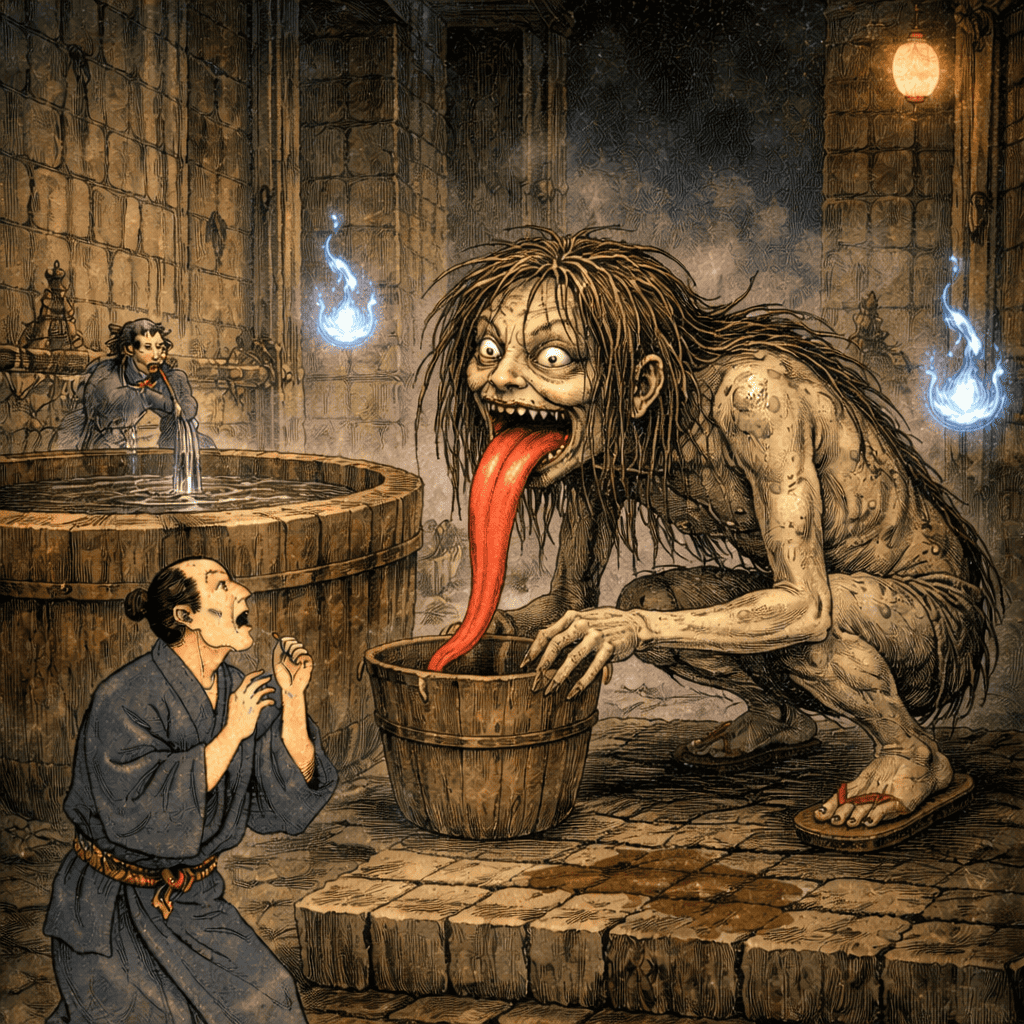
You have not cleaned your bathroom in some time. The grout between the tiles has darkened. Something has accumulated in the corners of the tub that does not bear close examination. The drain smells of things best not thought about in daylight. You tell yourself you will clean it tomorrow, and then tomorrow comes and goes, and the accumulation continues, growing thicker, older, more thoroughly itself. And then one night, something comes to do what you would not — something that finds exactly what you have neglected to be deeply, enthusiastically desirable.
The akaname is a yokai whose entire existence is organized around a single, specific activity: licking the filth from dirty bathrooms. It is neither fearsome nor dangerous, and it does not harm the people whose bathrooms it visits. It simply arrives at night in neglected bathing spaces and methodically cleans them with its tongue — a form of supernatural housekeeping that is either reassuring or deeply disturbing depending on how you feel about the idea of something in your bathroom while you sleep, going over every surface with extraordinary thoroughness and considerable relish.
What is Akaname?
Akaname — "filth licker" — is a yokai that inhabits dirty, neglected bathrooms and bathing areas, surviving on the grime and accumulations of the unclean. The name combines aka (filth, grime, the reddish-brown residue that accumulates in wet spaces) with name/nameru (to lick). It is a solitary creature, appearing alone in the hours before dawn when the household is asleep, and it restricts itself entirely to the bathing space — it does not wander into other areas of the house. Its relationship with its food source is extremely specific: it wants bathroom filth, and nothing else will do.
The traditional interpretation of the akaname is fundamentally moral. Like many Japanese supernatural beings associated with household spaces, it functions as an incentive for proper maintenance: keep your bathroom clean, and the akaname will have nothing to eat and will eventually stop coming. Let it go, and you will have a visitor with unusual tastes visiting you every night. Whether this is worse than simply cleaning your bathroom regularly is a question each household must answer for itself. Michael Dylan Foster's survey of domestic yokai places the akaname within a category he describes as "consequence spirits" — supernatural beings whose presence is itself the punishment for failing to observe proper household standards (Michael Dylan Foster, "The Book of Yokai," 2015).
The word "aka" in akaname is worth examining in detail. In Japanese, aka can refer to the specific reddish-brown deposit that forms in damp spaces — the mineral residue, soap scum, and organic accumulation that coats the surfaces of bathtubs, shower walls, and drain channels when they go uncleaned. This is a very particular kind of dirt, specific to wet environments, and the akaname's food preference is correspondingly precise. It does not eat general household filth; it eats bathing-space filth. This specificity is characteristic of many Japanese folk supernatural beings, whose functions are defined with a precision that reflects the Japanese cultural tendency toward specialization and exactness in all things, including the allocation of supernatural responsibility.
What Does Akaname Look Like?
The akaname is typically depicted as a small, humanoid figure with red or reddish-brown skin — the color of old bathroom grime, appropriately enough — a round body, small limbs, and a disproportionately long tongue that is its primary physical feature. Its eyes are sometimes described as round and slightly glazed, with the expression of a being entirely focused on a task it finds genuinely rewarding. It often appears with disheveled hair and a generally unkempt appearance, which is ironic given that its function involves cleaning. In Toriyama Sekien's influential 18th-century illustration, the akaname is shown crouching in a bathing space, tongue extended toward the wall, looking entirely at home in its preferred environment (Toriyama Sekien, "Gazu Hyakki Yako," 1776).
The tongue is the defining physical feature of the akaname and receives the most detailed description in various accounts. It is described as extremely long — capable of reaching every surface in a traditional bathing room from a single position — and covered with a rough, sticky surface ideal for removing accumulated residue from stone, wood, and tile. The tongue is also described as slightly luminescent in some accounts, glowing with a faint reddish light in the darkness of the unlit bathroom. This bioluminescence serves the narrative function of explaining how the creature navigates and works in complete darkness — it provides its own light, just enough to see what it is eating.
Regional variations in the akaname's appearance exist across Japan's diverse folk traditions. Some accounts from the Kansai region describe it as considerably larger than the standard depiction — large enough that encountering it in a traditional bathhouse would be immediately apparent rather than only detectable through the clean surfaces it leaves behind. Northern Honshu traditions in the Tohoku area sometimes describe it with additional features such as claws adapted for gripping slippery wet surfaces, emphasizing its specialization for the bathing environment. These variations all preserve the core characteristics: reddish skin, enormous tongue, complete comfort in the bathroom environment, absolute indifference to everything outside it.
Where Did Akaname Come From?
The akaname's origins lie in the broader Japanese tradition of household spirits that enforce domestic standards — a category that includes numerous beings whose presence is associated with the consequences of failing to maintain one's home properly. The bathing space in traditional Japanese culture had particular ritual significance: cleanliness in the bath was connected to spiritual purity, and the bathing ritual was understood to cleanse not just the body but the spirit. The traditional Japanese ofuro — the deep soaking bath that remains central to Japanese domestic life — was more than a hygiene facility; it was a ritual space for purification. A bathroom that was physically filthy was therefore also spiritually compromised, and the akaname represents the supernatural consequence of that neglect.
The creature first appears definitively in Toriyama Sekien's Gazu Hyakki Yagyo (1776), where it is depicted and described with the characteristic detail of Sekien's yokai encyclopedias. Whether Sekien invented the akaname or documented an existing folk tradition is uncertain — his encyclopedias combined both, and distinguishing between the two is sometimes impossible. What is clear is that the concept resonated sufficiently with existing folk anxieties about the bathing space that it quickly became established in the broader yokai tradition. By the time Lafcadio Hearn was collecting Japanese supernatural stories in the late 19th century, the akaname was sufficiently established in folk consciousness to appear in casual conversation as a known supernatural entity rather than requiring explanation (Lafcadio Hearn, "Kwaidan," 1904).
The connection between the bathing space and the supernatural is not unique to Japanese tradition — numerous world cultures have associated water, bathing, and drainage with liminal supernatural presences. What distinguishes the Japanese akaname tradition is its specificity about the nature of the supernatural presence and its direct connection to the behavior of the household that owns the bathing space. The akaname is not a spirit that inhabits bathrooms regardless of their condition; it specifically inhabits dirty bathrooms. The household's own behavior creates the conditions for the supernatural encounter, a moral dynamic that is fundamental to how the akaname functions as a cultural concept.
During the Edo Period, when public bathhouses (sento) became central institutions of urban life in Japanese cities, the akaname tradition adapted to accommodate the new scale of bathing culture. Public bathhouses were famously well-maintained establishments in which cleanliness was both a practical necessity and a point of professional pride — but the private bathing spaces of households, particularly in poorer neighborhoods, were less reliably clean. The akaname tradition provided a supernatural motivation for domestic hygiene that supplemented whatever practical motivations households might have had, embedding proper bathroom maintenance within the larger framework of supernatural accountability that governed Japanese folk domestic life.
What Are the Most Famous Akaname Legends?
The akaname's legend is not extensive in terms of narrative stories, but it has a rich tradition of use as a practical motivator in Japanese households across multiple centuries. Parents told children about the akaname to encourage proper bathroom cleaning habits — a supernatural threat is often more effective than parental instruction, and the image of a sticky-tongued creature licking up what you failed to clean is more viscerally motivating than abstract warnings about hygiene. In this sense, the akaname functions less as a monster and more as a personified consequence: not a punishment for uncleanliness, but the uncleanliness itself given form and appetite.
A representative account from Edo Period oral tradition describes a woman who, hearing strange sounds from her bathroom in the early morning hours, lit a lantern and investigated. She found the akaname at work — or rather, she found her bathroom conspicuously cleaner than she had left it and a faint reddish glow disappearing through the drainage channel. The next night, she cleaned the bathroom herself before retiring. The night after that, and the night after that, she continued cleaning. The strange sounds did not return. The story's structure is elegant in its simplicity: the supernatural encounter motivates behavior change, and the behavior change removes the supernatural presence. The akaname is self-eliminating once it accomplishes its purpose.
The more frightening version of the akaname legend emphasizes what happens when the creature is actually encountered in person rather than merely known to have been present through the evidence of its cleaning. Direct encounter with the akaname — coming face to face with the reddish figure in the darkness, seeing that tongue extend toward you — is described as causing intense fear and, in some accounts, temporary illness. The illness is understood as spiritual contamination from proximity to the creature: the akaname is made of filth, and contact with it, even accidental contact, transfers a degree of that filth back to the person who touched it. The proper response to direct encounter is extensive ritual purification.
How Does Akaname Appear in Modern Japan?
The akaname is a minor but beloved figure in modern yokai culture, appearing in comprehensive yokai collections, video games, and illustrated encyclopedias with a kind of affectionate recognition. Its particular combination of non-threatening nature and deeply specific function makes it a popular figure in discussions of the more mundane, domestically focused side of yokai tradition. Japanese cleaning product commercials have occasionally referenced the akaname tradition — the suggestion of a supernatural consequence for a dirty bathroom is both culturally legible and, in the right treatment, genuinely funny. The Yo-kai Watch franchise includes an akaname character with a design that emphasizes the creature's comedic potential while remaining faithful to its core characteristics.
Which Anime and Manga Feature Akaname?
The akaname has a notable presence in the GeGeGe no Kitaro anime franchise, appearing across various adaptations of Shigeru Mizuki's foundational yokai manga. Mizuki's version of the akaname is consistent with the classical folk tradition — reddish-brown skin, enormous tongue, complete absorption in the task of bathroom cleaning — while rendered with the characteristic warmth that Mizuki brought to even his most outwardly repulsive yokai characters (Shigeru Mizuki, "GeGeGe no Kitaro," manga, 1960s; GeGeGe no Kitaro, Toei Animation, 1968). In the Kitaro universe, the akaname is one of many yokai that appear as background figures in the supernatural world Kitaro navigates, neither ally nor enemy but simply a creature going about its very specific business.
Mizuki's treatment of the akaname in his illustrated yokai encyclopedias — separate from the Kitaro narrative series — is particularly revealing of his approach to the creature. He presents it with deadpan seriousness: a creature with a specific ecological niche, a clear behavioral pattern, and a definite relationship with the human world that is neither threatening nor particularly friendly but simply functional. This scientific-naturalist treatment of the akaname, applying the vocabulary of natural history to a supernatural creature, became Mizuki's signature contribution to yokai culture and is exemplified in his handling of domestic yokai like the akaname.
Beyond the Kitaro franchise, the akaname's influence on anime and manga aesthetics manifests in the broader tradition of domestic supernatural beings that appear throughout Japanese animation. Haunted-house anime and manga — a significant subgenre — consistently include bathroom spirits of various types, often unnamed but clearly in dialogue with the akaname tradition: reddish figures in damp spaces, tongue-heavy creatures drawn to filth, beings that represent the supernatural consequences of domestic neglect. The akaname established the template for this character type, and contemporary animators working in the domestic horror genre draw on its visual grammar whether or not they explicitly reference the source.
Where Can You Encounter Akaname in Japan?
The akaname does not have a specific geographic location associated with it — it is a household yokai found wherever dirty bathrooms exist. For those interested in its artistic documentation, Toriyama Sekien's original illustrations can be found in facsimile editions at major Japanese bookstores and in the collections of folklore museums throughout the country. The National Diet Library in Tokyo holds the original Sekien volumes, and various regional folklore museums maintain collections of related material.
The Mizuki Shigeru Road in Sakaiminato includes an akaname figure, rendered in bronze with the characteristic faithfulness to Mizuki's designs that makes the road a genuine survey of the yokai tradition as Mizuki understood and depicted it. Traditional bathhouses (sento) in older neighborhoods of Tokyo, Osaka, and Kyoto provide the atmospheric context in which the akaname tradition makes its most immediate sense — the deep wooden tubs, the tiled walls, the drainage channels, the particular quality of damp and steam that defines the traditional Japanese bathing experience. Many historic sento have been preserved as cultural landmarks, and several in Tokyo's Taito and Sumida districts still operate as working bathhouses in buildings dating to the early 20th century.
Conclusion
The akaname is, in the final analysis, the most domestically honest of all yokai. It does not pretend that the consequences of neglect are anything other than what they are. It does not threaten violence or madness or spiritual catastrophe. It simply says: leave your bathroom uncleaned long enough, and something will come to appreciate what you have abandoned. That something has an unusually long tongue and finds your drain grime delicious.
The choice is yours. The akaname is patient. It has been waiting in neglected bathing spaces for centuries, and it has learned that humans are very, very bad at cleaning their bathrooms regularly. The tradition that produced it understands something important about the relationship between care and the supernatural: that the uncanny tends to inhabit the spaces we abandon, that neglect is a form of invitation, and that the things we fail to maintain develop a life of their own. Clean your bathroom. Not because you believe in the akaname. Because the act of cleaning is itself a form of attention, and spaces that receive attention remain spaces for the living. It will never run out of work.
This is The Yokai Files.
Support The Yokai Files
Enjoyed this deep dive into Japanese folklore?
The Yokai Files is reader-supported. Your support helps us research deeper, write more, and keep the darkness alive.