Bakeneko: The Monster Cat That Lives in Every Long-Lived Household Pet
Published: March 28, 2026
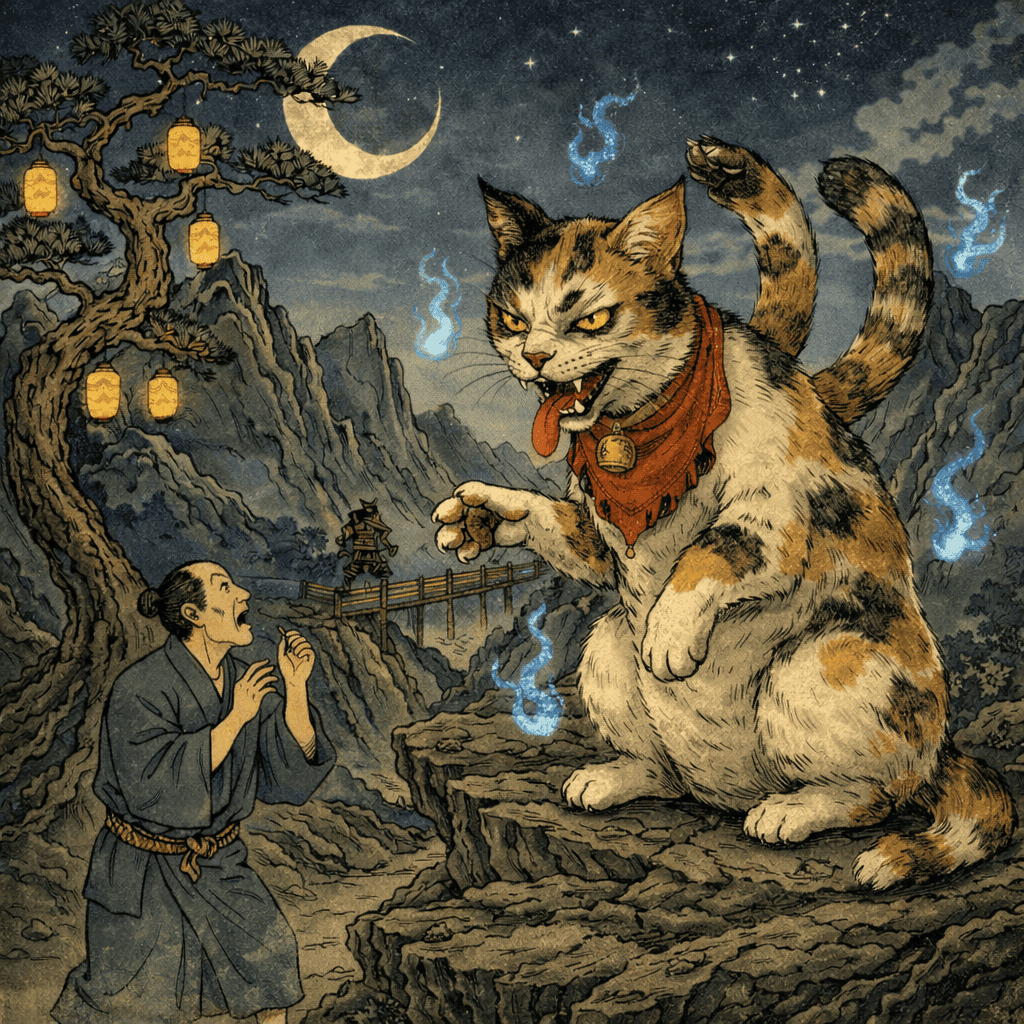
Your cat has been with you for twelve years. You have fed it every morning and every evening for twelve years. You have watched it sleep in the same patches of sunlight on the same floors through a decade of your life's changes — through moves and illnesses and the deaths of people who used to visit and no longer do. It knows you in the particular, intimate way that only an animal who has watched you for years can know you: your moods before you are aware of them yourself, your routines better than you remember them, the exact tone in your voice that means food is coming versus the tone that means you are sitting down and it can come be near you. You have trusted its presence completely. You have never had reason not to. And then one night you get up for water and see it standing upright in the kitchen — standing on two legs like a person, its paws doing something with the objects on the counter that you cannot quite make out in the darkness. When it hears you, it drops instantly to all fours. It looks at you with those yellow eyes. After a moment it walks past you toward the bedroom, tail raised, entirely unperturbed. It is just a cat again. You stand in the kitchen for a long time before you follow.
The bakeneko is the dark potential that sleeps inside every household cat — the supernatural transformation that can occur when an animal has lived long enough, grown large enough, or absorbed enough human emotion and proximity to human death to cross the boundary between ordinary animal and supernatural being. It is not an external threat. It is not something that comes from outside. It is the thing you already invited inside, fed every day, allowed to sleep on your bed, and trusted completely. The bakeneko is the betrayal hidden in domesticity itself — the revelation that what you thought you knew and what actually lives with you are two different things.
What is Bakeneko?
Bakeneko translates as "changed cat" or "monster cat" — bake being the nominalized form of the verb bakeru, to transform or to change into something other than what one was. It refers specifically to an ordinary domestic cat that has undergone a supernatural transformation, gaining magical abilities and, in many accounts, intentions that are no longer simply those of a cat. The specific conditions that trigger this transformation vary across regional traditions, but the most consistently cited factors include age (a cat that lives beyond a certain threshold, often given as ten to thirteen years), size (a cat that grows unusually large, beyond what a normal cat should reach), and spiritual contamination — prolonged exposure to grief, to death, or to funeral rites that were improperly conducted or inadequately observed.
The bakeneko is distinct from but closely related to the nekomata — a similar cat spirit specifically characterized by a forked tail that develops after the cat reaches an even greater age or power. Some traditions treat these as distinct entities on a continuum: the bakeneko is the early stage of feline supernatural transformation, the nekomata the more advanced and more dangerous form. Both are capable of shapeshifting into human form, of raising and manipulating the dead, and of possessing living human beings, but the bakeneko represents the threshold stage — the point at which a cat you might recognize has crossed into something you cannot fully predict or control. As Michael Dylan Foster notes, the bakeneko belongs to the category of yokai that arise from the transformation of the familiar, making them distinctively more unsettling than beings that were always supernatural (Michael Dylan Foster, "The Book of Yokai," 2015).
What Does Bakeneko Look Like?
The bakeneko's most disturbing quality is that it continues to look like a cat. The transformation is internal and behavioral before it becomes obviously physical — the cat grows larger and heavier than is entirely normal, its eyes develop an unusual quality of attention and comprehension that exceeds what you expect from an animal, and it begins to exhibit behaviors that seem to exceed normal feline intelligence. The first signs are subtle: the cat sitting very still in positions that suggest listening rather than simply resting; the cat present at moments of household crisis in a way that seems less coincidental than before; the cat watching you with an expression that is too complex for what an animal should feel.
In its more advanced manifestations, the bakeneko can stand on its hind legs and walk upright, and in human form it typically appears as a human figure with something feline in its quality of movement and attention. A particularly persistent traditional detail is the cloth on the head: the bakeneko in its semi-transformed state is often depicted wearing a cloth or tenugui (hand towel) on its head while standing upright, a detail that appears throughout Edo Period art and storytelling. The image of a cat standing on two legs with a cloth balanced on its head, moving through a household with an unnerving purposefulness, appears in popular prints, theater, and story collections of the period — disturbing and slightly absurd at the same time, which is precisely the register that made it so memorable.
Where Did Bakeneko Come From?
Cats arrived in Japan from the Asian continent sometime around the Nara Period (710–794 CE), brought initially to Buddhist temples and aristocratic households to protect stored sutras and food supplies from mice and rats. Their introduction within a religious context gave them an elevated and somewhat ambiguous status from the beginning: useful, even necessary, but associated with spaces that carried their own spiritual weight. Their subsequent adoption by the Heian court gave them an association with refinement and sensitivity — the courtiers of the Heian period kept cats as pets and wrote about them with genuine affection — but this elevated status coexisted uneasily with a genuine unease about their nocturnal behavior, their aloof unpredictability, and their undeniable tendency to act on their own terms regardless of human wishes.
The specific association between cats and death — one of the most persistent elements of Japanese cat supernatural belief — likely has practical origins in the observable fact that cats were known to be drawn to corpses, attracted by smell in a way that was culturally intolerable in a tradition where the proper and respectful treatment of the dead was of paramount spiritual importance. A cat that would approach, investigate, or worse, disturb a body being prepared for funeral rites was viewed with deep suspicion. This practical observation — cats and death in proximity — fed directly into the belief that cats were drawn to death-energy specifically and could be transformed by prolonged exposure to it. The bakeneko became, among other things, a cautionary framework for funeral practice: keep the cat away from the body, because if the cat jumps over the corpse, the dead may rise.
What Are the Most Famous Bakeneko Legends?
The most famous category of bakeneko legends involves the creature killing its owner and then assuming their human form — a body-snatching that allows it to continue living within the household while the real person is dead and concealed. In these stories, the bakeneko maintains its disguise with considerable skill, but is eventually undone by small behavioral tells that cannot be fully suppressed: it eats fish bones whole without apparent effort; it grooms its face in a way that no human does; it reacts to the smell of mice with an involuntary twitch of attention that no person would feel. The revelation moment — when a family member realizes that their mother, wife, or servant has been a cat for the past several weeks — is a set piece that appears across dozens of Edo Period collections, always hinging on the same insight: that no matter how sophisticated the disguise, nature expresses itself in small ways that cannot be entirely controlled.
The Nabeshima Bakeneko Disturbance is the most famous historical bakeneko legend — a story from the Nabeshima domain in Kyushu that was presented as a true account of events in the 17th century. According to the legend, the lord Nabeshima Mitsushige killed a woman and her beloved cat together during a political dispute. The cat, transformed by grief and by its mistress's violent death, assumed the dead woman's form and returned to the lord's household to haunt him — appearing in his dreams, weakening him nightly, draining his life through supernatural means. The lord's guard, Komori Hanbei, was the only man capable of staying awake through the haunted nights, and it was he who eventually confronted and destroyed the bakeneko. The story was adapted into kabuki as the Nabeshima Kaidan and remains part of the classical repertoire, performed to this day.
How Does Bakeneko Appear in Modern Japan?
The bakeneko has experienced a substantial revival in modern Japanese popular culture, appearing in anime, manga, film, and literature with a frequency that reflects both the ancient power of the legend and the modern Japanese cultural relationship with cats — one of the most intensely cat-loving cultures in the world, where cat cafes, cat islands, and cat-themed everything have become significant industries. The bakeneko occupies a peculiar and productive position within this landscape: it is the shadow side of cat adoration, the supernatural acknowledgment that the creature you love most may be the one you understand least.
Which Anime and Manga Feature Bakeneko?
Natsume's Book of Friends (produced by Brain's Base, 2008) is one of the most critically acclaimed supernatural anime series of the modern era, and the bakeneko tradition is woven throughout its world. The series — based on Yuki Midorikawa's manga — centers on a boy who can see yokai and who has inherited a book of yokai names from his grandmother. His primary companion is a powerful yokai who takes the form of a round, lazy-looking cat called Madara, nicknamed Nyanko-sensei. While Nyanko-sensei is formally a wolf-cat spirit rather than a bakeneko specifically, his character is saturated with bakeneko energy: the ancient power beneath the domestic exterior, the cat who has seen everything and decided to humor humans for reasons of his own, the supreme indifference beneath apparent affection. The series' treatment of yokai relationships — particularly the bond between Natsume and Nyanko-sensei — draws deeply on traditional ideas about the supernatural potential of cats and their ambiguous relationship with humans.
Studio Ghibli's The Cat Returns (2002) draws on the bakeneko tradition with characteristic Ghibli lightness — the film's world is one in which cats have their own kingdom, their own court, and their own cultural practices, and the boundary between human world and cat world is more permeable than anyone on either side fully acknowledges. The film is less about horror than about negotiation, about what it means to move between two worlds and to be claimed by the one you did not choose, but its premise — that the domestic cat has a supernatural dimension that is hidden from ordinary human perception — is pure bakeneko (The Cat Returns, Studio Ghibli, 2002).
Where Can You Encounter Bakeneko in Japan?
Cat shrines and temples appear throughout Japan, many with direct or indirect connections to supernatural cat traditions. Gotokuji temple in Setagaya, Tokyo — claimed as one of the origin sites of the maneki-neko (beckoning cat) figurine tradition — is filled with hundreds of ceramic cat figures brought as offerings, and its atmosphere of accumulated feline spiritual attention is genuinely distinctive. Imado Shrine in Asakusa, with its cat-themed decorations and its reputation for helping with relationships and love, has become a destination for cat lovers who want to blend devotion to cats with devotion in the traditional religious sense.
For the more specifically supernatural dimension of cat lore, the Nabeshima Bakeneko Shrine in Saga City, Kyushu, is dedicated to the spirit of the cat at the center of the most famous bakeneko legend. The shrine is small and relatively obscure, which adds rather than detracts from its atmosphere. Local tradition holds that the bakeneko's spirit was eventually appeased through proper ritual and is now venerated as a protective presence — the transformation from malevolent haunting to benevolent guardianship being one of the characteristic resolutions of Japanese supernatural conflict, in which the acknowledgment and honoring of grievance can convert a destructive spirit into a protective one.
Conclusion
The bakeneko endures because cats themselves endure — as beloved companions, as beautiful presences, as animals that accept human attention entirely on their own terms and have always retained some portion of their nature that remains genuinely unknowable to us. Every person who has watched their cat sit perfectly still in a darkened corner, staring at something invisible with complete focused attention, has felt the edge of what the bakeneko represents: the suspicion that the animal you live with knows things you do not, sees things you cannot, and is keeping its own counsel about what it makes of you and your world. The transformation into bakeneko is simply the point at which that suspicion is confirmed. The cat you fed and trusted has become something else. According to the tradition, it was always going to. The only variable was how long you had.
This is The Yokai Files.
Support The Yokai Files
Enjoyed this deep dive into Japanese folklore?
The Yokai Files is reader-supported. Your support helps us research deeper, write more, and keep the darkness alive.