Demon Slayer and the Real Japanese Folklore Behind It
Published: March 27, 2026
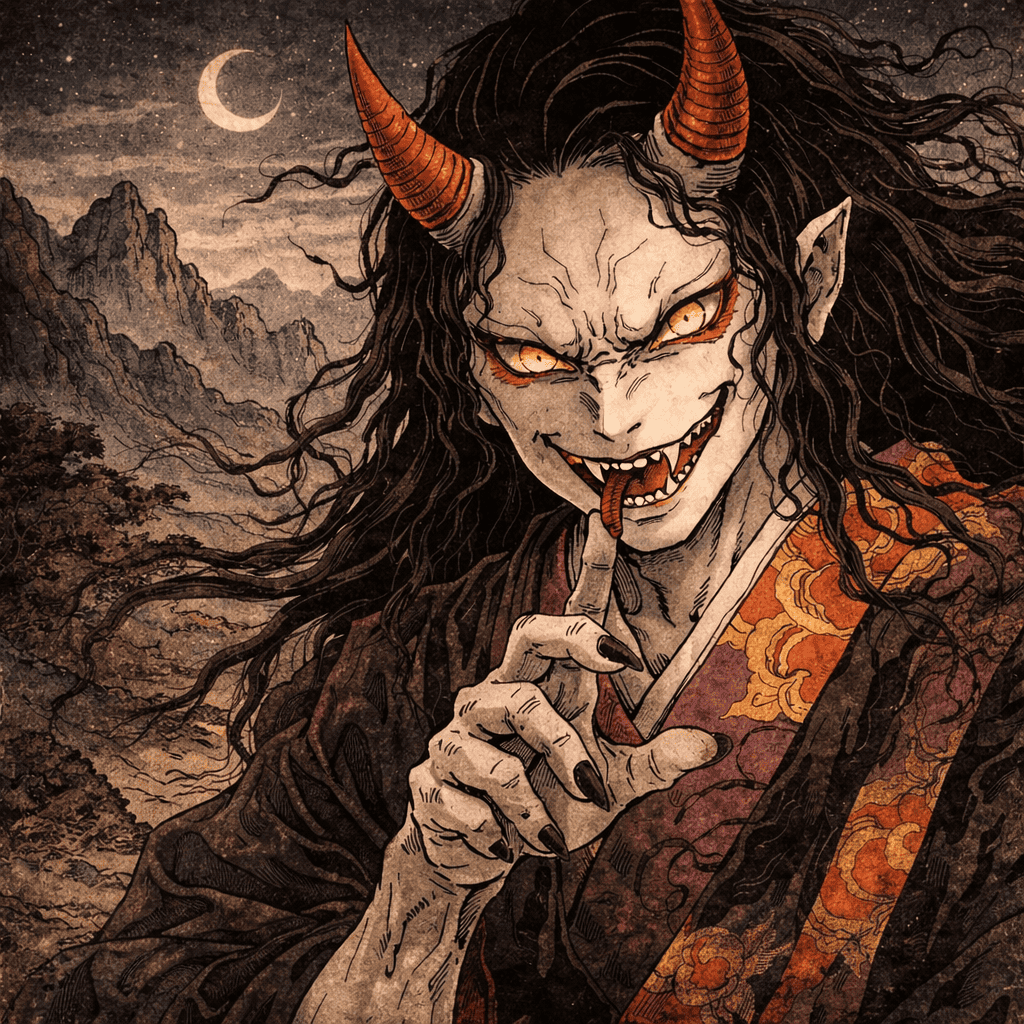
When the crimson moon rises over a Taisho-era village and a horned figure emerges from the shadows to feast upon sleeping families, viewers of Demon Slayer are not merely watching a modern anime invention. They are watching a nightmare that has haunted the Japanese imagination for more than a thousand years. Long before Koyoharu Gotouge drew the first panel of Kimetsu no Yaiba, wandering monks warned villagers about oni that devoured the unwary, poets wrote of demons that embodied plague, and parents scattered beans at the threshold to drive away the unseen evils that would otherwise slip inside with the changing seasons.
Demon Slayer endures because it reaches backward into this deep well of belief and draws forth imagery that still speaks to something ancient in the Japanese soul. The sun that dissolves demons, the wisteria that binds them, the breathing techniques that empower mortal swordsmen, and the corrupted flesh of those who traded humanity for immortality all carry echoes of Heian-period ghost stories, Edo-period yokai scrolls, and Taisho-era anxieties about modernization and disease. To understand why this anime resonates so powerfully, one must descend into the older, darker Japan that lies beneath every sword strike and every drop of demonic blood.
The connections between Demon Slayer and Japanese folklore presented in this article are based on historical research, official series lore, and widely-discussed fan analysis. Fan theories are clearly labeled as such throughout.
What Are Oni? The Real Japanese Demons
The word oni is often translated simply as demon, but that translation flattens a concept that Japanese culture spent a millennium refining. The oldest written form of oni used the character 鬼, borrowed from Chinese, where it referred to the spirits of the dead. In early Japan the word was pronounced "on" or "onu," rooted in an older term meaning hidden or concealed. Oni were originally invisible, lurking in corners, mountains, and the thresholds between worlds. They were felt before they were seen. They were the sudden fever, the failed harvest, the unexplained death, the shape that moved just beyond the oil lamp.
Over centuries the oni acquired a physical form in scrolls, theater, and temple art. Artists depicted them with horns sprouting from wild manes of hair, wearing tiger-skin loincloths, swinging iron clubs studded with spikes, and baring fanged mouths wide enough to swallow a man. Their skin turned red or blue or black, colors that in Buddhist cosmology corresponded to hellish realms and poisoned passions. They stood taller than men and radiated a heat that warped the air around them. Yet despite this grotesque iconography, the oni remained spiritually layered. Some oni were former humans who had become consumed by rage or grief. Some were vengeful ghosts who refused to leave the living. Some were punishers from the Buddhist hells, dispatched to drag sinners into cauldrons of boiling iron. To learn more about the full history of these beings, read our complete guide to the Oni, Japan's most fearsome demon.
What unites every variety of oni is the idea of transgression. An oni is what happens when a boundary is violated. When the boundary between life and death is crossed by a soul that will not let go, an oni is born. When the boundary between human and beast is crossed by a heart consumed with hatred, an oni is born. When the boundary between the spirit world and the human realm is thinned by neglect of ritual, oni slip through. Demon Slayer understands this intuitively. Every demon in the series was once a human who crossed a threshold they should not have crossed, and their monstrous forms are the outward expression of an inward corruption that began long before they were ever bitten.
How Demon Slayer Uses Traditional Oni Lore
The vulnerabilities of the demons in Demon Slayer are not invented. Each weakness draws a direct line back to folk belief that predates the anime by centuries. Sunlight is the most obvious example. In Japanese mythology the sun goddess Amaterasu represents purity, order, and the life force that sustains the world. Her light scatters impurity and reveals what darkness hides. Oni, as embodiments of hidden corruption, cannot exist in her presence. Edo-period woodblock prints show demons fleeing from dawn, and ghost stories routinely collapse at the first rooster's cry. The demons of Kimetsu no Yaiba inherit this ancient rule directly. Their bodies dissolve into ash when struck by sunlight because, in the logic of Japanese spiritual belief, they are concentrated darkness that the sun has always been meant to burn away.
Wisteria, the second great demon repellent in the series, carries its own folk history. The wisteria vine, called fuji in Japanese, blooms in cascading purple clusters in spring and was long associated with purification and noble lineage. The powerful Fujiwara clan of the Heian period took their name from this flower, and shrines across Japan planted wisteria arbors as spiritual barriers. Folk belief held that the scent of wisteria could drive away evil spirits, and in some regions wisteria flowers were woven into protective charms. When Demon Slayer makes wisteria poisonous to demons and marks the homes of the Demon Slayer Corps' elderly supporters with wisteria crests, the series is reaching back into a genuine tradition of botanical spiritual defense.
The setsubun ritual of bean throwing, which every Japanese child grows up practicing, also leaves its fingerprints on the story. On the night before the first day of spring, families scatter roasted soybeans at their doorways while shouting "oni wa soto, fuku wa uchi," meaning "demons out, fortune in." The ritual originates in a Heian-period court ceremony called tsuina, imported from Tang China, in which costumed figures drove out plague demons from the imperial palace. Over centuries the ceremony moved from court to temple to household, but its purpose never changed: at the seasonal boundary, when spiritual defenses are weakest, beans and words banish the oni that would otherwise enter. Demon Slayer sits downstream of this belief. Its villagers bar their doors at sunset, hang charms at the entrance, and understand that demons come when ritual fails.
The breathing techniques of the Demon Slayer Corps also have roots in real Japanese spiritual practice. Buddhist monks in the esoteric Shingon and Tendai schools have trained for more than a thousand years in breath control as a path to enlightenment and supernatural ability, and Shinto purification rites include breath as a vehicle for expelling spiritual impurity. The discipline of training the body to serve the sword while training the breath to serve the spirit is not a Gotouge invention. It is the lineage of every samurai who ever meditated in a mountain temple and every mountain ascetic who ever walked barefoot through winter snow. The swordsmen of the Taisho era in Demon Slayer are heirs to this tradition, which is why their water and flame and thunder manifest as extensions of breath rather than as abstract magic.
The choice of the Taisho era as setting is itself meaningful. The Taisho period, lasting roughly from 1912 to 1926, was the last moment in Japanese history when oil lamps and electric bulbs, wooden homes and steel trains, kimono and Western suits coexisted in uneasy balance. It was the twilight before full modernization, the gap in which old beliefs still felt plausible to educated people. Setting a demon-hunting story in Taisho Japan places it precisely in the liminal zone where the old world had not yet vanished and the new world had not yet consumed it. Demons could still plausibly walk the countryside, and the boundary between superstition and technology had not yet closed.
The Historical Connection: Oni and Disease
Long before germ theory reached Japan, the Japanese understood epidemic disease as a spiritual invasion. Plague was not a microbe but a demon, and the logic was consistent across centuries. A disease arrived suddenly, struck without visible cause, killed the innocent alongside the wicked, and departed just as mysteriously as it had come. What else could such a force be but an oni? Court diaries from the Heian period record the arrival of smallpox epidemics as the coming of plague demons, and the emperor commissioned Buddhist rites and shrine prayers to expel them. The oni and the illness were the same entity described in two languages.
The setsubun bean-throwing ritual stands at the heart of this identification. Its ancestor, the court tsuina ceremony, was explicitly a plague-expulsion rite. Officials dressed as demons were chased from the palace by officials armed with bows and bean-filled bags, symbolically driving epidemic out of the imperial body politic. When the ritual migrated into ordinary households, it retained this original purpose. The beans scattered at the threshold on the eve of spring were not simply symbolic evil. They were symbolic disease. "Oni wa soto, fuku wa uchi" meant, in its oldest sense, "sickness out, health in." The changing of the seasons was when people fell ill, and the bean-throwing was a medical ritual wearing spiritual clothes.
This identification of oni with disease persisted deep into the Taisho era, precisely when Demon Slayer is set. Tuberculosis ravaged Japan in the early twentieth century, killing more than one hundred thousand people a year at its peak. Cholera, typhus, Spanish influenza, dysentery, and syphilis all left their mark on Taisho society. Western medicine was arriving, but it was not yet universally trusted, and in rural villages the old language of possession and curse still explained illness more convincingly than microbes. A family that lost three children to fever was not unlucky. It had been touched by an oni. When Demon Slayer depicts demons who devour entire households by night and leave survivors traumatized beyond repair, it is reaching into a cultural memory in which plague and demon were never fully distinguished.
This background is essential for understanding the resonance of the story. The Demon Slayer Corps does not merely fight monsters. In the older Japanese imagination, it fights disease itself, the invisible hidden thing that crosses the threshold while the family sleeps. Every swordsman who falls is also a doctor, a priest, and a sanitary official, standing in the gap where belief and biology have not yet separated.
Fan Theories: The Disease Motif
Note: The following are fan theories and have not been officially confirmed by the author Koyoharu Gotouge.
Japanese and international fans have built an elaborate interpretive framework around the Upper Moon demons, the highest-ranking servants of the demon king Muzan Kibutsuji. In this fan reading, each Upper Moon embodies a specific disease that devastated Taisho-era Japan, transforming the series into an extended allegory about epidemics. The reading is speculative, but it aligns elegantly with the historical identification of oni and illness described above, which is part of why it has spread so widely.
Upper Moon One, Kokushibo, is frequently read as bubonic plague, the Black Death that arrived in Japan in successive waves. His name translates roughly as "black death moon," and his dominance over the other Upper Moons mirrors the plague's place as history's most notorious epidemic. Upper Moon Two, Doma, is often linked to tuberculosis, the quiet wasting disease that killed through slow drowning of the lungs, a fitting parallel to a demon whose ice-based techniques freeze and hollow his victims while leaving them seemingly peaceful.
Upper Moon Three, Akaza, is commonly associated with measles, which in the Taisho era was a childhood killer whose red rash and high fever left entire communities mourning. Akaza's red markings and explosive combat style suggest the disease's visible ferocity. Upper Moon Four, Hantengu, is interpreted as leprosy, an illness that historically split families and drove the afflicted into isolation, mirroring Hantengu's ability to split his body into multiple emotional fragments.
Upper Moon Five, Gyokko, is read as amoebic dysentery, a parasitic infection spread through water, which aligns with Gyokko's water-vase techniques and aquatic imagery. Upper Moon Six, the sibling pair Daki and Gyutaro, is widely linked to syphilis, a disease historically associated with the pleasure quarters where the two demons operate and whose gradual, disfiguring progression echoes Gyutaro's resentful decay. And Muzan Kibutsuji himself, the originator of all demons, is most often interpreted as cancer, the disease of endless cellular division and corruption from within, which fits both Muzan's ability to multiply demons from his own blood and his obsessive search for a cure that would let him survive sunlight, mirroring the desperate search for a cancer cure in Gotouge's own life.
Again, these connections are fan analysis, not confirmed authorial statements. But the parallels align so tightly with the historical Japanese equation of oni and plague that the fan reading has become one of the most widely discussed theories in the series' global reception.
Other Yokai References in Demon Slayer
Beyond the central oni mythology, Demon Slayer weaves in echoes of other yokai that populated Edo-period scrolls and village ghost stories. The demon Daki, with her ability to extend her body and strike from unnatural angles, calls to mind the Rokurokubi, the woman whose neck extends impossibly long at night while her body sleeps, a yokai rooted in Edo-period pleasure-quarter ghost stories. The idea of a beautiful woman whose body betrays monstrous properties in hours of darkness is older than anime by several hundred years.
The chimeric, shape-shifting nature of Hantengu's emotional clones recalls the Nue, a legendary chimeric yokai with the face of a monkey, the body of a tanuki, the legs of a tiger, and the tail of a snake, whose nocturnal cries once cursed the Heian emperor himself. Both creatures embody the terror of a single entity that splinters into incompatible forms, and both represent what happens when bodies refuse to settle into one shape.
And the series' treatment of spider-based demons, particularly the family of arachnid demons encountered in the Natagumo Mountain arc, draws directly from the Jorogumo, the spider-woman yokai who appears as a beautiful woman by day and as a monstrous spider by night, luring travelers with song before binding them in silk. The Jorogumo is one of Japan's most persistent female yokai, and her fingerprints are visible in every Demon Slayer scene where a false family unravels into predatory webs.
Why Demon Slayer Gets Japanese Folklore Right
Demon Slayer succeeds where many supernatural anime stumble because it treats Japanese folklore as a living tradition rather than a costume. The Taisho-era setting is rendered with unusual care. Village homes have proper genkan entryways and irori hearths. Kimono are worn with the correct seasonal patterns. Meals are simple farmer rice, pickled vegetables, grilled fish. The early Taisho urban districts include gas lamps and streetcars but also incense-burning temples and traditional inns. The material texture of 1910s Japan grounds the story's supernatural events in a specific historical moment.
The ranked structure of the Demon Slayer Corps, with its Hashira elite commanding lower-ranked swordsmen, mirrors the hierarchical samurai society that had been officially dissolved only a few decades before the story begins. The bu class system, the Confucian emphasis on loyalty and duty, and the master-disciple training relationships all draw from genuine Edo-period institutions that lingered in memory throughout Taisho. Families still identified with samurai lineage. Martial arts schools still maintained vertical chains of transmission. A reader's grandfather, in 1920s Japan, might genuinely have trained as a swordsman under exactly the kind of master depicted in the series.
Demon Slayer also breathes with the aesthetic concept of mono no aware, the gentle sadness of impermanence that runs through classical Japanese poetry and fiction. Cherry blossoms fall. Heroes die young. Even demons, in their final moments, remember the warmth of human love before dissolving into dawn. The series refuses to portray demons as pure evil. It insists that every monster was once a suffering human, and it grants them dignity in their final seconds. This refusal of simple villainy is profoundly Japanese. It comes from a literary tradition that has always insisted on the fragility of every soul, the terrible beauty of what is lost, and the necessity of mourning even those we must destroy.
This is ultimately why Demon Slayer resonated globally. International audiences felt the weight of something ancient beneath the modern animation. They sensed, even without knowing the specific folklore, that the story was not invented yesterday. It carried a thousand years of belief. It offered sorrow alongside combat, history alongside spectacle, and the old Japanese insight that monsters and humans share a border that is far thinner than we would like to admit.
Conclusion
Every time a demon in Kimetsu no Yaiba crumbles in the dawn, something much older than the anime is being enacted. A belief that predates the printing press, predates the samurai, predates the capital city of Heian itself is being passed forward one more time. The oni are not gone from Japan. They have only changed their clothes. They still slip across the threshold when ritual fails, still feast upon the unwary, still carry with them the ancient equation of demon and disease, and they still flee before the rising sun because the sun has always meant what it means now.
Demon Slayer is a bridge across that thousand-year river. It carries Heian court fears into Taisho drawing rooms and from there into the screens of viewers who have never walked a Japanese village path at dusk. Whether the Upper Moon demons truly represent specific diseases remains fan speculation, but the deeper truth is not speculation at all. Japan has always known that the darkness is personal, that illness has a face, that monsters remember being human, and that the blade of a disciplined swordsman is also, always, an act of mourning.
This is The Yokai Files.
Support The Yokai Files
Enjoyed this deep dive into Japanese folklore?
The Yokai Files is reader-supported. Your support helps us research deeper, write more, and keep the darkness alive.