Gashadokuro: The Giant Skeleton of Japan's Forgotten Dead
Published: March 27, 2026
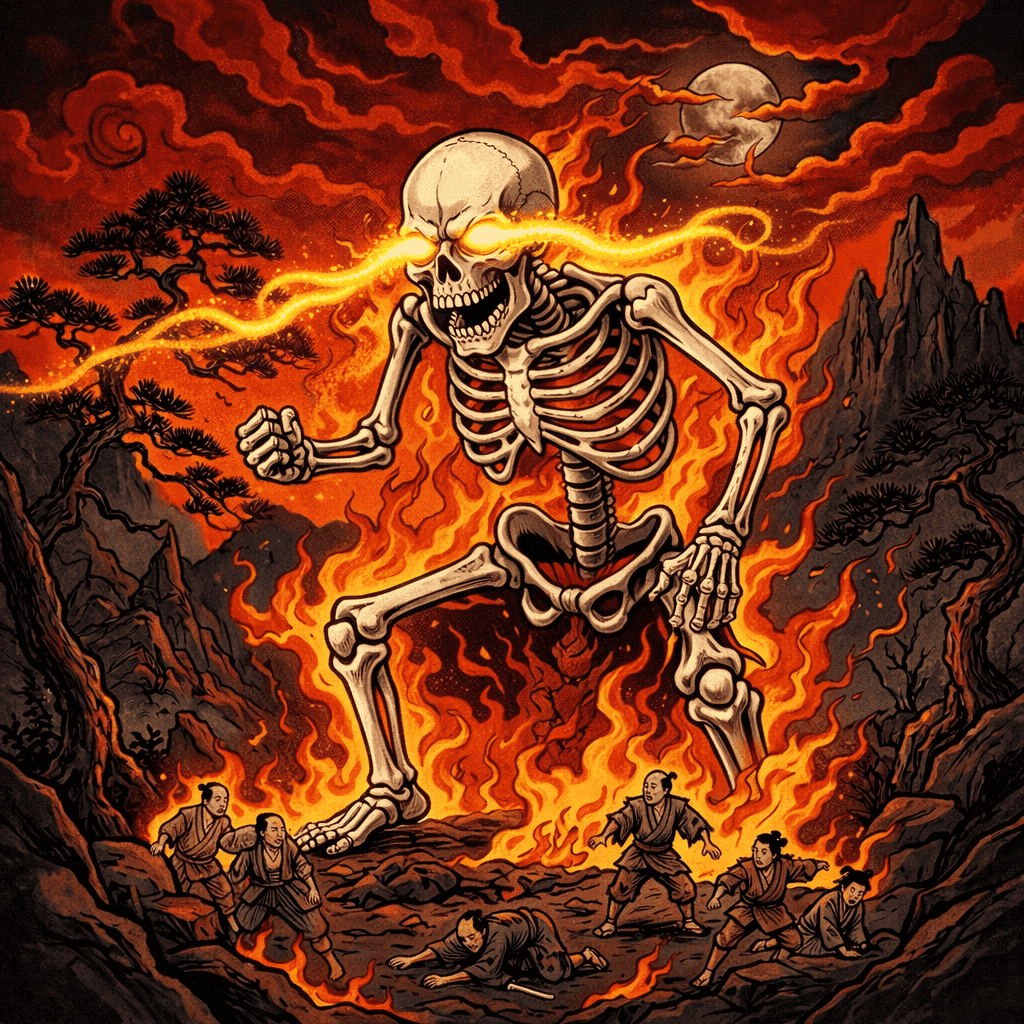
In the darkest hours of the night, when the battlefield has fallen silent and the crows have stopped their circling, a different kind of horror awakens. It rises from the earth itself — assembled from the bones of soldiers who starved to death, animated by their collective rage, their unspeakable hunger, their bitter resentment at being forgotten. Standing fifteen times the height of a man, silent as death itself, the Gashadokuro is not merely a monster. It is an accusation made flesh and bone — the supernatural consequence of a society's failure to honor those it sent to die in its name. Every rattling joint, every hollow eye socket blazing with cold fire, is a testimony to unacknowledged suffering on a massive scale.
The only warning you receive is the ringing of a bell inside your own skull — a sound no one else can hear, a sound that tells you something ancient and starving has fixed its empty eye sockets upon you. It is a sound that bypasses the ears entirely, resonating in the bones and the base of the skull, growing louder with each passing moment. By the time most people recognize what they are hearing, it is almost certainly too late. The Gashadokuro does not chase its prey. It does not need to. Its reach exceeds any human capacity to flee.
What is Gashadokuro?
Gashadokuro (餓者髑髏) is a colossal skeletal yokai from Japanese folklore, created from the accumulated bones and resentment of those who perished from starvation on the battlefield or were denied proper burial rites. The name combines two elemental concepts: "gasha" (餓者), referring to the starving dead — those who perished from hunger rather than wounds — and "dokuro" (髑髏), meaning skull. Together they paint an unmistakable portrait of what this entity is: a mountain of rattling bones animated by insatiable, death-embodying hunger, the physical form taken by mass starvation when it goes unacknowledged (Michael Dylan Foster, "The Book of Yokai," 2015).
Unlike many yokai that cause mischief, test human resilience, or operate according to complex and sometimes comprehensible motivations, the Gashadokuro exists in a state of pure, consuming fury that admits no negotiation and recognizes no distinction between the guilty and the innocent. It does not speak. It does not reason. It does not possess the complex personalities of trickster spirits or the grudging respect for courage that characterizes entities like the Tengu. The Gashadokuro is grief and starvation made manifest — a supernatural horror born directly from human tragedy, from the specific and historical failure of those who sent men to die in forgotten wars and then failed to bring their bones home. In this sense, every Gashadokuro is a specific accusation: here is what your neglect has created.
Buddhist theology provides the framework within which the Gashadokuro makes complete sense. The concept of onryō — a spirit driven by powerful negative emotions that cannot rest until those emotions are resolved — underlies the entire tradition of Japanese ghost and monster lore. The Gashadokuro represents the most extreme end of this spectrum: not one person's unresolved anger, but the combined onryō energy of hundreds or thousands of individuals, fused by shared suffering into a single devastating supernatural force (Lafcadio Hearn, "Kwaidan," 1904).
What Does Gashadokuro Look Like?
The Gashadokuro is described as a giant skeleton standing anywhere from fifteen to twenty times the height of an average human — some accounts place it at heights equivalent to a modern five-story building, a presence so massive that its silhouette against a night sky would blot out entire constellations. Every bone in its vast frame is constructed from the compacted remains of multiple human skeletons, fused together by supernatural energy and unresolved spiritual anguish. The individual bones of its enormous ribcage are each themselves formed from dozens of human ribs, pressed together and cemented with the dark energy of accumulated grief. Its fingers are capable of crushing a horse in a single grip. Its footsteps, paradoxically, make no sound — this is one of the most terrifying details in the traditional accounts, because a creature of this size should shake the earth with every step, yet it moves in absolute silence (Shigeru Mizuki, "Yokai Daizukan," 1994).
Perhaps most terrifying is what occupies its eye sockets: two burning points of cold blue or green fire — the concentrated spiritual energy of hundreds of souls who died in agony and were never given the ceremonies that would have allowed their spirits to rest. These fires do not flicker or waver. They burn with the steady, purposeful intensity of beings that have transcended ordinary suffering and exist now in a state of pure supernatural purpose. The Gashadokuro moves with the terrible patience of something that has no need to breathe, no heartbeat to betray its presence, no biological processes to create sound or warmth. It exists outside the natural world, animated entirely by accumulated supernatural rage and the thermodynamics of unresolved grief.
The only advance warning of its presence is the mysterious inner ringing — a high, clear bell-tone that sounds inside the skull of its intended victim. Ancient texts describe this sound as unlike any external bell; it appears to originate from within the mind itself, bypassing ordinary auditory processing entirely, growing louder and more insistent until the moment the Gashadokuro seizes its prey. Traditional accounts note that those who have survived encounters with the Gashadokuro — a vanishingly small number — report that the ringing persisted for days afterward, fading only gradually as the supernatural presence withdrew.
Where Did Gashadokuro Come From?
The origins of the Gashadokuro legend are deeply rooted in Japan's turbulent military history and the Buddhist concept of onryō — vengeful spirits created by intense negative emotions, particularly the anguish of those who died with unresolved grievances. In medieval Japan, warfare was essentially continuous across several centuries, and the treatment of fallen soldiers was often appalling by any standard. Armies that ran out of supplies had no recourse but to watch their men starve to death far from home, in unfamiliar territories where no local community would undertake the expense and ritual labor of proper burial. These men died not in the glorious combat that warrior culture celebrated but in silent, degrading misery, their final experience an endless, consuming hunger that the Gashadokuro legend preserves with remarkable specificity.
The most historically specific origin story connects the Gashadokuro tradition to the aftermath of the Taira-Minamoto War (Genpei War, 1180-1185 CE), one of Japan's most devastating conflicts. The Genpei War resulted in the near-annihilation of the Taira clan and left thousands of warriors on both sides dead from wounds, starvation, and exposure. The chaos of a conflict conducted across the full length of Japan meant that many of the dead were never recovered by their families, their bones scattered across mountains and valleys far from the temples where their spirits could have been properly commemorated. This specific historical reality fed directly into the Gashadokuro mythology that crystallized in subsequent centuries — the giant skeleton became the literal embodiment of what happened when the obligations of the living to the dead went catastrophically unfulfilled.
Regional variations in Gashadokuro traditions reflect the different military histories of Japan's various provinces. In areas that experienced particularly devastating famines — which in pre-modern Japan often followed in the wake of military disruptions to agriculture — local traditions sometimes describe Gashadokuro that arise not from battlefield dead but from famine victims: civilians who starved when armies stripped their fields and granaries. These regional accounts broaden the legend's scope from military tragedy to general social failure, suggesting that any mass death from starvation, regardless of its specific cause, carries the potential to generate this most terrible of yokai.
What Are the Most Famous Gashadokuro Legends?
The most famous Gashadokuro legend centers on Takiyasha-hime (瀧夜叉姫), the daughter of the rebel warlord Taira no Masakado, who was defeated and killed in 940 CE during one of the first great samurai rebellions in Japanese history. According to legend, Takiyasha-hime, consumed by grief and rage at her father's destruction and the annihilation of his cause, retreated to the ruins of his castle at Soma and dedicated herself to the study of dark supernatural arts. Drawing on her knowledge of Chinese sorcery and the power of accumulated spiritual anguish, she performed rituals designed to gather the spirits of all those who had died fighting for her father — soldiers who had starved during the campaign, warriors whose bones lay unburied on distant roads, men whose families never received their remains.
This legend was immortalized in the famous woodblock print by Utagawa Kuniyoshi, created around 1844, depicting a massive skeleton looming over the wizard Mitsukuni as he confronts the sorceress Takiyasha amid the decaying grandeur of Soma Castle. The print — "Soma no furudairi" (相馬の古内裏, "The Old Palace of Soma") — became one of the defining visual representations of supernatural horror in Edo-period Japanese art and established the Gashadokuro's iconic visual form: the colossal skeleton with burning eyes, reaching down toward tiny human figures with fingers like the beams of a collapsed building. It remains one of the most reproduced images in all of yokai iconography and is largely responsible for the Gashadokuro's enduring visual identity in modern representations.
Accounts from rural communities near old battlefields describe encounters with enormous skeletal shapes moving through fog-shrouded rice fields in the hours before dawn, accompanied by the faint sound of bones grinding against bones and that distinctive inner ringing that drives victims toward paralysis. These accounts persist even into the twentieth century, attached to locations near known mass graves from Japan's feudal conflicts. Local farmers near Sekigahara and other famous battle sites maintained specific avoidance behaviors — never traveling alone at night, always maintaining small roadside shrines near suspected burial locations, performing annual ceremonies to acknowledge the dead. Whether understood as genuine supernatural precaution or cultural memory made practical, these behaviors represent a direct, living connection to the Gashadokuro tradition.
How Does Gashadokuro Appear in Modern Japan?
The Gashadokuro has found a natural and powerful home in modern horror entertainment, where its combination of colossal scale, relentless purpose, and profoundly tragic origin story makes it one of the most narratively rich yokai available to contemporary creators. In the Nioh video game series, the Gashadokuro appears as one of the most formidable boss encounters, faithfully rendered as a towering skeletal giant whose attacks carry the weight of accumulated supernatural fury. The game's treatment honors the entity's historical connection to battlefield dead by placing these encounters in locations with significant historical resonance, allowing players to experience the full context of the legend rather than simply a monster fight.
The Gashadokuro's enduring power in modern culture stems from its moral dimension. Unlike horror monsters that simply represent external threats, the Gashadokuro is a mirror — a reflection of what human societies create when they fail their most vulnerable members. In an era when questions about how societies treat the dead and how wars are memorialized have acquired fresh urgency, the Gashadokuro speaks to anxieties that transcend its specifically Japanese cultural context. It has appeared in international horror films, fantasy novels, and tabletop role-playing games, each time carrying its essential message: the neglected dead do not disappear. They accumulate. They grow. And eventually, they return.
Which Anime and Manga Feature Gashadokuro?
The giant skeleton — an entity assembled from the bones of the battlefield dead — has inspired numerous characters and visual motifs in anime and manga, where the horror of mass death and unquiet spirits is a recurring theme. While not always named explicitly as Gashadokuro, the archetype of the colossal skeletal horror born from accumulated suffering appears throughout the medium, reflecting the Gashadokuro's hold on the Japanese supernatural imagination. Series dealing with historical warfare, the supernatural consequences of battle, and the obligations owed to the dead frequently invoke this imagery, drawing on the deep cultural resonance of the Gashadokuro tradition.
The broader tradition of skeletal supernatural beings in anime — from massive bone constructs in fantasy series to the ghost warriors of historical anime — owes a significant debt to the Gashadokuro concept: the idea that bones carry memory, that the dead do not simply decompose but retain their suffering in physical form, and that mass tragedy has a supernatural weight proportional to the scale of human negligence involved. This is distinctly Japanese in its articulation, shaped by the specific theological and historical context that produced the Gashadokuro legend, and it gives anime treatments of skeletal supernatural beings a depth and moral weight that purely Western horror traditions rarely achieve with similar imagery.
Where Can You Encounter Gashadokuro in Japan?
The ruins of Soma Castle in Fukushima Prefecture, the legendary origin point of the Takiyasha-hime story, attract visitors interested in Japan's supernatural history and the roots of the Gashadokuro legend. The area around Soma has maintained its connection to this tradition through local cultural memory and the annual Soma Nomaoi festival, which commemorates the same historical period of Masakado's rebellion. Though the festival has evolved primarily into a celebration of samurai pageantry, its roots in the chaos of the early tenth century give it an undeniable dark resonance for those who know the full history.
Various battlefield sites across Japan maintain shrines specifically designed to propitiate the spirits of those who died there — a direct practical response to the belief in entities like the Gashadokuro. Sekigahara in Gifu Prefecture, site of the massive 1600 battle that determined the fate of Japan for two and a half centuries, maintains several such spirit-calming installations alongside its historical museums. Local tradition holds that the fields there carry a particular spiritual weight, especially after dark, and visitors to the battlefield are advised by local guides to maintain respectful conduct throughout their time on the site. The supernatural is not merely historical here — it remains a living concern.
Conclusion
The Gashadokuro is more than a monster story. It is a memorial — a supernatural record of the cost of warfare and the spiritual debt owed to those who die forgotten. In a culture that has always taken seriously its obligations to the dead, maintaining complex and expensive memorial traditions across generations, the Gashadokuro stands as the ultimate consequence of collective negligence: what happens when those obligations go unpaid, when grief goes unhonored, when the bones of the fallen lie unblessed in foreign soil. It is a mythology with genuine moral authority, one that has served for centuries as both warning and lament — a reminder that the dead are not powerless, and that the manner of their dying matters in ways that transcend the merely biological.
Even today, when someone walks near an old battlefield and hears a strange ringing inside their skull — a sound with no external source, clear and persistent — tradition says they should not look up. They should walk away, quietly and respectfully, and find the nearest shrine where an offering can be left for those who starved in the dark and were never thanked for their sacrifice. Whatever towers above them in the night air, it is a consequence, not a curse — and consequences, the tradition teaches, can sometimes still be addressed, even at this late hour.
This is The Yokai Files.
Support The Yokai Files
Enjoyed this deep dive into Japanese folklore?
The Yokai Files is reader-supported. Your support helps us research deeper, write more, and keep the darkness alive.