Hitotsume-kozo: The One-Eyed Monk Child That Watches From the Mountains
Published: March 28, 2026
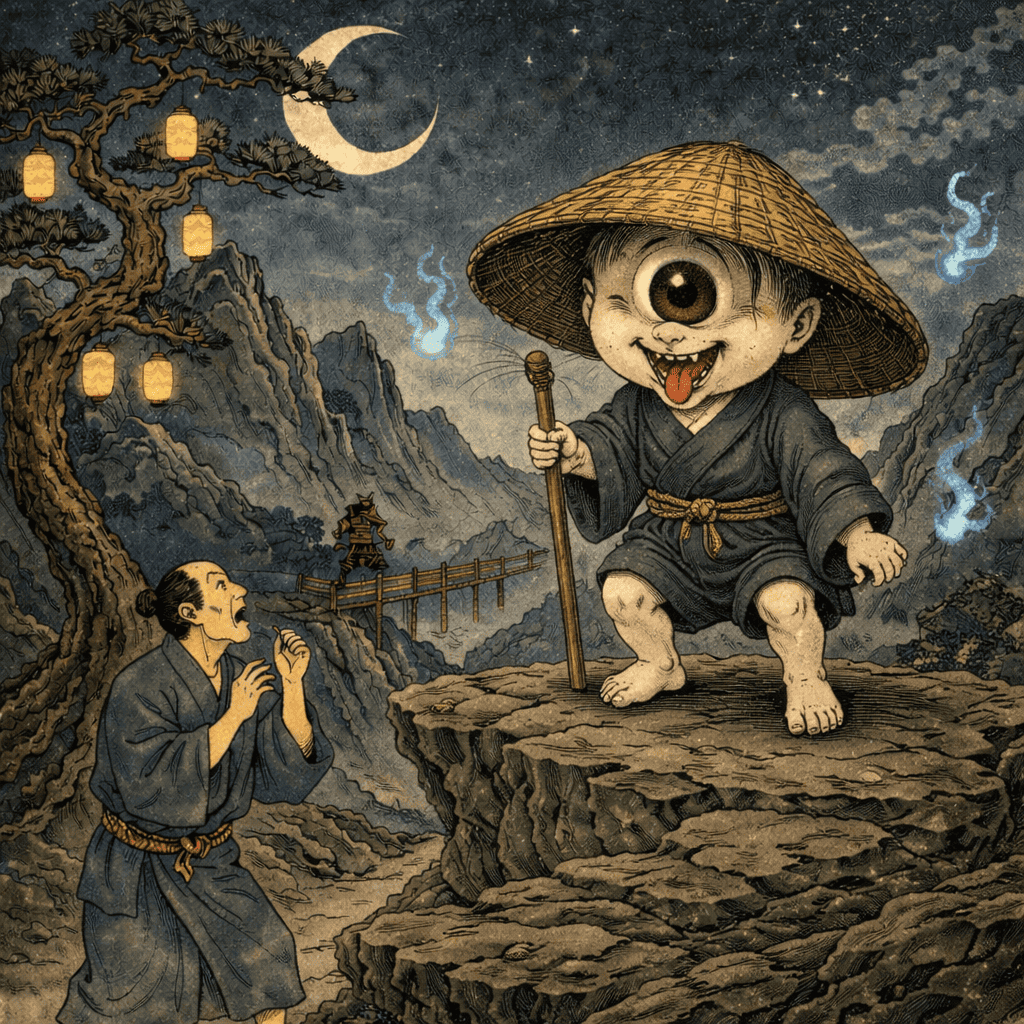
The child appears at the edge of the mountain path, dressed in the robes of a young monk, with a shaved head and the posture of a well-mannered student. It seems completely normal from behind. It turns around. There is one eye. One enormous eye, set in the center of its face, fixing you with an unblinking gaze that contains something no child's eye should contain — a quality of age, of observation, of knowing you in ways you have not revealed. The child does not speak. It simply watches. And then it is gone.
The hitotsume-kozo sits in the precise intersection between frightening and merely strange that defines so much of Japanese yokai tradition. It appears harmless — a child, after all, dressed as a monk — but its single eye marks it as categorically wrong, as something that exists outside the normal parameters of the world you thought you understood. It does not attack. It watches. And its watching, in a tradition that understands the supernatural gaze as a form of power in itself, is more than enough.
What is Hitotsume-kozo?
Hitotsume-kozo translates as "one-eyed boy" or "one-eyed monk child" — hitotsu meaning "one," me meaning "eye," and kozo meaning a young monk or boy servant. It is a yokai that appears as a small child dressed in the robes of a young Buddhist novice, distinguishable from a normal child only by the single large eye in the center of its face in place of the normal two. It belongs to a broader category of one-eyed supernatural beings in Japanese tradition — the hitotsume group — that includes larger, more dangerous entities, but the hitotsume-kozo itself is generally considered to be relatively harmless.
The creature is associated with specific calendar days in Japanese folk tradition — particularly the eighth day of the second and twelfth months — when it was said to pass through villages, observing and recording the behavior of the households it visited. This surveillance function connects the hitotsume-kozo to a broader Japanese supernatural tradition of beings that monitor human behavior and report it to higher spiritual authorities: a folkloric accountability mechanism dressed as a child with a single eye. As Michael Dylan Foster notes in his comprehensive survey of yokai lore, the hitotsume-kozo exemplifies the way Japanese supernatural beings often serve simultaneous roles as threats, morality enforcers, and embodiments of cultural anxiety (Michael Dylan Foster, "The Book of Yokai," 2015).
The specific choice of the monk's appearance for this yokai is not accidental. Buddhist novices — kozo — occupied a liminal space in Edo Period Japanese society: they were children in the religious world, present at temples and on the roads between them, figures that ordinary people might encounter without unease. The hitotsume-kozo exploits this familiarity, wearing the costume of the harmless while carrying the mark of the uncanny. It is a creature designed specifically to violate the safety of the recognizable.
What Does Hitotsume-kozo Look Like?
The hitotsume-kozo's appearance is precisely described across the various sources that document it: a child of approximately ten years old, shaved head, wearing simple gray or brown monk's robes, carrying a begging bowl or staff in the manner of a Buddhist novice. Its height is typically described as around one meter. The single eye — its defining characteristic — is large, centered in the face, and unblinking, with a gaze that witnesses have described as simultaneously vacant and unbearably perceptive. Its tongue is described in some accounts as unusually long, capable of extending to disturbing lengths, though this feature is not universal across traditions.
Toriyama Sekien's illustration of the hitotsume-kozo in his 1776 yokai encyclopedia provides the most influential visual rendering of the creature: a small figure shown mid-stride on a road, the single eye large and dark, the robes plain and modest, the overall impression one of something simultaneously childlike and profoundly wrong. Sekien's version became the canonical image that subsequent artists and folklorists worked from, establishing the visual grammar of the hitotsume-kozo for the following two and a half centuries (Toriyama Sekien, "Gazu Hyakki Yako," 1776).
Regional variations across Japan produce slightly different physical descriptions. In some areas of the Tohoku region, the hitotsume-kozo is described as taller, more adult in proportion, with the eye positioned lower in the face. In coastal communities of the Kanto area, it is sometimes described as carrying a lantern rather than a begging bowl, suggesting its movement through the night rather than the day. These local variations reflect the way yokai traditions adapt to specific geographic and cultural contexts while maintaining their core identifying features.
Where Did Hitotsume-kozo Come From?
The origins of the hitotsume-kozo are connected to several distinct traditions that converge in the figure of the one-eyed monk child. The one-eyed supernatural being has deep roots in Japanese mythology — the god Hiruko, the first child of Izanagi and Izanami who was born without bones and cast away, is associated with physical difference and one-eyedness in some traditions. The hitotsume clan of supernatural beings appears in folk traditions from multiple regions, suggesting that the anxiety about one-eyed entities predates any specific yokai classification system.
The specific form of the hitotsume-kozo — small, monk-like, observant — seems to have developed from folk beliefs surrounding the surveillance function of supernatural beings on specific calendar days, connected to the concept of visiting gods (marebito) who arrive from outside the community on liminal dates. The eighth day of the second month and eighth day of the twelfth month — the dates associated with the hitotsume-kozo's appearances — are seasonal transition periods when the boundary between the ordinary world and the supernatural world was understood to be thinner than usual. These liminal calendar moments attracted numerous supernatural beings in Japanese folk tradition, and the hitotsume-kozo occupies this slot with its particular combination of surveillance and the monk's appearance.
The connection between one-eyedness and supernatural power in Japanese tradition is worth examining at length. The cyclops of Greek mythology is a creature of brute force; the one-eyed figures of Norse mythology (most famously Odin, who sacrificed an eye for wisdom) are associated with profound knowledge obtained at great cost. The Japanese one-eyed supernatural tradition tends toward observation and record-keeping — a surveillance culture expressed in supernatural terms. The hitotsume-kozo watches not because it wants to harm but because watching is its nature and its function, a feature that connects it to the broader Japanese supernatural tradition of beings that exist to observe and evaluate human behavior.
During the Edo Period (1603–1868), as yokai culture flowered into a major element of popular entertainment and artistic production, the hitotsume-kozo was systematized alongside hundreds of other supernatural beings. The urban culture of Edo — the city that would become Tokyo — developed a sophisticated relationship with yokai, treating them simultaneously as genuine supernatural presences, artistic subjects, and cultural entertainments. The hitotsume-kozo's seasonal nature made it a recurring presence in almanacs and illustrated popular texts, appearing as a reliable feature of the supernatural calendar that Edo residents tracked alongside agricultural events and Buddhist holidays.
What Are the Most Famous Hitotsume-kozo Legends?
The traditional protective measure against the hitotsume-kozo is one of the most charming and peculiar in all of Japanese folk practice: placing a basket or sieve outside the door on the days when it was expected to pass. The logic was that the hitotsume-kozo, upon encountering the many holes of the basket or sieve, would be compelled to spend the entire night counting them — and thus would not enter the house. This protective logic connects the hitotsume-kozo to a global tradition of supernatural beings that can be trapped or delayed by counting, from European vampires who must count scattered seeds to Greek versions of fate-counting creatures. The one-eyed being is particularly susceptible to this trap, perhaps because its single eye makes counting a more consuming task.
Alternatively, some traditions called for leaving a single large eye-shaped object — such as a bamboo eye decoration called a me-kazari — to satisfy or intimidate the creature. The idea here is different: the hitotsume-kozo is not trapped but acknowledged. By placing an eye outside your door, you are in a sense saying that you too are watching, that your household is not unguarded, that the surveillance goes both ways. These practical countermeasures suggest that the hitotsume-kozo was taken seriously enough as a presence that communities developed active and thoughtful defenses against it.
A legend from the Kanto region tells of a merchant who encountered a hitotsume-kozo on the road between Edo and a neighboring province on a cold February evening. The child appeared from the shadow of a pine grove, turned its single eye on the merchant, and stood without moving for what felt like a very long time. The merchant, who had heard of the hitotsume-kozo and its counting weakness, threw a handful of coins on the road between them. The child looked down at the coins. When the merchant arrived home three hours later, he could not remember anything that had happened between the moment of throwing the coins and walking through his own gate — but his money pouch was untouched, and the coins he had thrown were found the next morning, each one turned face-up on the frozen road, in a perfect line. The hitotsume-kozo had counted them. But it had also arranged them.
Lafcadio Hearn, the Irish-Greek writer who spent his later years in Japan and became one of the first Western systematizers of Japanese supernatural tradition, wrote about the broader category of one-eyed supernatural beings in his collected works, noting their particular combination of the uncanny physical with the mundane behavioral — they look wrong but act in comprehensible, even rule-bound ways that make them simultaneously more and less frightening than purely alien entities (Lafcadio Hearn, "Kwaidan," 1904).
How Does Hitotsume-kozo Appear in Modern Japan?
The hitotsume-kozo appears in modern yokai encyclopedias and illustrated collections with consistent frequency, its position in the yokai canon secured by centuries of documentation and the particular visual distinctiveness of its design. In Toriyama Sekien's 18th-century yokai encyclopedias — one of the primary sources for systematizing Japanese yokai knowledge — the hitotsume-kozo receives its own entry with detailed illustration, cementing its place in the formal yokai canon (Toriyama Sekien, "Gazu Hyakki Yako," 1776).
Its relative harmlessness makes it a popular figure in children's media about yokai, where its disturbing eye is balanced by its non-threatening, childlike overall impression. The hitotsume-kozo also appears in scholarly discussions of the relationship between physical difference and supernatural identity in Japanese culture, where its one eye marks it as categorically other while its monk's robes mark it as socially legible — a being defined by the tension between these two aspects of its presentation.
In video games that draw on the Japanese yokai tradition — a rich genre that includes titles from various major studios — the hitotsume-kozo appears as both enemy and ally, its surveillance function often translated into game mechanics involving scouting, detection, or information-gathering. The Yo-kai Watch franchise includes hitotsume-kozo-inspired characters. Various yokai-themed role-playing games use one-eyed monk creatures as a distinctive enemy type that blends the familiar with the uncanny in precisely the way the original tradition intends.
Which Anime and Manga Feature Hitotsume-kozo?
The hitotsume-kozo holds a distinguished place in the history of yokai anime, appearing as one of the recurring characters in GeGeGe no Kitaro, the landmark yokai manga series created by Shigeru Mizuki and adapted into an anime by Toei Animation beginning in 1968. Mizuki's Hitotsume-kozo is rendered with affectionate specificity — small, robed, single-eyed, hopping through the supernatural landscapes of the series with the particular combination of harmlessness and uncanniness that defines the original folk tradition (Shigeru Mizuki, "GeGeGe no Kitaro," manga, 1960s; GeGeGe no Kitaro, Toei Animation, 1968).
Mizuki's treatment of the hitotsume-kozo is characteristic of his broader approach to yokai: he takes the creature seriously as a cultural entity with its own dignity and history, while presenting it in a visual language accessible to children and adults alike. The GeGeGe no Kitaro anime introduced the hitotsume-kozo to several generations of Japanese viewers who might never have encountered it through traditional folk channels, effectively ensuring the creature's cultural continuity into the modern era. The 1968 Toei Animation series, and its subsequent remakes across multiple decades, have kept the hitotsume-kozo visually present in Japanese popular culture in ways that purely folkloric transmission could not have sustained.
Beyond the GeGeGe no Kitaro franchise, one-eyed supernatural children appear across Japanese anime and manga in ways that draw on the hitotsume-kozo tradition without necessarily naming it. The motif of the wrongly-eyed child — normal in all respects except for a gaze that reveals its non-human nature — recurs throughout horror manga in particular, where the hitotsume-kozo's visual grammar has been absorbed into a broader vocabulary of the uncanny child that stretches from classical yokai art to contemporary horror illustration.
Where Can You Encounter Hitotsume-kozo in Japan?
The hitotsume-kozo does not have a specific geographic home but is broadly associated with mountain paths and rural roads — the routes between settlements where a traveler might encounter a small, monk-like figure at dusk without immediate alarm. The Edo-Tokyo Museum in Ryogoku, Tokyo, includes exhibits on Edo Period popular culture that touch on yokai belief, including one-eyed supernatural beings. Yokai art collections at the International Manga Museum in Kyoto and various Japanese folklore museums contain illustrations and artifacts related to the hitotsume-kozo and its broader tradition.
The Mizuki Shigeru Road in Sakaiminato, Tottori Prefecture — the hometown of GeGeGe no Kitaro's creator — features bronze statues of numerous yokai including the hitotsume-kozo, making it one of the few places in Japan where the creature has a permanent, publicly accessible physical presence. The road attracts hundreds of thousands of visitors annually and functions as the spiritual home of the modern yokai tourism industry. For those interested in the folk tradition rather than the anime legacy, mountain temple complexes in rural Japan — where the monk's-road setting of the original hitotsume-kozo legend feels most viscerally real — provide the most authentic atmospheric context for understanding the creature.
Conclusion
The hitotsume-kozo is a watcher. In a tradition that understands observation as a form of power — that to be seen truly, to be known completely, is to be vulnerable in a way that few other experiences can match — the child with the single enormous eye is more disturbing than many creatures that are overtly violent. It sees. It remembers. It reports. Whatever you were doing when you saw it at the mountain path's edge, it noted, and the record it carries is more permanent than you would like.
What distinguishes the hitotsume-kozo from the more violent entries in Japan's supernatural catalogue is precisely this non-violence — the fact that its power resides entirely in what it knows rather than what it does. In a culture that has always understood social accountability as a fundamental moral mechanism, a being that observes and records is not merely a curiosity but a genuine threat. You cannot bribe it. You cannot fight it. You can only put a basket outside your door and hope it counts all night. The basket has many holes. The hitotsume-kozo has one eye, and all the time in the world. Put a basket outside your door on the eighth of February. Count the holes if you need something to do. The hitotsume-kozo will be counting them too.
This is The Yokai Files.
Support The Yokai Files
Enjoyed this deep dive into Japanese folklore?
The Yokai Files is reader-supported. Your support helps us research deeper, write more, and keep the darkness alive.