Ittan-momen: The Murderous Flying Cloth That Haunts the Night Roads
Published: March 28, 2026
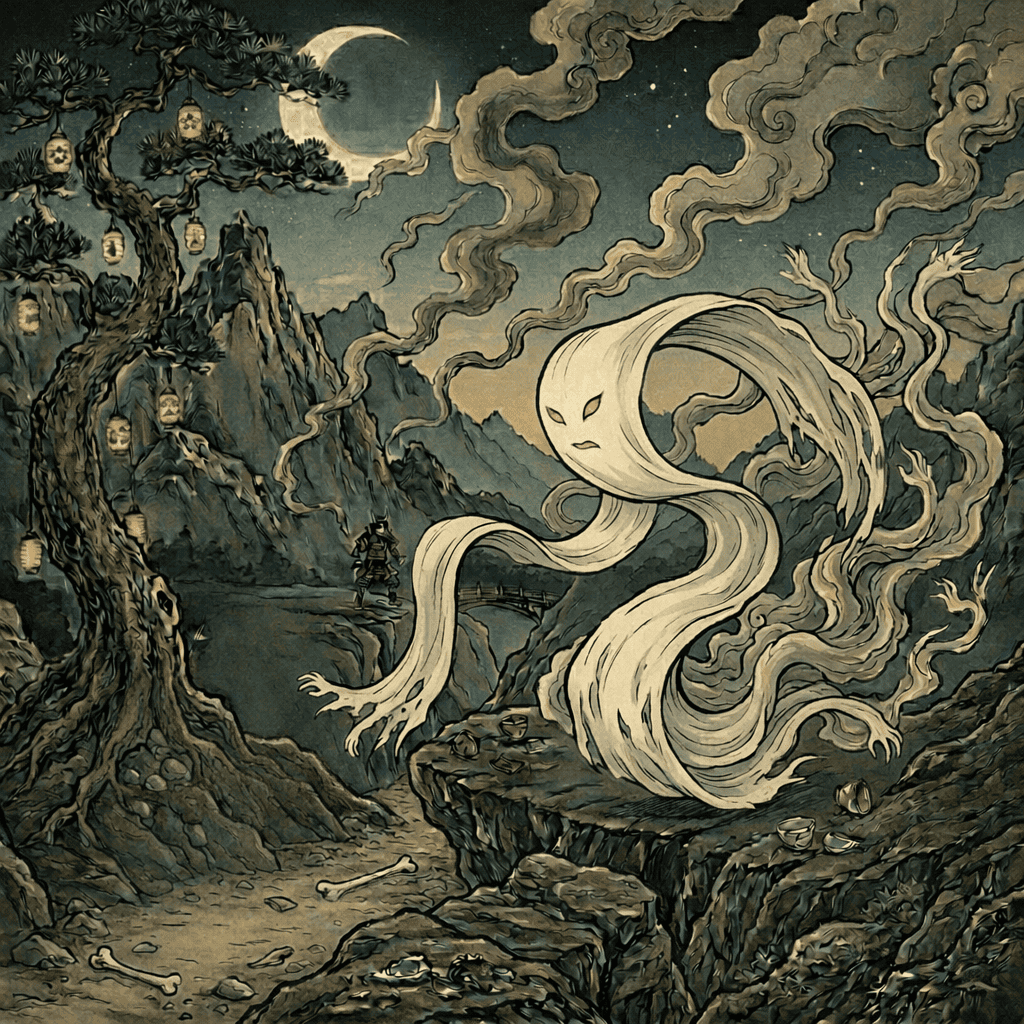
It comes at night, on the roads between villages, silent and fast. One moment the darkness is empty; the next, something white is unrolling from the sky — a long strip of cloth, pale as a funeral shroud, moving with impossible speed and terrible purpose. By the time a traveler realizes what they are seeing, it has already wrapped itself around their face. The cloth tightens. The breath stops. The road that seemed so familiar becomes the last thing they will ever walk.
Ittan-momen is among the strangest yokai in Japan's vast supernatural catalogue: a haunted bolt of cotton cloth that flies through the night air and kills people by suffocation. It sounds almost comical — a haunted tablecloth, a murderous curtain — until you sit with the image for a moment and realize that there is almost nothing more helpless than being wrapped tightly in fabric in complete darkness, unable to call for help, unable to breathe, unable to do anything but wait for the end. The mundane made monstrous is always the most effective horror.
What is Ittan-momen?
Ittan-momen belongs to the category of tsukumogami — objects that have developed supernatural consciousness through great age or through becoming saturated with human emotion. The name means roughly "one-tan of cotton cloth" — a tan being a unit of measurement for cloth approximately thirty-six centimeters wide and ten meters long, the amount needed to make one kimono. This specific measurement is significant: the ittan-momen is not an amorphous textile spirit but a very specific quantity of cloth with a very specific and lethal purpose.
It is most strongly associated with Kagoshima Prefecture in Kyushu, where it appears in local folklore as a genuine nighttime hazard rather than a literary invention. Traditional accounts describe it as appearing specifically on autumn and winter nights — when darkness falls early and the roads between rural settlements are empty and long. The creature's appearance is simplicity itself: a long white strip of fabric, indistinguishable from an ordinary bolt of cloth except for the fact that it is moving on its own and approaching you at speed.
The tsukumogami tradition that gives the ittan-momen its supernatural origin is one of the richest and most distinctively Japanese streams of yokai lore. Japanese religious and philosophical tradition holds that all things — objects as well as living beings — possess some form of spiritual essence, and that objects which have been used for a long time, or which have been involved in emotionally significant human experiences, may develop independent consciousness. Umbrellas, sandals, lanterns, drums, and tools of every variety appear in the tsukumogami tradition, but cloth carries particular supernatural weight: it touches human bodies constantly, absorbs sweat and tears and blood, and is used for both the intimate garments of daily life and the ritual garments of death. Cotton cloth used to wrap the dead — or simply cloth that has witnessed enough human suffering — might accumulate enough spiritual residue to become something else entirely.
What Does Ittan-momen Look Like?
By definition, the ittan-momen looks exactly like a bolt of white cotton cloth — because that is what it is. The horror of its appearance is precisely this ordinariness. It has no face, no limbs, no features that would mark it as supernatural. It is simply cloth, moving through the night air with a rippling, undulating motion, trailing through the darkness like a banner in a wind that isn't there. In illustrations by Shigeru Mizuki, who popularized the ittan-momen through his GeGeGe no Kitaro manga, it is depicted as a friendly-looking entity with simple cartoon eyes and a cheerful expression — which, if anything, makes it more unsettling rather than less.
The visual depictions of ittan-momen in traditional art are comparatively rare — it appears in relatively few of the great illustrated yokai encyclopaedias, reflecting its status as a regional phenomenon rather than a nationally recognized creature. Toriyama Sekien, whose systematic catalogues covered an enormous range of yokai, did not include the ittan-momen, suggesting that the creature was either not widely known in Edo-period urban culture or was considered too regional and specific for his comprehensive project. (Toriyama Sekien, "Gazu Hyakki Yako," 1776) It is largely through Mizuki's modern revival that the ittan-momen received the visual codification that most Japanese people recognize today.
The movement of the ittan-momen is described in folk accounts as both beautiful and terrifying — it ripples and billows in ways that cloth should not, animated by something internal rather than external, with a purposefulness that no natural phenomenon could produce. At a distance it might be mistaken for laundry that has blown free in the wind. Up close, the sensation of its approach — the silence, the whiteness, the speed — leaves no ambiguity about what is happening.
Where Did Ittan-momen Come From?
The ittan-momen's origins lie in the folk traditions of Kagoshima Prefecture, where it appears in the Kaii Yomihon — a collection of strange tales compiled in the Meiji Period that documented local supernatural beliefs before they disappeared under modernization. Its existence as a specifically regional yokai suggests genuine local folk belief rather than literary invention, though the exact historical origin of the tradition is unclear. The tsukumogami framework — the belief that objects of a certain age develop souls — provides the theological underpinning: cotton cloth used for funerals, burial robes, or other death-related purposes might accumulate enough spiritual residue to develop its own consciousness and malevolent intent.
The geographical specificity of the ittan-momen to Kagoshima is itself a point of folkloric interest. Kagoshima has historically been somewhat isolated from the cultural mainstream of central Japan — geographically peripheral, culturally distinct, home to supernatural traditions not found elsewhere. The ittan-momen represents the kind of hyperlocal yokai that exists only in a specific region's tradition, shaped by that community's particular landscape, history, and anxieties. The long roads between Kagoshima's rural settlements, the autumn and winter nights that came early and stayed late, the specific vulnerability of solitary travelers: these were the conditions that produced this specific creature.
Michael Dylan Foster's work on the yokai tradition emphasizes the importance of regional diversity — the way Japan's vast catalogue of supernatural beings includes many creatures known only in specific localities, representing local environmental anxieties and community-specific beliefs that resist the homogenizing tendencies of national culture. The ittan-momen is a perfect example of this: a creature that would never have been invented anywhere else, shaped by the specific darkness of Kyushu's country roads. (Michael Dylan Foster, "The Book of Yokai," 2015)
What Are the Most Famous Ittan-momen Legends?
The most detailed accounts of ittan-momen encounters describe travelers on rural roads at night who see a white shape in the distance, moving toward them at increasing speed. Those who run are caught; those who stand still are caught; those who try to shout for help find that the cloth wraps around their throat before the sound can leave their mouth. The only protection described in traditional accounts involves specific prayers or charms that must be spoken at the moment of encounter — which is to say, almost no practical protection at all, since the creature attacks too quickly for most victims to respond.
Lafcadio Hearn, whose explorations of Japanese supernatural tradition frequently took him to regional and peripheral traditions not covered by more mainstream sources, noted the particular effectiveness of the ittan-momen's horror — the way it used the complete familiarity of its physical form to amplify rather than diminish dread. Hearn was drawn to precisely this quality in Japanese supernatural tradition: the way it found the uncanny in the ordinary, making everyday objects and experiences into vectors for genuine terror. (Lafcadio Hearn, "Kwaidan," 1904)
There are very few individual named ittan-momen encounters in the tradition — unlike the kappa or the yurei, the ittan-momen is not associated with specific historical figures or famous individual incidents. It exists more as a category of threat than as a specific character with a personal history. This anonymity is itself part of its horror: it is not an individual with motivations that might be understood or negotiated with, but a type of danger, a property of certain roads on certain nights.
How Does Ittan-momen Appear in Modern Japan?
The ittan-momen's modern fame is almost entirely due to Shigeru Mizuki, who included it as a supporting character in his landmark yokai manga GeGeGe no Kitaro. In Mizuki's version, the ittan-momen is a loyal ally of Kitaro rather than a threat, serving as a kind of supernatural vehicle — flying through the night with characters riding on its surface. This domestication of the creature is a fascinating example of how traditional yokai are reinterpreted by popular culture: a killer transformed into a companion. Mizuki's encyclopaedic engagement with yokai tradition brought hundreds of creatures from regional obscurity into national awareness, and the ittan-momen is among the most visible beneficiaries of his attention.
The paradox of the ittan-momen's modern image is instructive. A creature that in its original context was a genuine source of folk dread — an explanation for unexpected deaths on lonely roads, an embodiment of the specific vulnerability of night travelers in pre-modern rural Japan — has been transformed into a friendly, functional character in a children's franchise. The horror has been completely evacuated, leaving only the distinctive visual form: the long white strip of cloth, the cartoon eyes, the playful rippling movement. Whether this represents cultural loss or cultural adaptation is a question worth sitting with.
Which Anime and Manga Feature Ittan-momen?
The ittan-momen's most defining appearance in anime and manga is in Shigeru Mizuki's GeGeGe no Kitaro, first serialized in manga form in the 1960s and adapted into anime television series by Toei Animation beginning in 1968. In Mizuki's reimagining, the ittan-momen is one of Kitaro's closest and most loyal companions — a gentle, helpful creature with no trace of the murderous intent described in the Kagoshima folklore from which it originated. It serves primarily as transportation, wrapping around characters and carrying them through the night sky at speed, its movement through the air rendered with a rippling, almost dance-like quality that makes it one of the most visually distinctive characters in the franchise. (GeGeGe no Kitaro, Toei Animation, 1968)
The multiple anime adaptations of GeGeGe no Kitaro — produced by Toei across several decades, with each new series updating Mizuki's yokai world for contemporary audiences — have maintained the ittan-momen as a consistent presence, refining its personality from a simple yokai ally to a genuinely characterized companion with its own voice and emotional range. For generations of Japanese children, the friendly white cloth of Kitaro's world is their first introduction to a creature that, in its original Kyushu tradition, was something very different indeed. The transformation from folk monster to beloved animated character is the ittan-momen's own shape-shifting story.
Where Can You Encounter Ittan-momen in Japan?
Kagoshima Prefecture remains the spiritual home of the ittan-momen legend. The rural roads between villages in the prefecture's more mountainous interior regions are the traditional site of ittan-momen encounters — though modern lighting and automobile traffic have substantially diminished the conditions that made the creature's threat credible. Local tourism offices in the Osumi Peninsula region sometimes include the ittan-momen in materials about local folklore, acknowledging the creature as part of the region's distinct supernatural heritage.
The Shigeru Mizuki Memorial Museum in Sakaiminato, Tottori Prefecture — dedicated to the artist who made the creature famous — features the ittan-momen prominently alongside other yokai from the GeGeGe no Kitaro franchise. The town of Sakaiminato has embraced its yokai heritage extensively, with bronze statues of various creatures including the ittan-momen positioned throughout the shopping district — including a life-sized ittan-momen installation that captures Mizuki's friendly interpretation of the creature in permanent bronze. A walk through Sakaiminato's yokai-themed streets offers perhaps the most comprehensive encounter with Mizuki's vision of Japanese supernatural tradition available anywhere in Japan.
Conclusion
The ittan-momen reminds us that the most disturbing monsters are not the ones that are obviously monstrous. They are the ordinary things — the cloth, the tool, the household object — that have silently crossed a line we cannot see and become something else entirely. Every bolt of cloth in a darkened storeroom, every white sheet stirring in a night breeze, every strip of fabric moving at the edge of vision: the ittan-momen is the reason you look twice. It is the fear that the things we make eventually return to claim us — that the materials of daily life, given enough time and enough human contact, develop intentions of their own. From the folk darkness of Kagoshima's country roads to the cheerful friendly companion of Shigeru Mizuki's imagination, the ittan-momen has traveled a long way without losing its essential strangeness. The night roads of Kyushu are longer now than they used to be.
This is The Yokai Files.
Support The Yokai Files
Enjoyed this deep dive into Japanese folklore?
The Yokai Files is reader-supported. Your support helps us research deeper, write more, and keep the darkness alive.