Jorōgumo: The Spider Woman Who Weaves a Web of Death
Published: March 27, 2026
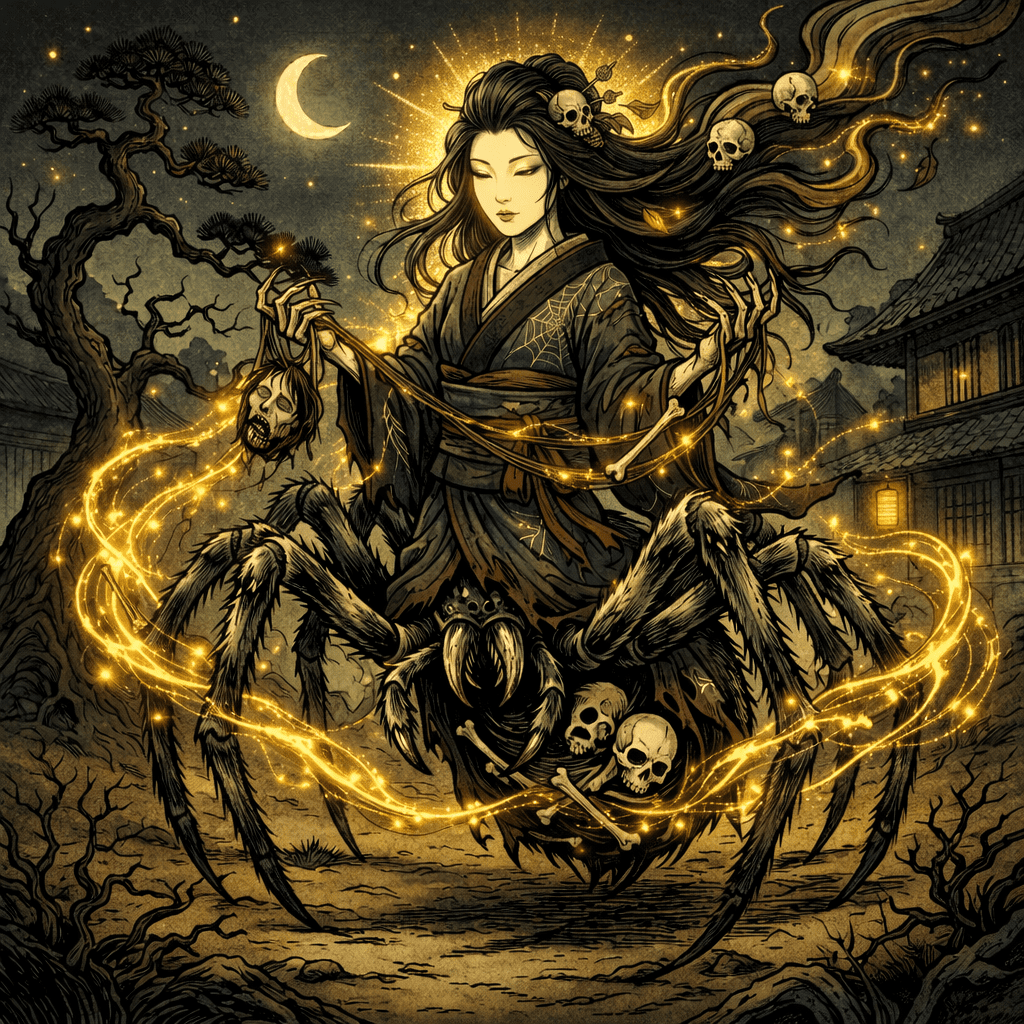
At the edge of the waterfall's mist, where the ancient forests of Japan grow thick and the sound of rushing water drowns out everything else, she waits. To the traveler who stumbles upon her forest dwelling in the hours before dusk, she appears as a woman of extraordinary beauty, perhaps playing a biwa by firelight, her kimono arranged with careful artistry, her smile an invitation to rest and forget the exhausting journey ahead. The fire is warm. The music is lovely. The woman is, without question, the most beautiful person you have ever seen in this life.
The silk threads she works with her hands are not fabric. The fire she tends does not warm anything that actually matters. And her true form — the massive spider body she conceals with shapeshifting power five hundred years in the making — has been waiting for exactly this moment, with exactly this degree of patience, for exactly as long as it takes. She is not in a hurry. She has never been in a hurry. The web was finished long before you arrived, and you have been walking toward it since before you left home.
What is Jorōgumo?
Jorōgumo (絡新婦) is a supernatural spider being from Japanese folklore — specifically, a jorogumo spider (Nephila clavata, a large golden orb-weaver native to Japan and recognizable by its striking black and yellow markings) that has lived long enough to accumulate sufficient supernatural power to transform. The name carries multiple layers of meaning that illuminate different aspects of her nature: it can be read as "binding bride," referring to her predatory relationship with male victims; as "whore spider," suggesting her use of sexual allure as a hunting strategy; or simply as "entangling spider," the most literal translation. Each reading captures something true about her (Toriyama Sekien, "Gazu Hyakki Yako," 1776).
At five hundred years of age, a jorogumo spider gains the ability to shapeshift into human form — typically manifesting as a beautiful woman who lures men into her web through seduction, misdirection, and the patient exploitation of desire. She is classified among the most dangerous of Japan's supernatural predators not because of raw physical power like the Gashadokuro, but because of intelligence that has been refined by five centuries of observation and practice. She does not attack. She seduces, manipulates, and ensnares, working across weeks or months rather than moments. Her patience is measured in centuries, her understanding of human desire is encyclopedic and intimate, and her web — both literal and metaphorical — is constructed with such care that it is invisible until the moment escape becomes impossible (Michael Dylan Foster, "The Book of Yokai," 2015).
Jorōgumo has become a significant figure in modern Japanese fantasy and horror, appealing to storytellers attracted to her combination of intelligence, extraordinary patience, and the predatory beauty that makes her both terrible and compelling. In the Onmyoji franchise — based on the historical figure of Abe no Seimei and his encounters with supernatural beings — she appears as a complex entity whose relationship with her human targets is presented with genuine moral ambiguity. The Touhou Project features spider-woman characters whose design and characterization draw directly from Jorōgumo mythology. Numerous manga series have explored her archetype in settings ranging from historical Japan to contemporary urban fantasy, consistently preserving the core dynamic of beauty as predatory mechanism and the web as the truest expression of her nature.
Western fantasy literature and gaming has also embraced spider-woman archetypes that show clear Jorōgumo influence — the Arachne figure, the drider of tabletop role-playing games, the many predatory spider-women of dark fantasy. What these cross-cultural resonances suggest is that the specific combination of spider and seductress taps into something deep and widespread in human psychology: the fear of the patient predator that studies its prey, that understands desire well enough to weaponize it, and that has mastered the art of making the trap feel like exactly what you were looking for.
Which Anime and Manga Feature Jorōgumo?
Spider demon characters in anime and manga owe a significant and often direct debt to the Jorōgumo tradition, which provides the foundational template for the beautiful supernatural woman whose spider nature is both her horror and her power. The archetype of the spider yokai who inhabits the boundary between human and monster, who uses beauty as both disguise and weapon, and whose webs are simultaneously her home and her hunting ground appears throughout the anime canon in various forms and with varying degrees of explicit acknowledgment of the Jorōgumo source material.
Series dealing with yokai hierarchies and the supernatural world of Japan consistently include spider entities whose characterization reflects the Jorōgumo's defining qualities: the long lifespan that provides perspective humans cannot match, the predatory intelligence that makes her genuinely dangerous rather than simply monstrous, and the ambiguity about whether her actions constitute evil or simply the expression of a nature she did not choose and cannot entirely transcend. The Jorōgumo's enduring presence in anime reflects the ongoing relevance of her core narrative: that the most sophisticated trap is invisible until the moment you are already inside it.
Where Can You Encounter Jorōgumo in Japan?
Joren Falls in Izu, Shizuoka Prefecture, is the most specifically and historically associated location with Jorōgumo legend. The falls are genuinely spectacular — a 25-meter cascade surrounded by ancient cryptomeria forest whose density and age create an atmosphere of genuine temporal displacement, a sense of having entered a landscape where the normal rhythms of modern life do not fully apply. The local community acknowledges the supernatural associations with appropriate cultural pride, and the falls remain one of the more atmospherically potent sites in the Izu peninsula regardless of one's views on the supernatural. Visitors who walk alone near the pool at the falls' base, particularly in the late afternoon when the mist thickens, report that the legend feels less like history and more like immediate possibility.
The Kiyotaki River area west of Kyoto, where forested mountain streams have supported hermits, priests, and supernatural traditions for more than a millennium, carries strong Jorōgumo associations in local folklore. The Kibune area to the north — home to Kifune Shrine, dedicated to water deities — provides another atmospheric location where the combination of ancient forest, moving water, and deep supernatural tradition creates conditions appropriate to spider-woman legends. Throughout Japan's river gorges and mountain watersheds, wherever the jorogumo spiders themselves build their large golden webs across the light in late summer, the Jorōgumo tradition feels like an accurate description of something genuinely present in the landscape.
Conclusion
The Jorōgumo endures as a legend because she embodies a fear that cuts across cultures and centuries with uncanny precision: that beauty is a trap, that charm is a weapon, and that the most dangerous predators are the ones that make you want to be caught. She is five hundred years of patient hunger given human shape — a reminder that the most sophisticated trap is not made of steel or stone but of silk thin enough to be invisible until you are completely bound within it, until the warmth and the music and the beauty have done their work, and the thing that invited you inside reveals itself at last in the light of a fire that was never, in any sense that mattered, meant to keep you warm.
This is The Yokai Files.
How Does Jorōgumo Appear in Modern Japan?
Jorōgumo has become a significant figure in modern Japanese fantasy and horror, appealing to storytellers attracted to her combination of intelligence, extraordinary patience, and the predatory beauty that makes her both terrible and compelling. In the Onmyoji franchise — based on the historical figure of Abe no Seimei and his encounters with supernatural beings — she appears as a complex entity whose relationship with her human targets is presented with genuine moral ambiguity. The Touhou Project features spider-woman characters whose design and characterization draw directly from Jorōgumo mythology. Numerous manga series have explored her archetype in settings ranging from historical Japan to contemporary urban fantasy, consistently preserving the core dynamic of beauty as predatory mechanism and the web as the truest expression of her nature.
Western fantasy literature and gaming has also embraced spider-woman archetypes that show clear Jorōgumo influence — the Arachne figure, the drider of tabletop role-playing games, the many predatory spider-women of dark fantasy. What these cross-cultural resonances suggest is that the specific combination of spider and seductress taps into something deep and widespread in human psychology: the fear of the patient predator that studies its prey, that understands desire well enough to weaponize it, and that has mastered the art of making the trap feel like exactly what you were looking for.
What Are the Most Famous Jorōgumo Legends?
The most celebrated Jorōgumo story is set near the Joren Falls (Joren-no-Taki) in Izu, Shizuoka Prefecture, where the falls drop 25 meters into a pool surrounded by forest that has maintained its primeval character for centuries. A woodcutter working in the trees near the falls notices that his straw sandal has caught on something and looks down to find silken threads wound around his foot with precise deliberateness — not accidentally caught, but deliberately placed. He cuts himself free quickly, then, cautiously, ties the loose threads to a tree stump nearby and steps back to watch. A few minutes later, the stump is yanked violently into the pool below the falls with a force that no living creature of visible size could have generated. Had he not freed himself, had he not been quick-thinking enough to transfer the connection from his body to something expendable, he would have been dragged in with it — and whatever waited in that pool had no intention of letting anything go.
Another famous account involves a samurai of considerable reputation who begins disappearing from his usual social circles with increasing frequency. His friends grow suspicious at these unexplained absences and eventually follow him into the forest, where they discover him proceeding with evident purpose toward a location that, when they approach, appears from outside to be a decaying ruin of a structure — but which their friend enters as though it is an elegant and welcoming home. Looking through gaps in the broken walls, they witness their friend sitting in apparent contentment while a spider the size of a draft horse moves around him with purposeful efficiency, wrapping his lower body in silk with the careful precision of a craftsperson at work. They break through the walls, drive the spider off with fire and blades, and drag their friend out. He is alive, but deeply disoriented, and never fully recovers. He dies within the year — not from any identifiable physical cause, but as though something essential was taken from him during those months in the forest, and the silk that was removed from his body had also carried away something that could not be replaced.
A third strand of Jorōgumo legend involves encounters where the spider-woman does not kill directly but rather takes something more subtle — time, vitality, the specific quality of aliveness that makes a person fully present in the world. Victims who escape her web sometimes describe months that passed like days, years of life that they cannot account for, a sense of having been partially somewhere else for a period whose duration they cannot specify. These accounts suggest a predator whose feeding is not always obvious, whose appetite is sometimes satisfied by the slow, quiet extraction of life force rather than the immediate consumption of flesh.
What Does Jorōgumo Look Like?
In her human form, Jorōgumo appears as a woman of exceptional, carefully calibrated beauty. She is typically described as young, elegantly dressed in fine silk kimono whose quality is itself a trap — it suggests wealth, refinement, and safety, all of which are illusions. She possesses the refined manners of high society and an air of cultured sophistication that makes men trust her instantly, lowering defenses that might otherwise catch the subtle wrongness of her situation. She might present herself as a noblewoman traveling alone, which should itself raise questions — why would a noblewoman be alone in a forest? — but the questions do not arise because the beauty is too immediate and too complete. Every detail of her human appearance is carefully calculated over centuries of practice to appeal to the specific vulnerabilities of the kind of person most likely to wander near her waterfall.
Her true form is a massive spider — some accounts describe her as horse-sized, others as larger still, with the golden-yellow markings of the jorogumo species amplified to supernatural intensity. Her silk is described as stronger than any man-made rope, capable of binding a struggling adult man so thoroughly and so quickly that resistance is futile within seconds of contact. The transition between forms is handled with varying degrees of subtlety across different accounts: in some, the revelation is sudden and complete; in others, attentive observers notice signs in advance — a finger that seems to have an extra joint, eyes that catch firelight with a faceted quality that no human eye possesses, the way she moves through the shadow at the edge of the fire's light with a smoothness that no human body should achieve (Shigeru Mizuki, "Yokai Daizukan," 1994).
Some regional traditions describe a hybrid form — a woman's upper body emerging from a spider's lower body, a visual that makes explicit the horror implicit in the more modest shapeshifting accounts. In these versions, the Jorōgumo does not bother with complete concealment; she is confident that by the time a victim sees her true form, it is already too late to matter. The full spider body is revealed only when the web is already deployed, when the silk is already working, when the outcome is no longer in question.
Where Did Jorōgumo Come From?
The Jorōgumo legend emerges from the broader Japanese folkloric concept of tsukumogami — the belief that any object or creature that achieves sufficient age or accumulated spiritual energy undergoes a transformation, gaining human-level consciousness and supernatural capabilities. This principle applies across the full range of Japanese natural and artificial objects: old umbrellas become lantern-headed creatures, discarded sandals become shuffling demons, ancient tools develop personalities and grudges. Living creatures subject to the same process include foxes, tanuki, cats, and — given sufficient time — spiders. The jorogumo spider, already one of Japan's largest and most visually striking arachnids, constructing elaborate webs of extraordinary architectural sophistication and hunting with patience that inspired direct human admiration and unease, was a natural candidate for supernatural elevation in the popular imagination.
The Jorōgumo legend appears extensively in Edo-period collections of supernatural tales and kaidan, particularly in the Tonoigusa and other eighteenth-century compilations that catalogued Japan's supernatural traditions with new systematic ambition. The waterfall settings that are almost universal in these stories reflect both the real habitat preferences of large spiders in Japan — damp, forested areas near water sources provide both moisture and the insect populations that sustain large webs — and the symbolic weight that waterfalls carry in Japanese mythology. The waterfall is a threshold, a place where the ordinary world's rules become uncertain, where the sound of water drowns out the subtle warning signals that might otherwise alert the careful traveler to supernatural danger.
Historical and regional variations in Jorōgumo traditions reflect different emphases on her nature. In some traditions she is more straightforwardly predatory, a spider in a woman's clothing who hunts men as straightforwardly as her smaller relatives hunt flies. In others she is portrayed with greater moral complexity — a creature capable of genuine attachment, who kills not from malice but from fundamental incompatibility between her nature and any sustainable relationship with humans. These more complex versions raise uncomfortable questions about whether her victims are truly innocent, whether their deaths are consequence or punishment, and what kind of obligation a being of five centuries' wisdom owes to creatures who last, at most, a century.
Support The Yokai Files
Enjoyed this deep dive into Japanese folklore?
The Yokai Files is reader-supported. Your support helps us research deeper, write more, and keep the darkness alive.