Kappa: Japan's Water Demon That Drowns the Careless and Rewards the Respectful
Published: March 28, 2026
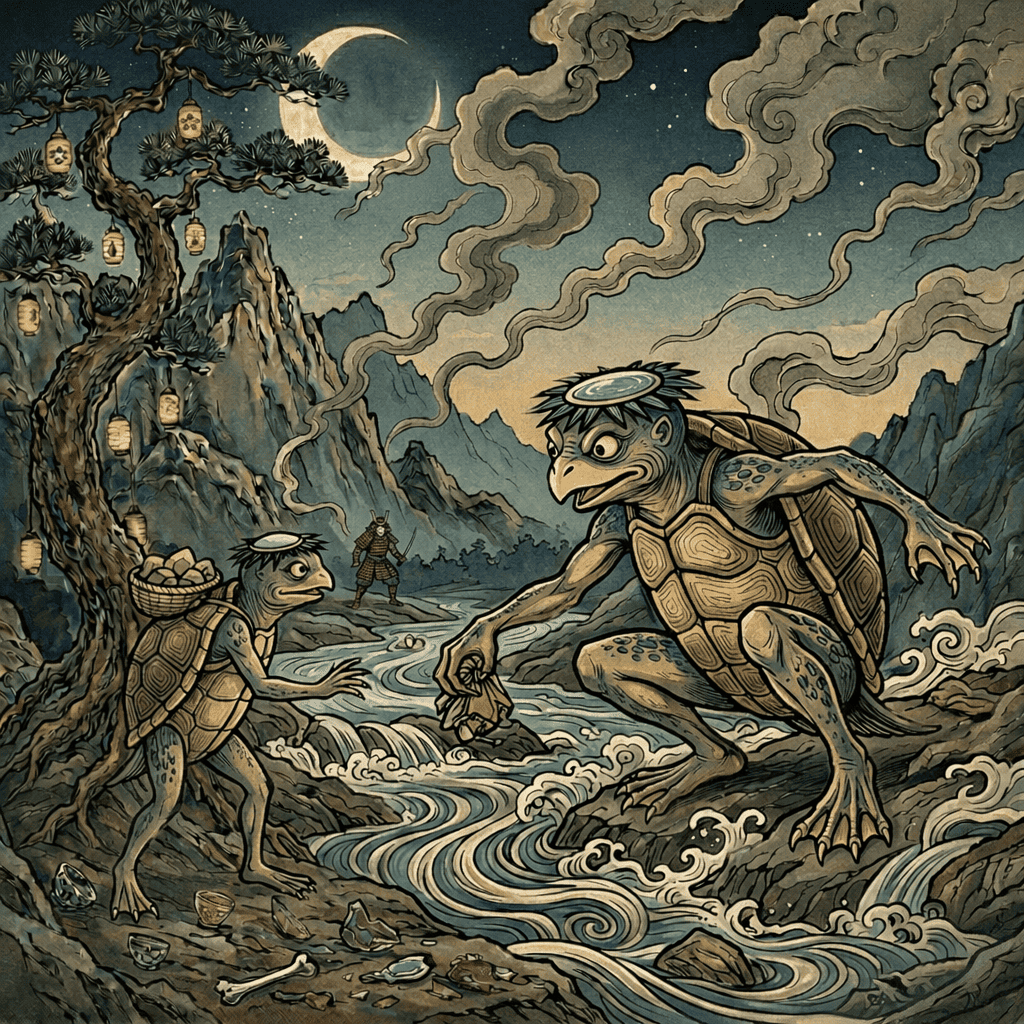
Every summer in Japan, parents warn their children about the rivers. Not about the current. Not about the depth. About what lives below the surface — a creature that looks like a child from a distance, that calls out in a friendly voice, that loves nothing more than dragging the unwary into the water and drowning them before consuming their organs through a method that folklore describes with unsettling anatomical specificity. It has a dish of water on its head that, if dried out, renders it helpless. It loves cucumber and sumo wrestling. It is both terrifying and absurd, which is precisely why it has survived for so long in Japanese cultural memory.
The kappa is perhaps the most recognizable yokai in Japan's vast supernatural tradition — the creature that appears on warning signs near bodies of water, that has its own official documentation in local government records in some prefectures, and that exists simultaneously as a genuine object of folk belief and as a beloved mascot for everything from sports teams to cucumber rolls. Understanding the kappa means understanding the peculiarly Japanese ability to hold terror and affection in the same hand without dropping either.
What is Kappa?
The kappa is a water-dwelling yokai found throughout Japan, though it is most strongly associated with rivers, ponds, and swamps. The name is typically written with characters meaning "river child," and alternative names include kawataro ("river boy"), kawako, and numerous regional variations — in Saga Prefecture it is called the gataro, in parts of Kyushu the enkō, and along the Tone River basin in eastern Japan the hyōsube. It belongs to the category of suijin — water spirits — though unlike the benevolent water deities worshipped at shrines, the kappa is fundamentally a dangerous and unpredictable being whose relationship with humans depends almost entirely on whether it has been properly respected or not.
What makes the kappa particularly interesting from a folkloric perspective is its profound ambivalence. It is not simply a monster. It is a creature with a strict code of honor, a love of knowledge, and the capacity to form genuine alliances with humans who treat it correctly. There are traditions of families in various regions of Japan claiming to have made treaties with local kappa — agreements in which the kappa promises not to harm the family's members in exchange for specific offerings. Some of these "contracts" have been preserved as historical documents in prefectural archives.
The kappa is further distinguished by its deep ties to agricultural communities. Rice farmers along riverbanks left cucumber offerings at the water's edge before planting season, a practice that scholars interpret as a vestige of much older water-deity propitiation rites. In this light the kappa is not merely a monster used to frighten children but a supernatural force that governed the relationship between human cultivation and the rivers that fed it — terrifying when ignored, potentially cooperative when properly acknowledged.
What Does Kappa Look Like?
The kappa's physical description is remarkably consistent across Japanese regions, suggesting either a unified folkloric tradition or — as some theorists have argued — the description of an actual creature that multiple communities encountered independently. It is roughly the size of a child, with green or bluish-green skin that is described as wet, scaly, or reptilian depending on the source. Its body is humanoid but distinctly amphibious: webbed hands and feet, a powerful build suited for swimming, and a shell on its back like that of a turtle. Toriyama Sekien's eighteenth-century illustrated catalogues of yokai depicted the kappa with meticulous detail — beak-like mouth, reptilian scales, and the characteristic head-dish — establishing a visual canon that persists to this day. (Toriyama Sekien, "Gazu Hyakki Yako," 1776)
The most distinctive and narratively important feature is the saucer-like depression on top of the kappa's head, which holds a pool of water. This water is the source of the kappa's power; if it spills — which can be accomplished by tricking the kappa into bowing, since it is compelled by its own code of honor to return a bow — the kappa loses its supernatural strength and may become helpless. Its face is typically described as combining beak-like or frog-like features with a disturbing intelligence in its eyes. It smells of fish and river mud.
Regional variations in the kappa's appearance are significant. In many Kyushu traditions the kappa is described as more hairy and ape-like than the standard depiction — closer to the hyōsube variant, which looks less like a turtle-humanoid and more like a small, wet, malevolent primate. In parts of Tohoku the kappa is described as having a more elongated, serpentine quality. These regional differences may reflect genuine local belief traditions, separate origin points for the legend, or simply the natural drift of oral tradition across centuries of retelling. Lafcadio Hearn, who documented supernatural Japan at the turn of the twentieth century with an outsider's sharp eye, noted that the kappa's description varied dramatically depending on which village one asked. (Lafcadio Hearn, "Kwaidan," 1904)
Where Did Kappa Come From?
The origins of the kappa legend are genuinely uncertain, and scholars have proposed several competing theories. The most prosaic explanation suggests that kappa legends developed as a way to warn children away from dangerous bodies of water — the creature's threat being a more viscerally effective deterrent than simple parental instruction. The specific anatomical focus of the kappa's predation (it was said to extract a mysterious organ called the shirikodama through the victim's anus) may have developed as an explanation for the bloating and internal changes visible in drowned corpses.
More mythologically oriented theories connect the kappa to the ancient tradition of river deity worship in Japan. Some scholars argue that the kappa is a degraded form of the river god — what happens to a divine being when the community stops properly venerating it. This interpretation would explain the kappa's dual nature: it retains the river god's power and its expectation of respect while having lost the benevolent orientation that comes with proper worship. Michael Dylan Foster, one of the leading Western scholars of yokai studies, situates the kappa within a broader pattern of supernatural beings that represent the wild, unpredictable forces of the natural environment — entities that predate human settlement and resist full domestication. (Michael Dylan Foster, "The Book of Yokai," 2015)
A third line of inquiry focuses on possible real-world inspiration. Various animals have been proposed as the physical basis for kappa sightings — giant salamanders (which can reach nearly two meters in length and do inhabit Japanese rivers), large sea turtles entering river mouths, or even anomalous primate sightings. None of these explanations fully accounts for the consistency of the description or its deeply cultural elements. The kappa is most productively understood not as a misidentified animal but as a genuine product of human psychology: the personification of the river's dangerous, indifferent power in a form that could be negotiated with, appeased, and ultimately understood on human terms.
What Are the Most Famous Kappa Legends?
The literature of kappa encounters is vast, ranging from brief warnings in local histories to elaborate narrative tales. One of the most famous story types involves a kappa attempting to attack a horse at a riverbank — a common scenario given horses' need to drink from rivers. In many versions, the horse breaks free and drags the kappa to the stable, where it is discovered and captured by the horse's owner. The trapped kappa, having been bested, offers to teach the human medical knowledge — particularly skill in setting broken bones and healing injuries — in exchange for its freedom.
Several families in Japan claim hereditary medical knowledge that traces back to exactly this type of encounter. The Koga family of Kyushu is perhaps the most famous example, with family documents preserved to this day that supposedly record the treaty made with a local kappa and the medical secrets transferred as part of that agreement. Whether one accepts this tradition literally or not, it demonstrates the degree to which the kappa was integrated into practical human life rather than existing purely as a source of fear.
Kunio Yanagita's 1910 collection "Tono Monogatari" (The Legends of Tono) documented multiple kappa accounts from Iwate Prefecture, including stories of kappa attempting to assault women washing clothes at riverside and of kappa children born from such encounters — a disturbing variant of the legend that speaks to very old anxieties about rivers and the vulnerability of those who worked near them. The Tono legends remain among the most important primary source documents for understanding what kappa belief actually meant to people who held it seriously.
How Does Kappa Appear in Modern Japan?
The kappa has achieved a level of mainstream cultural recognition that few other yokai have managed. It appears on official warning signs at rivers and lakes across Japan, making it possibly the only supernatural being with government-sponsored public safety signage. The cucumber roll in sushi — kappa maki — is named after the kappa's legendary love of cucumbers, which are said to be the offering most likely to pacify an aggressive one. This culinary connection has made the kappa's name familiar to anyone who has ever ordered Japanese food.
In the wider popular culture the kappa appears endlessly — sometimes as a comedic character, sometimes as a genuine threat, and sometimes as an ancient being whose relationship with humanity is complicated by centuries of coexistence. Internationally, the kappa has gained recognition through its appearances in the Harry Potter universe (listed in Fantastic Beasts and Where to Find Them) and in numerous Western fantasy works inspired by Japanese mythology. The creature's combination of danger and honor, its vulnerability to politeness, and its love of sumo wrestling make it a figure of perennial fascination.
Which Anime and Manga Feature Kappa?
The kappa's most influential appearance in anime and manga comes through Shigeru Mizuki's GeGeGe no Kitaro, the landmark yokai manga serialized from 1960 onward and adapted into multiple anime television series by Toei Animation beginning in 1968. Mizuki's version of the kappa — appearing as a recurring character in Kitaro's world of supernatural beings — helped define the creature's popular image for generations of Japanese children, portraying it as a water-dwelling entity with its characteristic dish and turtle shell but rendered in Mizuki's distinctive style that balanced genuine eeriness with an almost affectionate humor. (GeGeGe no Kitaro, Toei Animation, 1968)
Dragon Ball, Akira Toriyama's global phenomenon that began serialization in 1984, features Sagojou — a kappa-inspired character among the ensemble cast, drawing on the same folkloric tradition while embedding it in a science-fantasy framework that took the character far from its riverside origins. The presence of kappa-influenced characters in Dragon Ball introduced the creature's visual and conceptual vocabulary to audiences worldwide who had no direct contact with Japanese folklore, contributing to the kappa's status as one of the few Japanese supernatural beings with genuine global name recognition.
Where Can You Encounter Kappa in Japan?
Kappa sightings and traditions are distributed throughout Japan, but certain regions have particularly strong associations. Kyushu — especially Saga and Kumamoto Prefectures — has one of the richest kappa traditions, with local museums, shrines, and documents related to kappa encounters. The Kappa Museum in Tono City, Iwate Prefecture, celebrates the kappa legends of the Tono region, made famous by Kunio Yanagita's 1910 collection "Tono Monogatari" (The Legends of Tono), which documented kappa sightings and traditions from that area with a fieldwork rigor that gave the legends unusual documentary weight.
Asakusa in Tokyo has a district called Kappabashi — "Kappa Bridge" — named after a legendary kappa who helped drain the swampy area in the Edo Period. Today Kappabashi is famous as Tokyo's kitchenware district, and the kappa mascot appears throughout the area. A shrine at the far end of Kappabashi honors the kappa of the original legend, and small kappa figures can be found throughout the district. Whether you are there to buy professional kitchen knives or to pay respects to the water spirit whose labor supposedly made the neighborhood possible, Kappabashi offers a uniquely Tokyo combination of the commercial and the mythological.
Conclusion
The kappa survives in Japanese culture because it tells a truth about the relationship between humans and the natural world that is more complex than simple fear or simple reverence. It is a being that will kill you if you treat it carelessly and that will teach you medicine if you treat it with respect. It is the river itself — beautiful and dangerous, ancient and indifferent, capable of nourishing or destroying depending on how carefully you approach it. From its first documented appearances in Heian-era texts through Toriyama Sekien's meticulous Edo-period illustrations, from Lafcadio Hearn's wondering accounts of riverside warnings to Shigeru Mizuki's affectionate manga reimaginings, the kappa has crossed every era of Japanese history without losing its essential strangeness. Every summer, Japanese children are still warned about the kappa. Every summer, people still drown in Japan's rivers. The kappa is still waiting, patient and strange, in the green water below.
This is The Yokai Files.
Support The Yokai Files
Enjoyed this deep dive into Japanese folklore?
The Yokai Files is reader-supported. Your support helps us research deeper, write more, and keep the darkness alive.