Kasa-obake: The One-Eyed Umbrella Monster Hopping Through the Night
Published: March 28, 2026
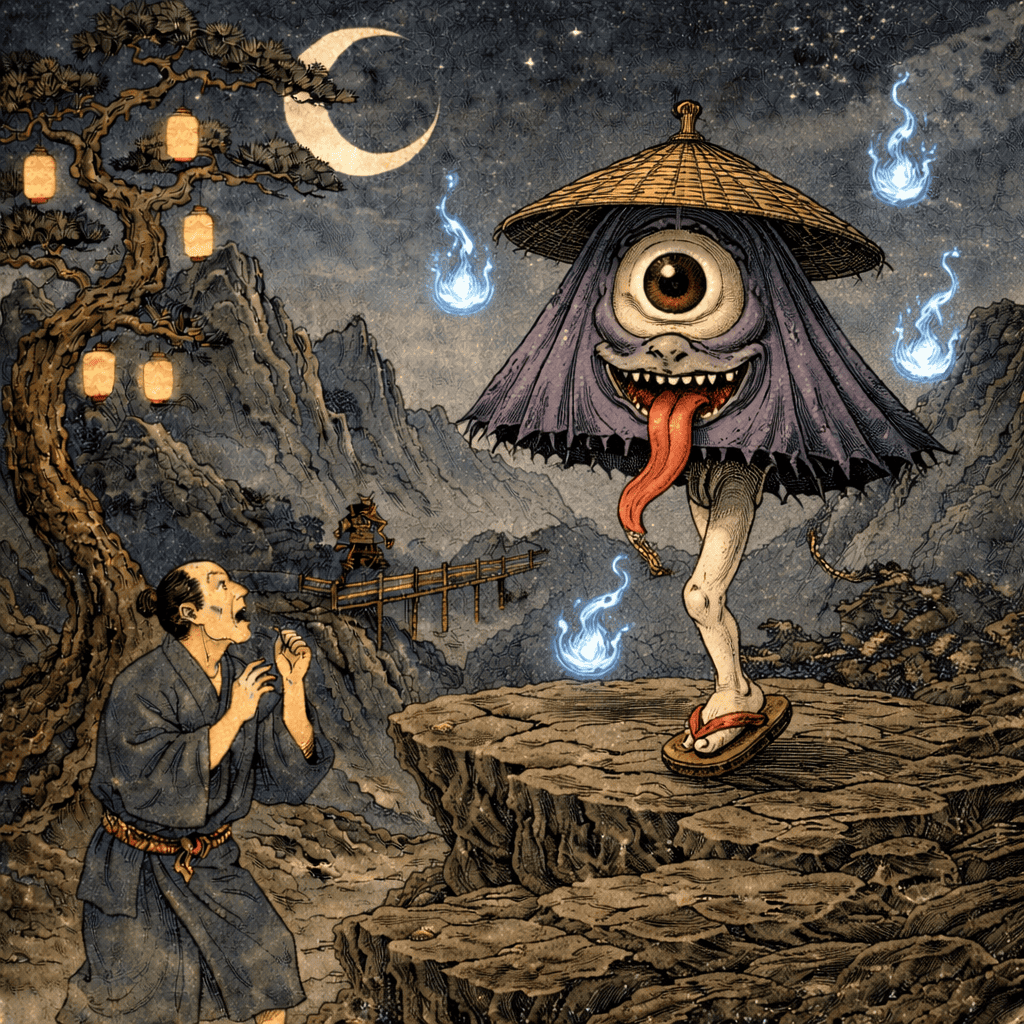
Someone left their umbrella in the corner of a storage room thirty years ago and forgot about it. It sat in the darkness through the changing seasons, through the deaths and births of the household that owned it, through decades of being completely overlooked and entirely forgotten. And then, one night, a single eye opened in its paper surface. A leg emerged, then another. It hopped off the shelf, bounced out the door on its one sandaled foot, and disappeared into the rain-soaked night, apparently delighted to finally be doing something.
The kasa-obake is one of the most cheerfully bizarre entries in Japan's vast supernatural catalogue — a haunted umbrella that achieves consciousness through long neglect and spends its existence hopping through the night on a single wooden leg, its one enormous eye surveying the world with what appears to be pure, uncomplicated wonder. It is not malevolent. It is not particularly useful. It is simply what happens when an umbrella lives too long and decides it would rather be somewhere else.
What is Kasa-obake?
Kasa-obake — "umbrella ghost" or "umbrella monster" — is a tsukumogami, an object that has developed supernatural consciousness through great age. The tsukumogami tradition holds that objects which reach one hundred years of age develop souls and the capacity for independent action, typically manifesting their new consciousness through the acquisition of eyes, mouths, and limbs. The kasa-obake is the paper umbrella (wagasa) form of this transformation: after a century of existence, the umbrella develops a single eye in its surface, sprouts a pair of legs (or in some depictions, a single wooden leg with a sandal), and acquires a long, sticky tongue that it uses to startle people.
The kasa-obake's relationship with humans is fundamentally non-threatening — it startles rather than harms, inconveniences rather than injures. In most accounts it appears on rainy nights, bouncing through the streets with apparent enthusiasm, perhaps seeking some experience of being used that it was denied through the long decades of its storage. There is something almost poignant about this creature: a tool that was never fully used, finally free to move through the rain it was designed to protect against. As Michael Dylan Foster observes in his analysis of tsukumogami, the kasa-obake embodies a fundamentally Japanese theological concern about the proper treatment of objects — that carelessness toward the things we own carries spiritual consequences that eventually manifest in unexpected and often comical ways (Michael Dylan Foster, "The Book of Yokai," 2015).
The term kasa itself requires some elaboration. The traditional Japanese wagasa is a paper-and-bamboo umbrella of considerable craft — these were not disposable objects but carefully made tools that could last decades with proper maintenance. The wagasa's construction involved skilled artisans, multiple materials, and significant labor. Owning a wagasa was a matter of some financial commitment, and the expectation was that it would be cared for and maintained. The kasa-obake thus represents not merely an old umbrella but a well-made object that was allowed to deteriorate through inattention — a more pointed moral failure than simple age would suggest.
What Does Kasa-obake Look Like?
The standard kasa-obake appears as a traditional Japanese paper umbrella (wagasa) with a single large eye near its center, a long lolling tongue extending from a mouth somewhere on its surface, and either one wooden sandaled leg emerging from its handle or two human-like legs. It is typically depicted mid-hop, airborne, with the eye wide open and the tongue extended — an expression of exuberant, slightly manic joy. Despite its unsettling features, the overall impression is inexplicably endearing: this is a yokai whose first reaction to achieving consciousness appears to be unalloyed delight at the fact of its own existence.
There is notable variation in how many legs the kasa-obake is depicted as having. The single-leg version — the most common in classical depictions — emphasizes the umbrella's handle as the source of its mobility, a single wooden shaft that has developed a foot at its end. The two-legged version, which appears more frequently in modern illustrations and anime adaptations, makes the creature more overtly humanoid and somewhat more sympathetic in its movement. The single-leg version is generally considered more faithful to the original tradition and is the version that appears in Toriyama Sekien's influential illustrations (Toriyama Sekien, "Gazu Hyakki Yako," 1776).
The color of the kasa-obake varies considerably across artistic traditions, reflecting the wide variety of wagasa colors available in the Edo Period. Red is perhaps the most commonly depicted version in modern renderings, as the color provides maximum visual contrast and matches the festive associations of traditional red paper umbrellas. White versions appear in more somber contexts, connecting to the white of mourning and the white of ghost tradition. The color of the umbrella does not appear to have systematic symbolic meaning in the original folk tradition — the kasa-obake is what it is regardless of what color it happened to be painted when it was new.
Where Did Kasa-obake Come From?
The tsukumogami concept — objects becoming supernaturally alive — is one of the most philosophically interesting aspects of Japanese supernatural tradition. It emerges from a Shinto-inflected animism that attributes spiritual potential to all things, combined with a Buddhist sensibility about the weight of accumulated history and the danger of waste. The Tsukumogami Emaki, a scroll painting from the 15th century, depicts numerous animated objects including umbrellas, and establishes the visual tradition of the kasa-obake. This scroll predates Toriyama Sekien's systematic yokai encyclopedias by three centuries, demonstrating that the animated-umbrella concept had deep roots in Japanese visual and folk culture long before the Edo Period systematizers codified it.
The theological message embedded in tsukumogami tradition is simultaneously cautionary and affirming. The cautionary aspect: take care of your possessions, or they will turn against you. Objects that are neglected, discarded, or used carelessly accumulate a kind of spiritual resentment that eventually manifests as supernatural animism — the thing you ignored has decided to make itself impossible to ignore. The affirming aspect: everything that has existed long enough is worthy of spiritual consideration. The hundred-year threshold is not arbitrary — it represents a duration sufficient to accumulate genuine history, to have been present for multiple human lives and deaths, to have absorbed the experiences of the household it inhabited. The kasa-obake is old enough to have a point of view, and it has decided to express it by hopping through the rain.
The emergence of tsukumogami belief in the historical record coincides with the development of a sophisticated craft culture in Japan during the Heian and Muromachi periods. Objects of sufficient quality and craftsmanship — swords, pottery, musical instruments, umbrellas — were understood to accumulate spiritual potency through both age and use. The tsukumogami tradition can be read as a supernatural expression of the deep value placed on well-made things in Japanese culture, and the kasa-obake specifically as a commentary on what happens when that value is not honored in practice.
What Are the Most Famous Kasa-obake Legends?
Unlike the more dangerous yokai with elaborate narrative traditions, the kasa-obake exists primarily in visual art and brief anecdotal accounts rather than extended stories. Its appearances in Edo Period popular culture were typically humorous — the umbrella monster functioned as comic relief in collections that also contained genuinely frightening supernatural beings, providing tonal variety and demonstrating the breadth of what the yokai tradition could accommodate. The Hyakumonogatari Kaidankai tradition of competitive ghost-story telling occasionally included kasa-obake encounters as palate cleansers between more intense narratives — the animated umbrella as a kind of supernatural intermission.
One popular Edo Period account describes a merchant who, returning home in a rainstorm, had his umbrella knocked from his hand by the wind. He chased it through several streets before catching it, only to find, when he finally grabbed it, that it was looking at him. The merchant threw the umbrella away in panic and ran. The following morning, the umbrella was found standing upright outside his door, apparently having returned on its own. The merchant — according to the account — subsequently kept it with great care and attentiveness, and it never troubled him again. The lesson is explicit: proper attention dispels the supernatural threat, because the threat was generated by the lack of attention in the first place.
The broader tsukumogami tradition includes dozens of object types that can undergo the hundred-year transformation — sandals, drums, teakettles, musical instruments — and each brings its own personality to its awakened state. The kasa-obake is distinguished by its particular enthusiasm for the outdoors, its apparent delight in rain, and its combination of slightly frightening appearance (the eye, the tongue) with completely non-threatening behavior. It licks people with its tongue in some accounts — which is startling but hardly dangerous — and hops through the night making whatever noise a large animated umbrella makes when enthusiastically hopping.
How Does Kasa-obake Appear in Modern Japan?
The kasa-obake is one of the most widely recognized yokai in modern Japan, functioning primarily as a mascot and design element rather than a genuine supernatural concern. It appears on yokai merchandise, in children's media, in video games, and as a decorative motif that signals "Japanese supernatural" without the heaviness of more threatening yokai. Its googly-eyed, hopping image has become shorthand for the playful, eccentric side of Japan's supernatural tradition — the face of yokai culture that welcomes rather than frightens.
Yokai Watch, the multimedia franchise that introduced an entire generation of Japanese children to the yokai tradition, includes kasa-obake type characters rendered in the franchise's characteristic cute-but-slightly-weird aesthetic. The franchise's approach — treating yokai as collectible companions rather than supernatural threats — is in many ways the logical extension of the kasa-obake's original non-threatening personality: a creature that achieves consciousness and immediately starts having adventures rather than causing harm is a natural mascot for this kind of benevolent yokai engagement.
Which Anime and Manga Feature Kasa-obake?
The kasa-obake has a distinguished history in yokai anime, appearing most prominently in Shigeru Mizuki's GeGeGe no Kitaro universe. Mizuki's animated umbrella character, introduced in his manga of the 1960s and adapted in the Toei Animation anime from 1968, became the most widely recognized version of the kasa-obake for multiple generations of Japanese viewers (Shigeru Mizuki, "GeGeGe no Kitaro," manga, 1960s; GeGeGe no Kitaro, Toei Animation, 1968). Mizuki's kasa-obake is rendered with characteristic specificity — the single eye is expressive rather than merely creepy, the tongue is playful rather than menacing, and the overall personality of the character communicates the particular combination of strangeness and harmlessness that defines the original folk tradition.
Mizuki's treatment of tsukumogami in the GeGeGe no Kitaro series more broadly reflects his deep engagement with the underlying theology of animated objects. The series includes numerous tsukumogami characters — object-spirits of various types — and treats them with the same sympathetic curiosity that Mizuki brought to all his yokai work. The kasa-obake within this context is not merely a sight gag but a genuine character: an entity with its own personality, preferences, and perspective that happens to also be an umbrella. This characterization is faithful to the folk tradition in the deepest sense, which understands the tsukumogami not as a monster wearing an object's shape but as an object that has genuinely become something more than it was.
Beyond the GeGeGe no Kitaro franchise, tsukumogami-themed works in anime and manga have proliferated in recent decades, driven by a broad cultural interest in the relationship between objects and spiritual identity. Series such as Tsukumogami Kashimasu (2018) — in which objects at a rental shop are revealed to have their own inner lives — and various short films from independent animators draw on the same tradition that produced the kasa-obake, exploring what it means for an object to develop consciousness and how such a being would navigate a world that has forgotten the spiritual potential of things. The kasa-obake stands at the beginning of this tradition in popular animation, the original animated object whose particular combination of the familiar and the strange established the template for all subsequent tsukumogami media.
Where Can You Encounter Kasa-obake in Japan?
The kasa-obake appears throughout Japan's yokai tourism industry — in the Mizuki Shigeru Road in Sakaiminato, where a bronze kasa-obake statue is among the most photographed of the road's many yokai figures; in yokai museums across the country; and in the endless variety of yokai souvenir merchandise available at temple gift shops and specialty stores throughout Japan. The kasa-obake has become particularly iconic in Kyoto's tourist areas, where the combination of traditional aesthetics, rainy season atmosphere, and abundant souvenir shops creates a natural market for cute animated umbrella imagery.
For those interested in the tsukumogami tradition more broadly, the Kyoto National Museum occasionally exhibits the Tsukumogami Emaki, the medieval scroll that provides the earliest systematic visual documentation of object-yokai including the animated umbrella. The International Manga Museum in Kyoto holds extensive collections of yokai manga including Mizuki's work, providing a comprehensive survey of how the kasa-obake evolved from classical scroll painting to modern animation character.
Conclusion
In a tradition that includes demons who drink blood from skull-cups and vengeful ghosts that drive men to madness, the kasa-obake is a necessary reminder that the supernatural does not always arrive with darkness and dread. Sometimes it arrives hopping through the rain on one wooden leg, tongue flapping, eye wide open, delighted to finally be experiencing the weather it was made for. The tsukumogami tradition teaches that everything old enough deserves a certain respect, a certain care, a certain acknowledgment of the accumulated history it carries.
Forget your umbrella for a hundred years, and you may come home one night to find it has decided to take itself for a walk. This is not punishment in the traditional sense — it is the object exercising a freedom it earned through the long patience of its neglected existence. The kasa-obake does not want revenge. It wants to hop through the rain. It wants to startle late-night travelers with its tongue and its single unblinking eye. It wants, in the simplest possible sense, to be noticed. Care for your things. Notice them. They have been noticing you for a very long time. It will come back. It has nowhere else to be.
This is The Yokai Files.
Support The Yokai Files
Enjoyed this deep dive into Japanese folklore?
The Yokai Files is reader-supported. Your support helps us research deeper, write more, and keep the darkness alive.