Kitsune: The Sacred Fox Spirit Between Divinity and Deception
Published: March 28, 2026
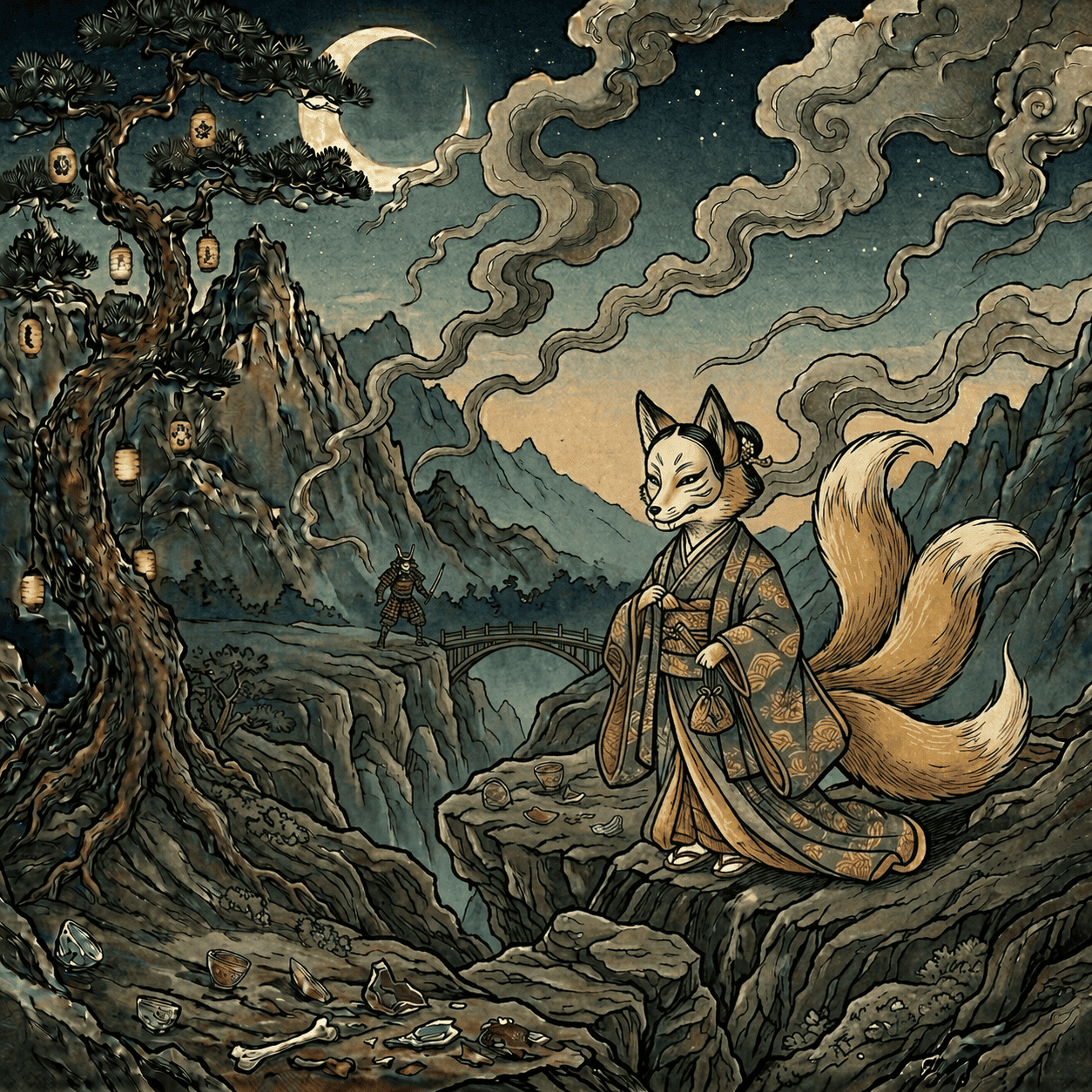
No creature in Japanese mythology occupies as complex a position as the kitsune. It is simultaneously a sacred messenger of the gods and a cunning deceiver of humans. It is worshipped at tens of thousands of shrines across Japan and blamed for some of the most elaborate frauds and psychological torments in folkloric history. It takes the form of a beautiful woman to seduce men, then vanishes in the morning — sometimes leaving behind a genuine love, sometimes leaving behind madness. It serves Inari, the deity of rice and prosperity, as a divine emissary. It is ancient, intelligent, and profoundly ambiguous.
The kitsune is not a single type of being but rather a category that spans an enormous range of power, intention, and moral character. A young fox with one tail may be little more than a mischievous animal that has only recently begun its supernatural journey. A nine-tailed fox is an entity of near-divine power that has lived for nine centuries, accumulated wisdom and strength beyond human comprehension, and may serve as a messenger of heaven itself — or as its most dangerous adversary. The fox in Japan is a mirror that shows you whatever you bring to it.
What is Kitsune?
Kitsune simply means "fox" in Japanese, but in the context of supernatural tradition, it refers specifically to the fox as a magical, shape-shifting spirit being. Japanese fox lore distinguishes between ordinary foxes and kitsune, though the boundary between the two is understood to be permeable — any fox that lives long enough will inevitably begin accumulating supernatural power and eventually make the transition into full kitsune status. As a kitsune ages, it grows additional tails, with each new tail representing a century of life and a corresponding increase in magical ability.
The moral orientation of a kitsune is deeply connected to its relationship with Inari worship. Zenko kitsune — "good foxes" — are associated with Inari shrines, serve as divine messengers, and actively assist humans who show proper piety and respect. Yako kitsune — "field foxes" or "wild foxes" — are not aligned with any divine authority and act according to their own inscrutable motivations, which may range from benign curiosity to active malice. The elaborate institutional structure of Inari worship effectively divided fox spirits into the sacred and the dangerous, though in practice the line between them was never entirely clear.
Beyond these two primary categories, regional Japanese traditions developed an array of additional kitsune types — the kuuko (air fox), the kūgen (sky fox), and the tenkou (celestial fox) among them — each representing progressively greater power and divine connection. A ten-tailed celestial fox, in the most elevated traditions, is considered nearly indistinguishable from a divine being, and its foxlike nature becomes more symbolic than literal. The tail count is always the essential shorthand: one tail means a young, potentially dangerous but limited creature; nine means something ancient and nearly incomprehensible in its accumulated power.
What Does Kitsune Look Like?
A kitsune's natural form is that of a fox — but the fox itself becomes increasingly otherworldly as it ages and gains power. Young kitsune are typically described as appearing like ordinary foxes, though unusually intelligent and unnervingly watchful. Older, more powerful kitsune may appear as white foxes (a sacred color in Japanese tradition), golden foxes, or even black foxes — with these unusual colorations marking them as clearly supernatural to anyone who knows what to look for.
In human form, kitsune most commonly appear as beautiful women, though they can and do take male forms when the situation calls for it. No matter how perfect the disguise, certain tell-tale signs may betray their true nature: a shadow that shows a fox's shape, the brief appearance of a tail under clothing, fox-like eyes when they forget to maintain concentration, or an unusual relationship with fire — kitsune are strongly associated with flames called kitsune-bi, or "fox fire," which appear as glowing lights around them in certain circumstances.
Toriyama Sekien's illustrated encyclopaedias of yokai depicted kitsune in both their fox and their human-adjacent forms, capturing the ambiguity that makes the creature so compelling — beautiful and dangerous, sacred and profane, a being whose true nature you can never quite fix in focus. (Toriyama Sekien, "Gazu Hyakki Yako," 1776) Lafcadio Hearn, too, was drawn to the kitsune, writing of fox-fires glimpsed on dark country roads and of the unsettling quality of encounters with creatures whose humanity might or might not be real. (Lafcadio Hearn, "Kwaidan," 1904)
Where Did Kitsune Come From?
Fox belief in Japan has roots that predate the formal introduction of Inari worship, which itself developed around the late Nara Period (8th century CE). Early Japanese fox folklore shared characteristics with fox spirit traditions found throughout East Asia, particularly in China, where the fox (huli jing) had an ancient reputation as a transformer and deceiver. The specific association with Inari — the deity of rice, agriculture, industry, worldly success, and fertility — gave Japanese fox belief an institutional structure that Chinese fox lore lacked, embedding the kitsune deeply in official religious practice.
Fushimi Inari Taisha in Kyoto, the head shrine of all Inari shrines, was established in 711 CE, and the proliferation of Inari worship throughout Japan brought kitsune iconography — the fox statues that guard every Inari shrine — to every corner of the country. By the Heian Period, sophisticated fox spirit narratives were already well established in Japanese literary culture, appearing in the Nihon Ryoiki and other early collections. The close connection between kitsune and rice agriculture is significant: foxes are natural predators of the rodents that devastate rice crops, making the divine fox a genuinely practical protector of agricultural communities before any mythological superstructure was built around it.
Michael Dylan Foster traces the kitsune's evolution across Japanese history from a relatively simple trickster and possessor to an increasingly complex figure whose moral valence shifted with each historical period — more dangerous and more ominous in times of social instability, more benevolent and more associated with legitimate religious institutions during periods of cultural consolidation. (Michael Dylan Foster, "The Book of Yokai," 2015) This historical sensitivity makes the kitsune an unusually rich lens through which to read Japanese cultural history.
What Are the Most Famous Kitsune Legends?
One of the most famous kitsune legends is the story of Kuzunoha — a white fox who took human form to repay a kindness from a man named Abe no Yasuna, who had rescued her from hunters. She lived with him as his wife for years and bore him a son — the legendary onmyoji Abe no Seimei, one of the greatest practitioners of divination and spiritual arts in Japanese history. When her true nature was finally discovered, Kuzunoha returned to the forest, leaving behind a poem on the shoji screen: "If you long for me, come find me in the forest of Shinoda where the leaves of the catalpa tree glisten." Abe no Seimei's half-fox heritage was understood to be the source of his extraordinary supernatural abilities — his inhuman perceptiveness, his power over spirits, his uncanny gifts.
The concept of kitsune-tsuki — "fox possession" — represents another major stream of kitsune lore. People experiencing strange behavior, illness, or mental disturbance were sometimes diagnosed as being possessed by a fox spirit. The symptoms could include speaking in unusual voices, ravenous appetite (particularly for tofu and aburaage, foods associated with foxes), and behavior that seemed contrary to the person's normal character. Exorcism of fox spirits was a specific skill practiced by religious specialists, and the tradition was taken seriously enough to appear in official medical records well into the modern era. Certain families were identified as kitsune-mochi — "fox holders" — believed to keep fox spirits in hereditary service, a status that brought both feared power and social stigma in equal measure.
Perhaps the darkest kitsune legend of the historical record concerns Tamamo-no-Mae — a beautiful woman at the court of Emperor Toba in the twelfth century whose supernatural perfection raised increasing suspicion. When an yin-yang master divined her true nature as a nine-tailed fox of immense power, she fled the court and transformed into the Sessho-seki — the "killing stone" of Nasu in Tochigi Prefecture — a stone said to kill any living thing that touches it. The stone was reportedly cracked in 2022, and the story circulated internationally as a dark omen, demonstrating the continuing grip of fox legend on popular imagination.
How Does Kitsune Appear in Modern Japan?
The kitsune has become one of Japan's most globally exported supernatural figures. In anime and manga, fox-eared and fox-tailed characters — known as kitsune characters — are ubiquitous, appearing in everything from romantic comedies to dark fantasy epics. The nine-tailed fox appears as a major character in Naruto (as the demon Kurama sealed within the protagonist), in the Inuyasha franchise, in the Nioh game series, and in countless other works. The fox-girl archetype has become a recognized genre convention internationally, often stripped of the original creature's danger and ambiguity but retaining its visual distinctiveness.
At the same time, the spiritual dimension of the kitsune remains very much alive. Inari shrines — of which there are over thirty thousand across Japan — continue to be actively venerated, and the fox statues that guard them are regularly adorned with fresh offerings of aburaage (fried tofu). The relationship between the Japanese people and the fox spirit is not merely historical or literary; it is ongoing, embedded in the rhythms of agricultural prayer and urban shrine visits that continue to this day.
Which Anime and Manga Feature Kitsune?
Kurama, the fox spirit antagonist and eventual ally in Yoshihiro Togashi's Yu Yu Hakusho — adapted into anime by Studio Pierrot beginning in 1992 — brought the kitsune archetype to a generation of anime fans in a form that balanced the creature's traditional associations with beauty, intelligence, and danger against the shonen action format's demand for emotionally resonant character development. Kurama's backstory as a powerful fox demon reborn in human form drew directly on the classical kitsune tradition of supernatural beings inhabiting human bodies, while his mastery of plant-based combat added a distinctive visual vocabulary to the archetype.
Shippo, the young fox demon in Rumiko Takahashi's Inuyasha — animated by Sunrise beginning in 2000 — offered a contrasting interpretation: a child kitsune whose limited powers, emotional vulnerabilities, and genuine warmth positioned the fox spirit tradition within a more accessible, comedic framework. Where Kurama embodied the kitsune's ancient danger and cultivated elegance, Shippo embodied its youth and untested potential, together providing the full spectrum of the tradition's imaginative range. Both characters became touchstones for how the kitsune archetype could be adapted to modern storytelling without losing its essential character.
Where Can You Encounter Kitsune in Japan?
Fushimi Inari Taisha in Kyoto is the essential kitsune pilgrimage site — the head of all Inari shrines and one of the most visited religious sites in Japan. The famous tunnel of over ten thousand torii gates that winds up the mountainside is lined throughout with fox statues, and the mountain itself is considered the dwelling place of divine foxes. Visiting at night, when the crowds thin and the lanterns cast the fox faces in orange shadow, is a genuinely atmospheric experience that connects the modern visitor to a tradition stretching back over a thousand years.
For those interested in the darker, more folkloric aspects of fox lore, the Toyokawa Inari in Aichi Prefecture — which is actually a Buddhist temple rather than a Shinto shrine, reflecting the complex intersection of fox worship with different religious traditions — houses one of the largest collections of fox statues in Japan. The path leading to the main hall is lined with hundreds of stone foxes of varying sizes, creating an experience simultaneously devotional and deeply uncanny. The Nasu area of Tochigi Prefecture, site of the legendary Sessho-seki, offers a more atmospheric encounter with the darker side of fox mythology.
Conclusion
The kitsune endures because it refuses to be simple. It is divine and it is dangerous. It loves and it deceives. It serves the gods and it defies them. It is the most sacred animal in one of Japan's most widely practiced religious traditions and one of the most feared supernatural beings in the folk imagination. From Toriyama Sekien's meticulous eighteenth-century catalogues to the packed torii tunnels of Fushimi Inari, from Lafcadio Hearn's wondering accounts of fox-fire on dark country roads to Kurama's thousand-year-old cunning and Shippo's fumbling, tender youth, the kitsune has kept pace with every transformation in Japanese culture without ever losing its fundamental mystery. To understand the kitsune is to understand something essential about the Japanese worldview: that the sacred and the terrifying are not opposites, that wisdom and danger travel together, and that the boundary between the divine and the monstrous is thinner than anyone is comfortable admitting.
This is The Yokai Files.
Support The Yokai Files
Enjoyed this deep dive into Japanese folklore?
The Yokai Files is reader-supported. Your support helps us research deeper, write more, and keep the darkness alive.