Kuchisake-onna: The Slit-Mouth Woman of Modern Japan
Published: March 27, 2026
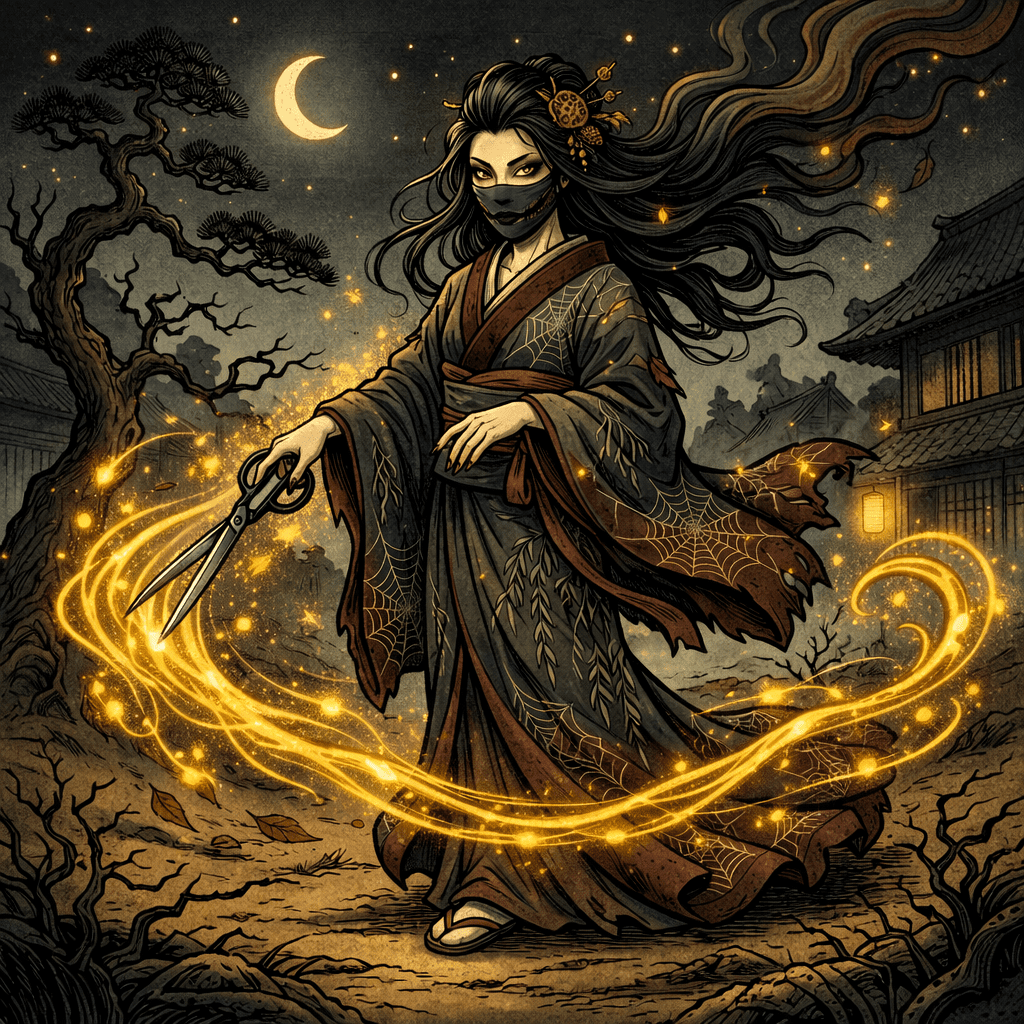
She approaches from behind, footsteps silent on the empty evening street. When you turn, you see only a woman wearing a surgical mask — not unusual in Japan, where masks are common courtesy during cold season. Her eyes are dark and very still, fixed on you with a quality of attention that feels slightly wrong, like a camera lens rather than a human gaze. She tilts her head slightly, that same unsettling stillness, and asks in a voice that sounds almost entirely normal: "Am I pretty?"
There is no correct answer. Every possible response is a trap. Say yes, and she removes the mask to reveal a mouth slit from ear to ear — a wound that transforms her entire face into a grin of impossible width — and asks again with terrifying patience: "Even now?" Say no, and she produces scissors from somewhere and closes the distance between you before you can complete the thought to run. The Kuchisake-onna is Japan's most terrifying modern legend not because she is ancient, but because she could be waiting on any street corner, right now, tonight — because she emerged from the same ordinary world you inhabit, and she is still there.
What is Kuchisake-onna?
Kuchisake-onna (口裂け女, "Slit-Mouth Woman") is a vengeful spirit or urban legend figure who appears as a beautiful woman wearing a surgical mask, who accosts lone pedestrians with her infamous unanswerable question. She occupies a genuinely unusual position in the taxonomy of Japanese supernatural beings: she is classified by folklorists as both a modern urban legend and a traditional yokai, inhabiting the rare and productive space of a supernatural entity that emerged in living memory rather than ancient history, yet has been absorbed into Japan's folkloric consciousness with the same cultural weight as figures from the Heian period (Michael Dylan Foster, "The Book of Yokai," 2015).
What makes Kuchisake-onna particularly compelling to folklorists and horror scholars is her dual nature as both cultural product and cultural mirror. She emerged from a specific and identifiable historical moment in Japanese society and carries within her legend a complex encoding of anxieties about beauty standards, domestic violence, gender power dynamics, and the masked normalcy that Japanese social convention requires people to maintain over suffering. She is not merely a ghost story — she is a social document written in fear, a supernatural articulation of wounds that the culture preferred not to discuss directly.
Unlike the ancient yokai whose origins are lost in the pre-literate mists of Japanese history, the Kuchisake-onna can be dated with unusual precision — and that datability is itself one of the most interesting things about her. She demonstrates that the impulse to create supernatural beings from social anxiety did not end with modernization but simply changed its forms, finding new vehicles for the same ancient human need to give monstrous shape to fears that resist direct expression.
What Does Kuchisake-onna Look Like?
Before the mask comes off, Kuchisake-onna appears entirely normal — a woman, often described as young and conventionally beautiful by contemporary standards, wearing fashionable clothes and a white surgical mask. This is the horror's most psychologically sophisticated element: she is entirely indistinguishable from any other masked pedestrian until the moment she chooses not to be. Her eyes are described as intensely focused, her posture abnormally still with a quality that feels subtly wrong without being obviously supernatural — the uncanny valley of human behavior, where something is almost right but definitively is not.
When she removes the mask, the revelation is catastrophic and irreversible. Her mouth has been cut — or simply is — open from corner to corner, creating a grin of impossible anatomical width that stretches to the hinges of her jaw and beyond. The interior of this wound is described variously across different accounts: scarred, keloid tissue in some versions; raw, wet flesh in others; or, most disturbingly, perfect white teeth arranged in a smile that should not be physically possible but is maintained with apparent ease, as though this is simply how her face was always meant to be. The expression, frozen permanently at maximum width, combines with the searching, burning intensity of her eyes to create one of the most psychologically disturbing images in Japanese supernatural iconography — a face that communicates the full violence of its history in a single, unblinking revelation.
She carries large scissors or a long knife, capable of replicating her own disfigurement in any victim who answers incorrectly. Some accounts describe her as possessing superhuman speed — able to run faster than any human, to appear at corners ahead of fleeing victims regardless of how fast they run, to teleport between positions with the sudden directional quality of a vengeful spirit unbound by physical geography. This teleportation ability, common in Japanese supernatural tradition, is particularly effective in the urban environment where she operates: a city's grid of streets provides endless opportunities for a spirit to step from one location to another by routes that humans cannot follow.
Where Did Kuchisake-onna Come From?
The Kuchisake-onna legend exploded across Japan in 1978-1979 in what became one of the country's most extraordinary documented mass panic events in the postwar period. Reports of encounters with a slit-mouthed woman spread through school networks at a velocity that anticipated the dynamics of later internet rumor transmission, causing genuine widespread fear — police in Gifu Prefecture and then multiple other prefectures issued formal warnings to parents and children, schools organized group escort systems, and elementary school children across Japan modified their routes home based on intelligence about where she had supposedly been seen. The panic spread outward from Gifu through much of Japan before gradually subsiding, leaving behind a legend that has never fully dissolved from Japanese cultural consciousness.
The origin narrative most commonly attached to the legend involves a beautiful woman whose husband — in some versions a jealous surgeon who had performed cosmetic procedures on her, in others simply a violent and controlling man — slashed her mouth open when he discovered her infidelity or became enraged at her beauty drawing other men's attention. In the most common version, he asked her mockingly "Who would think you are pretty now?" before cutting. She died from her wounds, or killed herself from the shame and pain of her disfigurement, and her vengeful spirit now forces others to confront the same question of beauty and violence that destroyed her life — seeking an answer that no one can give, asking forever in streets where similar cruelties continue to occur behind closed doors.
The post-COVID normalization of mask-wearing globally has given the Kuchisake-onna legend a dimension that its originators could not have anticipated. In a world where masked faces are genuinely ordinary, the premise of her encounter — the inability to read someone's face, the sense that the mask might be concealing not illness but something far more dangerous — has acquired a fresh and disquieting resonance. The horror has always been latent in the premise; contemporary experience has simply made it more immediate.
Which Anime and Manga Feature Kuchisake-onna?
The Kuchisake-onna has been embraced by anime and manga as a figure whose combination of contemporary horror and ancient yokai energy makes her compelling for modern supernatural stories. One significant appearance occurs in Toilet-Bound Hanako-kun (地縛少年花子くん), where school-based supernatural entities include figures drawing directly from Kuchisake-onna mythology. The series, set in a school haunted by supernatural beings that embody school rumors and urban legends, uses the Kuchisake-onna tradition as part of its exploration of how contemporary ghost stories emerge from and modify older supernatural frameworks — exactly the process that created her in the first place.
More broadly, the Kuchisake-onna's archetype — the beautiful woman disfigured by violence, returning with supernatural power to ask an impossible question — has influenced numerous anime and manga characters who embody similar themes of beauty, violence, and the horror of revealed truth. Her distinctly modern origin makes her particularly relevant to anime that deals with contemporary Japanese society's anxieties, where her imagery serves as shorthand for a specific kind of horror: the domestic, the hidden, the suddenly and irrevocably revealed. The question she asks — "Am I pretty?" — echoes through Japanese horror fiction long after the specific figure has left the scene.
Where Can You Encounter Kuchisake-onna in Japan?
Kuchisake-onna is not associated with specific sacred sites or rural locations in the way of older yokai. She belongs entirely to the urban and suburban environment — the quiet residential streets of Japanese cities at dusk, the stretches between convenience stores and train stations where a lone pedestrian might find themselves briefly isolated from others, the school routes that children walk each morning and afternoon. Her domain is the ordinary world turned suddenly dangerous: not the forest, not the mountain, not the ancient temple, but the grocery store parking lot at nine in the evening.
Gifu Prefecture, where the 1978-1979 panic is said to have originated, has a particular cultural claim on her legend. Some communities in the region maintain this connection as a form of dark regional identity — the originating location of Japan's most successful modern supernatural panic. Horror tourism to Gifu for Kuchisake-onna-related purposes remains modest but persistent, attracting visitors interested in the history of the legend rather than any specific supernatural site. This is appropriate: her haunting ground is not a place but a time of day, not a geography but a social situation, not a sacred mountain but the specific vulnerability of a lone person on an empty street, just after dark.
Conclusion
The Kuchisake-onna is a horror for the modern age — born not in ancient forests or feudal battlefields but on the evening streets of contemporary Japan, from the anxieties of a rapidly modernizing society that had not yet found adequate language to discuss what happened behind closed doors. Yet she has proven as durable as any ancient yokai, because she encodes a timeless fear: that beneath the normal face of everyday life, terrible things wait to reveal themselves. The mask we all wear to participate in civil society — of composure, of pleasantness, of fine — might be concealing anything. And when a stranger stops you and asks with perfect stillness whether they are pretty, there may be no safe answer, because the question is not really about beauty. It is about pain, and what pain does to those who are never given the chance to heal.
This is The Yokai Files.
What Are the Most Famous Kuchisake-onna Legends?
The legend has accumulated a remarkably detailed body of lore regarding both her methods and the purported means of escape — an unusually practical focus for a supernatural legend that reflects the urban, childhood-audience context in which it circulated. The most famous escape methods include throwing hard candy or boiled sweets (konpeito or hard sugar candies) at her feet, exploiting a compulsive need she apparently has to collect them before continuing, buying enough time to run. Answering her initial question with "average" or "so-so" (maamaa in Japanese) is said to create enough ambiguity to delay her response. Most intriguingly, asking her in return "Do I look pretty to you?" is reported to send her into sufficient self-reflective confusion to enable escape — a detail that suggests the wound she carries is fundamentally about the gaze directed at her, and that redirecting that gaze destabilizes her purpose.
Regional variants of the legend have accumulated over decades of retelling. In some versions she is slower and can be outrun by a determined adult. In others she is purely a spirit and passes through walls, making physical flight irrelevant. Some accounts from the 1979 panic period include specific street intersections and neighborhoods where she was supposedly seen — a geographic specificity that made the terror feel immediately real and locally verified to schoolchildren of the era, each neighborhood's children adding their own location data to the spreading network of fear. These specific accounts, while obviously unverifiable, demonstrate the mechanism by which urban legends acquire their staying power: the attachment to real places that people can visit and feel appropriately nervous about.
How Does Kuchisake-onna Appear in Modern Japan?
Kuchisake-onna has become one of Japan's most successfully exported horror icons, achieving international recognition that very few yokai have managed. The 2007 film Carved (Kuchisake-onna), directed by Koji Shiraishi, brought her story to modern cinematic treatment with impressive craft, achieving international distribution and introducing her to horror audiences worldwide who had no previous awareness of the 1979 panic that created her. Her image — the masked woman, the impossible smile, the scissors — has appeared in countless international horror anthologies, Halloween costume catalogs, and haunted house attractions across multiple continents. She occupies a position in the global horror vocabulary that very few specifically cultural figures achieve: immediately recognizable even to those with no direct connection to Japanese supernatural tradition.
The post-COVID normalization of mask-wearing globally has given the Kuchisake-onna legend a dimension that its originators could not have anticipated. In a world where masked faces are genuinely ordinary, the premise of her encounter — the inability to read someone's face, the sense that the mask might be concealing not illness but something far more dangerous — has acquired a fresh and disquieting resonance. The horror has always been latent in the premise; contemporary experience has simply made it more immediate.
Support The Yokai Files
Enjoyed this deep dive into Japanese folklore?
The Yokai Files is reader-supported. Your support helps us research deeper, write more, and keep the darkness alive.