Mokumokuren: The Eyes That Appear in Damaged Shoji Screens
Published: March 28, 2026
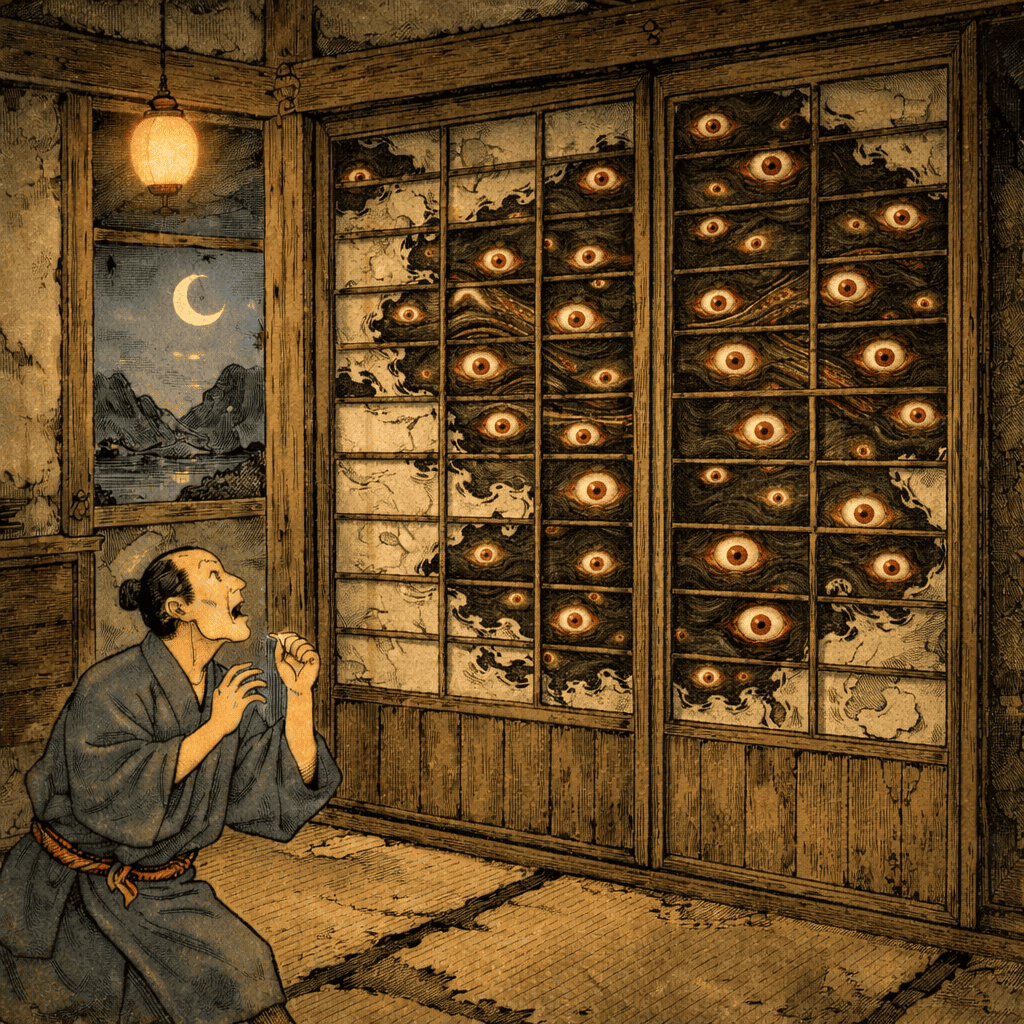
The shoji screen in the old room has been damaged for months. The paper has small holes in it, tears from age and carelessness, the kind of wear that accumulates in a house that has been lived in too long without sufficient care. You have meant to repair it. You have not gotten around to it. One evening, late, you notice that some of the holes have a quality that the others do not: they catch light differently, they seem to move slightly when you are not looking at them directly, and when you lean in close to examine one, you become certain — with a certainty that has nothing rational behind it — that it is looking back.
The mokumokuren is one of Japan's most architecturally specific yokai — a supernatural being that inhabits not bodies of water or mountains or graveyards, but damaged shoji screens, the translucent paper room dividers that are one of the most distinctive elements of traditional Japanese interior design. Its eyes appear in the tears and holes of the paper, watching silently from within the walls of a house that has been allowed to fall into disrepair. It is the house's way of telling you that it notices what you have neglected.
What is Mokumokuren?
Mokumokuren — roughly "many-many-eyes" or "eyes everywhere" — is a yokai that manifests in the holes and tears of old, damaged shoji screens. The name is constructed from moku or me (eye) repeated and combined with ren (a collective or linking suffix), evoking the multiplicity of eyes that is the creature's defining characteristic. The shoji is a sliding door or room divider constructed from a wooden lattice frame covered with translucent washi paper, a defining feature of traditional Japanese architecture that divides interior spaces while allowing light to pass through. When shoji paper is damaged and left unrepaired, it can — according to this tradition — become inhabited by eyes: small, watchful, human-like eyes that appear in the torn areas and observe whoever inhabits the room.
The mokumokuren is classified as a tsukumogami — a spirit that develops in neglected objects — and its specific nature connects it to the broader household maintenance tradition of Japanese yokai belief. Like the akaname, which inhabits dirty bathrooms, the mokumokuren represents the supernatural consequence of failing to care for one's home. Its specific danger is limited: it watches, it observes, and if truly provoked or left for too long, it may cause the homeowner to lose their eyesight — a symbolic punishment that connects directly to what it is. An eye-creature that takes eyes. The logic of supernatural consequence in Japanese folk tradition tends toward this kind of precise symmetry. Michael Dylan Foster describes the mokumokuren as exemplifying what he calls the "maintenance ethic" embedded in Japanese domestic supernatural belief — the idea that a properly maintained home is a spiritually safe home, and that physical deterioration invites supernatural occupation (Michael Dylan Foster, "The Book of Yokai," 2015).
The shoji itself is worth understanding in some depth, because the mokumokuren's nature is inseparable from the specific architectural object it inhabits. Unlike a solid wall, the shoji creates a zone of ambiguity — you can see light through it, can detect the silhouette of someone on the other side, can hear through it clearly, but cannot see precisely what is there. This architectural liminal quality, simultaneously permeable and opaque, makes the shoji a natural site for supernatural unease. Damaged shoji — with actual holes rather than merely translucent paper — intensifies this ambiguity: now there are specific apertures through which the two sides of the screen can observe each other. The mokumokuren literalizes this into the nightmare version of that dynamic: the holes are watching, actively and intentionally, with an intelligence that is not your neighbor's or your housemate's but something entirely other.
What Does Mokumokuren Look Like?
The mokumokuren has no separate physical body distinct from the shoji it inhabits. It appears as eyes — multiple, human-like eyes — looking out from the holes and tears in the damaged paper screen. Toriyama Sekien's classic illustration shows a shoji screen densely populated with these eyes, all of different sizes, all gazing outward with an intensity that suggests both awareness and hunger (Toriyama Sekien, "Gazu Hyakki Yako," 1776). The eyes appear in the existing damage rather than creating new damage themselves, which means the homeowner's own negligence determines how extensively they are being watched. A shoji with many holes hosts many eyes. A shoji with few holes hosts few. The extent of the supernatural surveillance is a direct function of the extent of domestic neglect.
The eyes themselves are described as human in form — complete with iris, pupil, and eyelid — but wrong in their context, set in paper rather than a face, looking out without a body behind them. This specificity of appearance is important: the eyes are not cartoonish or abstract. They are recognizably human eyes, which makes their presence in the paper screen more disturbing rather than less. A human eye looking out from a hole in the wall is not a curiosity. It is a violation of the boundary between the human and the other, rendered in the most familiar possible form.
Different accounts describe the eyes as blinking at different rates, as tracking the movement of people in the room with unnerving precision, as closing at dawn and opening again at dusk. Some accounts describe them as glowing faintly in complete darkness — a faint phosphorescent gleam from each eye that would make the damaged screen visible in a dark room in a way that an undamaged screen would not be. This nocturnal luminescence, combined with the unblinking quality attributed to many yokai eyes, creates an image of the damaged screen at night that is among the most unsettling in the Japanese supernatural tradition: a wall studded with gleaming watching eyes, tracking everything that moves in the room.
Where Did Mokumokuren Come From?
The mokumokuren appears to have been primarily a literary and artistic creation rather than a deep folk tradition, with its main documentation coming from Toriyama Sekien's yokai encyclopedias of the 18th century. Sekien was a prolific inventor of yokai as well as a documentarian of existing ones, and some scholars believe the mokumokuren was largely his creation — a vehicle for exploring the visual possibilities of eyes in unexpected contexts, combined with the familiar household-maintenance moral framework that characterizes so many domestic yokai. Sekien's encyclopedias are remarkable not only as documents of existing folk tradition but as creative works in their own right, and the mokumokuren illustrates how a skilled artist working in the yokai tradition could generate new supernatural beings that felt genuinely traditional because they engaged so directly with real cultural anxieties.
Whether or not Sekien invented the creature, its resonance with genuine Japanese anxieties about household space, privacy, and the unseen gaze has kept it vital for nearly three centuries. The shoji screen is specifically a screen that divides while still allowing the suggestion of presence — you can see the shadow of someone on the other side, can detect movement without seeing its source — and the mokumokuren literalizes this architectural ambiguity into supernatural form. This translation of architectural experience into supernatural narrative is characteristic of how the most resonant yokai are constructed: they take something real about the physical and social environment — the uncanny quality of the shoji, the anxiety about being watched without knowing it — and give that quality a name, a face, and a set of behaviors.
The concept of the supernatural gaze in Japanese tradition has deep roots that predate any specific yokai. The idea that to be watched is to be vulnerable, that observation by supernatural entities carries real spiritual consequences, appears throughout Japanese mythology and folk belief. The hitotsume-kozo watches and records; the various divine beings that monitor human behavior for celestial authorities watch and judge; and the mokumokuren watches from the very walls of the home, using the damage that the homeowner created as its apertures. The gaze that comes from inside the house is arguably more disturbing than any external supernatural threat — the home is supposed to be the space of safety and privacy, and the mokumokuren makes that very safety conditional on the maintenance of the home's physical integrity.
During the Edo Period, when the mokumokuren was systematized in Sekien's encyclopedias, paper screens were a universal feature of Japanese domestic architecture across all social classes. Unlike some yokai that were associated with the experiences of specific regions or social groups, the mokumokuren's home environment was one that virtually every Japanese person shared. The damaged shoji was not an exotic setting but a feature of everyday domestic life, which meant that the mokumokuren tradition could speak directly to a universal experience: the damaged screen you keep meaning to fix, the holes that accumulate in the paper over a winter, the deferred maintenance that feels harmless until the stories you grew up with remind you that deferred maintenance has a cost.
What Are the Most Famous Mokumokuren Legends?
The mokumokuren does not have an extensive narrative tradition — it appears primarily in illustrated yokai encyclopedias rather than in story collections, its visual impact doing the work that narrative does for other yokai. What accounts exist describe householders who notice eyes in their damaged shoji, initially dismissing them as tricks of light, and then progressively recognizing the intelligence behind the gaze. The remedy is straightforward: repair the shoji. The eyes disappear when the holes that host them are closed. The simplicity of the solution is part of what makes the tradition interesting: unlike most supernatural threats, this one can be fixed with paper, paste, and a free afternoon.
One classic account involves a household in Kyoto during the late Edo Period. The head of the household, a prosperous merchant, had been neglecting the maintenance of a storage room at the back of his house — the room where he kept old inventories, discarded furniture, and objects he no longer used. The shoji of this room had developed numerous holes over several years, and when a young servant was sent to retrieve something from the storage room late one evening, she returned immediately, pale and refusing to re-enter. She reported seeing eyes in the screen. The merchant, skeptical, went himself — and saw them too. Dozens of eyes, all different sizes, all looking at him from the damaged paper with an attention he found deeply unnerving. He had the screen repaired the following morning. The servant refused to work in that room for months thereafter, claiming she could still feel the gaze even though the paper was now whole.
The detail in this account — the servant's residual unease even after the repair — touches on something the mokumokuren tradition implies but rarely states directly: that the repair removes the visible manifestation but not the underlying spiritual condition that created it. A screen that has hosted mokumokuren eyes has been, in a sense, spiritually colonized, and while the yokai departs when the holes are closed, the memory of its presence lingers in the space. Some accounts recommend not just repairing the shoji but replacing it entirely and performing purification rituals for the room — a more thorough response to what is, at its core, a simple maintenance problem elevated to supernatural significance.
How Does Mokumokuren Appear in Modern Japan?
The mokumokuren appears in comprehensive yokai collections and has a significant presence in Japanese horror visual vocabulary. Eyes in unexpected surfaces are a recurring motif in J-horror — the tradition of contemporary Japanese horror film and literature that achieved international recognition in the 1990s and 2000s — and the mokumokuren can be seen as a classical precursor to this tradition. The horror of eyes in walls, eyes in floors, eyes in the fabric of the house itself, runs from the mokumokuren's Edo Period illustration through the visual language of modern Japanese horror without interruption, demonstrating the durability of the underlying fear this yokai embodies.
In video games, the mokumokuren appears as an environmental hazard and atmospheric element in games with traditional Japanese haunted-house settings. The use of watched spaces — rooms where the sense of being observed creates discomfort — in horror game design draws on the same psychological mechanism that the mokumokuren tradition engages. Games that feature rooms full of watching eyes, or that use surveillance as a horror mechanic, are in dialogue with the mokumokuren's fundamental premise even when they do not explicitly reference it.
Which Anime and Manga Feature Mokumokuren?
The mokumokuren has a direct presence in the GeGeGe no Kitaro franchise, where it appears among Shigeru Mizuki's extensive catalog of yokai characters in both the manga and the Toei Animation adaptations beginning in 1968. Mizuki's treatment of the mokumokuren is characteristically precise — a damaged shoji populated with watching eyes, rendered with the combination of naturalistic accuracy and supernatural unease that defines his best work (Shigeru Mizuki, "GeGeGe no Kitaro," manga, 1960s; GeGeGe no Kitaro, Toei Animation, 1968). In the Kitaro universe, the mokumokuren functions as an element of the haunted house tradition that appears frequently in the series, contributing to the sense of domestic spaces transformed by supernatural neglect into something genuinely threatening.
Haunted house themes in anime constitute a significant and distinctive subgenre that has engaged with the mokumokuren tradition both explicitly and implicitly across decades of production. Series such as Gegege no Kitaro's various remakes (1971, 1985, 1996, 2007, 2018) have each revisited domestic supernatural beings including the mokumokuren, updating their visual presentation while preserving the fundamental dynamics of the original tradition. The 2018 Toei Animation remake of GeGeGe no Kitaro introduced the mokumokuren to a new generation with updated visual effects that emphasized the uncanny quality of eyes appearing in paper surfaces, using lighting and animation techniques unavailable in the original 1968 series to amplify the creature's inherent horror.
Beyond the Kitaro franchise, the influence of the mokumokuren on haunted house anime is pervasive if often unattributed. The classic horror anime aesthetic of eyes appearing in unexpected surfaces — walls, mirrors, screens, floors — draws directly on the mokumokuren's visual grammar. Series such as Xxxholic (CLAMP, adapted by Production I.G.), which deals extensively with the supernatural dimensions of domestic spaces and the gaze of supernatural beings, operate in the same aesthetic territory as the mokumokuren even when their reference points are primarily contemporary rather than classical. The creature established a visual language for domestic surveillance and the watched interior that subsequent animators and illustrators have built on continuously, making the mokumokuren one of the most influential yokai in the history of Japanese visual horror even for audiences who have never heard its name.
Where Can You Encounter Mokumokuren in Japan?
Old machiya townhouses in Kyoto and traditional farmhouses across rural Japan offer the atmospheric context in which the mokumokuren tradition makes its most visceral sense. Many of these buildings have been preserved or converted into museums, guesthouses, or cultural centers, and spending time in their paper-walled interiors — particularly at night, with the screens casting shadows and the wood settling around you — provides an immediate understanding of why the damaged shoji became a site of supernatural anxiety. The particular quality of light that comes through intact washi paper, and the particular quality of darkness that comes from a screen with holes in it, are things that must be experienced in person to be fully understood.
The Kyoto Museum of Traditional Crafts preserves examples of traditional shoji construction and repair, providing context for understanding the object at the center of the mokumokuren tradition. For those interested in Toriyama Sekien's original illustrations, the National Diet Library in Tokyo holds his complete works, and various art museums including the Tokyo National Museum contain related Edo Period yokai art. The Mizuki Shigeru Road in Sakaiminato includes a mokumokuren installation that renders the shoji-eye image at human scale. Traditional inn (ryokan) accommodations throughout Japan provide the most authentic physical context: a night in a room divided by shoji screens, with the sounds of an old building around you and the knowledge of what Japanese tradition says might be watching through any holes in the paper, is its own kind of education in why this creature has persisted for so long.
Conclusion
The mokumokuren teaches a lesson about attention. The shoji screen is damaged. You notice. You do not act. The damage worsens, the holes multiply, and each one becomes a small aperture through which something looks inward at a household that has stopped paying attention to itself. The eyes are your own inattention made visible and given a gaze. They watch you from the screens you have neglected, noting everything with the patience of something that has all the time in the world and nowhere to be.
Repair the shoji. Not because you believe in the eyes. Because the act of repair is itself a form of attention, and houses that are paid attention to stay whole longer than those that are not. The mokumokuren just makes that truth uncomfortable. It takes the private space of the home — the space you believed was yours, observed only by the people you chose to share it with — and populates it with watchers generated by your own carelessness. In a tradition preoccupied with the relationship between care and the supernatural, between maintenance and safety, between attention and protection, the mokumokuren is perhaps the most elegant expression of the core principle: the things you neglect develop their own eyes. And they have been watching you for longer than you know.
This is The Yokai Files.
Support The Yokai Files
Enjoyed this deep dive into Japanese folklore?
The Yokai Files is reader-supported. Your support helps us research deeper, write more, and keep the darkness alive.