Noppera-bo: The Faceless Ghost That Lurks on Japan's Night Roads
Published: March 28, 2026
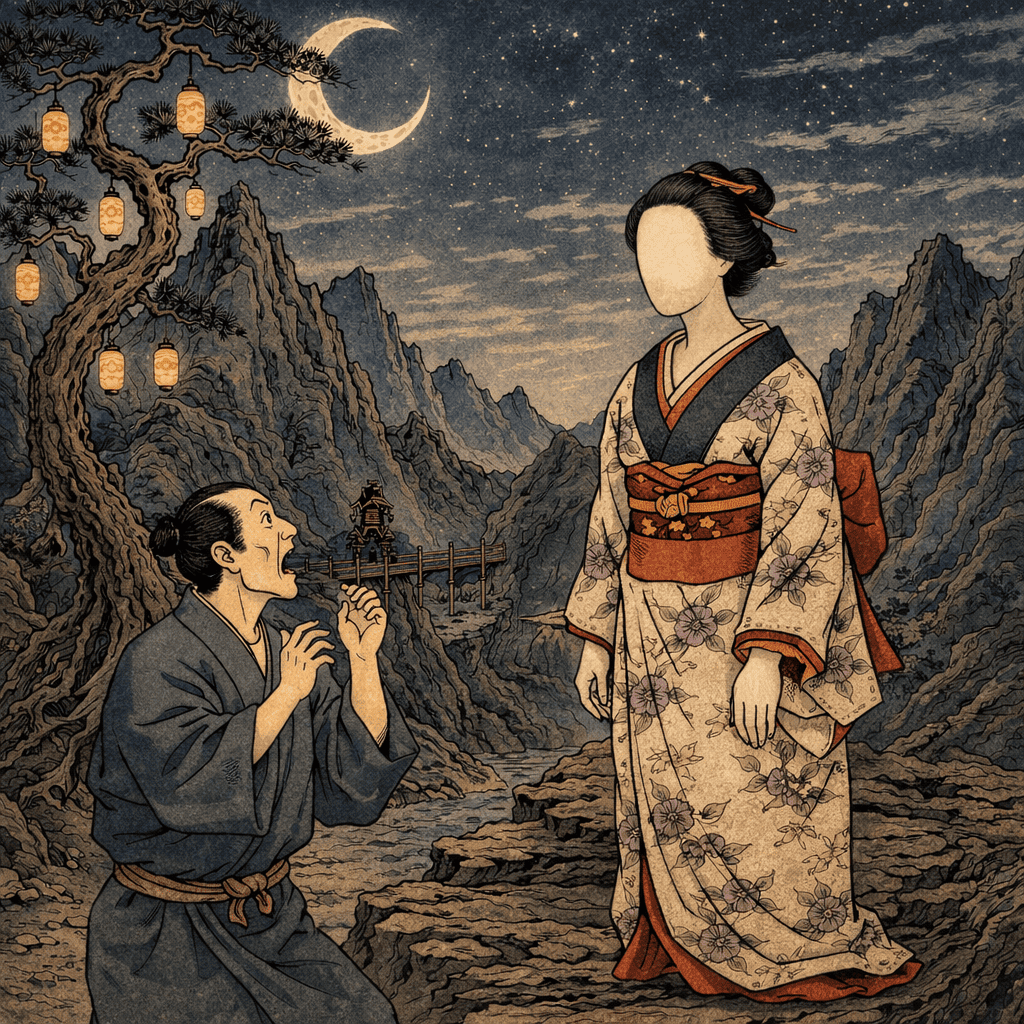
The woman at the side of the road was weeping. This much seemed straightforward — a person in distress, alone at night, the natural human response obvious and immediate. The traveler approached, asked what was wrong. The figure turned around. Where her face should have been, there was nothing: no eyes, no nose, no mouth, just a smooth, featureless expanse of skin where all the human features should have been. The traveler ran. He ran until he reached the lights of a food stall, gasping out what he had seen. The vendor listened, then turned to face him. Where his face should have been, there was nothing either.
The noppera-bo — the faceless ghost — operates on a principle of horror that is as pure as any in Japanese supernatural tradition: the removal of the human face, the erasure of the features that make a person recognizable and communicable, the revelation that the world contains entities that look human from behind and from a distance but are, at the moment of intimate encounter, something else entirely. It does not attack you physically. It simply shows you what it is, and trusts that this will be enough.
What is Noppera-bo?
Noppera-bo — written のっぺらぼう, literally "smoothly blank" or "featureless" — is a yokai that appears as an ordinary human being until it reveals a smooth, blank face where features should be. The name derives from the Japanese adjective nopperi, meaning smoothly flat or featureless, combined with the suffix -bo, which indicates a person or entity. The creature is sometimes also known as nupperi-bo or nuppefuhofu in variant traditions, and it is occasionally conflated with the mujina — the shape-shifting badger or raccoon dog — though this conflation is itself a source of deliberate confusion in the most famous literary account of the encounter (Lafcadio Hearn, "Kwaidan," 1904).
The noppera-bo is not typically classified as a malevolent entity in the sense of causing physical harm; its interaction with humans is primarily psychological, and the shock of its true face is its primary weapon. What the noppera-bo takes from its victims is not blood or life but the comfortable assumption that the world is what it appears to be — that the people you encounter in it are people, that faces contain what faces should contain, that the social codes by which you navigate human interaction apply to the entities you meet. The noppera-bo demonstrates that these assumptions can be wrong, and the demonstration is irrefutable.
The creature is associated with roads at night — it typically appears to travelers walking alone after dark, either approaching as a weeping figure or appearing as a worker or vendor in a remote location. The horror unfolds in stages: first the encounter with what seems to be a normal human in an unexpected place, then the revelation of the blank face, then — in the most complete versions of the encounter — the confirmation at what should be a safe location that the blank face is not a unique aberration but a repeatable condition of the world you now inhabit.
What Does Noppera-bo Look Like?
From behind and from a distance, the noppera-bo is indistinguishable from an ordinary human being. It appears in the clothing appropriate to its assumed context — a traveler in traveler's clothing, a vendor in work clothes, a grieving woman in appropriate mourning attire. Its movement, posture, and general demeanor are all convincingly human. It occupies space the way a human does. It makes sounds the way a human does. The revelation of its true nature comes only at the moment of face-to-face encounter: instead of the expected features, there is simply smooth skin, featureless, without even the subtle contours that appear in a face even when the eyes are closed.
The blank face is not like a mask. It is not like a face hidden or covered. It is like a face that was never made — a head with the general shape of a human head but none of the specific features that make a head a face. Hearn's description in "Kwaidan" captures the specific horror with precision: the vendor at the food stall "smoothing all those features into emptiness" with one sweep of a hand, as if erasing what was there rather than revealing what was always the case (Lafcadio Hearn, "Kwaidan," 1904). The gesture — the deliberate smoothing of the face — suggests performance, a being that is aware of the effect it produces and chooses the moment of revelation.
The noppera-bo's blank face is able, in some traditions, to briefly form features — to show what appears to be the face of someone the victim knows, a loved one or acquaintance — before smoothing back to blankness. This variant is considered particularly devastating, as it weaponizes recognition itself: the moment of believing you see a familiar face, followed by the erasure of that face, intensifies the horror of the blank beyond what a simple featureless stranger could produce.
Where Did Noppera-bo Come From?
The noppera-bo appears in Japanese supernatural literature from the Edo Period, though the tradition of faceless or face-distorting supernatural beings is older. Several early Edo Period collections of supernatural tales include encounters with smooth-faced entities, reflecting a cultural preoccupation with the face as the primary site of human identity and the horror of its absence or erasure. The face in Japanese culture carries enormous social weight: it is the site of on (obligation, honor) and its loss, the surface through which social relationships are managed and maintained. A being without a face is a being that cannot participate in the social order that faces exist to manage.
The creature's specific modern form was significantly shaped by Lafcadio Hearn's 1904 "Kwaidan" collection, which included his version of the noppera-bo story under the title "Mujina" — deliberately naming the story after the shape-shifting animal rather than the faceless entity, a move that creates an additional layer of uncertainty about what exactly the traveler encountered. Hearn's elegant, spare prose gave the story a literary quality that made it highly influential, and his version became the standard template for how the noppera-bo encounter is told in English and in many modern Japanese retellings (Lafcadio Hearn, "Kwaidan," 1904).
Earlier literary treatments include the Edo Period collection "Tonoigusa" (1660), which contains accounts of faceless supernatural beings encountered on roads at night, and various regional ghost story collections that demonstrate the broad distribution of the faceless encounter trope across Japanese geography. The creatures in these earlier accounts are more ambiguous about their nature and motivation than the relatively standardized noppera-bo of later tradition, suggesting that the specific yokai category crystallized over time from a broader tradition of faceless supernatural encounter.
What Are the Most Famous Noppera-bo Legends?
Hearn's version of the noppera-bo story, set on the old road between Akasaka and the moat at Aoyama in what is now central Tokyo, remains the most famous and most carefully crafted account of the encounter. The story proceeds with extraordinary economy: a merchant walking home late encounters a young woman crouching and weeping beside the road at the edge of the moat. He stops, concerned, asks what is wrong. She turns. The blank face. He runs, eventually reaching a distant food stall where a man with a paper lantern is working. He stammers out his encounter. The vendor looks up. "Was it anything like THIS?" And the vendor's face is blank (Lafcadio Hearn, "Kwaidan," 1904).
The two-stage structure of Hearn's account is what elevates it above a simple supernatural encounter story. The first revelation is horrifying; the second, at the place of apparent safety, transforms the horror from a specific incident into a general condition. The safe place is not safe. The help you ran to cannot help you. The world contains more blank faces than the one you saw, and you cannot know in advance which faces are blank. This second revelation — the defeat of the safe space — is the true achievement of the story, the reason it has been retold for over a century in versions that differ in setting but maintain the essential two-stage structure.
Beyond the Hearn version, regional Japanese traditions contain numerous noppera-bo encounters with their own distinctive features. In some Kansai traditions, the faceless figure appears specifically at crossroads, which are understood as liminal spaces where supernatural and natural realms intersect. In northeastern Japan, accounts describe the noppera-bo appearing at wells and water sources — locations that in Japanese folk belief are understood as points of entry between the worlds of the living and the dead.
How Does Noppera-bo Appear in Modern Japan?
The noppera-bo has become one of the most internationally recognized Japanese supernatural figures, and its influence on global visual culture extends well beyond direct citation. The blank face as a signifier of uncanny horror — the human form minus the human features — has become a broadly understood visual shorthand in horror and supernatural contexts. Faceless figures in contemporary horror films, games, and visual art often draw, consciously or not, on the noppera-bo tradition's fundamental insight: that the removal of the face is more disturbing than any monstrous transformation could be.
In contemporary Japanese urban legend tradition, the noppera-bo has been updated for modern settings: some versions describe the faceless person appearing in subway cars, in elevators, or in the reflections of glass doors rather than on lonely roads. The setting changes; the horror of the blank face does not. The modernized versions preserve the essential two-stage structure — the initial encounter and the confirmation at a supposedly safe location — demonstrating how adaptable the core narrative structure is to changing environments (Michael Dylan Foster, "The Book of Yokai," 2015).
Which Anime and Manga Feature Noppera-bo?
The noppera-bo has been depicted in multiple anime and manga contexts, reflecting its status as one of Japan's most recognizable yokai. In the GeGeGe no Kitaro franchise (Toei Animation, 1968), faceless supernatural beings appear in various episode contexts, with the noppera-bo tradition informing several storylines that explore the horror of the blank face and its effect on the human characters who encounter it (GeGeGe no Kitaro, Toei Animation, 1968). The franchise's broad yokai roster naturally incorporates this classic figure.
In Nurarihyon no Mago (Brain's Base, 2010), an anime series that explores the political structures of the yokai world, the noppera-bo appears as part of the broader catalogue of supernatural beings that populate the story's cosmology. The series' treatment reflects the standard visual interpretation of the noppera-bo — a figure with a smooth, featureless face — while incorporating the creature into a more complex narrative about yokai society and hierarchy. The series demonstrates how the noppera-bo, as a visually distinctive and immediately recognizable yokai, serves as reliable shorthand for supernatural unease when deployed within a yokai-centered narrative framework (Nurarihyon no Mago, Brain's Base, 2010).
Beyond direct depictions, the noppera-bo's visual concept — the blank face — has influenced Japanese horror anime and manga in ways that often go unacknowledged. The faceless female figure No-Face in Spirited Away draws partially on this tradition, as do numerous antagonists in horror manga that use featurelessness as their primary visual horror element. The noppera-bo's core innovation — that the absence of features is more disturbing than their distortion — has become so absorbed into Japanese visual horror language that its specific source is often invisible (Michael Dylan Foster, "The Book of Yokai," 2015).
Where Can You Encounter Noppera-bo in Japan?
The specific road where Hearn set his "Mujina" story — the old road to Akasaka in Tokyo — still exists in some form, though it is now thoroughly urban. The Akasaka-Aoyama area of Tokyo retains some of the atmospheric weight of its history, with old temples and shrines interrupting the modern architecture. For those who want to walk the old road and feel the geography of the story, the area is accessible by subway from Akasaka-Mitsuke or Aoyama-Itchome stations and offers a genuine layering of old and new that is appropriate to the encounter the story describes.
More atmospheric noppera-bo territory can be found on the old Tokaido road between Tokyo and Kyoto, sections of which still exist as walking paths through rural areas. The Tokaido was the main artery of Edo Period travel, and the ghost story tradition associated with it is extensive. Walking preserved sections of the road — particularly in the hilly sections between Hakone and Mishima — provides direct contact with the kind of isolated night-road environment that the noppera-bo tradition requires.
Conclusion
The noppera-bo's power comes from what it removes rather than what it possesses. A face is how we recognize a person as a person — as having interiority, history, emotion, the capacity for relationship. Remove the face and what remains is a shape that moves like a human and sounds like a human and occupies human space but is not one in any way that matters to us. The noppera-bo asks: what would you do if you discovered that the person you were talking to had no face? And then, worse: what would you do if you discovered that the person you ran to for help had no face either?
At that point, the question becomes not what they are, but what you are going to do with the information that nowhere is safe. The noppera-bo is waiting on the road. It has been there for a long time. It will be there for a long time more. Hearn knew this when he wrote his spare, devastating version of the story, and the century-plus of retellings since proves him right: some horrors do not age (Lafcadio Hearn, "Kwaidan," 1904).
This is The Yokai Files.
Support The Yokai Files
Enjoyed this deep dive into Japanese folklore?
The Yokai Files is reader-supported. Your support helps us research deeper, write more, and keep the darkness alive.