Nue: The Chimeric Monster That Haunted the Imperial Palace
Published: March 27, 2026
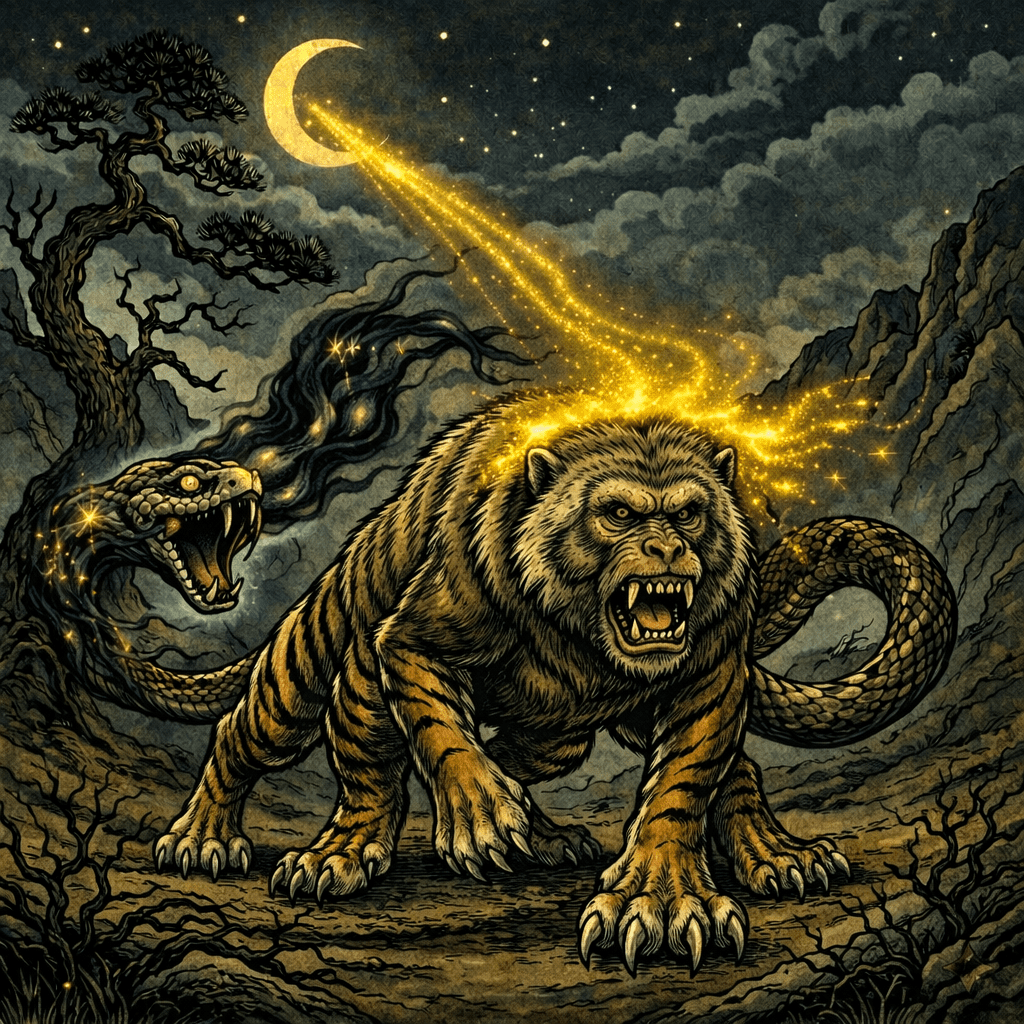
In the depths of the Heian night, when Kyoto's imperial palace lay wrapped in silence and the aristocracy dreamed their perfumed dreams behind screens of lacquered wood and woven silk, a sound began. It came from the direction of the palace roof — a cry unlike anything that should exist in the natural world, a sound that mixed the hollow melancholy of the lesser cuckoo with something darker and far more ancient, something that bypassed the ears and registered directly in the part of the brain that recognizes mortal danger without consulting reason. The court diviners were summoned. The priests performed their rituals. The incense burned through the night. And still the sound continued, and still the Emperor sickened.
The Emperor fell ill with the specific, terrible illness of supernatural haunting — the kind that drains from inside rather than attacks from outside, leaving the body technically functional but the mind and spirit progressively emptied of their capacity to sustain life. The court fell into controlled panic. And on the rooftop above the innermost sanctum of the imperial palace, assembled from the impossible combination of monkey, tanuki, snake, and tiger into a form that violated every principle of natural classification, the Nue settled its impossible body and continued its cry into the killing dark.
What is Nue?
The Nue (鵺) is one of Japan's most ancient and philosophically disturbing chimeric monsters — a creature assembled from incompatible animal parts that should not exist in any coherent biological form, yet does, with devastating supernatural effect on any human consciousness that encounters it. In classical Japanese literature, the Nue is described as having the head of a monkey, the body of a tanuki (raccoon dog), the legs of a tiger, and a tail that is itself a living, independently animate snake. This precise combination of creatures from entirely different ecological niches — the arboreal primate, the forest omnivore, the apex predator, the reptilian — creates something that defies natural classification at every level of analysis (Shigeru Mizuki, "Yokai Daizukan," 1994).
The Nue's most distinctive and most terrible characteristic is not its appearance but its effect: its presence and its cry cause mysterious illness, specifically described in historical accounts as a profound psychological and spiritual disturbance — a progressive erosion of the victim's capacity to remain oriented in reality that might today be described as severe anxiety disorder, existential crisis, or a dissociative breakdown induced by supernatural means. The Nue does not need to attack physically. It does not need to touch its victims or even approach them directly. It haunts, and the haunting itself does the work, hollowing out the capacity for health and peace from the inside until nothing remains to sustain life.
This mode of attack — through psychological disturbance rather than physical violence — places the Nue in a specific and important category of Japanese supernatural beings: those whose horror operates through the mind rather than the body, whose danger is existential rather than merely physical. The Heian aristocracy, for whom psychological and spiritual wellbeing were understood as directly connected to physical health in ways that modern medicine has largely disconnected, were particularly vulnerable to exactly this kind of supernatural assault (Lafcadio Hearn, "Kwaidan," 1904).
What Does Nue Look Like?
The visual description of the Nue in classical sources is deliberately and precisely unsettling because it assembles perfectly recognizable elements into a configuration that the brain cannot process as natural. The monkey head — intelligent, almost human, with the mobile face and bright eyes of a creature that mirrors human expression uncomfortably closely — sits atop a tanuki body that should be comical, familiar, unthreatening, yet in this context seems profoundly wrong, the roundness and furriness of a forest animal become somehow grotesque when surmounted by a primate's face. The tiger legs provide physical power entirely disproportionate to the body above them — the legs of an apex predator attached to something that looks like it should be waddling through an autumn forest collecting acorns. And the snake tail, living independently, watching with its own cold intelligence from behind, ensures that even when facing the creature directly you remain perpetually exposed to a different kind of attention (Toriyama Sekien, "Gazu Hyakki Yako," 1776).
In artistic representations spanning the Heian through Edo periods, the Nue is typically depicted as a dark mass — rendered as black cloud or smoke from which these animal elements emerge partially, incompletely, as though the creature exists in a state of perpetual incompletion. This visual choice is not artistic uncertainty but accurate representation of the Nue's fundamental ontological status: it is something that exists between categories, that belongs fully to none of the natural kingdoms it draws from, that occupies the classificatory gaps between the things we know rather than inhabiting any of those things themselves. The darkness surrounding it is not merely visual atmosphere; it is the visual language of categorical wrongness, of a thing that generates its own conceptual shadow.
Its voice is described in historical records as the call of a hototogisu (lesser cuckoo, Cuculus poliocephalus) — a haunting, melancholy bird call that in Japanese classical poetry is so thoroughly associated with grief, longing, and the awareness of mortality that it appears in hundreds of poems as shorthand for the particular quality of beauty-tinged-with-sadness that the Japanese aesthetic tradition calls mono no aware. The combination of this deeply culturally resonant sound with the Nue's impossible physical form creates a creature that attacks through aesthetic wrongness as much as supernatural malevolence — a being that corrupts beauty itself, turning the most poetically charged call in the Japanese natural world into a herald of illness and death.
Where Did Nue Come From?
The Nue's origins are rooted in both ancient animist beliefs about chimeric supernatural creatures — beings that combine multiple animal natures into a form that transcends any individual species — and in the specifically Heian aristocratic culture of omen interpretation and supernatural threat assessment. The Heian court was extraordinarily sensitive to supernatural portents, maintaining an elaborate infrastructure of professional diviners, exorcists, and ritual specialists whose function was to identify, interpret, and neutralize supernatural threats to the imperial family and the social order they embodied. A creature that combined animals from all four directional quadrants of the Chinese-influenced cosmological system (monkey-north, tanuki-center, tiger-west, snake-south in some interpretations) would represent a supernatural convergence of malevolent influences from across the entire cosmological spectrum — not merely bad luck in one direction but a systematic assault on the ordered universe from every angle simultaneously.
The historical specificity of the most famous Nue legend — naming real people, real places, a real emperor's illness and recovery — suggests that whatever sequence of events gave rise to the story, it was significant enough to enter the historical record in a form that persisted and was believed rather than simply filed away as imagination. Court chronicles from the mid-Heian period do record periods of imperial illness accompanied by mysterious nighttime disturbances, and the cultural response to such events — calling for warrior-archers skilled in ritual archery to perform purification through the symbolic act of shooting into supernatural darkness — is historically documented as a genuine practice of the period. The Nue legend crystallized around a real practice responding to a real cultural anxiety, giving it the solidity that only genuine historical experience can provide (Michael Dylan Foster, "The Book of Yokai," 2015).
What Are the Most Famous Nue Legends?
The defining Nue legend is recorded in the Heike Monogatari (平家物語, The Tale of the Heike), one of Japan's great literary epics of the medieval period, composed in the thirteenth century to commemorate the Genpei War. During the reign of Emperor Konoe (1141-1155) in the twelfth century, the Emperor suffered from terrible, recurring nightmares and a mysterious wasting illness that had no apparent natural cause and resisted every conventional treatment. Night after night, precisely at the Hour of the Ox (between 2 and 4 AM, the hour of dead-spirit activity in the Chinese cosmological framework), a black cloud was observed gathering over the northeastern section of the palace roof, accompanied by a cry that the court identified as the hototogisu but with qualities that no natural bird could produce. The Emperor's condition deteriorated with each passing night, and the anxiety of the court reached crisis level.
The warrior Minamoto no Yorimasa, renowned for his skill with the bow and his military discipline, was summoned and tasked with dealing with whatever lurked in the black cloud above the palace. On the appointed night, Yorimasa took his position in the palace gardens, waited with the complete stillness that distinguished the great archers from the merely competent, and at the moment when the black cloud gathered most densely, fired a single arrow into its center. A terrible, complex cry erupted — not the hototogisu call but something deeper and more final — and something fell from the cloud into the garden below. His companion Ii no Hayata ran to the fallen creature and dispatched it with his blade where it lay, discovering the impossible chimeric form: monkey head, tanuki body, tiger legs, and still-writhing snake tail that he was required to pin to the ground before it could bite him. The Emperor recovered immediately and completely. Yorimasa received his arrow back as the highest honor the court could bestow, and the Nue's body was placed in a boat filled with weighted stones and sent down the river — drifting eventually, according to legend, to wash ashore near Ashiya in what is now Hyogo Prefecture, where local people buried it with appropriate rites to prevent any revival.
A second Nue incident is recorded in the same tradition, occurring later in Yorimasa's career — suggesting that either the first Nue was not unique or that its defeat attracted others of its kind to the site of the confrontation. This second encounter was handled with the same disciplined archery, and the same recovery of the Emperor followed. The repetition suggests not merely a single extraordinary event but an ongoing vulnerability of the imperial space to this specific supernatural threat — a structural weakness in the palace's supernatural defenses that required active maintenance rather than a single heroic intervention.
How Does Nue Appear in Modern Japan?
The Nue has found a rich and varied afterlife in modern Japanese media, where its chimeric nature, its association with psychological disturbance rather than physical violence, and its specific historical grounding in the Heike Monogatari give it a cultural weight that purely invented monsters cannot achieve. The word "nue" has entered modern Japanese as an idiom — something described as "nue-like" (nue no you na) is fundamentally ambiguous, defying classification, impossible to pin down, existing in the gaps between established categories. This linguistic absorption of a supernatural creature's defining quality into everyday usage represents the deepest possible integration of mythology into living culture.
In video games, the Nue appears across numerous titles that engage with Japanese supernatural tradition — from historical strategy games set in the Heian and medieval periods, where the Nue appears as an accurate historical-folkloric reference, to fantasy role-playing games where its chimeric attack pattern and psychological damage mechanics distinguish it from straightforwardly physical enemies. Its darkness and confusion-based attacks reflect the traditional understanding of its nature: it does not fight so much as it corrupts perception, making its enemies unsure of what they are seeing, hearing, and experiencing.
Which Anime and Manga Feature Nue?
The Nue's combination of ancient literary prestige and genuinely disturbing supernatural qualities has made it a compelling subject for anime and manga that engage seriously with Japanese yokai tradition. In Nurarihyon no Mago (Nura: Rise of the Yokai Clan), the Nue appears as a significant supernatural entity within the story's hierarchical framework of yokai power — preserving the traditional understanding of the Nue as something that operates at the highest levels of supernatural authority rather than merely as a monster to be defeated. The series' treatment of the Nue reflects an awareness of the creature's literary and historical pedigree, positioning it within a coherent tradition rather than simply using its striking visual design as convenient spectacle.
More broadly, the Nue's defining quality — its existence between categories, its resistance to classification, its ability to disturb simply by being present — has influenced numerous anime characters and entities whose supernatural nature is characterized by ambiguity and the disruption of established frameworks. The idea that a supernatural being's power derives not from raw force but from the fundamental wrongness of its existence, from its occupation of the spaces between the things we can name and understand, is distinctly captured in the Nue tradition and echoes through the anime and manga that engage most thoughtfully with Japanese supernatural heritage.
Where Can You Encounter Nue in Japan?
The Nue Mound (Nue-zuka) in Ashiya City, Hyogo Prefecture, marks the legendary landing point where the Nue's body washed ashore after being sent down the river from Kyoto. Local tradition maintains a small shrine at this location, modest in scale but persistent across centuries, marked on regional tourism materials as a point of historical and folkloric significance. The mound is not the dramatic supernatural site that the legend's scope might suggest — there is no imposing structure, no elaborate ceremony. Its quiet, unassuming presence over many generations is itself a form of testimony to the genuine depth of the Nue's place in regional memory: not a manufactured tourist attraction but a genuine community acknowledgment that something extraordinary once ended here.
The Heian Jingu shrine complex in Kyoto, a reconstruction of the original Heian palace environment, and the surrounding Kyoto Imperial Park maintain a quality of ancient stillness and spatial authority that makes the original Nue legend feel geographically real rather than abstractly historical. Walking the paths of the park in the early morning, before the tourist crowds arrive, when the ancient pine trees cast their particular quality of filtered light and the sounds of the city are still muted, it is possible to understand how this space could feel vulnerable to exactly the kind of supernatural intrusion that the Heike Monogatari describes.
Conclusion
The Nue represents a different and perhaps more sophisticated kind of horror than the physical violence of the Gashadokuro or the predatory beauty of the Jorōgumo. It is the horror of the unclassifiable — of something that should not exist because it violates the organizing principles by which we understand the natural world, and that generates illness simply by existing in proximity to human consciousness that cannot accommodate it. Its power comes not from what it does but from what it is: an embodiment of categorical wrongness, a creature that demonstrates that reality contains configurations which human minds are not equipped to process safely. The Heian aristocrats who fell ill in its presence were not weak or superstitious — they were responding appropriately to something genuinely incompatible with the ordered world their civilization had constructed.
In the darkest hours of the Kyoto night, when the air carries the melancholy cry of a bird that seems to come from no particular direction, when the sound fills the space between sleep and waking with its specific quality of beautiful wrongness — the old fear surfaces. Something assembled from wrong parts is watching from above. And its watching, its mere existence nearby, is enough to make the world feel less stable, less organized, less safe than it seemed before the sound began.
This is The Yokai Files.
Support The Yokai Files
Enjoyed this deep dive into Japanese folklore?
The Yokai Files is reader-supported. Your support helps us research deeper, write more, and keep the darkness alive.