Nurikabe: The Invisible Wall That Blocks Roads and Drives Travelers Mad
Published: March 28, 2026
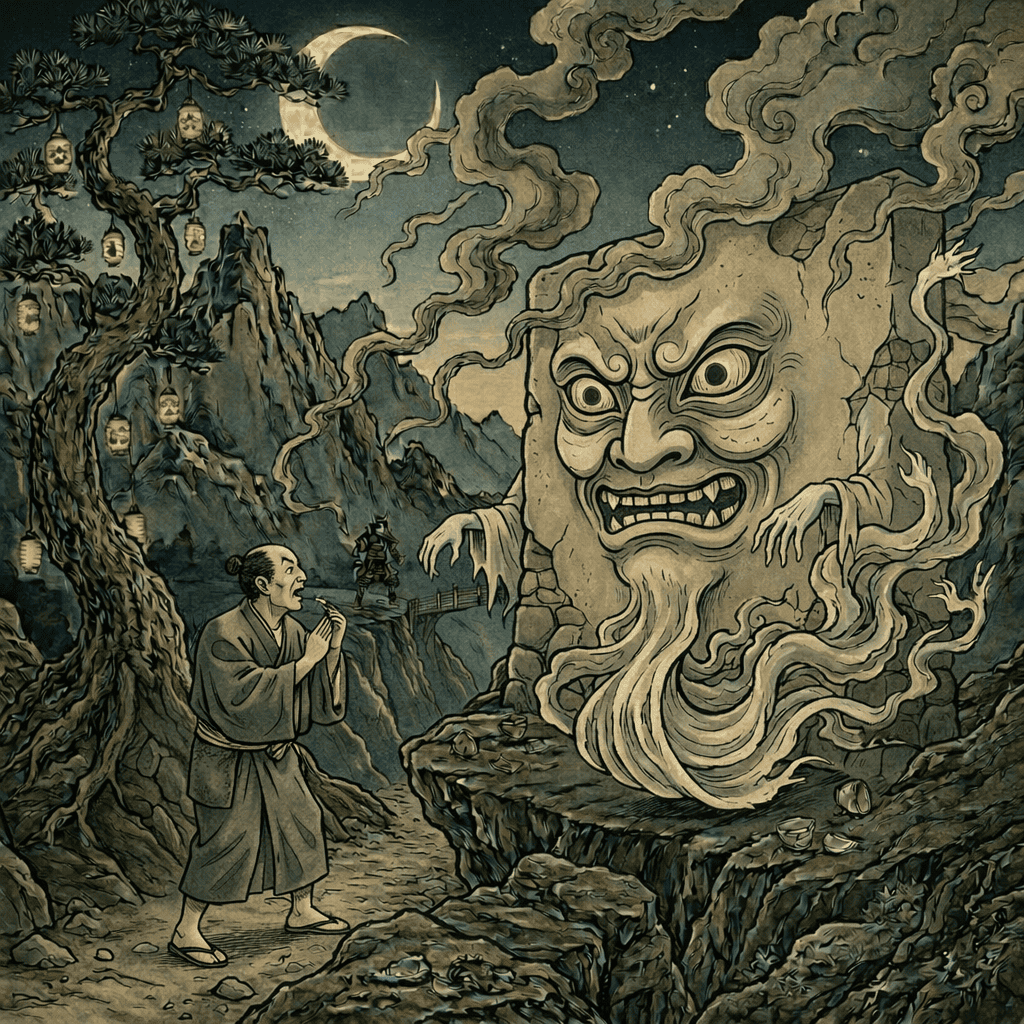
You are walking a familiar road at night. You have walked it a hundred times. You know every turning, every landmark, every stone underfoot. The distance between home and your destination is as familiar as your own heartbeat. And then — nothing. Not a wall, not a barrier you can see or touch or describe to anyone who was not there. Simply an absolute impossibility where movement should be: you cannot go forward, you cannot go around, and the longer you stand there pressing against what should be empty air, the more the darkness presses back, and the more certain you become that something is very, very wrong with the world ahead of you. You push again. You feel resistance — solid, impassive, entirely without sympathy for your confusion. You lean all your weight forward and nothing gives. You step sideways and the resistance follows. You keep stepping and it keeps following. There is no end to it. The road is open. The way is clear. And yet you are not going anywhere tonight.
The nurikabe is one of Japan's most primal supernatural encounters — a being that manifests not as something you see but as something you feel: the sudden, inexplicable impossibility of continuing forward. It is the wall that appears where no wall exists, the barrier that cannot be crossed and cannot be reasoned with. It is, in some of its more frightening interpretations, capable of driving travelers to complete madness. And yet it is also, in Japan's uniquely ambivalent relationship with its yokai, a beloved cultural figure whose round, wall-like form peers amiably from merchandise across the country. The creature that once trapped travelers in the darkness of Kyushu's rural roads now decorates children's lunchboxes. This is the nurikabe's particular genius: it has remained genuinely frightening while becoming genuinely charming, and it has done so without changing anything about what it fundamentally is.
What is Nurikabe?
The nurikabe is a yokai whose primary manifestation is as an invisible wall that blocks travelers on roads at night. The name translates roughly as "plastered wall" — nurikabe referring to the plastered walls of traditional Japanese buildings, the kind of smooth, immovable surface that defines the boundary between inside and outside in the Edo-Period streetscape. It is most strongly associated with Kyushu, particularly Fukuoka Prefecture, where belief in the creature was documented extensively in the Meiji and Taisho periods. Its basic function is deceptively simple: it blocks your path and will not let you pass.
Traditional accounts describe the nurikabe as appearing specifically on night roads, typically around midnight, causing travelers to be unable to move forward regardless of how hard they try. The wall extends as far as the traveler can reach — always just a little wider than any attempt to go around it. It cannot be touched in any meaningful sense and it cannot be seen, yet it is utterly impenetrable. In some accounts, travelers trapped by a nurikabe wander in confusion until dawn, when the creature dissipates with the first light. In darker versions, the traveler is driven entirely out of their mind, found wandering in circles at sunrise with no memory of the night. The creature belongs to a category of yokai that scholars sometimes call "obstacle spirits" — supernatural beings whose power consists not in attacking but in impeding, in refusing to allow passage, in the simple but absolute power of the word no.
What makes the nurikabe particularly interesting within the broader taxonomy of yokai is the question of intent. Does it block travelers maliciously, or is it simply following its own inscrutable nature? Traditional accounts rarely address this question, which may be deliberate — the absence of motivation makes the nurikabe more frightening, not less. A monster with a reason can potentially be reasoned with. A wall has no reasons. It is simply there. As Michael Dylan Foster notes in his survey of yokai traditions, the nurikabe exemplifies the category of yokai that represents "the transformation of mundane experience into supernatural encounter" — the ordinary made inexplicably, terrifyingly wrong (Michael Dylan Foster, "The Book of Yokai," 2015).
What Does Nurikabe Look Like?
The nurikabe has no fixed visible form in traditional folklore — it is experienced rather than seen. This invisibility is fundamental to its nature: it is a phenomenon before it is a creature, an event before it is an entity. You know the nurikabe is there because you cannot move past it, not because you can see it blocking your way. Traditional Kyushu folklore makes no mention of the nurikabe having a visual form at all. It existed purely as a sensory and psychological experience: the wall you cannot see, the resistance with no source, the road that has become a dead end for no reason you can identify.
However, Shigeru Mizuki's influential artistic interpretation gave the creature a definitive visual identity that has become the standard depiction: a large, roughly rectangular, dark grey or dark beige block-like body, resembling an animated plastered wall, with small eyes set close together near the top and tiny vestigial arms that barely project from its sides. The texture of the surface is rough and uneven, like actual plaster that has dried imperfectly. The overall impression is of a sullen, immovable object that has decided to become a sullen, immovable being — the wall metaphor made literal with exactly the kind of straightforward visual wit that characterizes Mizuki's best character designs. This image has become so definitive that it is now essentially impossible to think about the nurikabe without picturing it (Shigeru Mizuki, "GeGeGe no Kitaro," manga, 1960s).
Where Did Nurikabe Come From?
Like many regional yokai, the nurikabe's origins are rooted in genuine folk belief that predates literary documentation by centuries. The experience of being suddenly unable to continue on a familiar road at night — of feeling a resistance that has no physical cause — is something that has been reported across cultures and likely reflects genuine perceptual experiences related to disorientation, extreme fatigue, atmospheric conditions, or what we would today describe as dissociative episodes. In pre-modern Japan, where travel on rural roads at night carried real dangers ranging from criminals to simple disorientation in the dark, the need for a conceptual framework to explain inexplicable impediment was genuine and practical. The nurikabe provided that framework.
The nurikabe belongs to a broader category of Japanese supernatural phenomena concerned with the obstruction of movement — related conceptually to the tofu-kozo, the dorotabo, and various other creatures associated with specific locations or conditions on travel routes. Folklorists have noted that the density of documented yokai encounters on specific roads during the Edo period correlates with the most dangerous sections of those roads — places where travelers were known to get lost, to fall into ravines, or to become confused by terrain that looked similar in multiple directions. The supernatural explanation served as a warning system, coding dangerous locations with legendary significance that would be passed down and remembered.
Traditional belief in Kyushu held that the nurikabe could be dispelled by striking the ground at the base of the wall — specifically the lower portion — with a stick. This countermeasure is highly specific and significant: it tells us that the nurikabe, despite being invisible and intangible, is understood to have a base, a bottom, a point of contact with the ground. Striking the ground at its base breaks whatever connection it has to the physical world and causes it to dissipate. The practical wisdom encoded in this countermeasure is that when you cannot go forward and do not understand why, you should do something deliberate and grounded — quite literally, make contact with the earth — rather than continuing to push blindly against the resistance. This remains reasonable advice for disorientation of any kind (Toriyama Sekien, "Gazu Hyakki Yako," 1776).
What Are the Most Famous Nurikabe Legends?
The nurikabe appears in numerous regional folk accounts from Kyushu, most following a similar but disturbingly consistent pattern: a traveler on a night road, often on a route they know perfectly well, suddenly finds themselves unable to move forward. The road continues clearly ahead of them, there is nothing visibly blocking the way, and yet an invisible force prevents any progress whatsoever. In the most dramatic versions, travelers who try to go around the nurikabe find that it extends infinitely in both directions — they can turn around and go back the way they came, but they cannot continue forward. This directional specificity — forward is blocked, backward is not — is one of the nurikabe's most distinctive and disturbing characteristics. It is not a random obstruction. It is specifically opposed to your direction of travel.
One particularly detailed account from Fukuoka Prefecture, collected in the Meiji period, describes a merchant who encountered a nurikabe on a road he traveled twice weekly for many years. He knew the road in the way that only constant familiarity creates — knew its sounds at different times of night, knew which shadows were harmless and which meant shelter, knew exactly how many steps from the crossroads to his destination. When the nurikabe appeared, it was the very familiarity of the road that made the experience so disorienting: the obstruction made no sense precisely because nothing about this stretch of road had ever obstructed him before. He spent more than two hours trying to find a way around before finally remembering the countermeasure — striking the ground with his walking stick — which instantly cleared the way. He said afterward that the most frightening part was not the wall itself but the creeping certainty, as the hours passed, that he had somehow become fundamentally wrong about the nature of reality.
How Does Nurikabe Appear in Modern Japan?
In modern Japanese culture, "nurikabe" has become a common metaphor for bureaucratic obstruction, institutional inertia, and any invisible but absolute barrier to progress. The expression "nurikabe ni butsukaeru" — "to run into a nurikabe" — is used colloquially to describe hitting an insurmountable obstacle in daily life, particularly one that has no obvious rational basis. This metaphorical usage demonstrates how thoroughly the creature has been absorbed into everyday language and thinking, migrating from the haunted night roads of Kyushu into the offices, bureaucracies, and daily frustrations of modern Japanese life. The nurikabe has become the yokai of red tape, of the form that requires three forms to complete, of the rule that exists for no reason anyone can remember.
Mizuki's transformation of the nurikabe from invisible terror to lovable mascot is one of the most striking examples of yokai domestication in modern Japanese culture. The creature that drove travelers mad in the darkness of rural Kyushu became, in Mizuki's hands, a slow-moving but deeply loyal companion to Kitaro — a being whose immovability, once recontextualized from obstacle to ally, becomes a form of dependability. The nurikabe does not move. It will not be moved. In the context of a gang of supernatural allies facing supernatural enemies, this is actually rather reassuring. Its block-like form has made it particularly amenable to merchandise and toy design, and nurikabe figures, plushies, and accessories are among the most widely available items in Japan's thriving yokai souvenir industry.
Which Anime and Manga Feature Nurikabe?
The nurikabe's most significant anime and manga presence is in the GeGeGe no Kitaro franchise, where it appears as a major recurring character across all animated series produced by Toei Animation beginning with the first television adaptation in 1968. Shigeru Mizuki introduced the nurikabe as a member of Kitaro's yokai allies in the original manga, and the character's transition to animation gave it a voice, movement, and emotional range that deepened its cultural presence considerably. In the series, Nurikabe is portrayed as slow-thinking but fiercely loyal — a gentle giant whose power (remaining completely immovable when it chooses) becomes a virtue in the context of fighting genuine supernatural threats. Nurikabe's catchphrase in the anime, a deep and rumbling "Dame da" (No good / It won't work), became one of the franchise's most beloved recurring gags (GeGeGe no Kitaro, Toei Animation, 1968).
The 2018 reboot of the GeGeGe no Kitaro anime (the sixth television series, also produced by Toei Animation) revisited the nurikabe with updated animation and characterization while preserving the essential personality that Mizuki established. The character's visual design — that distinctive rectangular grey body with the close-set eyes and tiny arms — remained essentially unchanged across six decades of animation, a testament to the perfection of Mizuki's original concept. For generations of Japanese children, the GeGeGe no Kitaro anime was their first encounter with the nurikabe, and Mizuki's gentle version has permanently shaped how the creature is understood and loved (Shigeru Mizuki, "GeGeGe no Kitaro," manga, 1960s).
Where Can You Encounter Nurikabe in Japan?
Fukuoka and the broader Kyushu region remain the traditional homeland of the nurikabe in folklore. The creature belongs specifically to the travel culture of Kyushu's rural road network, and while those roads are now paved highways with electric lighting that has banished most of what made night travel frightening, the regional identity of the nurikabe remains strong. For those interested in the creature's folkloric roots, local folklore museums in Fukuoka Prefecture occasionally feature exhibits on regional yokai traditions.
For those interested in the Mizuki-era nurikabe, the Mizuki Shigeru Road in Sakaiminato, Tottori Prefecture, includes a nurikabe bronze statue among its eighty-six yokai figures that line the street. Sakaiminato was Mizuki's hometown, and the Mizuki Shigeru Museum there houses an extraordinary collection of original artwork, animation cels, and research materials from the artist's decades of yokai work. The experience of walking the road at dusk, when the human crowds have thinned and the bronze figures emerge from the gathering shadows, gives a reasonable sense of why the nurikabe tradition was so persistent in folk consciousness — and why Mizuki, who grew up with these stories, treated them with such affectionate respect.
Conclusion
The nurikabe endures because the experience it represents — the sudden, absolute impossibility of moving forward — is one of the most universally felt human frustrations. Every person who has ever been stopped by a bureaucratic rule with no logic, a social convention with no purpose, a fear with no rational basis, or a circumstance that simply will not yield to any amount of effort or reasoning knows the nurikabe. It is the wall that should not exist but does. The only remedy, according to the tradition that has survived since the old roads of Kyushu, is to strike at its base — to challenge the obstacle not at its highest, most imposing point but at its foundation, where it meets the ground. That wisdom, stripped of its supernatural specificity, remains entirely practical. When you cannot get past the wall, stop pushing against the middle. Find where it touches the earth. That is where it is most vulnerable. That is where it can be broken.
This is The Yokai Files.
Support The Yokai Files
Enjoyed this deep dive into Japanese folklore?
The Yokai Files is reader-supported. Your support helps us research deeper, write more, and keep the darkness alive.