Oni: Japan's Most Fearsome Demon Explained
Published: March 27, 2026
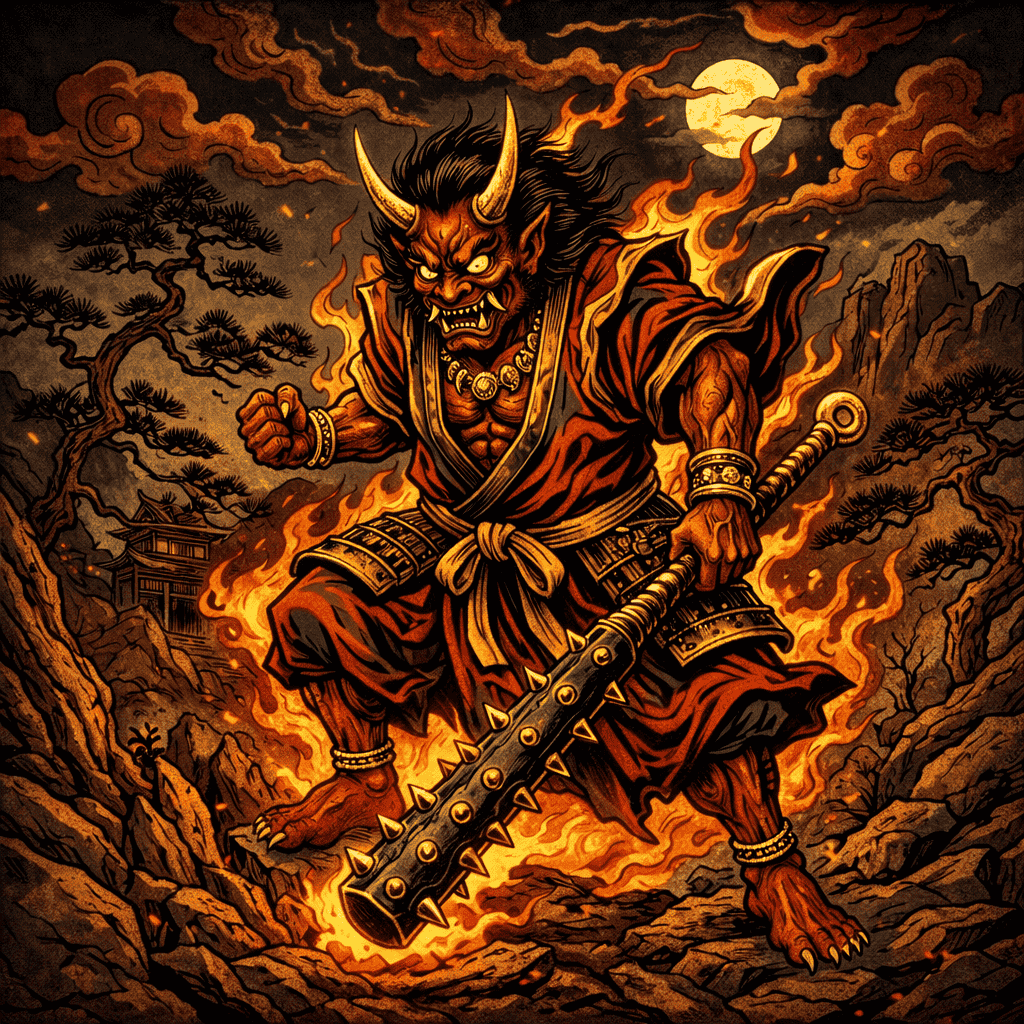
Imagine walking alone on a dark mountain path when a massive horned creature blocks your way — red skin like burning coals, wild hair, and a iron club raised above its head. In Japanese folklore, you have just encountered an Oni. And your chances of survival are not good.
The Oni is arguably the most iconic supernatural being in all of Japanese mythology. For over a thousand years, these terrifying demons have haunted the Japanese imagination — appearing in ancient scrolls, Buddhist temples, modern anime, and even children's games. But what exactly is an Oni? And why does this ancient creature still hold such power over Japanese culture today?
What is Oni?
The word "Oni" (鬼) is one of those Japanese terms that resists easy translation. While it is often rendered in English as "demon" or "ogre," neither word fully captures what an Oni truly is. In Western mythology, demons are agents of evil with clear moral alignment. Oni are something more complex — supernatural beings that exist at the boundary between the human world and the spirit world, capable of both punishment and protection.
The kanji character 鬼 originally referred to the souls of the dead — spirits that had not passed on properly and lingered in the world of the living. Over centuries, influenced heavily by Buddhism arriving from China and Korea, this concept evolved into the monstrous horned figure we recognize today.
What Does Oni Look Like?
If you ever encounter an Oni, you will know it immediately. These creatures are unmistakable.
Oni are typically depicted as enormous humanoid figures, far larger than any human. Their skin comes in vivid supernatural colors — most commonly red or blue, though green, yellow, and black Oni also appear in various traditions. Red Oni are said to be consumed by rage and desire, while blue Oni represent sadness, jealousy, and cold malevolence.
Their faces are twisted into permanent expressions of fury — wild eyes, sharp fangs, and a mouth wide enough to swallow a person whole. Two thick horns protrude from their heads, a feature borrowed from Chinese demon iconography that became inseparable from the Japanese Oni image. Their hands end in sharp claws, and they are almost always depicted wearing loincloths made from the skin of tigers — a symbol of their connection to the dangerous, wild world beyond human civilization.
The weapon of choice for an Oni is the kanabō (金棒) — a massive iron club, often studded with spikes. In Japanese, there is even a proverb: "Oni with an iron club" (鬼に金棒, Oni ni kanabō), meaning to give an already powerful thing even more power.
Where Did Oni Come From?
The Oni as we know them today emerged from a fusion of native Japanese spiritual beliefs and Buddhist cosmology that arrived in Japan around the 6th century.
In early Japanese animism, the world was filled with invisible spirits — some benevolent, some dangerous. The souls of people who died in states of extreme anger, jealousy, or sorrow were believed to transform into malevolent entities. These spirits, called onryō (怨霊), were the seeds from which the Oni concept grew.
Buddhism added a new dimension. In Buddhist cosmology, hell (Jigoku) is a place of terrible punishment presided over by Enma, the king of the underworld. His enforcers — the demons who drag sinners to their torment and carry out their punishment — became known as Oni. This gave the creatures a clear moral function: they were not simply monsters, but agents of cosmic justice.
By the Heian period (794–1185), Oni had become deeply embedded in Japanese aristocratic culture. Noble families hired priests to perform rituals driving away Oni, and the creatures appeared frequently in literature, including the famous Tale of Genji. The night of Setsubun — the last day of winter — became associated with Oni invasions, leading to the tradition of throwing roasted soybeans to drive them away that continues to this day.
The Most Famous Oni Shutendoji
Of all the Oni in Japanese legend, none is more feared than Shuten-doji (酒呑童子) — the "sake-drinking boy." Despite his somewhat gentle name, Shuten-doji was considered the king of all Oni, a creature of such terrifying power that he required the greatest heroes of the age to defeat him.
According to legend, Shuten-doji lived on Mount Ōe in Kyoto, commanding an army of Oni who kidnapped noblewomen and devoured the flesh of humans. The warrior Minamoto no Yorimitsu, one of the most celebrated heroes of the Heian period, was dispatched by the Emperor to destroy him.
Yorimitsu and his companions disguised themselves as wandering monks and infiltrated Shuten-doji's mountain fortress. They offered the Oni king sake laced with a divine poison — and when the great demon fell into a stupor, they struck off his head. Even severed from his body, the head of Shuten-doji continued to snarl and snap at Yorimitsu, so great was his supernatural power.
This story has been retold countless times across Japanese history, and Shuten-doji remains a symbol of overwhelming power meeting its inevitable end.
Oni In Modern Japanese Culture
Despite being creatures of ancient legend, Oni are everywhere in modern Japan.
Every year on Setsubun (節分), typically February 3rd, families across Japan participate in a ritual called mamemaki — the scattering of roasted soybeans. As they throw the beans, they shout "Oni wa soto! Fuku wa uchi!" — "Demons out! Good fortune in!" Children throw beans at parents or teachers dressed in Oni masks, driving away bad luck for the coming year. It is one of Japan's most beloved annual traditions, and the Oni is central to it.
In popular culture, the influence of Oni is impossible to ignore. The global anime phenomenon Demon Slayer (Kimetsu no Yaiba) draws directly from Oni mythology — its villains are demons born from human suffering, much like the original Oni concept. Jujutsu Kaisen similarly draws on Japanese supernatural traditions, with Oni-like cursed spirits central to its world. Even Pokémon shows Oni influence — creatures like Hitmonchan and various ghost-type Pokémon trace clear lineage back to Japanese demon iconography.
Where Can You Encounter Oni in Japan?
For those who want to experience Oni culture firsthand, Japan offers several remarkable destinations.
Mount Ōe in Kyoto Prefecture is the legendary home of Shuten-doji, and today it hosts the Oni Museum (鬼の博物館), which displays Oni art, masks, and artifacts from across Japan. The mountain itself retains an eerie, atmospheric quality that makes the old legends feel remarkably present.
The Nishiki Tenmangu Shrine in Kyoto is famous for its Oni statues, while the city of Kitakyushu in Fukuoka Prefecture holds an annual Oni festival drawing visitors from across Japan.
Temples throughout Japan display fierce guardian figures called Niō (仁王) — muscular demon-like beings that stand at temple gates. While technically distinct from Oni, these figures draw on the same visual tradition and give visitors a visceral sense of the supernatural power Oni represent in Japanese culture.
The True Nature Of Oni
It would be a mistake to think of Oni as simply evil. Japanese culture has always understood them as something more nuanced.
Yes, Oni punish the wicked. Yes, they inspire terror. But they also guard against greater evils, enforce cosmic justice, and in some traditions even protect communities. The Oni masks used in certain Shinto festivals are not meant to frighten — they are meant to ward off malevolent spirits, using the power of fear itself as a shield.
In this sense, the Oni represents something profound about the Japanese view of the supernatural: the boundary between monster and protector, between punishment and salvation, is not always clear. The most terrifying things in the universe are not always our enemies.
Perhaps that is why, a thousand years after their first appearance in Japanese literature, Oni still walk among us — in festivals, in anime, in the quiet fear of a dark mountain road at night.
Fear them. Respect them. But above all — understand them.
This is The Yokai Files.
Support The Yokai Files
Enjoyed this deep dive into Japanese folklore?
The Yokai Files is reader-supported. Your support helps us research deeper, write more, and keep the darkness alive.