Onibi: Japan's Ghost Fire and the Lights of the Unquiet Dead
Published: March 28, 2026
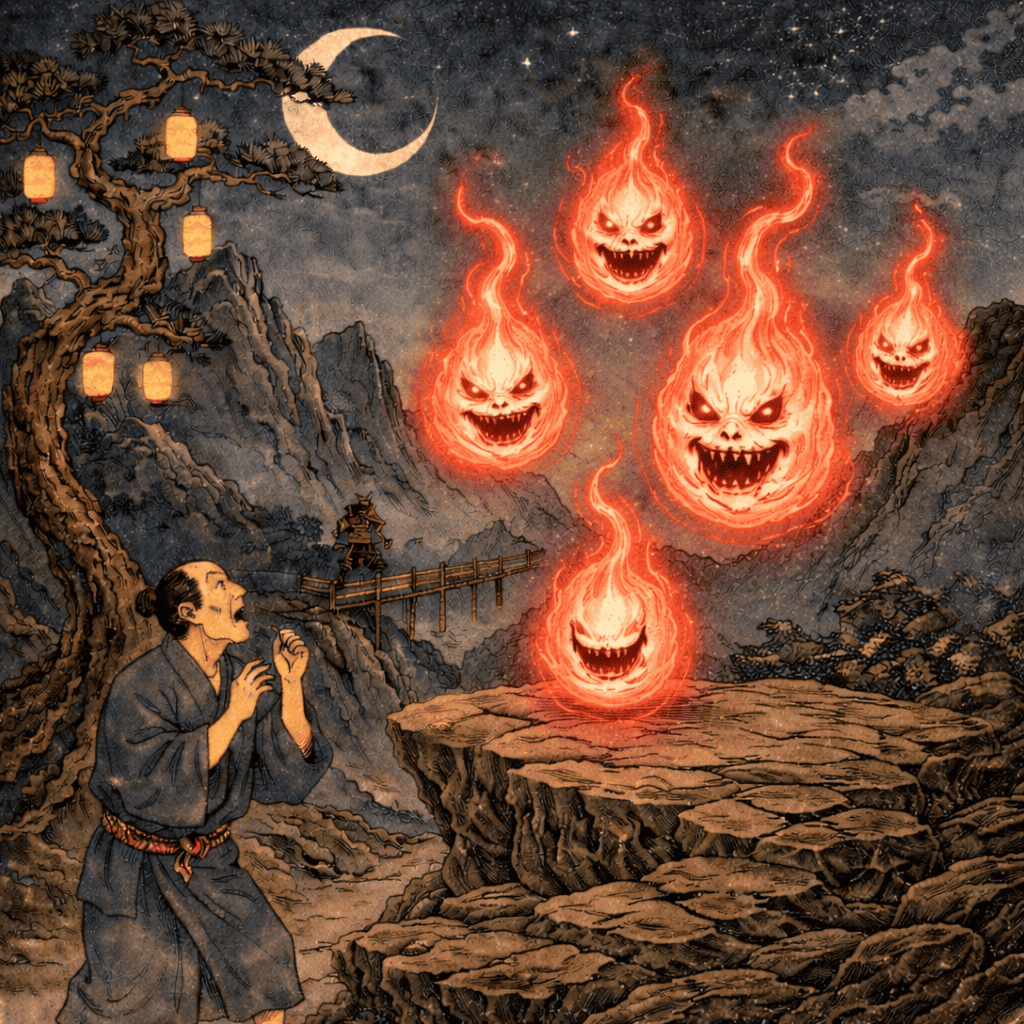
On a summer night, in the swampy lowlands at the edge of a village, a light appears. It is small, blue-white, and it drifts with a liquid smoothness that no lantern could achieve — hovering, rising, descending, moving in patterns that suggest intention without suggesting any intelligence you can recognize. You watch it from a distance, telling yourself it is swamp gas, telling yourself there is a rational explanation, and you are right that there is an explanation. You are wrong that it is rational. That light is the remains of someone who died angry, or afraid, or with unfinished business. And it is looking for a body to finish that business in.
Onibi — "demon fire" — is Japan's ghost light, the supernatural flame that hovers over graveyards and swamps and battlefield sites, the visible manifestation of the dead who cannot or will not rest. It is related to phenomena found in cultures around the world, from the will-o'-the-wisp of European tradition to the foxfire of the American South, but in Japanese supernatural tradition it carries a specific and detailed theological meaning: onibi is not merely a spooky light. It is evidence of a specific kind of death, a specific kind of spiritual failure, and potentially a specific kind of danger to the living who approach it.
What is Onibi?
Onibi is the Japanese term for a supernatural light phenomenon associated with the dead and dying. The name combines oni (demon, supernatural entity) with bi (fire), though the "oni" in this context does not necessarily refer to the horned demon of other traditions but to the broader category of supernatural or uncanny. Onibi appears as a small, floating ball of light — most commonly described as blue-white or pale blue-green — that hovers a few meters above the ground, moves smoothly and unpredictably, and appears near places where the dead are present: graveyards, battlefields, swamps where bodies may have been disposed of, and roads where travelers have died.
In Japanese folk belief, onibi is understood to be a manifestation of the spiritual energy that leaks from a corpse that has not been properly buried or properly mourned — or from a person who dies in a state of extreme emotional agitation. The spirit, unable to depart cleanly from the body, remains in the vicinity of death as a visible energy that has not yet dispersed. This makes onibi simultaneously a sign that something supernatural is present and a form of evidence that the normal processes of death and transition have been disrupted. Michael Dylan Foster's scholarly analysis places onibi within the broader category of reikon — detached spirits — that populate Japanese supernatural tradition, noting that the ghost light serves as a kind of thermometer for spiritual unrest in a given place (Michael Dylan Foster, "The Book of Yokai," 2015).
The distinction between onibi and related supernatural fire phenomena in Japanese tradition is worth establishing clearly. Kitsunebi — "fox fire" — is produced by foxes and does not carry the same death-association. Hitodama — "human souls" — are larger, more individuated soul-fires associated with specific recently-dead individuals rather than the diffuse spiritual residue of multiple deaths. Onibi sits between these categories: more dangerous and more anonymous than hitodama, more specifically death-linked than kitsunebi. It is the residue of death in general, the accumulated spiritual energy of places where the transition from life has been particularly traumatic.
What Does Onibi Look Like?
Onibi typically appears as a small sphere or oval of pale luminescence, ranging in size from a candle flame to a human head. The most common color description is blue-white, though accounts describe variations including red, green, yellow, and deep blue depending on the specific tradition and the nature of the spirit involved. It floats without any visible means of support, moving with a smooth, gravity-independent motion that distinguishes it immediately from any flame produced by combustion. Multiple onibi often appear together, drifting in loose clusters, their individual lights occasionally merging and separating in patterns that suggest a diffuse, collective awareness.
The color variation across onibi traditions carries meaning in many regional accounts. Blue-white onibi are the most common and are associated with the standard restless dead — spirits that died in distress but without particular malice. Red onibi are more ominous in many regional traditions, associated with violent death or intense anger that has carried over from life. Green onibi are rarer and in some traditions associated with illness — the spiritual residue of those who died from disease rather than violence or accident. These color distinctions are not universal but reflect the way different communities elaborated the basic onibi tradition to accommodate the specific types of death and spiritual disruption they encountered in their own histories.
Toriyama Sekien's rendering of onibi in his yokai encyclopedias shows clusters of small lights floating above a dark landscape, each light a slightly different size, their collective motion suggesting a purposeful drift toward some destination that no living observer can discern (Toriyama Sekien, "Gazu Hyakki Yako," 1776). This image — the cluster of ghost lights in the darkness — became the canonical visual representation of onibi and established the aesthetic template that subsequent artists, filmmakers, and game designers have drawn on for over two centuries.
Where Did Onibi Come From?
Onibi belief is ancient, appearing in Japanese records across many centuries and deeply embedded in the folk religious understanding of what happens to spiritual energy after death. The phenomenon has a rational explanation — the spontaneous ignition of phosphine and methane gases produced by decomposition in swampy environments can produce small, hovering flames that appear briefly and move with wind currents. This scientific explanation does not invalidate the folk tradition but rather helps explain why onibi sightings cluster in particular locations (near swamps, near burial sites) and at particular times of year (hot, humid nights when decomposition gases are most actively produced).
The specific danger attributed to onibi in Japanese tradition — that it can enter a living person's body and cause illness or death — connects to broader beliefs about the interaction between the spiritual residue of the dead and the living body. Physical proximity to onibi was considered a genuine health risk, not simply because of what it is but because of what it wants: the warmth and life-force of the living to replace what it has lost. This vampiric quality of onibi — the dead seeking the energy of the living — appears across Japanese supernatural tradition in multiple forms, from the hitodama's lingering near family members to the more aggressive spiritual possession believed to cause sudden unexplained illness.
The religious framework that gives onibi its specific meaning is drawn from both Shinto and Buddhist traditions. From Shinto comes the understanding that the dead have ongoing relationships with the living, that spiritual energy persists after physical death and requires proper ritual management. From Buddhism comes the concept of the hungry ghost — beings trapped between states of existence by attachment or unresolved karma — which provides a theological category for the onibi's condition. Lafcadio Hearn observed this dual religious inheritance in his studies of Japanese supernatural belief, noting that Japanese ghost-fire traditions carry a weight of genuine theological meaning that Western parallels often lack (Lafcadio Hearn, "Kwaidan," 1904).
Regional variations in onibi belief across Japan's diverse geography are extensive. In coastal communities, onibi traditions often emphasize the lights appearing over water — particularly the sea — and are associated with drowned fishermen or sailors who died without the benefit of burial rites. In mountainous regions, onibi appear on mountain paths and in forest clearings, associated with travelers who died of exposure or accident in the passes. In agricultural communities of the interior plains, the swamp-onibi tradition predominates: lights over the rice paddies and wetlands where the conditions for phosphine production are most reliably present. These geographic variations demonstrate how a single supernatural concept adapts to the specific landscape and death-patterns of different communities.
What Are the Most Famous Onibi Legends?
Onibi legends are distributed across virtually all of Japan's regions, each with local variations that reflect the specific history of death and spiritual disruption in that area. The battlefield sites of the Sengoku Period — the century of civil war that tore Japan apart from the mid-15th to early 17th centuries — are particularly associated with mass onibi sightings in traditional accounts, with the spiritual energy of thousands of soldiers who died violently and without proper burial manifesting as vast clouds of ghost fire visible for miles. Sekigahara, site of the decisive 1600 battle that established the Tokugawa shogunate and which resulted in tens of thousands of deaths in a single day, is one of several former battlefields where onibi traditions are particularly strong.
A particularly vivid legend from the Tohoku region describes a Buddhist monk who, traveling between temples on a summer night, encountered a swarm of onibi so dense that they temporarily obscured the road ahead. The monk, trained in the proper ritual responses to such encounters, recited sutras for the spirits he believed the lights represented. The onibi, in the account, did not immediately disperse — but they moved aside, creating a narrow path through their mass that the monk walked through without being harmed. When he reached the next temple, he reported that the lights had followed him to the edge of the temple grounds and then stopped, as if the consecrated space created a boundary they could not cross.
The Obon festival — the mid-summer Buddhist observance during which the dead are believed to return to the living world for three days — creates the annual peak of onibi activity in traditional accounts. The period from the thirteenth to the sixteenth of August sees the highest concentration of ghost-light reports in Japanese folklore, a temporal clustering that connects directly to the ritual calendar. During Obon, the dead are not merely present as residual spiritual energy but are understood to be actively returning to visit their living descendants, and the onibi that appear during this period are understood as the visible evidence of this visitation — the glow of ancestors making their way home.
How Does Onibi Appear in Modern Japan?
Onibi appears throughout modern Japanese horror and supernatural fiction, typically as an atmospheric element that signals the presence of the restless dead rather than as a primary antagonist. In video games, onibi-type enemies appear as floating fire sprites in numerous Japanese RPGs and adventure games. The Pokemon franchise includes creatures clearly inspired by the onibi tradition — Litwick, Lampent, and Chandelure form an evolutionary line of ghost-fire Pokemon that draw directly on this supernatural tradition, luring victims with their light before draining their life energy, a mechanic that translates the onibi's dangerous attractiveness into game form. The visual language of onibi — small, blue-white, floating, otherworldly — has become a standard visual shorthand for supernatural presence across Japanese media.
Which Anime and Manga Feature Onibi?
Onibi and related ghost-fire phenomena appear throughout Japanese yokai anime, functioning as atmospheric signifiers of supernatural presence and as direct characters in their own right. In the GeGeGe no Kitaro anime series (Toei Animation, 1968), ghost fires appear as recurring environmental elements in the supernatural landscapes the series depicts — the visual language of floating blue-white lights signals the presence of the restless dead in ways that draw directly on the classical onibi tradition (GeGeGe no Kitaro, Toei Animation, 1968; Shigeru Mizuki, "GeGeGe no Kitaro," manga, 1960s).
Studio Ghibli's Spirited Away (2001) offers one of the most widely seen engagements with ghost-fire and animated-light aesthetics in international anime. The chochin obake — the animated lantern spirit — that appears in the film shares conceptual territory with the onibi tradition: it is an animated light, a luminous presence that exists at the intersection of the mundane and the supernatural, hovering in the spaces where the living and the dead coexist. While not an onibi directly, the film's extensive use of animated lights, glowing spirits, and luminous supernatural presences demonstrates how deeply the onibi aesthetic is embedded in Japanese visual storytelling — the ghost light as a fundamental visual vocabulary for the presence of the other world.
Princess Mononoke (Studio Ghibli, 1997) features the kodama — small glowing tree spirits — whose aesthetic owes something to the onibi tradition of luminous supernatural presences inhabiting natural spaces. Across Ghibli's catalog, the company has consistently drawn on the Japanese tradition of light-as-spirit, using glowing entities to signal the presence of the non-human world in ways that are simultaneously eerie and beautiful. This tradition extends from onibi through the broader Japanese supernatural aesthetic, finding its most internationally recognized expression in Ghibli's visual language but rooted in centuries of folk belief about what glowing lights in the darkness might mean.
Where Can You Encounter Onibi in Japan?
Old temple cemeteries throughout Japan are the classic onibi environment — particularly those in Kyoto and Kamakura, where the density of ancient burial sites is highest. The summer Obon festival in August is traditionally the time when the dead return to the living world, and onibi sightings are most commonly reported in the weeks surrounding this period. Visiting temple cemeteries on Obon evenings, when lanterns are lit to guide the returning dead, provides the closest modern approximation of the traditional onibi-encounter environment.
The Aokigahara forest at the base of Mount Fuji, with its high concentration of spiritual energy and its long association with death, is another location where onibi traditions are strong. The forest's dense volcanic rock floor creates unusual atmospheric conditions, and the combination of deep forest, historical association with death, and genuine natural darkness makes it one of the most atmospheric places in Japan to contemplate the onibi tradition. The former battlefields of the Sengoku Period — Sekigahara in Gifu Prefecture, Kawanakajima in Nagano, Nagashino in Aichi — all carry strong onibi associations in local tradition and have been sites of reported light phenomena for centuries.
Conclusion
Every light in the darkness deserves a second look. The onibi tradition insists on this: that the lights hovering over the marshes and drifting through the cemetery are not random phenomena but meaningful ones, that they represent specific people who died specific deaths and whose spiritual residue has not yet dispersed into the universe it was torn from. To see an onibi is to be in the presence of someone's incomplete death — the part that remained when the rest departed.
The tradition asks something of us in return for this knowledge: proper burial, proper mourning, proper ritual attention to those who die within our communities. The onibi is what happens when those obligations are not met — when the dead are left without the ceremonies that would allow them to depart cleanly, when grief is incomplete, when violence is too great for ordinary spiritual processes to absorb. The light that moves toward you across the water is not malevolent by nature. It is simply incomplete. Whatever it was that kept them here is still unresolved. The light moves toward warmth. The warmth it is looking for is yours.
This is The Yokai Files.
Support The Yokai Files
Enjoyed this deep dive into Japanese folklore?
The Yokai Files is reader-supported. Your support helps us research deeper, write more, and keep the darkness alive.