Rokurokubi: The Stretching-Neck Woman Hidden in Plain Sight
Published: March 28, 2026
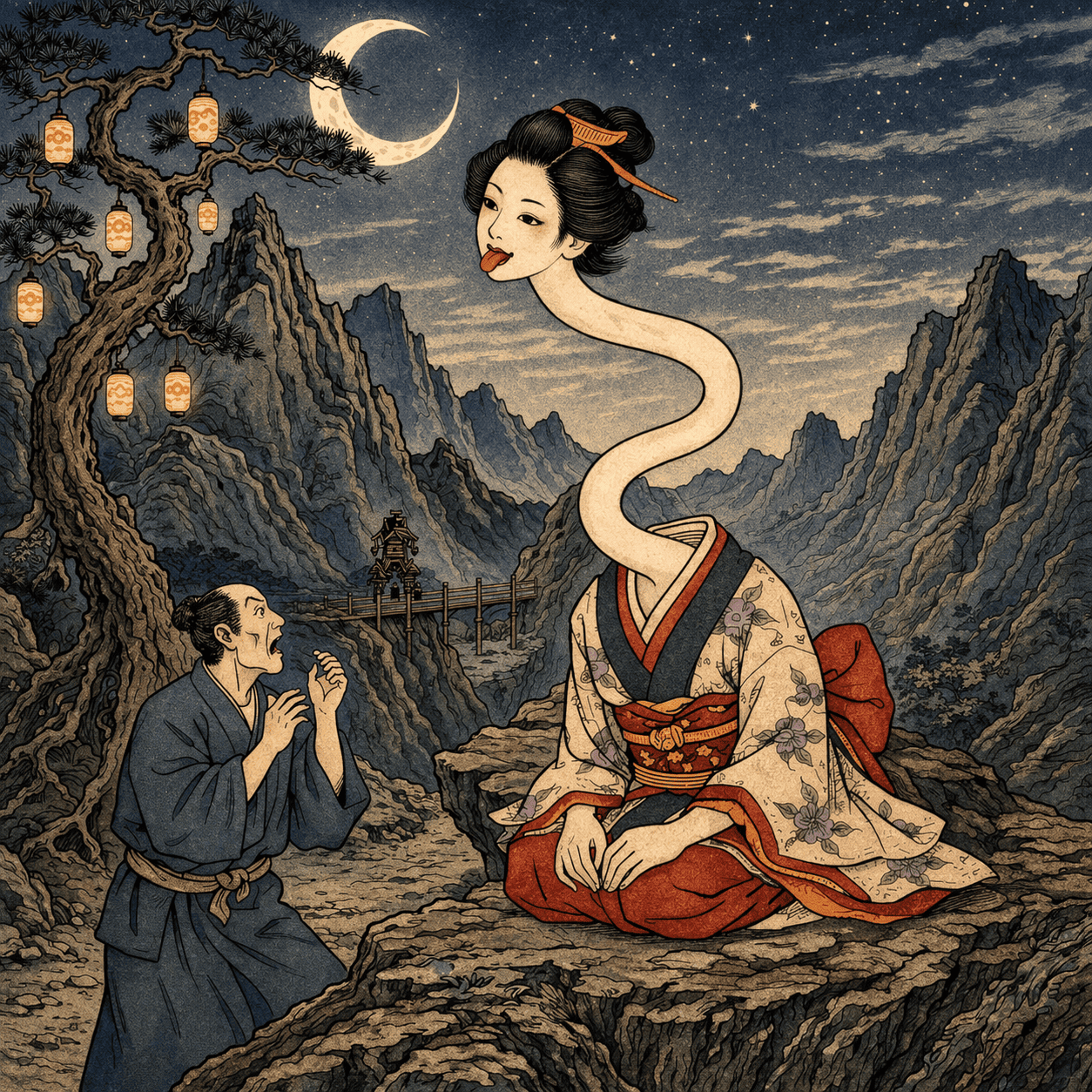
She has lived in this village for years. You know her face. You have eaten meals at her table, watched her tend to her garden, nodded to her on the road in the morning light. There is nothing about her that seems unusual — nothing in her manner, her conversation, her daily rhythms that would suggest anything other than an ordinary woman living an ordinary life. Nothing, that is, until the night you happen to pass her window just after midnight and see her body lying still and perfectly arranged in the darkness — and her head, separated from it by several meters of slowly extending neck, drifting silently through the room on that impossibly elongated column of flesh, the face wearing an expression you have never seen during daylight hours, something between curiosity and appetite. When it notices you watching, the neck contracts. The head returns. She blinks at you with entirely normal eyes. There was nothing, those eyes say. You saw nothing. Go back to sleep.
The rokurokubi is perhaps the most insidious of Japan's shapeshifting yokai — not because it is the most powerful or the most violent, but because it is the most ordinary. It looks exactly like a human being in every respect except for what it does when it believes no one is watching. It has integrated itself into human communities, formed human relationships, eaten at human tables, and in some versions of the legend, forgotten its own true nature entirely. The horror is not what it is. The horror is how long it has been hiding among you, and how many times you have already looked it in the face without knowing.
What is Rokurokubi?
The rokurokubi is a human-appearing yokai characterized by a neck that stretches to extraordinary lengths — in the most basic variant, the neck can extend several meters, allowing the head to reach places the body cannot. In the more extreme variant, called the nukekubi, the head detaches entirely from the body and flies independently through the night, typically in search of prey. The distinction between these two forms is significant: the stretching-neck rokurokubi is generally considered mischievous rather than malicious, given to frightening travelers and onlookers for reasons that seem more playful than predatory, while the detaching-head nukekubi is understood to be genuinely dangerous — a being that consumes human blood and whose detached head can be killed if its body is hidden or destroyed before it returns.
What makes the rokurokubi particularly fascinating within the broader taxonomy of Japanese supernatural beings is the range of interpretations around its nature and awareness. In some traditions, the rokurokubi is fully conscious of what it is and actively, skillfully conceals its nature from the humans around it. It maintains its human disguise as a deliberate performance, living as a normal community member during daylight and pursuing its supernatural activities in darkness. In others, the creature is entirely unaware of its own supernatural behavior — the neck stretching and head flying happen only during sleep, and the rokurokubi genuinely believes itself to be fully human, haunted by strange and fragmentary dreams that are actually incomplete memories of its nocturnal activities. This latter interpretation — the creature that does not know what it is — represents one of the most psychologically complex ideas in all of yokai folklore.
The rokurokubi is almost always depicted as female in traditional accounts, though male examples do appear in some collections. This gendering is significant and has been examined by scholars as reflecting anxieties about women's hidden natures and the limits of a husband's or community's knowledge of the women in their lives. The creature that looks entirely like a wife, mother, or neighbor and conceals something monstrous in its sleep connects to broader patterns of yokai that encode social tensions around gender, domesticity, and trust (Michael Dylan Foster, "The Book of Yokai," 2015).
What Does Rokurokubi Look Like?
During daylight hours, the rokurokubi is entirely indistinguishable from a normal human being. This is the most critical and most disturbing aspect of its appearance — it has no tells, no visible marks, no quality in its eyes or its movements or its voice that would indicate its supernatural nature. It has passed a hundred daylight inspections by people who thought they knew it. The transformation occurs only at night, typically during sleep or in a state of relaxed supernatural awareness. When the neck begins to stretch, it elongates smoothly and continuously, the skin and flesh extending with an eerie elasticity, until the head is suspended in the air above the body on a neck that might reach several meters in length. The head at the end of this extension retains all the facial features of the person sleeping below — the same face, the same hair, the same mouth — but the expression has changed. Something in the face that was kept carefully controlled during waking hours is now visible. Something behind the eyes.
Classical Japanese artwork — particularly the work of Toriyama Sekien, whose encyclopedic yokai collections of the 18th century remain among the most significant visual documents of Japanese supernatural tradition — depicted the rokurokubi in her stretched state with a combination of aesthetic elegance and unmistakable wrongness. The elongated neck curves with something that almost resembles grace. The face is beautiful. The overall image is of something that looks like a painting of a beautiful woman, but is tilted at an angle that no real person could occupy, extended to a length that no real body could produce (Toriyama Sekien, "Gazu Hyakki Yako," 1776).
Where Did Rokurokubi Come From?
The rokurokubi appears in Japanese supernatural literature from at least the early Edo Period, with references appearing in the 1666 collection Shokoku Hyaku Monogatari (One Hundred Tales from Various Provinces) and becoming more frequent through the 17th and 18th centuries as the publishing of kaidan — strange tale — collections became a popular and commercially successful genre. The origin stories offered in traditional accounts typically involve karmic consequences: a person who violated Buddhist precepts, who was complicit in wrongdoing against another person, or who harbored secret vices is reborn or transformed into a rokurokubi as punishment or karmic correction. This moral framework connects the creature to the broader Buddhist cosmology of karmic consequence that underlies much of Japanese supernatural belief.
The scholarly debate around rokurokubi origins has considered connections to Chinese supernatural traditions involving stretching or detaching heads, as well as indigenous Japanese traditions around the concept of the tamashii — the soul or spirit that can leave the sleeping body and travel independently. The rokurokubi may represent a localized, literalized version of the soul-travel concept: not an abstract spiritual departure but a physical, visible, and frankly disturbing extension. The fact that the rokurokubi is typically unaware of its own night activities in many traditions aligns precisely with how the traveling soul was understood — as a separate aspect of the person that acts without the waking consciousness's knowledge or control.
What Are the Most Famous Rokurokubi Legends?
Lafcadio Hearn's 1904 collection Kwaidan contains one of the most famous rokurokubi stories in the English language — a tale of a wandering Buddhist monk who takes shelter at what appears to be a simple rural inn, only to discover at midnight that all the inhabitants are rokurokubi. The monk wakes in the night to find the room's bodies sleeping peacefully below while their heads, on impossibly elongated necks, are wrapped comfortably around the room's ceiling beams, the faces wearing expressions of contentment that suggest they find their nocturnal arrangements entirely natural. The monk escapes by slipping out silently before the heads return. The strength of Hearn's rendering lies in its refusal to make the rokurokubi conventionally monstrous: the heads are not feeding or threatening, they are simply... resting, in a way that no human being rests. The horror is in the wrongness of the ordinary (Lafcadio Hearn, "Kwaidan," 1904).
A different and equally famous rokurokubi account — recorded in several Edo Period collections — tells of a samurai who discovers his wife is a rokurokubi. One night he pretends to sleep and watches as her neck extends and her head floats free to explore the room. Rather than flee or confront her, the samurai lies still and watches. She does nothing threatening. She simply moves through the room as a disembodied head on a coil of neck, examining objects she has looked at a thousand times with her body attached, then returning to her body before dawn. He never tells her what he saw. She never knows he saw it. The marriage continues. The story ends without resolution — which is, in its way, the most disturbing ending of all.
How Does Rokurokubi Appear in Modern Japan?
The rokurokubi appears regularly in modern Japanese horror and fantasy as a symbol of the hidden supernatural nature beneath ordinary human appearance. It has proven particularly versatile as a vehicle for psychological themes: the creature's divided nature — human by day, something else entirely by night — maps cleanly onto questions of hidden identity, secret lives, the performance of normalcy, and the fear of being revealed as fundamentally different from those around you. Contemporary writers and artists have returned to the rokurokubi repeatedly precisely because these themes remain as resonant as they were when Hearn first brought the creature to Western attention.
In modern yokai merchandise and character design, the rokurokubi is often depicted as a willowy woman with an extremely long neck — a more aestheticized, less frightening version of the traditional creature that emphasizes the visual strangeness of the extended neck without the full horror of complete detachment. This softened version appears in video games, collectible figures, and yokai-themed fashion, representing the same process of domestication that has affected many of Japan's most fearsome supernatural beings.
Which Anime and Manga Feature Rokurokubi?
In the GeGeGe no Kitaro anime franchise, rokurokubi characters appear across multiple series as both antagonists and, occasionally, sympathetic figures — beings whose appearance is startling but whose nature is not necessarily malevolent. The franchise's general approach of treating yokai as complex beings rather than simple monsters gave the rokurokubi room to be portrayed with nuance unavailable in purely horror-oriented work. Shigeru Mizuki's original manga depicted rokurokubi with his characteristic blend of the genuinely strange and the unexpectedly poignant, and the various animated adaptations preserved this approach (Shigeru Mizuki, "GeGeGe no Kitaro," manga, 1960s).
Nurarihyon no Mago (produced by Brain's Base, 2010) — a supernatural action series centered on a young man who is heir to a clan of yokai — features a rokurokubi character among its large cast of supernatural beings. The series is notable for its commitment to drawing on genuine yokai lore rather than simply using yokai names for original monster designs, and its rokurokubi reflects the traditional qualities of the creature: the integration into human society, the concealed supernatural nature, the neck that extends when human observation lapses. The character's presence in a largely sympathetic yokai ensemble reinforces the modern trend of treating the rokurokubi as a figure of hidden duality rather than simple menace.
Where Can You Encounter Rokurokubi in Japan?
The rokurokubi does not have a specific regional homeland in the way that some yokai do — the creature appears in folk traditions across Japan, consistent with its theme of hidden integration into human communities everywhere. The Hyakumonogatari Kaidankai tradition — the "one hundred ghost stories" game played during the Edo Period, where participants would tell ghost stories by candlelight, extinguishing one candle after each tale until the room was dark — frequently included rokurokubi tales, and the collections of these stories that survive give the creature a presence across most of Japan's major regions.
The Mizuki Shigeru Road in Sakaiminato includes a rokurokubi among its bronze yokai sculptures, and the Mizuki Shigeru Museum nearby maintains extensive materials on the creature's folkloric history and artistic representation. Various yokai-themed exhibitions that rotate through Japanese cultural centers and museums regularly feature the rokurokubi as a centerpiece, capitalizing on the creature's combination of visual drama and conceptual resonance.
Conclusion
The rokurokubi survives in Japanese imagination because the fear it embodies is genuinely universal: the fear that the people closest to you are not entirely what they present themselves to be. That behind the familiar face, which you have looked at across ten thousand meals and ten thousand mornings, is something you have never seen. Something that only appears when the lights are out and the person believes themselves unwatched. The neck stretches. The head floats free. And the creature that has smiled at you every morning of your shared life is revealed to be something else entirely when it sleeps. You will never watch a sleeping face with quite the same comfortable certainty again. And you will wonder, in the small hours, what your own face does when you are the one who is sleeping.
This is The Yokai Files.
Support The Yokai Files
Enjoyed this deep dive into Japanese folklore?
The Yokai Files is reader-supported. Your support helps us research deeper, write more, and keep the darkness alive.