Shuten-doji: The Demon King of Oe-yama Who Defied Death Itself
Published: March 28, 2026
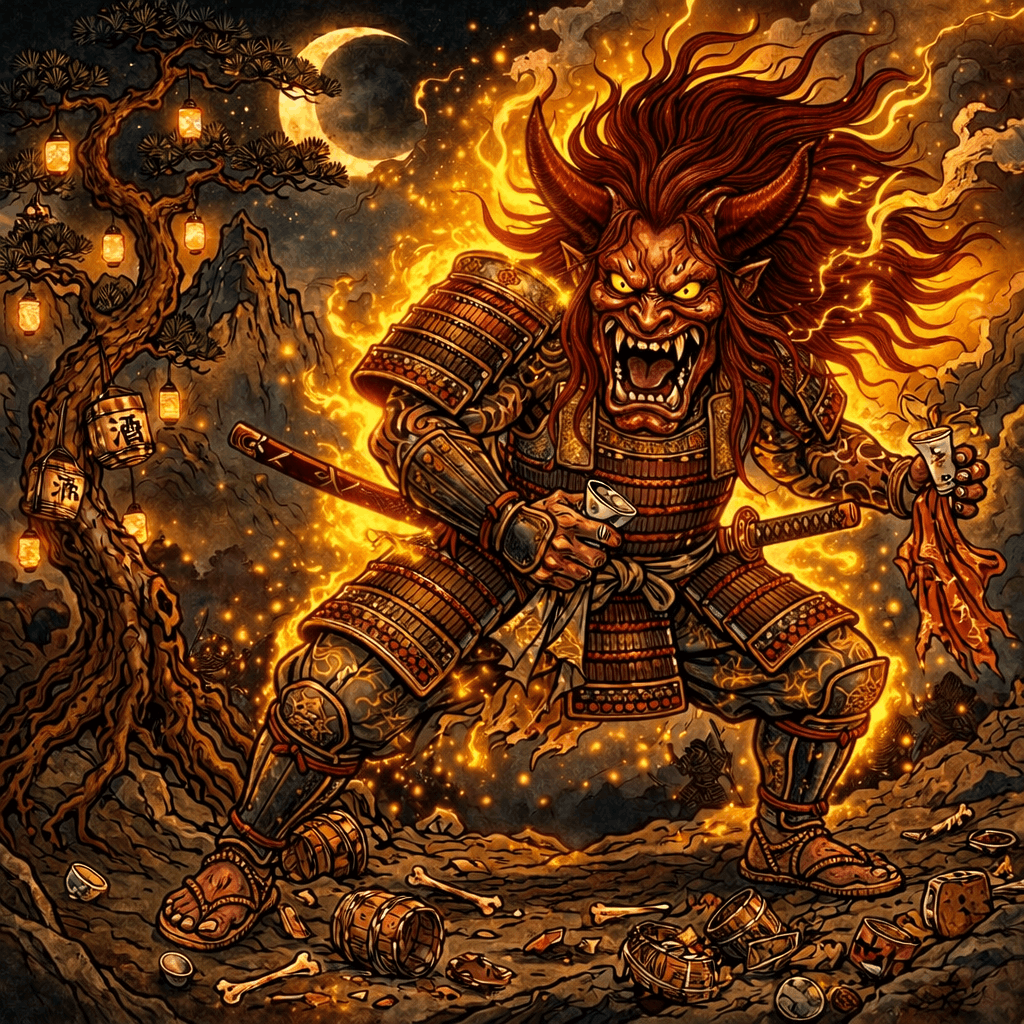
There are demons in Japanese mythology, and then there is Shuten-doji. Even among the fearsome oni that haunt Japan's ancient legends, this creature stands apart — a being of such terrifying power and cunning intelligence that entire armies were sent to destroy him, and even in death, he refused to surrender. His story is not simply a tale of a monster slain by a hero. It is something far more unsettling: the account of a being who may have been more than human, who ruled a mountain fortress filled with stolen nobles, and who looked death in the face and kept fighting.
The name Shuten-doji translates roughly as "Drunken Boy" — a deceptively playful title for one of the most feared supernatural entities in all of Japanese folklore. He was said to rule the peak of Mount Oe, commanding an army of lesser oni, drinking the blood of kidnapped aristocrats from golden cups, and laughing at the futile efforts of the capital to stop him. What the legends do not always tell you is how his story ends: not with the clean victory of a righteous warrior, but with a severed head that kept biting even after it left the body.
What is Shuten-doji?
Shuten-doji is classified as the king of all oni in Japanese mythology — a supreme demon lord whose power, intelligence, and cruelty far surpassed that of ordinary supernatural beings. Unlike the brutish, mindless monsters of Western mythology, Shuten-doji was portrayed as sophisticated and even charismatic, hosting elaborate banquets in his mountain palace and engaging in conversation with those he had captured before consuming them. This complexity is part of what makes him so enduring as a cultural figure.
His origins are somewhat murky, as befitting a creature of his stature. Some accounts describe him as the child of a god and a serpent, others as a human who transformed into a demon through excessive wickedness and debauchery. The name "Drunken Boy" refers to his legendary appetite for sake — he reportedly consumed it in quantities that would kill lesser beings, and his lair was always described as filled with the smell of alcohol and blood in equal measure. This duality — the festive and the horrific — defines everything about him.
In the broader context of Japanese demonology, Shuten-doji represents the apex of oni power. While most oni are depicted as enforcers of divine punishment or minor supernatural nuisances, Shuten-doji operated as an independent sovereign — a king who answered to no god, feared no human, and built his own dark kingdom in the mountains outside of Kyoto.
What Does Shuten-doji Look Like?
Classical depictions of Shuten-doji vary across different scroll paintings and illustrated texts, but certain features appear consistently. He is invariably enormous — towering over human beings and even over other oni. His skin is typically shown as deep red or dark blue, the traditional colors of demonic power in Japanese iconography. His face is contorted into an expression of both drunken pleasure and savage menace, with wild hair, prominent fangs, and eyes that burn with supernatural intelligence.
Unlike many yokai who are depicted in rags or nakedness, Shuten-doji is often shown wearing fine court clothing — a detail that underscores his aristocratic pretensions and his contempt for the human nobility he preyed upon. He holds a large sake cup in one hand, sometimes depicted as made of human skulls, and often wears multiple horns rather than the single pair typical of lesser oni. His sheer physical presence in artwork is meant to convey the impossibility of the task facing any hero who would challenge him.
Where Did Shuten-doji Come From?
The origin stories of Shuten-doji are numerous and contradictory, which is typical for figures who exist at the intersection of folklore and mythological legend. The most common account places his birth in the Heian Period, somewhere in the region of Omi Province. According to this version, he was the child of an oni and a human woman, which explains both his supernatural power and his unusual intelligence. Rejected by both worlds, he was drawn to alcohol and debauchery as a young man before eventually transforming entirely into a demon.
Another tradition describes him as the reincarnation of a vengeful spirit — possibly connected to Prince Sawara, a royal who died under unjust circumstances in the early Heian Period and whose ghost was blamed for a series of disasters that plagued the court. The connection to aristocratic tragedy and political injustice gives Shuten-doji a dimension that transcends simple monstrousness: he becomes, in some readings, a embodiment of the sins of the powerful turned back against them.
The geographic location of Mount Oe is significant. Situated between the ancient capitals of Nara and Kyoto, it was the boundary between the civilized world and the wilderness — a liminal space where demons and humans were understood to coexist in uneasy proximity. Shuten-doji's choice of this particular mountain was not incidental; it was a deliberate act of territorial aggression against the human world.
What Are the Most Famous Shuten-doji Legends?
The defining legend of Shuten-doji is the expedition of Minamoto no Yorimitsu — known as Raiko — and his four loyal retainers against the demon king's fortress on Mount Oe. By the late Heian Period, dozens of noble women had been kidnapped from the capital, and the emperor himself commissioned the mission to end the threat. Raiko and his men disguised themselves as yamabushi — mountain ascetics — to infiltrate the demon's lair.
The gods themselves aided the mission, providing a divine sake called Jinben Kidoku-shu — a poison lethal to demons but harmless to humans. Shuten-doji, ever the gracious if terrifying host, shared his own demonic sake with the disguised warriors before drinking the divine poison himself. Weakened but still ferocious, he fell into a stupor, and Raiko struck with the legendary blade Doujikiri, cleaving the demon king's head from his body.
What happened next is the detail that separates this story from a simple hero's triumph. Shuten-doji's severed head flew upward from the floor, locked onto Raiko's helmet with its jaws, and continued to bite down with full force — nearly killing the warrior even in its separated state. It took the combined strength of all five warriors to finally pry the head loose and pin it to the ground. Even death could not extinguish the Demon King's will to fight. The sword used in this battle, Doujikiri Yasutsuna, survives to this day and is preserved as a national treasure of Japan.
How Does Shuten-doji Appear in Modern Japan?
Shuten-doji has proven extraordinarily resilient as a cultural figure, appearing across virtually every medium of modern Japanese entertainment. In manga and anime, he is frequently portrayed as one of the great antagonists of supernatural fiction — powerful, intelligent, and possessed of a dark charisma that makes him compelling even as a villain. The Go Nagai manga "Shuten Doji" (1976) offered a revisionist take on the legend that reimagined the demon king as a tragic figure with unexpected heroic qualities.
In the realm of video games, Shuten-doji appears in the Fate series, Nioh, Onmyoji, and dozens of other titles that draw on Japanese supernatural traditions. He is almost invariably depicted as a boss-level or legendary character — an entity whose power requires significant preparation to confront. Modern interpretations have also explored more sympathetic readings of his character, portraying him as a being who was made into a monster by a society that rejected him rather than as an innately evil force.
Where Can You Encounter Shuten-doji in Japan?
Mount Oe in Kyoto Prefecture remains the spiritual epicenter of the Shuten-doji legend. The mountain is home to Oeyama Oni no Yakata, a museum dedicated to the oni legends of the region, and the site is dotted with monuments and artistic installations commemorating the battle between Raiko and the demon king. The nearby Oe-jinja shrine holds festivals that acknowledge the dark history of the mountain, and the area attracts visitors who come specifically for its supernatural associations.
For those interested in the artifacts of the legend, the Tokyo National Museum houses illustrated scrolls depicting the battle, and the sword Doujikiri Yasutsuna can be viewed at the Tokyo National Museum as part of its Japanese sword collection. The sword is considered one of the five great swords of Japan — a national treasure whose history is inseparable from the legend of the Demon King it was used to slay.
Conclusion
Shuten-doji endures not because he was the most powerful demon in Japanese mythology — though he may well have been — but because his story refuses to be simple. He is a monster who dresses like a nobleman, a destroyer who values fine wine and good conversation, a creature slain by trickery rather than by pure martial virtue. His severed head biting at the helmet of the man who killed him is one of the most vivid images in all of Japanese supernatural literature: a being so utterly refusal to yield that death itself could not stop it. In that image lies the reason this story has survived a thousand years. Some things, once awakened, cannot be put back.
This is The Yokai Files.
Support The Yokai Files
Enjoyed this deep dive into Japanese folklore?
The Yokai Files is reader-supported. Your support helps us research deeper, write more, and keep the darkness alive.