Dorotabo: The One-Eyed Rice Field Spirit of Japanese Folklore
Published: March 28, 2026
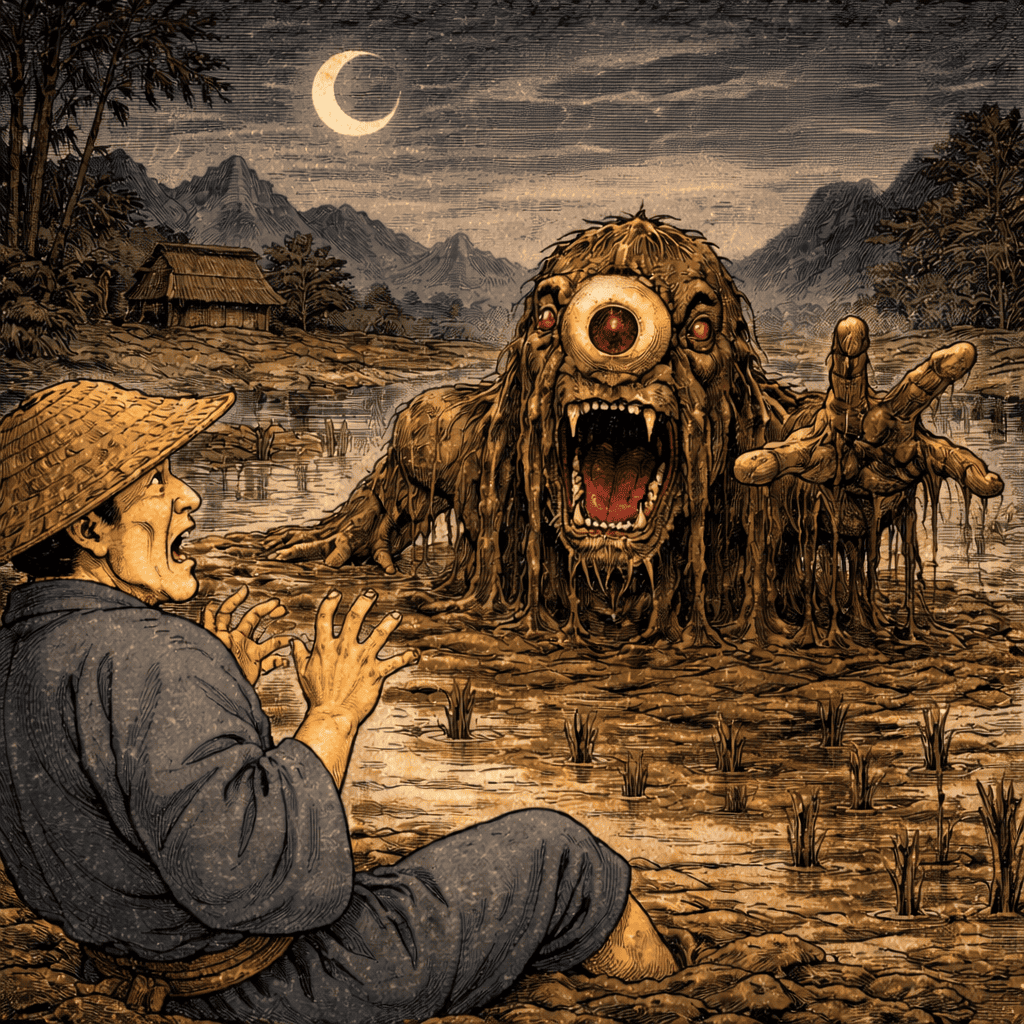
In the dead of night, a single eye emerges from the mud of an abandoned rice paddy. The eye opens slowly, deliberately, set in a face that is barely a face — an old man's features warped by soil and rot, half-sunk into the earth it once tended. A single arm rises from the mud, three crooked fingers reaching toward the sleeping village. And then the voice comes, a low and mournful cry that echoes across the quiet fields: "Return my field. Return my field. Return my field."
This is Dorotabo (泥田坊) — the "mud rice-field priest," one of Japan's most hauntingly specific yokai. He is not a demon of random chaos or a trickster of the roads. He is something far more unsettling: the spirit of a farmer who loved his land so deeply that death itself could not sever the bond, and whose rage at seeing that land abandoned or sold has transformed him into a creature of the mud. Dorotabo is a yokai of memory, of grief, and of the ancient Japanese belief that the earth remembers everyone who ever worked it.
What is Dorotabo?
Dorotabo is a yokai from Japanese folklore that manifests as the partial remains of an old man rising from the muddy water of a neglected rice paddy. The name combines doro (泥, mud) with ta (田, rice field) and bo (坊, a suffix meaning "priest" or "old man"), yielding roughly "the old man of the muddy rice field." He is counted among the tsukumogami-adjacent spirits — beings born from deep emotional attachment to specific places or objects — though his origin story places him closer to the category of onryo (vengeful spirits) than to the playful tsukumogami of ordinary tools.
What makes Dorotabo distinct from other vengeful yokai is the specificity of his grievance. He does not curse indiscriminately. He does not pursue those who wronged him personally in life. His rage is directed at a single thing: the abandonment or improper sale of the rice field he once cultivated with his own hands, season after season, generation after generation. He is a yokai born from the Japanese agricultural ethos, from the belief that a farmer and his land form a relationship so sacred it extends beyond death.
The earliest systematic description of Dorotabo appears in Toriyama Sekien's illustrated encyclopedia Konjaku Hyakki Shui (今昔百鬼拾遺, 1781), the third volume of his famous yokai catalog series. Sekien depicted Dorotabo as a one-eyed figure with a three-fingered hand extending from the mud of a rice paddy, his face twisted in anguish, crying out for the return of his field. (Source: Toriyama Sekien, "Konjaku Hyakki Shui," 1781)
What Does Dorotabo Look Like?
Dorotabo's appearance is defined by what is visible and, just as importantly, what remains hidden beneath the mud. What emerges above the surface of the paddy water is fragmentary, incomplete — a reminder that this is a creature more bound to the earth than to any recognizable human form.
The single eye is Dorotabo's most iconic feature. Only one eye is visible in his mud-caked face, staring out with a wet, sorrowful intensity. The eye is typically described as yellow or milky white, set deep in features that sag and blur where mud meets flesh. Some regional traditions describe a second, submerged eye that can only be seen when moonlight strikes the paddy at the correct angle.
The three-fingered hand extends from the mud like a drowning claw. Dorotabo has three crooked fingers — a detail consistent across virtually all depictions — and they scrape at the air as he cries out. The hand is thin, wrinkled, aged, marked by a lifetime of rice cultivation. The three fingers have been interpreted as representing the three-fold bond between farmer, field, and ancestor.
The partial face and body are perpetually half-submerged. Dorotabo's head and one arm emerge from the mud, but the rest of his body remains buried, fused to the earth of the paddy itself. He cannot leave his field. He cannot pursue. He can only rise, cry, and reach. This immobility is crucial to his horror: he is a prisoner of his own devotion.
The elderly visage makes clear that Dorotabo died in old age, after a lifetime of labor. His face bears the deep wrinkles of decades spent under sun and rain. His expression is described variously as angry, sorrowful, or simply exhausted — the face of a man whose work has been undone.
Where Did Dorotabo Come From?
The Dorotabo legend emerges from the deepest strata of Japanese agricultural society. Rice cultivation in Japan is ancient — rice paddies have been worked continuously in some regions for more than two thousand years — and the cultural weight placed on a farmer's relationship with his land cannot be overstated. A rice paddy was not merely property. It was inheritance, identity, ancestral obligation, and, in folk religious belief, a sacred space inhabited by protective kami (Source: Michael Dylan Foster, "The Book of Yokai," 2015).
According to the traditional origin story, Dorotabo was once an ordinary farmer who spent his entire life cultivating a single rice paddy. Through decades of backbreaking work, he transformed unproductive land into a thriving field, planting and harvesting season after season, building an inheritance for his children. When he finally died, he believed the field would remain in his family — that his descendants would continue the cycle of cultivation that defined his existence.
But the descendants, in this tale, were profligate. They neglected the field, allowed weeds to overtake the carefully maintained paddies, and eventually sold the land to outsiders — often to settle gambling debts or fund lives of leisure that the old farmer would have considered shameful. The spiritual bond between the farmer and his field, forged over a lifetime of devotion, could not accept this betrayal. His spirit rose from the very mud he had worked, trapped forever between death and the land, crying out for a return that could never come.
This origin story reflects real historical anxieties in Edo-period Japan (1603-1868). Land tenure was unstable, particularly among lower-class farmers. Debt could force the sale of ancestral fields. Bad harvests could destroy generations of accumulated work in a single season. The Dorotabo legend gave supernatural expression to the very real fear of agricultural dispossession — and to the moral claim that land should remain within families, under the care of those who had proven their devotion to it (Source: Komatsu Kazuhiko, "Yokai no Minzokugaku," 1994).
The Curse of Neglect
Dorotabo's haunting is unusual among Japanese yokai in that it carries a clear moral message. He does not curse randomly. He appears only to those who have failed the land — those who inherit a well-tended field and allow it to decay, or those who purchase a paddy and treat it with contempt. His cry of "tanbo o kaese, tanbo o kaese" ("return my field, return my field") is both lament and accusation.
In traditional accounts, encountering Dorotabo was considered a warning rather than an immediate death sentence. His victims were not typically killed but haunted — visited night after night by the mournful cry from the paddy, driven gradually toward either restoration of the field or madness and ruin. Villagers who saw Dorotabo emerging from a neighbor's neglected paddy took it as a sign that the current owner was courting spiritual disaster.
The deeper theology underlying the Dorotabo legend connects to Japanese folk beliefs about the sacredness of cultivated land. In Shinto tradition, rice paddies are inhabited by Ta no Kami, the god of the rice field, a deity who descends from the mountains in spring to bless the planting and returns to the mountains after the autumn harvest. A properly maintained paddy is a space of divine presence. A neglected paddy is a space where the spiritual covenant has been broken — and into that broken space, vengeful spirits like Dorotabo can manifest (Source: Shigeru Mizuki, "Yokai Daizukan," 1994).
Dorotabo represents something specific to agricultural civilizations: the moral weight of cultivated land. A field worked for generations is not raw nature. It is the physical residue of thousands of hours of human labor, an inheritance made tangible. To abandon such a field is, in the folk imagination, a kind of betrayal — not just of the previous generation, but of the entire communal project of feeding the nation.
Which Anime and Manga Feature Dorotabo?
Dorotabo owes his modern visibility almost entirely to one man: Shigeru Mizuki (1922-2015), the legendary manga artist whose lifelong project of cataloging and popularizing Japanese yokai brought countless obscure folk creatures to international attention. Mizuki included Dorotabo in his foundational manga and anime series GeGeGe no Kitaro (ゲゲゲの鬼太郎), and in doing so transformed a regional folk belief into a recognizable pop culture figure.
In Mizuki's interpretation, Dorotabo retains his traditional appearance — the single eye, the three-fingered hand, the mud-caked face — but his character is often given additional pathos. Mizuki was deeply sympathetic to yokai whose origins lay in human suffering or injustice, and Dorotabo's grief over his lost field aligned with themes the artist returned to throughout his career: the destruction of traditional ways of life, the costs of postwar development, and the moral weight of inherited obligations. (Ref: GeGeGe no Kitaro, Toei Animation, 1968; Shigeru Mizuki, "GeGeGe no Kitaro" manga, 1960s)
Dorotabo has appeared in multiple adaptations of GeGeGe no Kitaro, including the 1968 original anime series, subsequent reboots in 1971, 1985, 1996, 2007, and most recently the 2018 series produced by Toei Animation. While he is not a main character in the franchise, his distinctive visual design and moral backstory have made him a recurring supporting yokai, often appearing in episodes dealing with land disputes, abandoned villages, or ancestral curses.
Beyond GeGeGe no Kitaro, Dorotabo appears in yokai-themed video games and in the broader ecosystem of Japanese folklore media that Mizuki's work helped create. He remains a relatively obscure figure compared to kappa, tengu, or kitsune, but among enthusiasts of Japanese folk creatures, he is recognized as one of the most thematically rich of the agricultural yokai.
Where Can You Encounter Dorotabo in Japan?
For those seeking to encounter Dorotabo — or at least the cultural heritage that surrounds him — Japan offers several meaningful destinations.
Sakaiminato City, Tottori Prefecture, is the hometown of Shigeru Mizuki and the site of the famous Mizuki Shigeru Road (水木しげるロード), a kilometer-long street lined with more than 170 bronze statues depicting yokai from Mizuki's works. Dorotabo's statue stands among them — a small, haunting figure rising from a metaphorical paddy, his single eye gazing at passing visitors. The street has become one of Tottori's major tourist attractions, drawing folklore enthusiasts from across Japan and the wider world.
Rural agricultural regions throughout Japan — particularly in Tohoku, Shikoku, and Kyushu — preserve the rice-paddy landscapes where Dorotabo legends originally emerged. Traveling through these regions during the planting season (May-June) or the harvest (September-October) offers a sense of the agricultural cycles that gave rise to the yokai. In some communities, small shrines to Ta no Kami still stand at the edges of paddies, and the folk belief that certain fields are watched over — or haunted — by former farmers persists quietly beneath the surface of modern life.
Abandoned rice paddies (耕作放棄地, kosaku-hoki-chi) are a growing feature of rural Japan as agricultural populations age and younger generations move to cities. These neglected fields, filling with weeds and reverting slowly to wild land, are the very settings that traditional Dorotabo legends warned against. Walking past such a paddy at twilight — particularly one where you can see the remnants of carefully constructed irrigation channels and levees — gives a visceral sense of why Japanese farmers believed the land itself could hold a grudge.
Conclusion
Dorotabo is a yokai whose horror lies not in physical violence but in moral reproach. He does not seek to harm the innocent. He seeks only to name what has been lost — a devotion, a lineage, a covenant with the earth that sustained generations. His single eye watches from the mud because no one else will watch. His three-fingered hand reaches because no living hand still tends what he tended. His cry — "return my field" — is the voice of every ancestor who watches descendants squander what was carefully built.
In an age when Japan's rural villages are emptying, when paddies that fed communities for centuries are reverting to weeds, Dorotabo is perhaps more resonant than ever. The yokai of the mud field is not merely a ghost story. He is a warning about what happens when the thread between people and place is allowed to break — and a reminder that, in the Japanese supernatural imagination, the land itself remembers.
This is The Yokai Files.
Support The Yokai Files
Enjoyed this deep dive into Japanese folklore?
The Yokai Files is reader-supported. Your support helps us research deeper, write more, and keep the darkness alive.