Tanuki: The Shape-Shifting Trickster Who Guards Japan's Good Fortune
Published: March 28, 2026
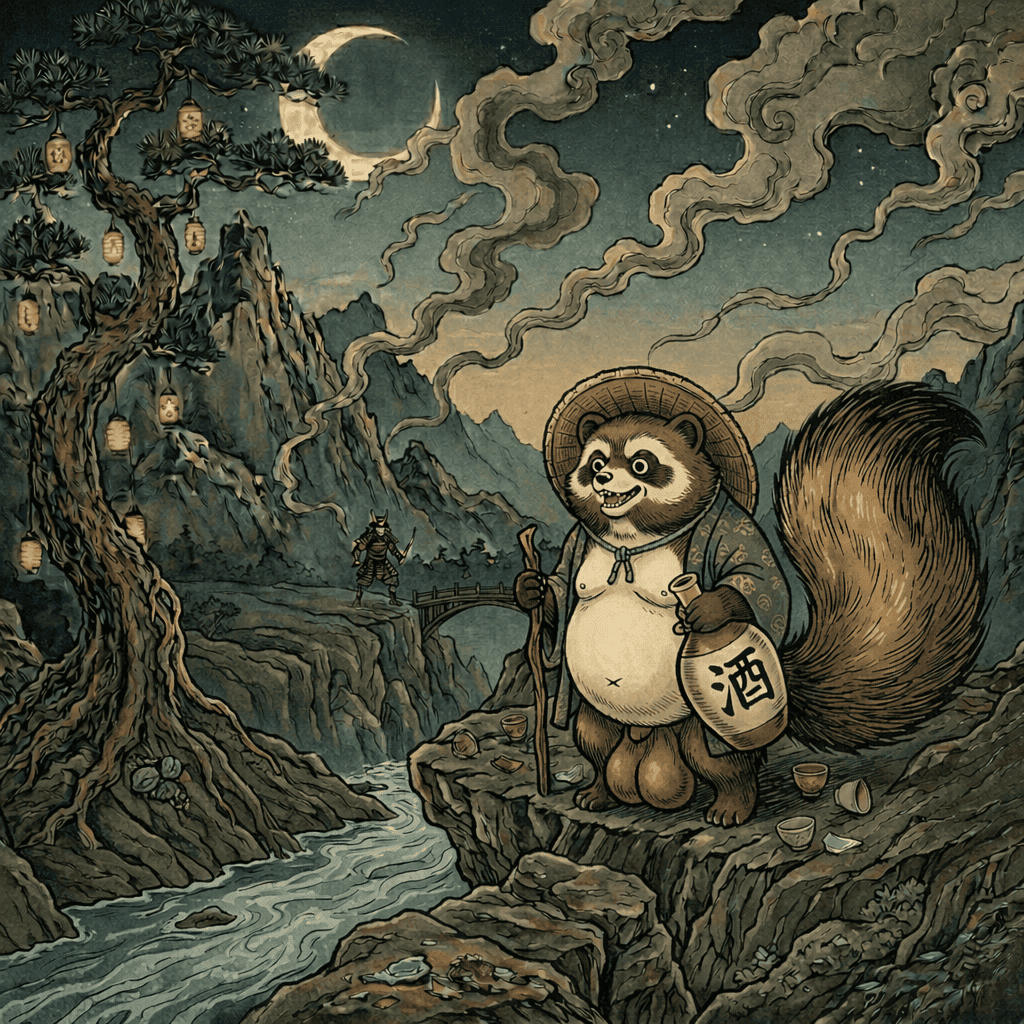
Outside the entrance of countless restaurants, sake shops, and homes across Japan, a chubby ceramic figure stands guard — a rotund raccoon dog with enormous testicles, a wide straw hat, a jug of sake in one paw, and an expression of such boundless, beaming satisfaction that it seems fundamentally incapable of harboring dark intentions. The tanuki is Japan's most beloved shapeshifter, a creature associated with good fortune, trickery, abundance, and a cheerful vulgarity that makes it unlike almost any other supernatural being in world folklore. It will trick you. It will steal from you. And then it will bring your household prosperity for a generation.
The tanuki — the Japanese raccoon dog, Nyctereutes procyonoides viverrinus — is a real animal native to Japan, known for its docile temperament, its distinctive banded markings, and its remarkable ability to play dead under threat. The supernatural tanuki of Japanese folklore takes these real qualities and amplifies them into something altogether stranger: a being of prodigious magical power that uses its gifts primarily to drink sake, play pranks, and drum rhythmically on its own abdomen to make music that echoes through the mountain forests at night.
What is Tanuki?
In Japanese supernatural tradition, the tanuki is classified as one of the primary shapeshifting animals — alongside the kitsune, with whom it is often compared and contrasted. Where the kitsune is elegant, calculating, and often genuinely dangerous, the tanuki is cheerful, impulsive, and tends to use its powers for entertainment and minor mischief rather than sustained malice. The tanuki's shapeshifting ability is real but somewhat unreliable — stories of tanuki transformations often end with the illusion dissolving at an inopportune moment, leaving the tanuki embarrassed and the victim confused.
The creature is particularly associated with prosperity and good fortune in its role as a commercial talisman. The ceramic tanuki figurine — called tanuki-yaki or shigaraki tanuki, after the pottery town where the style was developed — has become one of Japan's most recognizable cultural symbols, greeting visitors at the entrances of businesses across the country. Each element of the figurine's design has symbolic meaning connected to different aspects of good fortune: the large hat for protection from bad weather and bad luck, the sake bottle for virtue and wisdom, the account book for financial acumen, the cheerful expression for welcoming customers.
Unlike the kitsune, whose relationship with humans is defined by a complex moral hierarchy and institutional religious ties, the tanuki's relationship with people is fundamentally egalitarian and good-natured. It prefers the company of farmers, merchants, and wanderers to aristocrats and priests. Its tricks are more likely to be embarrassing than dangerous. And its fundamental orientation — toward abundance, pleasure, and communal celebration — makes it less a figure of supernatural dread and more a figure of supernatural fellowship. Michael Dylan Foster identifies the tanuki as one of the clearest examples of a yokai whose popular image has been progressively stripped of its darker historical dimensions, leaving a benevolent comedic figure in place of a genuinely ambiguous one. (Michael Dylan Foster, "The Book of Yokai," 2015)
What Does Tanuki Look Like?
The supernatural tanuki is typically depicted as a rotund, jolly-looking raccoon dog — its natural plumpness exaggerated by folklore into near-spherical proportions. Its fur is brown and grey with the distinctive banded facial markings of the real animal, and its eyes often have a gleeful, mischievous quality that conveys both intelligence and a fundamental unwillingness to take anything too seriously. In many traditional depictions, it wears a broad straw hat and carries a sake bottle. Toriyama Sekien included the tanuki in his systematic catalogues of supernatural beings, depicting it in a style that acknowledged both its comic and its genuinely uncanny qualities — a creature whose shapeshifting suggests an unsettling relationship with the nature of identity itself. (Toriyama Sekien, "Gazu Hyakki Yako," 1776)
The anatomical feature most prominently associated with the tanuki in traditional art — its enormously enlarged scrotum — is a genuine characteristic that connects to both fertility symbolism and to the tanuki's magical abilities. In folklore, the tanuki can expand its scrotum to function as a boat, a weapon, a blanket, a shelter, or almost any other object it requires. This frankly bizarre quality is treated with cheerful matter-of-factness in traditional tanuki lore, and the modern ceramic figurine preserves this feature as a good-luck symbol associated with financial expansion and abundance.
Lafcadio Hearn noted the peculiar mixture of the grotesque and the festive that characterizes tanuki imagery — the creature occupies a zone of Japanese supernatural tradition where horror and humor are genuinely indistinguishable, where the disturbing is presented as entertaining and the entertaining carries a faint undertone of dread. (Lafcadio Hearn, "Kwaidan," 1904) This tonal ambiguity is part of what makes the tanuki so enduring: it refuses to be tidied up into either the purely terrifying or the purely comical.
Where Did Tanuki Come From?
Tanuki appear in Japanese records as far back as the Nihon Shoki (720 CE), where they are described as shape-changers capable of bewitching humans. Early tanuki lore in Japan was significantly darker than the cheerful figure familiar today — early texts describe tanuki as malicious creatures capable of possessing humans, causing illness, and bringing disaster to households that mistreated them. The shift toward the more benevolent, comical tanuki of later folklore appears to have developed gradually through the Edo Period, when urban popular culture began to embrace the creature's comedic qualities over its dangerous ones.
The popularization of the tanuki as a commercial talisman accelerated significantly in the 20th century, particularly after the Showa Emperor Hirohito visited Shigaraki during World War II and tanuki statues were lined along his route for good luck. Photographs of this event circulated widely, and the tanuki figure became associated with success and fortune at a national level, leading to the explosion of ceramic tanuki statuary that remains ubiquitous across Japan today. The postwar economic boom further entrenched the tanuki's commercial associations — prosperity-seeking households and businesses adopted the smiling raccoon dog as a talisman for the new era of consumer abundance.
Regional variation in tanuki belief is considerable. In Shikoku, particularly in Tokushima Prefecture, the tanuki was historically taken much more seriously as a supernatural threat — stories of tanuki possession (tanuki-tsuki) parallel the better-known tradition of fox possession (kitsune-tsuki) and were treated with similar gravity. In these traditions the tanuki is less a jolly trickster and more an invasive spirit capable of genuine harm, a reminder that the creature's cheerful modern image is the product of selective cultural memory rather than the full depth of the tradition.
What Are the Most Famous Tanuki Legends?
The most famous tanuki legend in Japanese folklore is Bunbuku Chagama — the tanuki who transformed into a tea kettle. In this tale, a tanuki is rescued from a trap by a kind monk or peddler, and in gratitude transforms itself into a tea kettle to be sold, providing the human with income. However, the tanuki cannot fully commit to remaining in kettle form — it periodically extends its legs and scurries about the house, causing chaos and confusion before reverting to kettle shape. The story captures perfectly the essential tanuki quality: genuine desire to help, combined with an inability to maintain a disguise under pressure.
Another beloved tradition involves the sounds tanuki make in the mountain forests at night. According to legend, tanuki beat their distended abdomens like drums, creating a hollow "ponpoko" sound that echoes mysteriously through the darkness. This sound — which exists in some form in the calls real raccoon dogs make — has become so associated with the creature that a famous tanuki film takes its title directly from the description of this behavior. The tanuki's nocturnal drumming is both celebratory and slightly melancholy: a sound that carries from the forest into human settlements, a reminder that the wild world just beyond the tree line has its own celebrations and its own music, entirely indifferent to human concerns.
The legend of Shippeitaro, found in various regional forms, pits a brave warrior against a band of supernatural tanuki — in some versions the enemy is cats, but many regional tellings feature the raccoon dog. The tale involves a hero discovering a village terrorized by a supernatural animal demanding annual human sacrifice, defeating the monster with the help of a specific charm, and restoring peace to the community. These darker tanuki legends offer a counterweight to the creature's jolly commercial image and speak to the genuine ambivalence with which the supernatural animal was regarded in older traditions.
How Does Tanuki Appear in Modern Japan?
The tanuki is thoroughly embedded in modern Japanese popular culture. The ceramic figurine's presence at the entrance of businesses has become so standard that it functions as a kind of visual grammar — a signal of hospitality and good fortune that operates below the level of conscious attention for most Japanese viewers. Tanuki characters appear across Japanese gaming, anime, and manga, generally maintaining the creature's associations with magic, mischief, and good-natured chaos.
In the Super Mario franchise, Tanooki Mario — the power-up that gives Mario a tanuki suit with a raccoon-dog tail and ears — has introduced the tanuki to multiple generations of global players, though in a thoroughly defanged form that retains little of the original creature's supernatural strangeness. This global cultural export has given the tanuki a degree of international recognition it might not otherwise have achieved, even if the connection to the rich folkloric tradition behind it is largely invisible to international audiences.
Which Anime and Manga Feature Tanuki?
The Studio Ghibli film Pom Poko (1994), directed by Isao Takahata and produced by Studio Ghibli, remains the most ambitious and emotionally serious artistic treatment of the tanuki. The film follows a community of raccoon dogs in the hills surrounding Tokyo who discover that their forest home is being demolished to make way for urban development. In response, they attempt to use their ancestral shapeshifting powers to frighten away the construction crews — staging elaborate supernatural parades and transformations drawn from the full depth of tanuki folklore. The film treats the tanuki's magical abilities with both wonder and sadness, acknowledging that shapeshifting trickery is ultimately no match for bulldozers. (Studio Ghibli, "Pom Poko," dir. Isao Takahata, 1994)
Pom Poko is unusual in anime for using the tanuki's traditional folkloric attributes — including the scrotum imagery of classical tanuki art — with an almost documentary frankness, treating them not as vulgar jokes but as genuine elements of a cultural tradition being lost along with the forests that housed it. Takahata's film is ultimately an elegy: for the tanuki, for the natural world they inhabit, and for the folk traditions that made those wild spaces meaningful. No other work in any medium has engaged so seriously or so tenderly with what the tanuki represents in Japanese culture.
Where Can You Encounter Tanuki in Japan?
The town of Shigaraki in Shiga Prefecture is the spiritual home of the tanuki figurine tradition, and tanuki statues line its streets in extraordinary numbers. The Shigaraki Ceramic Cultural Park celebrates the town's pottery heritage, which includes the ceramic tanuki that have become one of Japan's most recognizable cultural exports. A visit to Shigaraki feels like entering the tanuki's own territory — the creatures peer from every storefront, every garden, every roadside shop, their ceramic eyes holding that characteristic expression of boundless and slightly unsettling satisfaction.
For those wishing to encounter real raccoon dogs — the actual animals behind the legend — various wildlife parks and sanctuaries across Japan house them, and they can occasionally be spotted in rural areas at dawn and dusk. Watching a real tanuki waddle through the underbrush with its characteristic unhurried gait, it becomes easy to understand why the Japanese imagination transformed this docile, chubby creature into a shapeshifting master of illusion. It already looks like it's up to something.
Conclusion
The tanuki is Japan's trickster deity — not the cool, calculating kind but the warm, bumbling, endlessly entertaining kind. It is a being whose supernatural power is deployed primarily in service of mischief, whose illusions collapse at inconvenient moments, and whose greatest magical achievement might be convincing an entire nation to put its likeness at the entrance of every business as a good luck charm. Isao Takahata's Pom Poko showed us what the tanuki really represents: the forest that was there before the city, the wild abundance that urban development consumes, the cheerful resilience of creatures who keep singing and drumming even as their world disappears. There is something profoundly human about this creature: a shapeshifter who can be anything but keeps accidentally being itself, a trickster whose jokes are on itself as often as on others. The tanuki drums on its own belly in the dark forest, and the sound carries for miles. There are worse ways to announce your presence in the world.
This is The Yokai Files.
Support The Yokai Files
Enjoyed this deep dive into Japanese folklore?
The Yokai Files is reader-supported. Your support helps us research deeper, write more, and keep the darkness alive.