Tengu: Japan's Fearsome Mountain Demons and the Masters of Martial Arts
Published: March 27, 2026
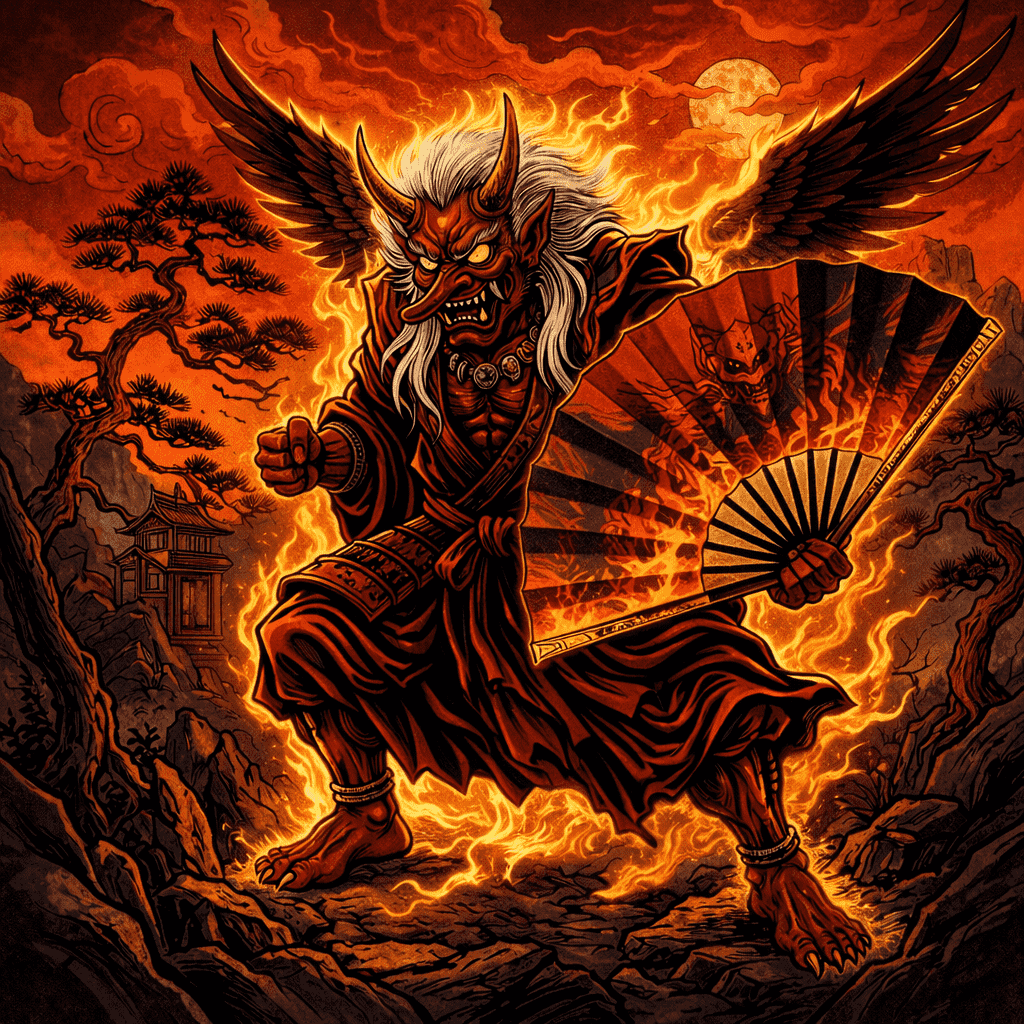
Deep in the mist-shrouded mountains of Japan, where ancient cedar trees reach toward storm-darkened skies and the wind carries whispers of forgotten prayers, something watches. It has watched for centuries — long before the first samurai raised a sword, long before Buddhist monks built their mountain temples. With wings that blot out the sun and eyes that pierce through deception, the Tengu stands as one of Japan's most formidable and enigmatic supernatural beings. Their presence saturates the high places of the Japanese islands, embedded in the very granite of sacred peaks like Kurama, Takao, and Oyama, each mountain carrying its own Tengu tradition stretching back a thousand years or more.
To speak of the Tengu is to speak of power that exists beyond human comprehension — a force that has shaped the destiny of warriors, humbled the arrogant, and tested the worthy across more than a thousand years of Japanese history. They are neither wholly demon nor wholly divine, occupying a terrifying space between worlds where their judgment is absolute and their skills unmatched. Unlike many yokai that can be appeased with offerings or repelled with talismans, the Tengu chooses its own encounters on its own terms. No ritual summons them. No prayer compels them. They appear when they will, to whom they will — and the encounter invariably changes the human involved, for better or for worse.
What is Tengu?
The Tengu (天狗, literally "Heavenly Dog") is a class of supernatural being found throughout Japanese folklore, mythology, and religion. Despite the canine element of its name — derived from the Chinese Tiangou, a dog-like comet or celestial portent — the Tengu bears no resemblance to a dog. Instead, it is a powerful entity associated with the mountains and forests, possessing avian characteristics and extraordinary martial and mystical abilities (Michael Dylan Foster, "The Book of Yokai," 2015). The name itself reflects the circuitous route through which Japanese supernatural beings absorbed and transformed continental Asian influences, taking a Chinese astronomical term and grafting it onto an entirely different creature born from the mountain worship traditions of the Japanese archipelago.
Within Japanese supernatural taxonomy, Tengu occupy a unique and elevated position. They are classified among the most powerful of all yokai — beings whose strength, intelligence, and supernatural abilities far exceed ordinary spirits. Yet their relationship to Buddhism and Shinto places them in a complex theological space that neither tradition fully resolves. Early Buddhist texts portrayed them as demonic obstructions to enlightenment, while later traditions elevated them to the status of protective mountain deities and guardian spirits of martial arts. This tension between the demonic and the divine is not incidental to the Tengu's character — it is their defining essence. They are the embodiment of power that transcends human moral categories.
Scholars note that Tengu exist within a broader framework of Japanese mountain spirits called "yama no kami" — deities of the high places who govern the forces of nature and test the worthiness of those who dare to enter their domain (Lafcadio Hearn, "Kwaidan," 1904). What distinguishes the Tengu from these other mountain spirits is their active, interventionist character. They do not merely preside over the mountains; they engage with the human world on their own terms, choosing their pupils, punishing the arrogant, and occasionally participating in the great dramas of Japanese history.
What Does Tengu Look Like?
Tengu are broadly divided into two distinct types, each with their own striking visual characteristics that reflect different aspects of their supernatural nature. The older and more animalistic form is the Karasu-Tengu (烏天狗, Crow Tengu), which appears as a large humanoid creature with the head of a crow or bird of prey. Its body is covered in dark feathers, its wings span enormous distances, and its taloned feet grip mountain peaks and ancient branches with crushing force. These crow-headed Tengu are considered the lesser of the two types — the soldiers and retainers of the great Tengu lords — yet they remain terrifying supernatural warriors capable of moving faster than sight and striking with power that shatters stone. The Karasu-Tengu carry swords and staffs, and their fighting techniques are said to be the origin of many Japanese martial arts traditions.
The more familiar and vastly more powerful form is the Dai-Tengu (大天狗, Great Tengu), which takes a predominantly human appearance — tall, muscular, with red skin and a dramatically elongated nose that stretches to impossible lengths. This oversized nose, the Tengu's most recognizable feature, is interpreted by scholars as a symbol of pride and supernatural power — the physical manifestation of an ego that has expanded beyond normal human dimensions. The Dai-Tengu is typically depicted wearing the distinctive garb of a mountain ascetic: a small black hat called tokin, white or blue robes, wooden sandals called geta, and carrying a feathered fan called a hauchiwa capable of summoning storms, moving mountains, and extinguishing fire. Their eyes burn with supernatural intensity — golden or crimson, ancient beyond measure — and their presence carries an almost physical weight of authority that makes ordinary humans feel the smallness of their existence (Toriyama Sekien, "Gazu Hyakki Yako," 1776).
Both forms radiate an aura of absolute authority that artists across centuries have struggled to capture. Regional traditions add further variations: some Tengu are depicted with white hair and beards suggesting vast age, others with the multi-colored plumage of exotic birds. In the mountains of Tohoku, Tengu sometimes appear wearing the straw cloaks of farmers, suggesting a deeper integration with rural life. In Kyushu traditions, some Tengu take female forms, complicating the predominantly male representation found in central Japanese tradition. What remains constant across all depictions is the overwhelming quality of presence — the sense that these beings occupy space differently than ordinary creatures, as though they exist slightly outside the normal boundaries of physical reality.
Where Did Tengu Come From?
The earliest mention of Tengu in Japanese written records appears in the Nihon Shoki (日本書紀), Japan's second oldest chronicle, compiled in 720 CE. This initial reference describes a meteor or shooting star as a "Tengu," borrowing the Chinese concept of the Tiangou — a celestial dog that devours the sun or moon during eclipses. However, this astronomical usage bears no resemblance to the fully developed Tengu of later tradition, suggesting that the name was applied to an already-existing indigenous supernatural concept that predated contact with Chinese cosmology. The mountain spirits of pre-Buddhist Japan — the fierce guardians of the high places worshipped by hunters, ascetics, and rural communities — likely provided the raw material from which the Tengu mythology was eventually constructed.
Early Buddhist teachings, particularly during the Heian period (794-1185 CE), portrayed Tengu as malevolent demons who led priests astray, caused wars, and tested the faith of practitioners. The Konjaku Monogatarishu, a collection of tales compiled around 1120 CE, contains numerous stories of Tengu who torment Buddhist monks, possess women, and disturb the religious order. They were thought to be the spirits of proud or arrogant monks who, through their hubris and excessive attachment to earthly concerns, were condemned to exist in a terrible intermediate state — too attached to the world for paradise, yet too spiritually developed for ordinary hell. This theological framework gave Tengu a peculiarly Buddhist horror: they are not outsiders to the religious world but its most cautionary products, the consequences of spiritual pride.
More broadly, Tengu-inspired characters — the supremely powerful mountain beings who serve as both obstacles and teachers — appear throughout the anime canon. The concept of the warrior-sage who tests protagonists through overwhelming combat, who possesses skills that defy normal understanding, and who inhabits a moral space between good and evil: this is the Tengu archetype, transplanted into modern narrative frameworks. Series such as Nurarihyon no Mago engage directly with Tengu as named supernatural entities within organized yokai hierarchies, preserving the traditional understanding of Tengu as among the highest-ranking beings in the supernatural world.
Where Can You Encounter Tengu in Japan?
Mount Kurama, north of Kyoto, remains the most sacred site associated with Tengu in all of Japan. Kurama Temple, founded in 770 CE, dedicates significant veneration to the great Tengu Sojobo, who is worshipped here as a divine protector of the mountain and, by extension, of the nation. The mountain's ancient cedar forests, where Yoshitsune allegedly trained under Sojobo's guidance, still carry an atmosphere of profound supernatural weight that even skeptical visitors find difficult to dismiss. The trees themselves seem older than memory, their trunks twisted into shapes that suggest faces, reaching limbs, watching presences. Visitors report an unsettling sense of being observed from the ancient canopy — a sensation that the local temple tradition validates rather than discourages.
Mount Takao in Tokyo's western reaches houses Yakuoin Temple, one of Japan's most important Tengu worship sites, dedicated to Tarobo, the Tengu lord of Mount Atago. The mountain's trails are lined with stone lanterns and dramatic Tengu statues — long-nosed, red-faced, radiating supernatural authority — creating a corridor of supernatural presence that draws millions of visitors annually. Atago Shrine in central Tokyo and Naritasan Shinshoji Temple in Chiba Prefecture maintain strong Tengu associations and house significant Tengu iconography. Throughout the Japanese Alps and the mountain ranges of Honshu, small shrines dedicated to local Tengu dot the landscape, maintained by communities who still regard these beings as protectors of mountain ecosystems, guardians against fire and misfortune, and embodiments of the dangerous power that has always characterized the high places of Japan.
Conclusion
The Tengu endures as one of Japan's most powerful supernatural archetypes because it embodies a profound truth about the nature of excellence, power, and the spiritual dangers of pride. In a culture that has always revered mastery — of the sword, the brush, the tea ceremony, the martial path — the Tengu represents the ultimate teacher: demanding, uncompromising, and absolutely beyond the reach of flattery or deception. To be chosen by a Tengu was not a gift; it was a trial by fire conducted at an altitude where ordinary human concerns ceased to matter. And to emerge from that trial transformed was the highest honor a warrior could receive — proof that one's potential had been recognized by a being whose standards were beyond human measurement.
More than a millennium of Japanese history flows through Tengu mythology: the spread of Buddhism, the rise of the samurai, the establishment of the great martial traditions, the tension between arrogance and wisdom that runs through every human culture. The Tengu absorbed all of it, transforming from celestial portent to Buddhist demon to divine protector, always adapting while remaining essentially itself — ancient, powerful, and watching from the mountain heights with eyes that see through every pretense. In the mist-covered mountains where ancient Japan still breathes between the cedar trunks, something watches. Whether you call it spirit or legend, guardian or demon, the Tengu remains — patient, powerful, and utterly real to those who climb high enough to meet the wind on their own terms.
This is The Yokai Files.
What Are the Most Famous Tengu Legends?
The most celebrated Tengu legend involves the young Minamoto no Yoshitsune, who would grow up to become one of Japan's greatest and most tragic military commanders. Orphaned at a young age and sent to Kurama Temple outside Kyoto, the boy known as Ushiwakamaru is said to have encountered the great Tengu Sojobo — king of all Tengu — in the deep forests of Mount Kurama. Recognizing in the child a combination of exceptional talent, fierce determination, and a destiny written in the patterns of fate, Sojobo took him as his personal student. Over years of secret training among the ancient cedars, the Tengu master taught the boy not only swordsmanship but also the ability to read the movements of enemies, to move with the speed of wind, and to perceive the spiritual dimensions of combat that separate true mastery from mere technical proficiency. These skills, supernatural in their origin, would later allow Yoshitsune to achieve military victories against forces many times larger than his own — victories so improbable that contemporaries attributed them to supernatural assistance.
Another famous account involves Emperor Sutoku, one of the most tragic figures in Japanese imperial history. Forced to abdicate, exiled, and eventually dying in bitterness far from the capital, Sutoku's death in 1164 CE was followed almost immediately by a series of disasters — earthquakes, floods, epidemics, and political upheavals — that contemporaries attributed to his vengeful spirit. According to some traditions, the sheer force of Sutoku's rage and grief transformed him posthumously into a great Tengu, a being of such tremendous supernatural power that his curse threatened to consume the entire nation. Priests attempted exorcisms; shrines were established to appease his spirit. This story illustrates the deeply held belief that humans of extraordinary passion and power could transform into Tengu after death, that the boundary between exceptional humanity and supernatural existence was more permeable than ordinary people understood.
Perhaps most chilling to ordinary people were the tales of Tengu-kakushi — Tengu abductions. Throughout Japanese history, people would suddenly vanish without explanation from their homes, their fields, their mountain paths. When they returned — sometimes days later, sometimes years — they were found in impossible locations: the tops of tall trees, the peaks of remote mountains, the rooftops of temples. Many returned in a state of profound disorientation, speaking in fragments about flying through the skies at impossible speeds, witnessing the hidden mechanisms of the world from above, encountering beings of terrifying power and strange wisdom. Some never recovered their faculties. Some never returned at all. The supernatural explanation provided both meaning and warning: the mountains were not safe for the careless or the disrespectful.
How Does Tengu Appear in Modern Japan?
The Tengu's influence on modern Japanese and global popular culture is profound and pervasive, extending far beyond the boundaries of traditional folklore into contemporary entertainment, fashion, and spiritual practice. In video games, the Tengu appear across countless titles as powerful enemies, mysterious mentors, and symbols of Japanese supernatural tradition. The iconic Tengu mask — the long-nosed face of the Dai-Tengu — has become one of the most recognizable symbols of Japanese aesthetic design worldwide, appearing in gaming franchises like Nioh, Ghost of Tsushima, and Sekiro: Shadows Die Twice, where the Tengu's martial legacy is rendered in extraordinary detail for global audiences. These depictions generally preserve the core characteristics of the tradition: overwhelming power, mastery of combat arts, and an inscrutable moral compass that operates according to principles ordinary humans cannot fully comprehend.
The Tengu mask itself has transcended its supernatural origins to become a symbol of Japanese traditional culture more broadly, appearing in festivals, Noh theater, and martial arts dojos as a protective and auspicious emblem. The irony is remarkable: beings once feared as demons who led Buddhist priests astray have become symbols of strength, wisdom, and authentic Japanese tradition. This transformation reflects the broader arc of Tengu mythology — from demonic obstacle to divine guardian, a journey that mirrors the complexity of spiritual development itself.
Which Anime and Manga Feature Tengu?
The Tengu's archetype as a supreme supernatural teacher and warrior has made them a natural fit for anime and manga, where the mentor-student dynamic and the concept of hidden power are central narrative conventions. One of the most direct and celebrated engagements with Tengu mythology in anime appears in Yu Yu Hakusho (Pierrot, 1992), through the character of Kurama — a fox spirit intertwined with profound supernatural power — and through the broader framework of demon-world hierarchies that draw heavily on traditional yokai classification. The Tengu's influence permeates the way powerful supernatural beings are depicted in the series: as entities of ancient pride, extraordinary ability, and deeply ambivalent relationships with humanity (Yu Yu Hakusho, Pierrot, 1992).
More broadly, Tengu-inspired characters — the supremely powerful mountain beings who serve as both obstacles and teachers — appear throughout the anime canon. The concept of the warrior-sage who tests protagonists through overwhelming combat, who possesses skills that defy normal understanding, and who inhabits a moral space between good and evil: this is the Tengu archetype, transplanted into modern narrative frameworks. Series such as Nurarihyon no Mago engage directly with Tengu as named supernatural entities within organized yokai hierarchies, preserving the traditional understanding of Tengu as among the highest-ranking beings in the supernatural world.
Support The Yokai Files
Enjoyed this deep dive into Japanese folklore?
The Yokai Files is reader-supported. Your support helps us research deeper, write more, and keep the darkness alive.