Ushi-oni: The Bull-Headed Sea Demon of Japan's Western Coast
Published: March 28, 2026
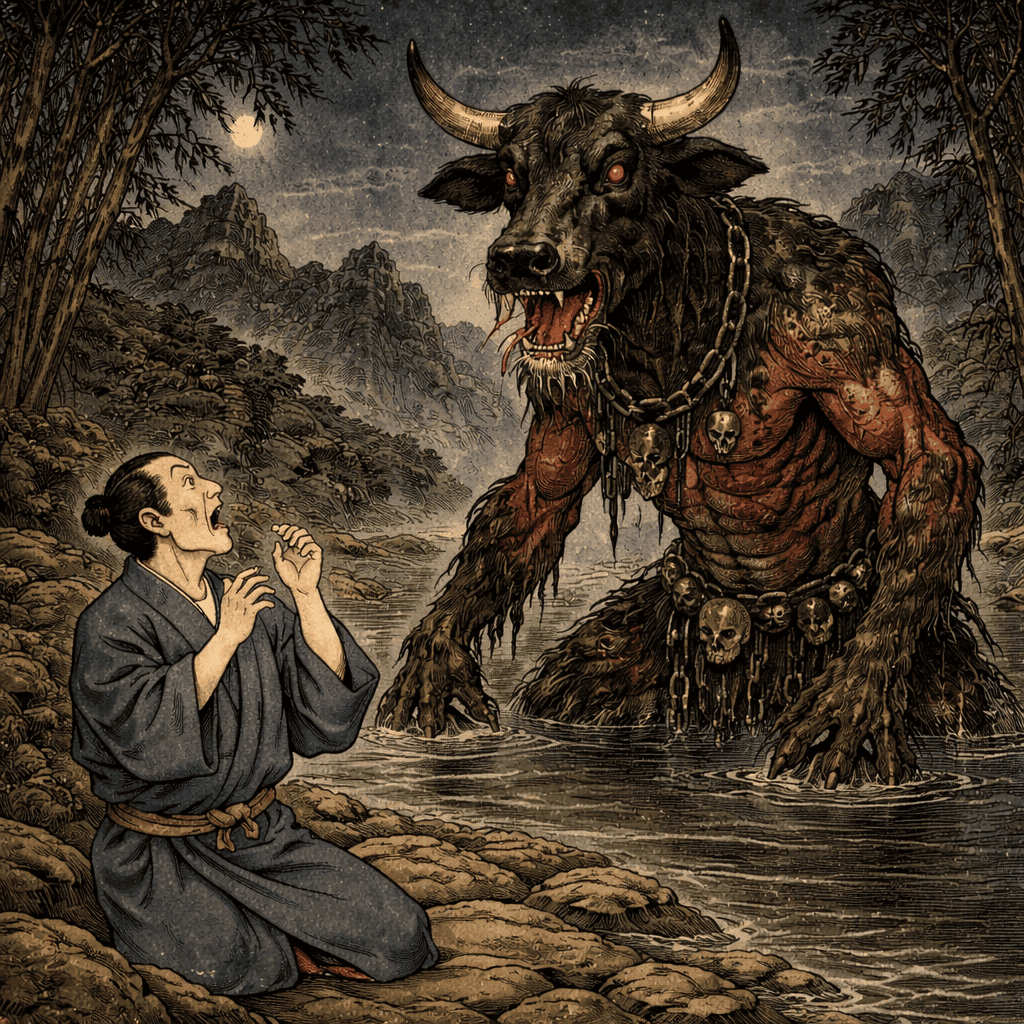
Something moves beneath the surface of the coastal waters of western Japan. It is enormous — the fishermen know this from the way boats that pass over certain channels seem to be affected by something below, from the displacement patterns of water that have no rational source, from the occasional glimpse of something dark and vast descending before the eye can properly resolve what it saw. The creature that lives in these waters has the head of a bull and the body of a spider or crab or serpent, depending on which account you consult. What all accounts agree on is that it is large, it is aggressive, and its interest in humans is not friendly.
The ushi-oni — "cow demon" or "bull demon" — is one of Japan's most regionally specific and genuinely terrifying supernatural beings, a creature of the western coastal sea that combines the power of a bull with the alien anatomy of a sea creature in ways that defy any simple categorization. Unlike the playful kappa or the mischievous tanuki, the ushi-oni exists purely as a threat — massive, violent, and deeply tied to the coastal communities who have lived in its shadow for centuries. It is a creature that embodies the sea at its most hostile: not its beauty or its abundance, but its capacity for destruction on a scale that humans cannot match or anticipate.
What is Ushi-oni?
Ushi-oni — written 牛鬼, literally "cow-demon" or "ox-demon" — is a name applied to several different supernatural beings in Japanese tradition that share the characteristic of bovine features combined with some other, more monstrous body type. The most widely recognized ushi-oni is the sea creature of western Japan — particularly associated with the coastal regions of Shimane, Tottori, and Ehime Prefectures — that lives in coastal waters and preys on fishermen and those who approach the sea. This creature is typically described as having the head of a bull and the body of a giant crustacean, spider, or serpent, though the exact configuration varies by region and account.
The term also refers to a separate, land-dwelling entity in some regional traditions — a large, bull-like demon that haunts mountain passes and remote roads — demonstrating that "ushi-oni" functions as a category label that encompasses multiple distinct supernatural beings across different geographic regions rather than a single specific creature. The sea-dwelling ushi-oni of western Japan is the most fully documented and most commonly referenced in modern compilations and popular culture. Both forms share an association with extraordinary violence and an indifference to human survival that makes them among the more straightforwardly dangerous entities in the yokai catalogue (Michael Dylan Foster, "The Book of Yokai," 2015).
What distinguishes the ushi-oni from many other dangerous yokai is the completeness of its hostility. There are no accounts of the ushi-oni being appeased, bargained with, or tricked into cooperation. It does not have a playful side that can be engaged, a weakness that can be exploited through cleverness, or a domain that can be respected to ensure safe passage through it. It is simply dangerous, and the only safe approach is avoidance of the waters and shores it inhabits.
What Does Ushi-oni Look Like?
The ushi-oni's appearance varies significantly between regional traditions, but the defining feature is consistent: the head of a bull or ox, with prominent curved horns, powerful jaw, and the aggressive, lowered-head charging quality of an enraged bovine. This bovine head is attached to a body that is described variously as spider-like (with multiple legs and possible spinnerets), crab-like (with large claws and an armored carapace), or serpentine (with a long, coiling body extending from the bull-neck). The combination is deliberately chimeric — an impossible creature that draws its power from the violent conjunction of incompatible anatomies, none of which suggests any possibility of peaceful coexistence.
In Ehime Prefecture's Uwajima region, local artistic representations show the ushi-oni as a creature with a bull's head, a sinuous body covered in dark hair or scales, multiple limbs of varying type, and a tail that ends either in a sharp point or in fire. The overall impression is of a creature that cannot be properly seen all at once — too large, too anatomically complex, too wrong in its proportions to be comprehended as a whole. The partial glimpses that fishermen and coastal dwellers describe in ushi-oni accounts are consistent with this: what they see is a part of something that is too large and too strange to be seen entire.
The Uwajima Ushi-oni festival effigy — the elaborate ceremonial construction carried through the city streets during the annual celebration — attempts to render the creature in physical form, and the result is one of the most striking festival objects in Japan: a structure several meters long, with a huge bull-head of painted papier-mache or cloth, a body made from bamboo and fabric, and multiple operators inside moving it through the streets. The effigy's size and elaborateness suggests the scale of what the tradition imagines the actual creature to be.
Where Did Ushi-oni Come From?
The ushi-oni's origins are rooted in the coastal communities of western Japan, where the sea itself was understood as a dangerous, poorly mapped territory inhabited by creatures for which human experience provided no adequate framework. The fishermen and coastal dwellers of the Seto Inland Sea and the western Honshu and Shikoku coasts lived in intimate proximity to a body of water that provided their livelihood and regularly claimed their lives. The creatures they imagined in its depths reflected both the genuine strangeness of what they occasionally glimpsed — deep-sea animals surfacing, giant squid, the enormous silhouettes of large marine life seen at depth — and the emotional reality of the sea as an environment that did not share human values.
The bull-head component may connect to the broad cross-cultural association of bulls with raw, destructive power — the bull as an embodiment of a force that cannot be reasoned with and cannot be stopped through ordinary means. In Japanese Buddhist iconography, the ox-headed demon Gozu is one of the guardians of hell, and the association of bovine features with supernatural danger predates the specific ushi-oni tradition. The chimeric body reflects the genuine strangeness of deep-sea and littoral creatures that coastal fishermen would occasionally encounter and that defied easy categorization — creatures that combined features in ways that violated the neat categories of everyday terrestrial biology.
Toriyama Sekien, the eighteenth-century artist who catalogued numerous yokai in his illustrated encyclopedias, included variants of bull-headed sea demons in his documentation of supernatural beings, demonstrating that the ushi-oni tradition was part of the mainstream yokai knowledge of educated Edo Period Japan rather than purely a regional folk belief (Toriyama Sekien, "Gazu Hyakki Yako," 1776). Sekien's work both reflected and codified the yokai tradition, and his inclusion of bovine sea demons suggests that the ushi-oni concept was already well-established by the late eighteenth century.
What Are the Most Famous Ushi-oni Legends?
One of the most famous ushi-oni legends comes from the Izumo region of Shimane Prefecture, where the creature is said to emerge from the sea at night to hunt along the coastline. In this tradition, the ushi-oni operates in partnership with a secondary creature — the nure-onna, a serpentine woman who appears on the shore as a human woman washing her hair and asks passing travelers to hold her child. The "child" she hands over is a bundle that becomes increasingly heavy — a mechanism similar to the konaki-jiji — while the nure-onna signals the ushi-oni waiting offshore. The combination of two supernatural entities working in concert, each with a distinct role, makes this encounter particularly layered: the nure-onna as lure and distraction, the ushi-oni as the actual predator.
In the Uwajima tradition of Ehime Prefecture, the ushi-oni is associated with the founding legends of the city's Warei Shrine, which according to legend was established specifically to control and propitiate the ushi-oni that terrorized the coastal population. The shrine's annual festival — the Warei Grand Festival, of which the ushi-oni procession is the most dramatic element — thus represents the ongoing management of a relationship between the human community and the supernatural force that threatens it: not the defeat of the ushi-oni but the annual renewal of an arrangement that keeps it at bay.
Historical accounts from the Tottori and Shimane coastal regions describe ushi-oni sightings with a specificity that suggests genuine folk belief rather than literary invention: specific locations, specific tidal conditions, specific seasons when the creature was more likely to be active. The association with certain coves and channels in the coastal geography of western Japan gives the ushi-oni tradition a geographic precision that is characteristic of deeply rooted local belief rather than broadly circulated literary tradition.
How Does Ushi-oni Appear in Modern Japan?
The ushi-oni has become a prominent figure in modern Japanese popular culture, appearing in video games, anime, and manga as a powerful monster whose chimeric form makes it visually compelling and adaptable to various design aesthetics. Its combination of recognizable (bovine head) and alien (crustacean or spider body) elements makes it effective as a monster design in ways that purely alien creatures are not — the bovine head creates an immediate emotional response (the charge, the horns, the lowered head) that the alien body then destabilizes.
The Uwajima Ushi-oni festival in Ehime Prefecture keeps the creature alive in the most visceral way possible: as a massive physical object carried through the city streets. The festival, which dates back several centuries, remains one of the most spectacular of Japan's regional supernatural celebrations, and the ushi-oni effigy — with its enormous papier-mache bull-head and elaborately constructed body — is one of the most distinctive festival objects in the country. The annual parading of the effigy represents the ongoing community relationship with the supernatural force the creature embodies (Michael Dylan Foster, "The Book of Yokai," 2015).
Which Anime and Manga Feature Ushi-oni?
The ushi-oni's distinctive visual profile — bull-head, monstrous body, extraordinary size — makes it a natural fit for the monster-design vocabulary of anime and manga set in feudal Japan or yokai-populated worlds. Various yokai-themed anime series have depicted bull-headed demon characters whose designs draw on the ushi-oni tradition, though the creature's specific regional identity as a coastal western Japan phenomenon is sometimes abstracted into a more generalized powerful oni-type enemy in media contexts (Michael Dylan Foster, "The Book of Yokai," 2015).
In action and role-playing games set in Japanese supernatural contexts — including the Nioh series and various Fate franchise games — the ushi-oni appears as a boss-level enemy whose design captures the chimeric quality of the folk tradition: bovine head, multiple limbs, armored body, the suggestion of something that defies single coherent form. These game representations have introduced the ushi-oni to audiences well beyond Japan, establishing it internationally as one of the more visually memorable creatures in the Japanese supernatural bestiary.
The ushi-oni's presence in yokai-compilation anime and manga — series that work through the traditional yokai catalogue as their primary subject matter — reflects its status as a canonical entry in the Japanese supernatural tradition. In these contexts, the creature is typically presented in its traditional Shimane or Ehime coastal setting, emphasizing the geographic specificity that distinguishes folk-tradition ushi-oni from the generalized monster versions of game and action media. The contrast between these two modes of representation — the rooted folk creature and the abstracted game monster — reflects the broader tension in how Japanese supernatural tradition is transmitted and transformed in contemporary popular culture.
Where Can You Encounter Ushi-oni in Japan?
Uwajima City in Ehime Prefecture, Shikoku, is the primary destination for ushi-oni cultural tourism. The Uwajima Ushi-oni festival occurs annually in late July as part of the Warei Grand Festival, with the giant ushi-oni effigy making its way through the city streets in a procession that represents one of the most visually spectacular of Japan's regional supernatural festivals. Uwajima Castle, perched on a wooded hill above the city, provides excellent views of the festival procession below. The city has fully embraced the ushi-oni as its civic identity, with depictions of the creature appearing throughout the commercial districts, on manhole covers, and in local food and souvenir branding.
For a more contemplative encounter with the ushi-oni tradition, the coastal roads of Shimane Prefecture — particularly between Izumo and Matsue along the Japan Sea coast — pass through the geographic territory most closely associated with the classic ushi-oni legends. The coast here is rocky, often fog-shrouded, and feels genuinely remote even today. Warei Shrine in Uwajima is the spiritual center of ushi-oni veneration and is worth visiting outside festival season for its architecture and for the historical documentation it maintains of the creature's connection to the city's founding tradition.
Conclusion
The ushi-oni is the sea's violence given form — not the playful, treaty-making violence of the kappa, but the deep, indifferent destructiveness of a body of water that is larger than any human reckoning and cares nothing for human need or safety. The bull-head speaks of raw power, the non-negotiable force that simply charges and does not stop. The chimeric body speaks of the alien strangeness of what lives in the depths, visible only in fragments that defy any coherent picture. Together they describe something that has no equivalent in human experience, that cannot be bargained with or appeased, that simply exists in the coastal waters and sometimes comes ashore.
The festival effigy paraded through Uwajima every year is partly celebration and partly propitiation — a reminder that the creature is real enough, in whatever sense matters, to deserve annual acknowledgment. The community that carries the ushi-oni through its streets is not pretending. It is managing a relationship that has structured life on this coast for longer than written records extend. The creature lurks in the waters below the festival route, as it has always lurked, and the people above it are grateful for another year of being above rather than below (Toriyama Sekien, "Gazu Hyakki Yako," 1776).
This is The Yokai Files.
Support The Yokai Files
Enjoyed this deep dive into Japanese folklore?
The Yokai Files is reader-supported. Your support helps us research deeper, write more, and keep the darkness alive.