Yamamba: The Mountain Crone Who Devours Travelers and Raises Heroes
Published: March 28, 2026
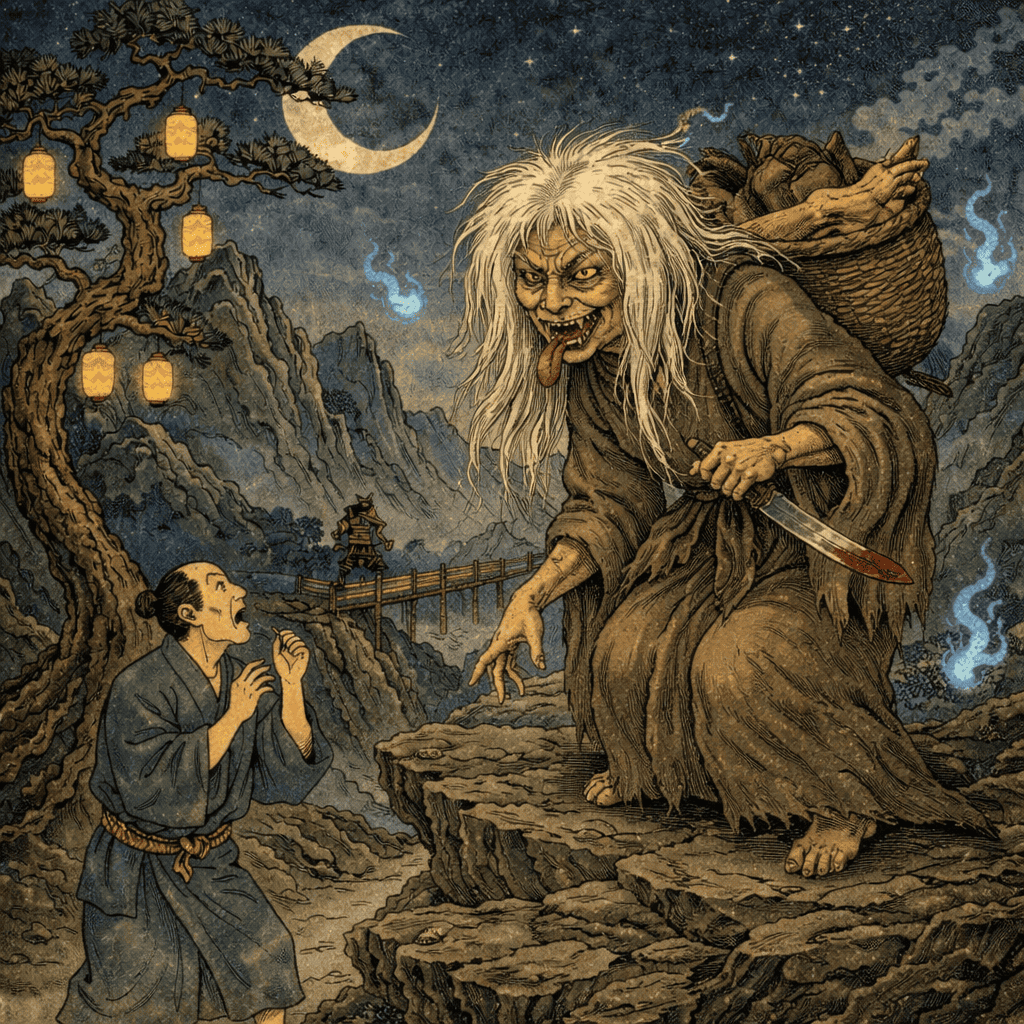
High in the mountains, far above the last village and beyond the last marked trail, there is a hut with smoke rising from it on cold nights. Travelers who have lost their way in the high passes have found it — a warm fire, a smell of cooking, a bent old woman who offers shelter and food with a generosity that seems too great for a place so remote and so far from any market or supply. Some of these travelers have returned to the valleys below with stories of miraculous hospitality, of warmth and food and a kindness they had not expected to find at such an altitude. Others have not returned at all. The mountain does not explain what happened to them. The mountain does not explain anything. It simply continues being what it is, and the smoke rises from the hut, and the door opens when the right traveler comes.
The yamamba is one of the oldest and most complex figures in Japanese folk tradition — a mountain hag who is simultaneously a devourer of travelers and a raiser of legendary heroes, a manifestation of wild natural force and a keeper of ancient knowledge, a terrifying predator and, in some accounts, the closest thing the Japanese supernatural tradition has to a mountain goddess in her most uncompromising form. She is not simply a monster. She is the mountain itself given female form: capable of nurturing or destroying with equal ease, for reasons that do not correspond to any human moral framework, in a register of experience that predates the ethical systems humans brought to the mountains and will persist long after those systems are forgotten.
What is Yamamba?
Yamamba — also spelled yamauba or yamahaha — translates literally as "mountain crone" or "mountain old woman," and this directness of naming is characteristic of how the creature has always been understood: she is what the name says she is. She is not a transformed human or a disguised deity or a creature with origins in any other form — she is a being who has always lived in the deep mountains, who is the deep mountains, who predates the roads and trails and villages that humans built in the foothills below her territory. Her defining characteristics are her deceptive appearance, her extraordinary power, and her absolute indifference to the distinctions humans make between what should be feared and what should be trusted.
The yamamba occupies a genuinely unusual position in the taxonomy of Japanese supernatural beings because she consistently defies moral categorization. She consumes human beings — this is an established, persistent, non-negotiable element of her legend across all regional variants. But she also raised Kintoki, one of Japan's most celebrated folk heroes, with a care and power that gave him legendary strength. She possesses deep knowledge of mountain plants, medicines, and natural processes. She can spin thread from her own body by night. She can bestow extraordinary blessings on those she chooses to favor. As Michael Dylan Foster has noted, the yamamba represents the category of supernatural beings whose power exceeds any ethical framework that humans might attempt to apply to it — she is not evil and she is not good; she is other, in the most absolute sense of the word (Michael Dylan Foster, "The Book of Yokai," 2015).
What Does Yamamba Look Like?
The yamamba appears in two distinct modes, and the contrast between them is itself the central dramatic element of every story she inhabits. In her deceptive form — the presentation she makes to travelers seeking shelter — she is an elderly mountain woman: bent, grey-haired, dressed in the rough practical clothing of someone who has lived high in the mountains for many years, her face worn by altitude and wind, her manner direct and unelaborated. This form is designed to inspire trust: it is the form of someone who needs nothing from you and has nothing to hide. It is the form you do not question.
In her true form, she is something altogether different: enormous, with wild white hair that extends in all directions as though it has absorbed the chaos of years of high-altitude storms, wearing clothing that has become indistinguishable from the mountain vegetation around her — torn fabrics threaded through with actual plant matter, a garment that has merged with the environment over decades until the distinction between cloth and forest is no longer meaningful. Her eyes, in this form, carry an intensity that is beyond any human emotional expression — not the intensity of rage or hunger exactly, but of a quality of attention so total and so alien that it becomes terrifying simply because you cannot name what you are seeing in them. Her mouth is capable of extending far beyond any human proportion, and the teeth within it are equal to the challenge of what they catch.
Some accounts describe the yamamba's hair as having a degree of independent movement, extending and contracting in response to her attention rather than simply falling under gravity, and her clothing as continuously incorporating new material from the forest around her. These details reinforce her status not as a person who lives in the mountains but as a manifestation of the mountain itself — the wild, unkempt, boundless energy of the high wilderness in a form that can walk, speak, and look at you.
Where Did Yamamba Come From?
The yamamba's origins lie in the deepest strata of Japanese folk tradition, predating literary documentation by centuries. The figure of the dangerous old woman in the mountains appears across Japanese folklore in various forms, and scholars have connected the yamamba to several overlapping traditions: the mountain goddess (yama no kami), who was understood to govern the hunt, the harvest, and the fertility of the mountain environment; the wild woman of the forests, a figure found in many world mythologies who represents nature's indifference to human civilization; and, in some regional traditions, the abandoned woman — a human who was driven into the mountains through poverty or rejection and who transformed through prolonged exposure to the mountain's spiritual intensity into something no longer fully human.
Toriyama Sekien included the yamamba in his late 18th-century yokai encyclopedias, and his visual rendering — the wild hair, the enormous mouth, the ragged mountain garments — established a visual standard that has influenced depictions ever since. Sekien's scholarly approach to yokai documentation treated the yamamba with the same systematic interest he brought to every supernatural being, neither dismissing her as mere superstition nor sensationalizing her terror but placing her within the broader ecology of Japanese supernatural belief (Toriyama Sekien, "Gazu Hyakki Yako," 1776).
What Are the Most Famous Yamamba Legends?
The most famous yamamba legend is the story of Kintoki — the child known in children's folklore as Kintaro, the Golden Boy. According to the tradition associated with Mount Kintoki in Hakone, Kintoki was born in the deep mountain forest and raised by the yamamba herself, who provided him with the mountain's strength and wild vitality as his inheritance. He grew to be a child of extraordinary physical power — able to wrestle bears and boars as playmates, to uproot trees with his hands, to communicate with the animals of the forest as though they were people. Eventually he was discovered by the warrior Minamoto no Yorimitsu (Raiko), the great demon-slayer of the Heian period, who recognized his qualities and took him to the capital to become one of his four great retainers. The story of the yamamba as foster mother to Japan's greatest folk strong-man is one of the most striking narratives in the entire tradition: the creature that eats travelers is also the creature that raised the hero who protects them.
The Noh play Yamauba, attributed to the playwright Zeami Motokiyo (c. 1363–1443), represents the most sophisticated artistic treatment of the yamamba legend in classical Japanese literature. The play's structure is characteristically Noh in its elegance: a dancer famous throughout the country for her performances of the yamamba character is traveling through the mountains when she encounters the real yamamba, who asks to see the dance. The play then becomes a meditation on representation and reality, on what it means to perform a being who is present, on the yamamba's own ambivalence about her nature — her desire to be understood rather than simply feared, and the impossible difficulty of that desire, since no human performance of the yamamba can capture what the yamamba actually is. The dancer's art fails not because she is inadequate but because the subject exceeds all possible representation.
How Does Yamamba Appear in Modern Japan?
The yamamba has undergone a significant feminist reinterpretation in modern Japanese cultural criticism and creative work. Scholars including Noriko Reider have examined the yamamba as a figure representing the unruly feminine — the woman who refuses domestication, who lives entirely outside the boundaries of social control and male governance, who possesses power that the patriarchal social order cannot contain, regulate, or punish. She is not a failed domestic woman but the negation of the domestic entirely: she lives where no household can follow, she obeys no rules that were made by people, and her power is not borrowed from any male authority but is native to her and to the mountain she embodies. This reading has made the yamamba a figure of genuine contemporary relevance for writers, artists, and academics interested in recovering and reinterpreting suppressed female power in Japanese mythology.
Which Anime and Manga Feature Yamamba?
Studio Ghibli's Princess Mononoke (1997) does not feature a character explicitly named yamamba, but the film's mountain spirits — particularly the kodama, the forest spirits, and the great Forest Spirit itself — embody the same quality that defines the yamamba in traditional folklore: the total indifference of natural power to human moral categories. The aged female figures connected to the boar and wolf clans in the film carry something of the yamamba's specific energy — the ancient, wild, female power of the deep mountain wilderness that predates human civilization and will outlast it. Director Hayao Miyazaki's stated goal of depicting nature as "neither good nor evil but overwhelming and indifferent" is functionally a description of the yamamba tradition, and Princess Mononoke can be read as the film that takes that tradition most seriously in the Ghibli canon.
In the GeGeGe no Kitaro franchise, the yamamba appears across multiple story arcs as a mountain-dwelling supernatural being of considerable power — typically portrayed with the combination of menace and ambivalence that defines the traditional character, rather than simply as a villain. Shigeru Mizuki's treatment of the yamamba reflects his broader understanding of yokai as beings whose nature exceeds simple moral classification — creatures that frighten because they are genuinely other, not because they are purely malevolent (Shigeru Mizuki, "GeGeGe no Kitaro," manga, 1960s).
Where Can You Encounter Yamamba in Japan?
Mount Kintoki in Kanagawa Prefecture — rising from the Hakone area, with views of Mount Fuji on clear days — is the most directly associated site with the yamamba through the Kintaro legend. The mountain is a well-maintained hiking destination with multiple trail options, and Kintaro-related imagery appears throughout the Hakone region in shops, restaurants, and public art. The experience of climbing the mountain in autumn, when the vegetation is turning and the higher reaches are cold and occasionally misty, gives a reasonable approximation of the kind of landscape in which the yamamba tradition was born — wild, beautiful, and absolutely indifferent to the comfort of visitors.
More broadly, the yamamba is a being of all Japan's deep mountain ranges — she is not localized in the way that some yokai are but is instead distributed across any range that is high enough, wild enough, and far enough from human settlement to have maintained genuine wildness. The Japanese Alps, the ranges of Tohoku, the high mountains of Shikoku — any place where the trail ends and the forest continues without human maintenance is, by the logic of the tradition, potential yamamba territory.
Conclusion
The yamamba defies the clean moral categories that most supernatural beings occupy. She is not evil — she is other. Her values are the mountain's values: ancient, cyclical, brutal in the specific way that natural systems are brutal, capable of extraordinary nurturing and extraordinary destruction with equal ease and without the distinction between those two things that human morality requires us to maintain. The travelers she devours and the heroes she raises are both expressions of the same mountain nature. She is what you encounter when you go far enough into the wilderness that human categories of good and evil stop applying — when the world around you is no longer organized according to any system you were taught, and you realize, standing at the door of that smoke-rising hut in the cold, that you brought nothing with you that will help you decide whether to knock.
This is The Yokai Files.
Support The Yokai Files
Enjoyed this deep dive into Japanese folklore?
The Yokai Files is reader-supported. Your support helps us research deeper, write more, and keep the darkness alive.