Yamata no Orochi: The Eight-Headed Serpent That Hid Japan's Most Sacred Sword
Published: March 28, 2026
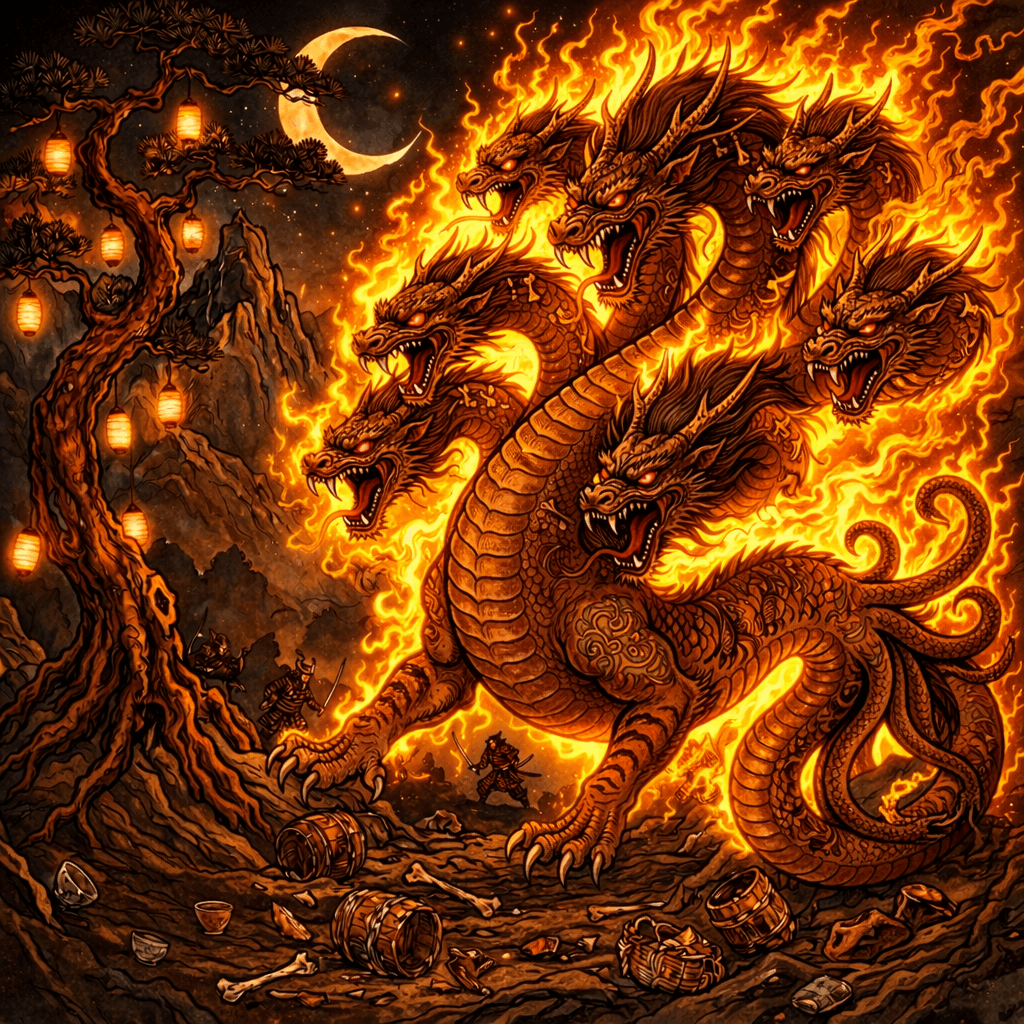
Before Japan had emperors, before it had a written history, before its countless shrines were built to mark the places where the sacred and the earthly intersected — there was a serpent. Eight heads. Eight tails. A body so vast that its coils pressed into eight valleys and eight hills simultaneously. A creature that demanded human sacrifice every year, that consumed entire families, that could not be defeated by any human weapon or any mortal strategy. A creature whose eventual defeat would not only free the land from its terror but would birth one of the most sacred objects in Japanese civilization.
Yamata no Orochi is one of the oldest supernatural beings in Japanese mythology, appearing in the Kojiki — Japan's oldest chronicle, compiled in 712 CE — and in the Nihon Shoki. Its story involves gods, sacrifice, divine wine, and one of the three imperial regalia of Japan. But unlike most dragon myths from around the world, the Orochi legend is not primarily about a hero's courage. It is about the willingness to use deception, patience, and a very large amount of sake to overcome what brute force cannot.
What is Yamata no Orochi?
Yamata no Orochi — literally "eight-forked great serpent" — is a mythological creature from Shinto tradition described as a monstrous eight-headed and eight-tailed serpent or dragon. The "yamata" in its name refers to the eight branches or forks of its body, while "orochi" is an archaic Japanese term for a large serpent or dragon. It is one of the most ancient supernatural beings in Japanese recorded mythology, predating the systematic classification of yokai by centuries.
The Orochi occupies a singular position in Japanese religious history. It is not merely a monster to be defeated but an entity whose destruction was a cosmological event — the act that brought the sacred sword Kusanagi-no-Tsurugi into the human world. This sword, found hidden within the creature's tail, would go on to become one of the Three Imperial Regalia of Japan, the sacred objects that legitimize the authority of the imperial line to the present day. The Orochi's story is therefore not just mythology; it is the origin story of Japanese sovereignty itself.
What Does Yamata no Orochi Look Like?
The Kojiki and Nihon Shoki provide remarkably specific physical descriptions of Yamata no Orochi. Its body stretched across eight valleys and eight hills — an incomprehensible scale that placed it beyond any creature that could exist in the natural world. Its eyes were described as red like the winter cherry, and its belly was stained perpetually crimson with blood. Fir trees and cypress grew upon its back, suggesting that the creature had existed long enough for entire forests to take root on its body.
Modern artistic depictions have expanded on these ancient descriptions considerably, often portraying the Orochi as a hydra-like entity with eight distinct serpentine heads rising from a single massive body. Each head is frequently shown with different coloring — representing the eight aspects of its terrible nature. The creature is universally depicted as existing on a geological scale, its movements capable of reshaping the landscape around it. This is a being whose physical form is less animal and more elemental force.
Where Did Yamata no Orochi Come From?
The Orochi's mythological context is rooted in the cosmic drama of Shinto creation mythology. The god Susanoo-no-Mikoto, the storm deity and brother of the sun goddess Amaterasu, had been exiled from the Plain of High Heaven following a disastrous quarrel with his sister. Weeping and raging, he descended to the land of Izumo in what is now Shimane Prefecture — and it was there that he encountered an elderly couple named Ashinazuchi and Tenazuchi, weeping over their youngest daughter Kushinada-hime.
The couple had originally had eight daughters. Each year, Yamata no Orochi had come to claim one as a sacrifice. Seven daughters had already been taken and consumed. Kushinada-hime was the last, and the time for her sacrifice was approaching. Susanoo, moved by their desperation and captivated by the beauty of Kushinada-hime, promised to destroy the Orochi in exchange for her hand in marriage. This is the moment where the legend transforms from a story of helpless horror into one of divine intervention — though divine intervention, in this case, required a great deal of preparation and even more alcohol.
What Are the Most Famous Yamata no Orochi Legends?
Susanoo's strategy against the Orochi was both elegant and surprisingly straightforward. He instructed Ashinazuchi and Tenazuchi to brew eight vats of a particularly potent sake called "eight-times-brewed sake" — a drink of legendary strength. He then had Kushinada-hime transformed into a comb, which he tucked safely into his hair to protect her. Eight platforms were erected, each holding one of the vats of sake, with the platforms arranged so the Orochi would find them as it arrived for its annual sacrifice.
When the Orochi arrived, each of its eight heads plunged into one of the eight vats and began drinking. The creature's capacity for sake was apparently matched only by its capacity for destruction, and it drank until all eight heads were fully intoxicated. Then Susanoo drew his sword — the Totsuka-no-Tsurugi — and began cutting. He hacked through the creature's eight heads and eight tails until the Orochi lay dead, its blood turning the Hinokawa River crimson for miles downstream.
It was during this butchering that Susanoo's blade struck something in the fourth tail and notched. Investigating, he found a magnificent sword hidden within the Orochi's body — a blade of extraordinary power that he recognized as something beyond ordinary. He sent this sword up to the heavens as a gift to Amaterasu, and it was eventually given to the legendary hero Yamato Takeru, who named it Kusanagi-no-Tsurugi — the Grass-Cutting Sword. Today, this sacred blade is said to rest at Atsuta Shrine in Nagoya, one of the most important Shinto sites in Japan.
How Does Yamata no Orochi Appear in Modern Japan?
Yamata no Orochi has become one of the most recognizable figures from Japanese mythology in global popular culture. In video games, it appears as a major antagonist in the Okami series — where the game's entire narrative revolves around defeating its eight-headed form — and as a powerful boss or summon in numerous other titles including Final Fantasy, Naruto, and the Fate series. The creature's distinctive multi-headed appearance makes it an immediately recognizable symbol of ancient Japanese supernatural power.
In anime and manga, the Orochi appears as both a monster and, in some reinterpretations, a tragic figure — a creature of immense power whose story raises questions about the nature of gods, sacrifice, and the violence that underlies the founding of civilizations. The Shimane region of Japan has embraced its association with the legend, with local products, festivals, and tourism built around the Orochi story and the connection to Susanoo and the Izumo Grand Shrine.
Where Can You Encounter Yamata no Orochi in Japan?
The Izumo region of Shimane Prefecture is the heartland of the Orochi legend. Izumo Taisha — one of the oldest and most important Shinto shrines in Japan — is dedicated to Susanoo's father-in-law Okuninushi, and the entire region is saturated with mythology related to the gods who dwelled here. The Hinokawa River, said to have run red with the Orochi's blood, still flows through the area, and local shrines mark sites associated with different moments of the legend.
For those wishing to see the sword that emerged from the Orochi's body, Atsuta Shrine in Nagoya is the destination. Kusanagi-no-Tsurugi is said to be enshrined there, though like all three imperial regalia, it is never displayed publicly and has not been confirmed to exist by any independent examination. The shrine itself is ancient, atmospheric, and deeply connected to the mythology that traces back through the Orochi legend to the very foundations of Japanese civilization.
Conclusion
Yamata no Orochi is more than a dragon that a god got drunk and killed. It is the foundational monster of Japanese civilization — the dark necessity whose destruction produced a sacred object that legitimizes imperial authority to this day. Every time the emperor of Japan undergoes the enthronement ceremony and receives the three imperial regalia, the shadow of the Orochi falls across the ritual. Inside one of those sacred objects is the memory of eight heads drinking from eight vats of sake, a god with a comb in his hair, and a river running red through the ancient land of Izumo. Some origins cannot be separated from their violence.
This is The Yokai Files.
Support The Yokai Files
Enjoyed this deep dive into Japanese folklore?
The Yokai Files is reader-supported. Your support helps us research deeper, write more, and keep the darkness alive.